How varroa mites spread between bees and hives
TL;DR
- Varroa mites spread through three main routes: bee-to-bee contact when bees drift or rob between colonies, swarms carrying mites to new sites, and infested brood moved during package or queen transfers.
- Robbing season and fall consolidation are the riskiest windows.
- Learn each route and you can plug the leaks before mite loads explode.
Why does understanding varroa spread matter so much?
Varroa destructor has killed more honey bee colonies worldwide than any other pest in recorded beekeeping history. The mite did not reach the United States until 1987, but within a decade it had changed how every beekeeper on the continent has to manage hives [1]. The reason it spread so fast, and why it keeps wrecking apiaries that skip monitoring, comes down to one uncomfortable truth: varroa does not need you to carry it anywhere. The bees do the work themselves.
Knowing the specific routes of transmission is not abstract biology. It is directly actionable. Every spread pathway has a matching intervention, and closing even one or two of the main routes can be the difference between a colony that survives winter and one that crashes in October. The Honey Bee Health Coalition's Varroa management guide calls bee movement between colonies "the primary mechanism by which mite populations are redistributed across an apiary and across a landscape" [2]. That framing is worth sitting with.
What is the most common way varroa mites spread between hives?
Drifting and robbing. Those two behaviors account for most mite transfers between colonies, and beekeepers badly underestimate how often both happen.
Drifting is when a forager or young bee returns to the wrong hive after a flight. It happens constantly. Studies at the University of Florida and elsewhere have documented drift rates of 10 to 30 percent of returning foragers in some apiary layouts [3]. Bees that drift carry any mites riding on their bodies straight into the receiving colony. Colonies arranged in long rows facing the same direction show the highest drift rates, because bees navigate back using visual cues, and identical boxes in a row are easy to mix up.
Robbing is louder and far more dangerous. When a strong colony robs a weak one, dozens or hundreds of bees from the strong colony pour into the weak hive and pick up mites in the chaos. Those bees carry the mites home. A single robbing event during a nectar dearth can move hundreds of mites in a matter of hours. That is why late summer and fall, when nectar dries up and colony populations are still high, are the seasons varroa spreads most aggressively.
Apiary layout matters more than most beekeepers realize. Hives set in a circle or arc, spaced at least three feet apart and facing different compass directions, show meaningfully lower drift than hives in a straight row. Painting hives different colors or adding unique entrance markers cuts drift further [3].
How do swarms spread varroa mites to new locations?
A swarm is a mite delivery vehicle. When a colony swarms, the queen leaves with roughly half the adult bees. Mites riding on those bees travel with the swarm wherever it lands. If that swarm moves into an empty tree cavity three miles away, it starts a new colony carrying whatever mite load came with those bees.
The mite burden on a swarm is usually lower than the parent colony's at the moment of swarming. Here is why: most of the mite population in a colony at any given time sits inside capped brood cells, not on adult bees. When the swarm leaves, it takes bees but leaves most of the capped brood behind. The mites in sealed cells stay with the parent colony, and the swarm carries only the phoretic mites on adult bees. Depending on timing, a swarm might carry 20 to 40 percent of the colony's total mite population [4].
That lower starting load is part of why swarms can look healthy for a few months after settling. The broodless stretch right after a swarm establishes keeps mites in the phoretic phase longer, which makes them temporarily easier to hit with certain treatments. Once brood rearing ramps up, though, mite numbers rebound fast if nobody acts. Feral colonies started from swarms are a steady varroa reservoir in any landscape, seeding managed apiaries through drifting foragers year after year [2].
Can varroa mites spread through buying packaged bees or queens?
Yes, and this is one of the most reliable ways to import a serious mite problem without knowing it.
A three-pound package holds roughly 10,000 to 12,000 bees. If the source apiary runs even a moderate infestation of 2 mites per 100 bees, that package shows up with 200 or more mites. An overwintered colony that takes those mites on top of its own starts spring at a real disadvantage.
Queens are a lower-volume risk per transfer but a much higher-volume risk across the industry, because one queen breeder ships to thousands of beekeepers. The queen herself cannot host varroa reproduction (varroa reproduces in worker and drone brood, not emergency queen cells according to most research, though the literature notes rare exceptions [4]). But the attendant bees traveling with a mailed queen can carry phoretic mites. A standard queen cage holds 5 to 15 attendants. The number of mites those attendants carry is small, but releasing them into the colony during queen introduction sends whatever mites they have in too.
Before installing any package or queen, ask your supplier about their most recent alcohol wash or sugar roll count. Good suppliers keep that data. If they do not, that tells you something.
For a broader look at the species kept in managed apiaries and how their varroa susceptibility varies, see our article on beekeeping species.
How does beekeeper equipment and honey movement spread varroa?
This route gets ignored too often. Used equipment is one of the few ways varroa can move without a live bee carrier, though the mechanism is indirect and the risk sits far below bee-to-bee transmission.
Varroa mites cannot survive long off the host. At room temperature, a phoretic mite off a bee dies within about 24 to 72 hours depending on humidity and temperature [5]. So contaminated equipment poses no risk if frames or boxes sit unused for a week. The real danger is moving equipment between colonies while bees are still active in it, or transferring comb with capped brood full of reproducing mites straight from one colony to another.
Transferring brood frames is a routine move for equalizing populations or propping up a queenless colony. It is also a direct mite transfer. Every capped worker cell on that frame has some chance of holding a reproducing varroa female. Move five frames of brood from a colony with a 3 percent infestation into a colony you meant to help, and you may hand it several hundred mites along with the nurse bees and brood.
The same logic covers honey supers. Leaving supers from one colony sitting open near another during extraction can trigger robbing, which then becomes a mite transmission event. Process supers promptly and keep them off the ground near active hives.
How far can varroa mites spread through bee flight alone?
Honey bees forage up to two to three miles from the hive, and foragers from multiple apiaries hit the same flowers. When those foragers interact, on flowers or during the robbing and drifting already described, mites can transfer.
Research on flower-mediated transfer is thin, but it is not zero. A study by Nolan and Delaplane published in Apidologie in 2017 found evidence that mite transfer can happen between bees visiting the same flower in quick succession, though it looks like a minor route next to in-hive drifting and robbing [6]. The mites pulling this off are phoretic mites that have moved to the bee's exterior and are hunting a new host.
What this means in practice: your varroa management does not happen in isolation. High mite loads in feral colonies or sloppy apiaries nearby keep pressuring your hives through forager contact. That is one of the strongest arguments for coordinating treatment timing with other beekeepers around you. The Honey Bee Health Coalition has pushed community-level varroa management for exactly this reason [2].
The effective transmission radius from one heavily infested colony roughly matches honey bee foraging range: one to two miles holds most of the risk, three miles is the practical outer edge [3].
What role do drone bees play in spreading varroa?
Drones matter out of proportion to their numbers, for two reasons.
First, drones drift far more than workers. Worker bees lock onto their home site within a few orientation flights. Drones do not. They travel to drone congregation areas and return to any convenient hive, not necessarily their own. From the bee's evolutionary side, that is the whole point: genetic mixing needs drones visiting foreign queens. From a mite's side, a drifting drone is excellent long-distance transport.
Second, varroa strongly prefers drone brood for reproduction. Drone cells stay capped about 14 days versus 12 days for worker brood, giving the founding mite more time to make offspring. Studies have found mite infestation in drone brood 7 to 10 times higher than in worker brood in the same colony [4]. So drones in infested colonies carry a heavier mite load on average than workers, and when they drift into neighboring colonies, they bring more mites with them.
Some beekeepers use drone comb removal as a management tool for exactly this reason. Insert a frame of drone foundation, let it get capped, then pull and freeze it before the mites finish developing. Done consistently through build-up season, it removes a meaningful share of the reproducing mite population, though it needs follow-through and is no substitute for an organic acid or registered chemical treatment.
How does varroa spread within a single colony?
Inside a colony, spread runs on phoretic mites hitchhiking on nurse bees as they move cell to cell feeding larvae. A mite in the phoretic phase (riding on an adult bee) stays on a bee an average of five to six days before it enters a brood cell [4]. All that time it rides wherever the host bee goes.
Mites do not enter cells at random. They wait at the rim of a cell holding a larva about to be capped, then drop in just before the nurse bee seals it, hiding under the food at the bottom of the cell. The timing is precise enough that mites capped in without a larva, or in a cell sealed too early, rarely survive. The system is efficient.
Within-colony spread speeds up as the mite population grows, because more phoretic mites compete for the same brood cells. Under 1 percent of adult bees infested, colony health usually holds steady. Between 2 and 3 percent, measurable hits to bee longevity and immune function show up. Above 3 percent, collapse can hit within weeks, especially near winter when the colony is rearing the long-lived winter bees that have to stay healthy to survive [2].
This is where steady monitoring pays off. An alcohol wash or sugar roll every 30 days during the active season gives you a number. That number tells you whether spread inside the colony is still slow and manageable or whether you are already past the treatment threshold. The EPA-registered treatment options each carry labeled application windows and conditions, and following the label is both a legal requirement and necessary for the product to work [7].
Which seasons have the highest risk of varroa spreading between hives?
Late summer and early fall, no contest. Several risk factors stack up at once.
Nectar dearth begins across most of North America in August. Colonies that grew through spring and early summer are now large, hungry, and finding less forage. Strong colonies send robbers to steal honey from weaker ones. Weaker colonies usually carry higher mite loads to start, so robbing becomes a high-efficiency transfer from the most infested colonies into the strongest ones.
At the same time, beekeepers are combining weak colonies with strong ones for winter. Each combination merges two mite populations. Skip treatment before combining and you compound the mite load of both colonies.
Spring is the second-highest risk window. Package installs, nuc purchases, and queen swaps all land in a tight stretch, creating several importation events back to back.
Midsummer swarm season brings its own spread risk. Swarms that go uncaught set up in tree cavities and turn into untreated feral reservoirs. The University of Minnesota Bee Lab has documented that feral colonies near managed apiaries raise the overall mite pressure managed colonies face through the season [8].
Winter, oddly, is the lowest spread risk because bees are not flying. But it is also when the damage from fall mite loads shows: colonies that entered winter above the treatment threshold of 3 mites per 100 bees have a sharply higher chance of dying before spring [2].
How do you stop varroa mites from spreading into your hives?
You cannot stop it entirely. That framing matters, because beekeepers who think they can build a mite-proof operation tend to drop monitoring once they believe they have won, then get blindsided. What you can do is cut importation risk and manage what gets in.
For apiary layout, set hives in arcs or circles with varied entrances instead of straight rows. The drift-reduction research is clear enough to justify the extra setup [3].
For robbing prevention, shrink entrances to one or two bee-widths during nectar dearth. Do not leave honey-wet equipment sitting open near hives. Feed inside the hive rather than in open trays during August and September.
For purchased bees and queens, ask for mite count data before you buy. If you install a package into a colony that already has bees, treat for varroa within the first two weeks of installation, before mite levels in the merged population can climb.
For brood frame transfers, treat the donor colony and confirm it is below threshold before you move frames. Beekeepers skip this step under time pressure more than any other, and it seeds a lot of late-season infestations.
For neighbors and local coordination, the Honey Bee Health Coalition's Best Management Practices document recommends that beekeepers within two miles of each other align treatment timing to shrink the reservoir population that seeds each other's hives [9]. Easier said than done, but bee clubs and local associations are the practical vehicle for pulling it off.
If you want a structured way to track mite counts, treatment windows, and spread-risk events across the season, the free protocol tools at VarroaVault are built for hobbyist and sideliner operations and can help you stay ahead of the numbers without a spreadsheet.
For sourcing monitoring gear and treatment supplies, see our guide to beekeeping supply companies and free shipping honey bee supply companies.
Does the type of hive affect how varroa spreads within it?
Hive design shifts some spread dynamics but does not change the underlying biology. The variables that matter are brood nest configuration and entrance placement.
Top bar hives and Warré hives usually run a single continuous brood nest without the removable frame structure of a Langstroth. That makes brood frame transfers (one of the main cross-colony transfer routes) less practical, which lowers that particular risk. It also makes mite monitoring much harder, since you cannot easily pull a sample of bees from a defined comb area.
Langstroth and other framed hives allow easier monitoring and more treatment options, including oxalic acid vaporization, Apivar strips, and Mite Away Quick Strips, all of which carry EPA-registered labels specifying in-hive application method [7]. Being able to run an accurate alcohol wash every 30 days is probably the single biggest practical advantage of removable-frame designs for varroa management.
Entrance configuration matters for robbing risk. Hives with large bottom entrances are harder to defend during dearth. Reducing the entrance to a few centimeters during high-risk periods is simple and works regardless of hive type.
For a broader look at hive design options and their tradeoffs, the varroa mite overview article covers treatment compatibility with different hive configurations.
What does the research say about how fast varroa populations grow after introduction?
Fast. Uncomfortably fast.
Varroa populations in an untreated colony grow exponentially. A single mated female mite introduced to a mite-free colony will, under good conditions, build a population large enough to kill that colony within one to three years [4]. The doubling time during peak brood-rearing season is roughly 12 to 17 days [4].
Put numbers on it: a colony that starts May at 0.5 percent infestation (5 mites per 1,000 bees), with no treatment or extra mite immigration, can reasonably reach the 3 percent threshold by August, and 6 to 10 percent by October, which is near-certain death heading into winter.
The growth curve is why treatment timing matters so much, and why thresholds exist as hard numbers instead of vague advice. The Honey Bee Health Coalition sets the treatment threshold at 2 mites per 100 bees during the summer brood-rearing season and 1 mite per 100 bees in August and September when winter bees are being produced [2]. Those thresholds come from modeling the relationship between mite load and colony survival probability. They are not arbitrary.
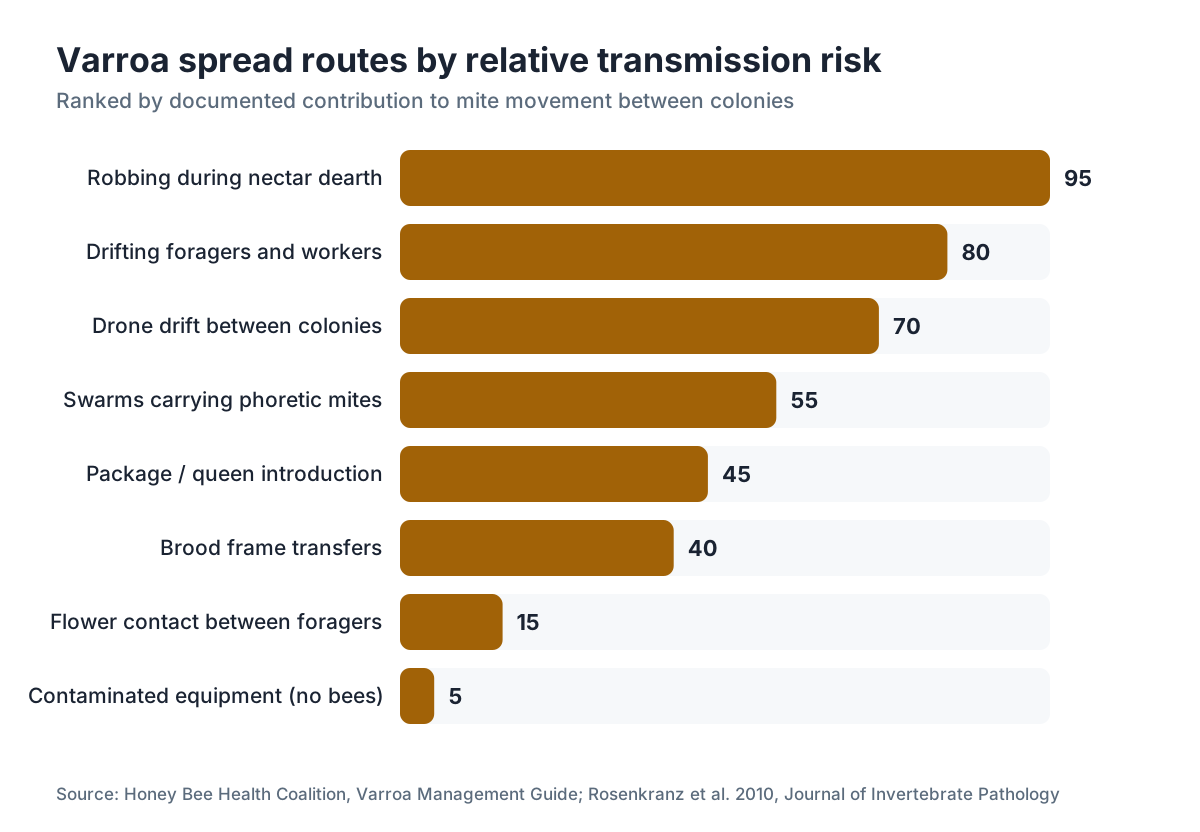
Here is a summary of the key transmission routes and their relative contribution to mite spread:
| Transmission Route | Relative Risk | Peak Season | Mitigation |
|---|---|---|---|
| Robbing by neighboring colonies | Very High | Late summer / fall dearth | Reduce entrances, treat proactively |
| Drifting foragers / workers | High | All active season | Varied hive orientation, spacing |
| Drone drift | High | Spring through summer | Drone comb removal |
| Swarms from infested colonies | Moderate | Spring / early summer | Catch and treat swarms |
| Package and queen introduction | Moderate | Spring | Request mite counts from suppliers |
| Brood frame transfers | Moderate | Any | Treat donor colony first |
| Flower contact between foragers | Low | Active foraging season | Not practically controllable |
| Equipment (no live bees) | Very Low | Any | Allow idle time between colonies |
Frequently asked questions
Can varroa mites jump from bee to bee?
Varroa mites cannot jump. They transfer by direct physical contact: a phoretic mite on one bee moves to another when the two touch, groom each other, or share a brood cell entrance. The mites are agile crawlers with no jumping or flying ability. Transfer happens most often inside the hive during normal bee-to-bee contact and brood care.
How long can a varroa mite survive without a bee host?
Not long. Off a bee host at room temperature and normal humidity, a varroa mite typically dies within 24 to 72 hours. At lower temperatures survival stretches slightly, but the mite depends on the host for warmth, moisture, and food. This is why contaminated equipment sitting unused for a week poses essentially no live mite risk.
Do varroa mites spread between different bee species?
Varroa destructor is highly adapted to Apis mellifera, the European honey bee, and Apis cerana, the Asian honey bee. On Apis cerana, its original host, mites reproduce at much lower rates because those bees groom and cap drone brood more effectively. The mite does not establish on bumble bees or solitary bees. If you keep Apis mellifera, all the spread risk described here applies directly to your colonies.
How fast do varroa mites reproduce once they enter a new colony?
A varroa population doubles roughly every 12 to 17 days during peak brood-rearing season. A colony starting May at 0.5 percent infestation can reach the 3 percent treatment threshold by August without intervention. This growth rate is the core reason monitoring every 30 days matters: a count that looks safe in June can be a crisis by mid-July.
Can varroa mites spread through contaminated honey or wax?
No. Varroa mites need a living bee or bee larva to survive and reproduce. They cannot persist in processed honey or rendered wax. The risk from these materials is effectively zero. The risk from unprocessed honey-wet combs left open near active hives is indirect: the honey triggers robbing, and the robbing bees transmit mites, not the honey itself.
How do I know if my hive got varroa from a neighboring colony?
You cannot always tell from a mite count alone, since a rapid rise could come from internal growth or external importation. A useful signal is a sudden spike in your alcohol wash results between monthly checks that outpaces the expected doubling rate. If your count jumps from 1 percent to 4 percent in three weeks without a broodless period in between, external importation through robbing or drifting is the most likely explanation.
Does moving my hives to a new location stop varroa spread?
Moving hives lowers exposure to neighboring colony reservoirs and can temporarily reduce importation pressure. Moving a colony more than two to three miles takes it out of forager overlap range with its old neighbors. But moving does not eliminate mites already in the colony, and the new site may have its own nearby feral colonies or poorly managed apiaries. Moving should accompany treatment, not replace it.
What is the treatment threshold for varroa before spread becomes a crisis?
The Honey Bee Health Coalition recommends treating when mite counts reach 2 mites per 100 bees during summer and 1 mite per 100 bees in August and September when winter bees are being produced. Above those thresholds, colony survival probability drops sharply. The threshold is lower in late season because the long-lived winter bees reared then need to be healthy and low-mite to carry the colony through winter.
Do africanized honey bees have lower varroa spread rates?
Africanized honey bees show stronger hygienic behavior and shorter capping times for worker brood, which reduces successful varroa reproduction within the colony. Some populations in South America have developed partial varroa resistance through these traits. Africanized colonies still harbor varroa and still spread mites through the same drift, robbing, and drone pathways. Their better tolerance does not eliminate the spread risk to neighboring European honey bee colonies. See our article on the africanized honey bee for more.
Can you spread varroa by sharing beekeeping tools between hives?
Live mites on tools are theoretically possible but practically a minor route next to bee movement. A hive tool used in a heavily infested colony and immediately used in another could carry phoretic mites if bees are still crawling on it. Wiping tools with alcohol between hives is a reasonable precaution. The real risk with shared equipment is comb with capped brood, which can hold reproducing mites. Never transfer brood frames from an untested colony.
How does nectar dearth increase varroa transmission between hives?
Nectar dearth triggers robbing in strong colonies. Robber bees pour into weakened colonies in large numbers, pick up mites in the chaos of the rob, then carry them back home. A single robbing event can move hundreds of mites in hours. Dearths typically hit from late July through September across most of North America, which is why that stretch sees the fastest mite population growth in apiaries.
Should I treat for varroa before installing a new package of bees?
Treat within the first two weeks after installation, not before. Packages have no sealed brood when they arrive, which means every imported mite is in the phoretic phase on adult bees. Oxalic acid dribble or vapor during this broodless window works very well because there is no brood shielding the mites. Waiting until the colony builds up brood before treating cuts oxalic acid efficacy sharply.
Sources
- USDA ARS, Varroa mite page: Varroa destructor arrived in the United States in 1987 and has since been the primary driver of managed honey bee colony losses
- Honey Bee Health Coalition, Varroa Management Guide (latest edition): Bee movement between colonies is the primary mechanism for mite redistribution; treatment threshold is 2 mites per 100 bees in summer and 1 mite per 100 bees in August-September
- University of Florida IFAS Extension, Honey Bee Diseases and Pests: Drift rates of 10 to 30 percent have been documented in studies; varied hive orientation and entrance markers reduce drift
- Rosenkranz P., Aumeier P., Ziegelmann B. (2010), Biology and control of Varroa destructor, Journal of Invertebrate Pathology 103:S96-S119: Varroa population doubling time is approximately 12 to 17 days during peak brood season; drone brood infestation rates are 7 to 10 times higher than worker brood; swarms carry roughly 20 to 40 percent of total colony mite population
- Pennsylvania State University Extension, Varroa Mite Management: Phoretic varroa mites off a bee host die within approximately 24 to 72 hours at room temperature depending on humidity
- Nolan M.P. & Delaplane K.S. (2017), Distance between honey bee Apis mellifera colonies regulates populations of Varroa destructor, Apidologie 48:8-16: Evidence that mite transfer can occur between bees visiting the same flower in close succession, though this is a minor route compared to in-hive drifting and robbing
- EPA, Pesticide Registration for Varroa Mite Treatments: Oxalic acid, amitraz (Apivar), and formic acid (Mite Away Quick Strips) are EPA-registered treatments with labeled application methods and conditions that must be followed
- University of Minnesota Bee Lab, Varroa Research: Feral colonies near managed apiaries increase overall varroa pressure that managed colonies experience through the foraging season
- Honey Bee Health Coalition, Best Management Practices for Hive Health: Beekeepers within two miles of each other should align treatment timing to reduce the reservoir population available to seed each other's hives
Last updated 2026-07-09