Acceptable varroa mite count: thresholds, testing methods, and when to treat
TL;DR
- Most U.S.
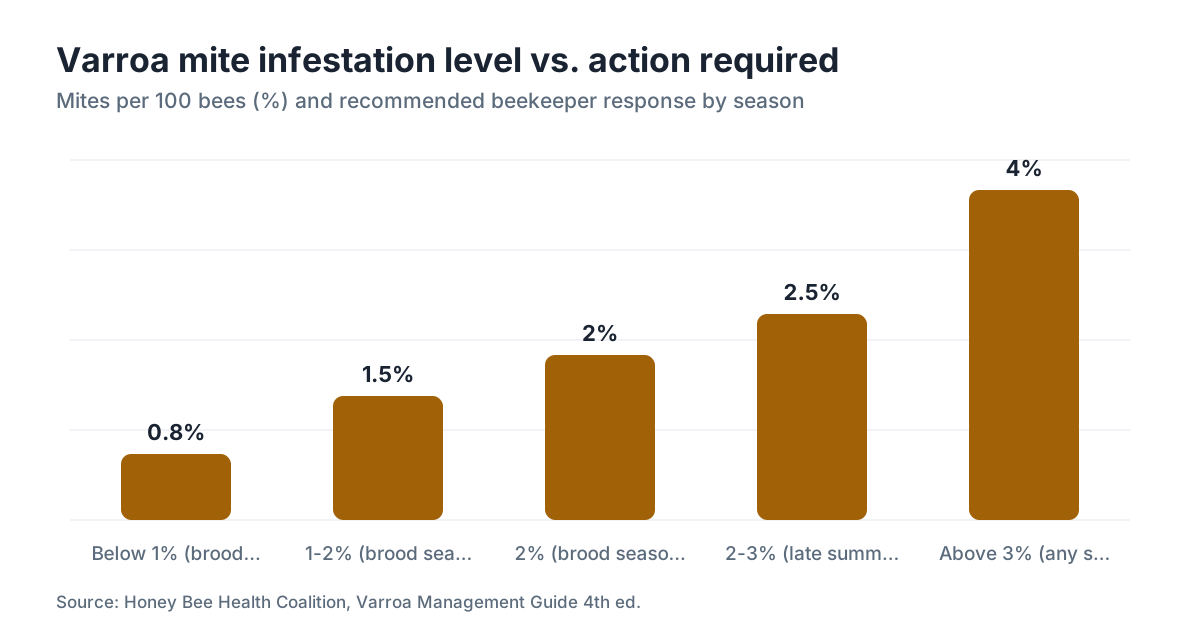
- extension programs and the Honey Bee Health Coalition set the treatment threshold at 2 mites per 100 bees (2%) during the brood-rearing season, and 2-3% in late summer before winter bees emerge.
- Above those numbers, colony losses climb sharply.
- Below them, treatment risk may outweigh benefit.
- Counting accurately is the only way to know where you stand.
What is an acceptable varroa mite count?
The short answer: 2 mites per 100 bees, or 2%, is the widely accepted action threshold during the active brood-rearing season. The Honey Bee Health Coalition's Varroa management guide states the threshold as "2 or more mites per hundred bees (2%) during the brood-rearing season" and bumps that to 2-3% in late summer, when the colony is raising the long-lived winter bees that need to survive until spring [1]. Go above those numbers without treating and your colony is almost certainly on borrowed time.
These thresholds come from decades of field research and colony survival data. They are not arbitrary. At 2%, mite populations are still growing but the colony has some capacity to cope. At 3-4%, you are watching a colony that will likely crash before the following spring, especially in northern climates where brood rearing stops for months and mites concentrate on adult bees. At 5% and above, the prognosis is grim.
That said, context matters. A 2% count in June in Georgia, where the colony will keep raising brood for months, is more urgent than a 2% count in November in Minnesota, when brood rearing has essentially stopped and the mite population has nowhere left to grow quickly. Thresholds are starting points for judgment, not substitutes for it.
One more thing worth saying plainly: a zero count does not mean zero mites. It means your sample did not catch them. Mite distribution inside a hive is not uniform, and a single wash of 300 bees is a statistical estimate, not a census.
How do varroa mite thresholds differ by season?
Season is everything with varroa. The mite population behaves completely differently depending on whether the queen is laying, how much capped brood is present, and how close you are to winter.
Spring and early summer (brood-rearing peak): The threshold is 2% (2 mites per 100 bees). Brood is abundant, mites are reproducing fast inside capped cells, and only about 20-30% of the mite population is on adult bees at any given moment [2]. Your wash sample only captures those "phoretic" mites, so the real infestation is significantly higher than your count suggests.
Late summer (August in most U.S. climates): The threshold drops to 1-2% in some guidance, or stays at 2-3% in others. This is the window that decides your winter. The colony is raising its last batches of winter bees, and those bees need to be healthy, fat, and free of the immune suppression and deformed wings that varroa and the viruses it vectors cause [2]. Treating in late July or August, when counts cross the threshold, is the single highest-leverage intervention in beekeeping.
Fall and winter: Once brood rearing stops or is minimal, all mites move onto adult bees. A count of 2% in a broodless colony is actually more alarming than 2% in a colony full of brood, because there is no correction factor to apply. Some programs use a lower threshold of 1% for broodless colonies precisely for this reason [1].
Spring before buildup: Count before the population explodes. If you come into spring above 1-2%, the mite load will compound fast as brood rearing accelerates. Treating early in spring, before capped brood becomes extensive, also improves treatment efficacy because more mites are exposed on adult bees.
| Season | Brood status | Action threshold (most guidance) |
|---|---|---|
| Spring buildup | Brood present | 2% (2 mites/100 bees) |
| Summer peak | Heavy brood | 2% |
| Late summer (Aug) | Brood present, winter bees forming | 2-3% (treat urgently) |
| Fall, broodless | No capped brood | 1-2% |
| Winter cluster | No brood | 1-2% (oxalic acid opportunity) |
How do you count varroa mites accurately?
Three methods work in practice: alcohol wash, powdered sugar roll, and sticky board count. Alcohol wash is the most accurate and the one recommended by the Honey Bee Health Coalition and most university extension programs for deciding whether to treat [1][3].
Alcohol wash (the gold standard)
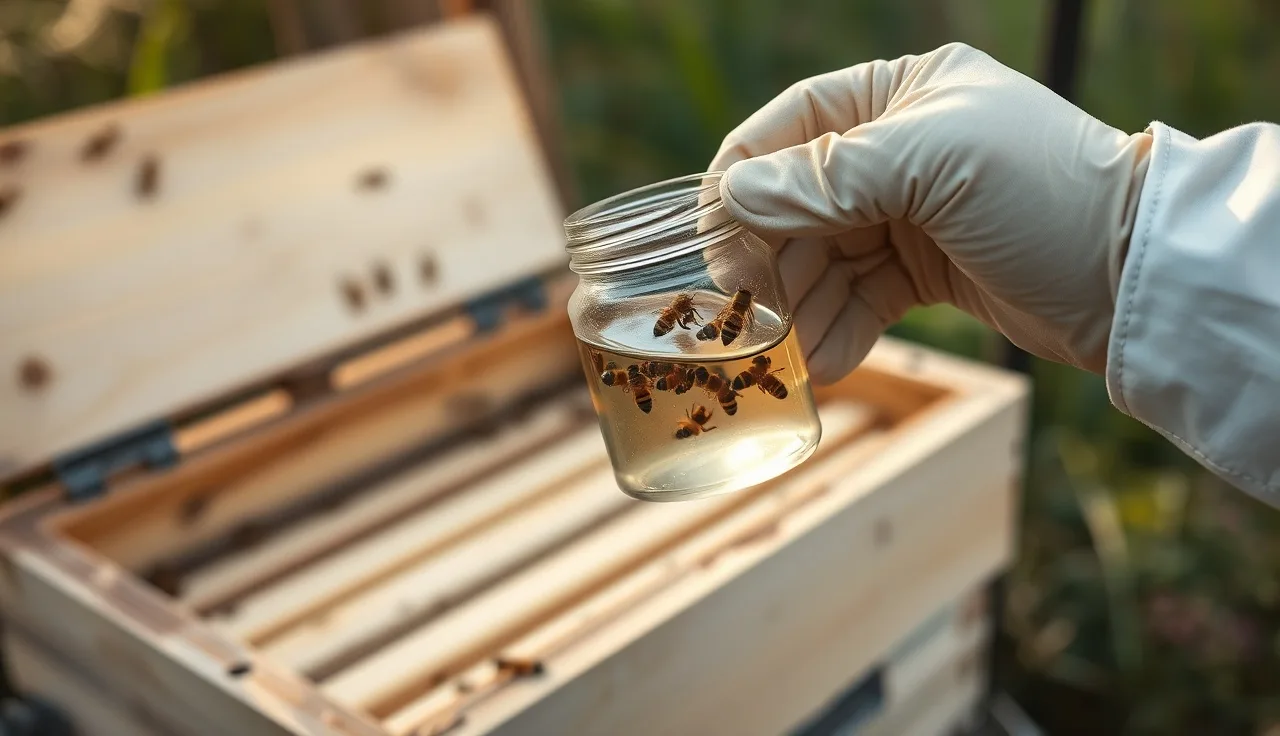
Collect approximately 300 bees (about half a cup) from the brood nest, ideally including nurse bees on a frame of capped brood. The queen should not be among them. Add 70% isopropyl alcohol to submerge the bees in a jar or purpose-made wash container. Seal and shake vigorously for 30-60 seconds. Pour the liquid through a fine screen into a second container, letting the mites fall through while catching the bees. Count the mites. Divide by the number of bees in your sample and multiply by 100 to get your percentage.
How to count your bees: counting 300 dead bees is tedious. Most practitioners estimate by volume. Half a cup (approximately 120 ml) holds roughly 300 bees. If you are not confident in your volume estimate, count a subsample.
If you want a tool that walks you through sample math and logs counts over time, the free calculator at VarroaVault takes the arithmetic out of the equation.
Powdered sugar roll
Same sample size, same collection method, but you use powdered sugar instead of alcohol. Shake the bees, let them fall through a screen, and count the mites in the sugar debris. This method does not kill bees, which matters if you want to return the sample bees to the hive. The problem: it consistently undercounts mites by 20-40% compared to alcohol wash, according to multiple university comparisons [3]. Use it if you have no choice, but know your real count is probably higher.
Sticky board count
Place a sticky board under a screened bottom board for 24-72 hours and count the natural mite drop. Divide by the number of days to get a daily mite drop. A 24-hour count above 10-12 mites is often cited as cause for concern, but this method is less reliable than a wash because drop rate varies with temperature, colony size, and brood status. Use sticky boards for monitoring trends, not for threshold decisions.
For a step-by-step guide to counting, Penn State Extension keeps a detailed online resource on varroa monitoring [3].
How many bees should you sample for a varroa count?
Three hundred bees is the standard sample size. That is not a round number chosen for convenience. At 300 bees, you have enough statistical power to detect a 2% infestation with reasonable confidence. Smaller samples have higher variance: if you wash 100 bees and find 1 mite, you cannot confidently distinguish a 0.5% from a 2% infestation.
Collect from the brood nest, not the honey super or the cluster's outer edge. Nurse bees on capped brood frames carry the highest mite loads because they interact constantly with cells where mites reproduce. Foragers returning at the entrance carry fewer phoretic mites and will give you an artificially low count.
Do not sample from the same frame twice in quick succession. And if your colony is small, such as a new split or a package, adjust your count proportionally: 150 bees sampled with 2 mites found equals approximately 1.3%, so still below threshold, but you have less statistical certainty.
The Honey Bee Health Coalition's guide is explicit: "Samples of at least 200 bees, but preferably 300, are recommended for accurate results" [1].
What happens if you ignore a high varroa count?
Colony collapse. That is the honest, unhedged answer.
Varroa destructor is the primary driver of winter colony loss in North America. The USDA National Agricultural Statistics Service reported that U.S. beekeepers lost approximately 45.5% of managed honey bee colonies between April 2020 and April 2021, among the highest loss rates on record [4]. Varroa and the viruses it vectors, particularly Deformed Wing Virus (DWV) and Sacbrood, are implicated in the majority of those losses.
Here is the mechanism. A mite reproduces inside a capped brood cell, injecting virus directly into the developing bee. Winter bees raised with high viral loads have smaller fat bodies, compromised immune systems, and shortened lifespans. A colony that enters winter with a 5% mite load does more than carry a lot of mites: its winter bees were already compromised before they emerged from the cell. Those bees cannot survive a four-month cluster. The colony dwindles and dies, usually in January or February, and the beekeeper finds a small cluster and a lot of mites on a sticky board come spring.
Ignoring a 3% count in August is not a calculated risk. It is almost certainly a dead colony by February. The mite population grows roughly exponentially during the brood-rearing season, doubling about every 4-6 weeks under normal conditions [2]. A 3% count in August can become 5-6% by September before brood rearing slows enough to cap growth.
When should you treat for varroa mites?
Treat when your mite count crosses the threshold for your season. That is the simple rule. In practice, timing also depends on what treatment you plan to use, your local climate, and whether honey supers are on.
The most important treatment window in most of the United States is late July through August. This is when colonies are raising the long-lived winter bees and when mite populations are often near their seasonal peak. Getting mite levels below 1% before August ends gives winter bees the best chance of emerging healthy.
For treatments that need broodless or low-brood conditions, such as oxalic acid dribble or oxalic acid vaporization in some regimens, the best window is November through early January in most northern climates, when brood is absent or minimal [5]. Oxalic acid only kills phoretic mites (those on adult bees), so treating when brood is present sharply reduces efficacy.
Apivar (amitraz strips) and Mite Away Quick Strips (formic acid) can be used with brood present, which makes them more flexible for late summer treatment. Check the EPA label for each product: temperature ranges, honey super restrictions, and application duration differ significantly between products [5][6].
A few practical rules:
- Never treat just because it is "treatment season." Count first.
- Never skip treatment just because you do not want to deal with it. Varroa does not take breaks.
- If you find a count above 5% at any point in the season, treat immediately regardless of honey harvest plans. Sacrifice the super to save the colony.
Which varroa treatment is right for your situation?
There is no single best treatment. The right choice depends on your mite count, the time of year, ambient temperatures, whether honey supers are on, and how much labor you want to do.
Oxalic acid (OA): Approved by the EPA and widely recommended. OA vaporization (Varrox, ProVap, Mann Lake, and others) kills phoretic mites on adult bees. Highly effective in broodless colonies (90%+ kill rate) but only about 50-60% effective when substantial brood is present, because it cannot penetrate capped cells [5]. OA dribble is approved for one application per year per EPA label. Vaporization protocols vary by product label, so read yours. OA is my first choice for winter treatment of broodless colonies.
Amitraz (Apivar strips): Highly effective, works with brood present, long application window (6-8 weeks per label). The main concern is resistance from overuse or improper removal. Never leave strips in longer than the label says, and do not use them in honey supers [6].
Formic acid (MAQS, Formic Pro): Works on mites in capped cells, which nothing else does as well. Temperature-sensitive: the MAQS label restricts use to 50-85°F (10-29°C) for most formulations. Can cause queen loss at higher temperatures. Effective but demands careful management [5].
Thymol (Apiguard, ApiLife VAR): Needs sustained temperatures above 60°F (15°C) to volatilize. Works reasonably well in warm-weather applications. Less common in the northern U.S. because the treatment window is narrow before cold weather arrives.
A comparison of key parameters:
| Treatment | Works with brood? | Temp constraints | Honey supers allowed? | Application duration |
|---|---|---|---|---|
| Oxalic acid vaporization | Partial (broodless best) | None major | No (consult label) | Multiple treatments per label |
| Oxalic acid dribble | No (broodless only effectively) | Above freezing | No | 1x/year per label |
| Apivar (amitraz) | Yes | 50-105°F | No | 6-8 weeks |
| MAQS (formic acid) | Yes (penetrates capped brood) | 50-85°F | Check label | 7 days |
| Apiguard (thymol) | Yes | Above 60°F | No | 4 weeks |
For application gear, see our beekeeping supplies and beekeeping supply companies guides.
How often should you monitor varroa mite levels?
Every 4-6 weeks during the brood-rearing season. That is the Honey Bee Health Coalition's recommendation, and it is honest advice [1]. Mite populations can double in 4-6 weeks under favorable conditions, so a clean count in June does not mean you are safe in August.
Here is a practical monitoring calendar for a typical northern U.S. beekeeper:
- March/April: First count as brood rearing accelerates. Treat if above 2%.
- May/June: Count monthly. Mite populations building with brood.
- Late July/early August: The count that matters most all year. Treat immediately if at or above threshold.
- September: Post-treatment efficacy check. Was your treatment effective? Did it bring you below 1%?
- November/December: Broodless count. Consider OA vaporization if above 1-2%.
After any treatment, recount 4-6 weeks later to confirm it worked. Treatment failure happens, whether from resistance, application errors, or a temperature window that was too cold. A recount is not optional if you care about your colony making it to spring.
If you want to track counts over multiple colonies and seasons, the free tools at VarroaVault let you log counts, flag threshold exceedances, and compare colonies. Monitoring is only as useful as the records you keep.
Does varroa mite resistance to treatments affect what count to accept?
Yes, in a specific way. If you treat, recount 6 weeks later, and your mite levels are barely lower or they bounce back fast, resistance is a real possibility. Amitraz resistance in varroa has been documented in multiple U.S. states and in Europe [7]. Pyrethroids (fluvalinate, coumaphos) showed widespread resistance in North American mite populations years ago, which is why those products are now largely deprioritized in most extension guidance.
Resistance does not change the threshold at which you should treat. It changes what you treat with. If Apivar strips are not working, switch to formic acid or OA for the next cycle. Rotating mechanisms of action is the standard resistance management approach.
The practical takeaway for your threshold: if you know resistance is present in your operation or region, be more conservative. Treat at 1.5% rather than waiting for 2%. A treatment that only kills 60% of mites instead of the expected 90%+ leaves you worse off than you planned if you started near the threshold.
For more on varroa biology and resistance mechanisms, see our varroa mite guide.
Is a 2% varroa count always safe, or can lower be better?
Two percent is the action threshold, not the target. The target is as close to zero as practical.
This distinction matters. A 2% count in June is not a green light to relax. It is the line at which you must act. Keep colonies below 1% all season through early intervention and steady monitoring, and your winter bees come out healthier, your colonies stay stronger, and you lose fewer hives.
Some treatment advocates, particularly those using OA vaporization on monthly schedules during the brood season, report keeping counts below 0.5% for extended periods. Whether the labor and oxalic acid cost is worth it compared to treating at threshold is a fair question, and nobody has good, controlled data comparing full-season suppression versus threshold-based treatment for small-scale U.S. hobbyists. The closest evidence comes from European studies on continuous OA vaporization schedules showing lower mite loads and better colony outcomes than seasonal amitraz use alone [8].
For hobbyists with a few hives, here is my honest advice: aim to keep counts below 1%, treat immediately when you hit 2%, and do not comfort yourself with a 1.8% reading thinking you have time. You probably do not, especially in late summer.
What do university extension programs and the USDA say about varroa thresholds?
The consensus is tight across most U.S. programs. Penn State Extension, the University of Minnesota, Michigan State University, and most others use the 2% threshold during the brood season, consistent with the Honey Bee Health Coalition's guide [1][3][9].
The Honey Bee Health Coalition's Varroa Management Guide is the closest thing to a national standard document. It states: "The economic threshold (the point at which the beekeeper should consider a management intervention) is 2 percent (2 mites per 100 bees) during the honey bee brood-rearing season" [1]. That document, now in its fourth edition, was developed with input from researchers, extension specialists, and industry groups and is freely available online.
The USDA's Agricultural Research Service has funded substantial varroa research and publishes findings through peer-reviewed journals. Its Beltsville Honey Bee Lab has documented mite biology, virus vectoring, and treatment efficacy over decades [4]. The EPA regulates all varroa miticides and publishes label requirements, which have legal force: following label directions is not optional [5][6].
One area where programs diverge slightly: the exact late-summer threshold. Some say 2%, others say 1-2% or even 1% for the pre-winter period. The University of Minnesota Bee Lab recommends treating by mid-August in Minnesota regardless of count if you have not treated since spring, on the logic that the timing window is so tight that being slightly early beats being slightly late [9].
For a broader view of what different honey bee species and colony types look like, our beekeeping species guide has context.
What are common mistakes beekeepers make with varroa counts?
Counting from the wrong bees. Sampling foragers at the entrance instead of nurse bees in the brood nest gives you a low count that does not reflect the colony's true mite load. Nurse bees carry more phoretic mites. Always sample from a brood frame in the middle of the box.
Using too small a sample. A wash of 100 bees has poor statistical power. At that size, finding 1 mite could mean 0.5% or 2%, and you cannot tell which. Use 300 bees.
Trusting a sugar roll over an alcohol wash for treatment decisions. Sugar rolls undercount consistently. If you decide based on a sugar roll showing 1%, you might actually sit at 1.5-2%. Use alcohol wash for any count that drives a treatment decision.
Counting once and forgetting about it. A single clean count in spring does not protect you in August. Mite populations move fast. Monitor every 4-6 weeks.
Not recounting after treatment. Some treatment applications fail or underperform because of resistance, application error, or environmental conditions. Recounting 4-6 weeks after treatment is the only way to know if it worked.
Waiting for visible symptoms. By the time you see deformed wings on foragers, the colony is heavily infested. Varroa management means counting before you see problems, not after.
Frequently asked questions
What is the maximum acceptable varroa mite count before treating?
The standard action threshold is 2 mites per 100 bees (2%) during the brood-rearing season. In late summer, when the colony is raising winter bees, some programs lower that to 1-2%. Above 2% at any point in the brood season, treat promptly. A 3% or higher count in August almost guarantees colony collapse before spring without intervention.
How do I do a varroa mite count at home without special equipment?
You need a jar with a fine mesh lid or screen, 70% isopropyl alcohol (rubbing alcohol), and a light-colored tray. Scoop about half a cup of nurse bees from a brood frame into the jar, add alcohol to submerge them, seal and shake for 60 seconds, then pour the liquid through the screen into the tray. Count the mites in the tray. Divide by your bee count and multiply by 100 for your percentage.
How many mites per 100 bees is bad?
Two mites per 100 bees (2%) is the action threshold. Above that, treat. At 4-5%, the colony is in serious danger, especially heading into fall. At 5% or above during late summer, treat immediately regardless of any other plans. Even 1-2% in a broodless fall colony warrants treatment, since all mites are now on adult bees and there is no correction factor for brood.
Can I use a sticky board count to decide whether to treat?
Sticky boards are useful for trend-watching but are not reliable enough for treatment threshold decisions. The natural mite drop varies too much with colony size, temperature, and brood levels. Use an alcohol wash or, as a second choice, a sugar roll for threshold decisions. A 24-hour sticky board count above 10-12 mites suggests a problem, but an alcohol wash is the only way to confirm your percentage.
What varroa count is acceptable in winter when there is no brood?
One to two percent is the commonly cited threshold for broodless colonies. With no capped brood, all mites are phoretic on adult bees, which makes them both more detectable and more vulnerable to treatments like oxalic acid vaporization. A count above 1% in a broodless winter cluster is a strong indication for immediate OA treatment to protect the bees that need to survive until spring.
How long does an alcohol wash for varroa take?
The actual wash process takes about 10 minutes per hive, not counting travel time between hives. Collecting the bees, shaking, straining, and counting runs 5-15 minutes depending on how fast you count. The main time cost is having your supplies ready and doing it regularly. Most beekeepers with fewer than 10 hives can complete a full monitoring round in under an hour.
Is 1% varroa infestation safe for my colony?
One percent is below the standard 2% action threshold, so most guidance says you do not need to treat yet. But 1% is not cause for relaxation, especially in late summer. Monitor again in 4 weeks. Mite populations can double in that time under active brood-rearing conditions. If you are already at 1% in July, there is a reasonable chance you hit 2% before August is over.
Does the varroa threshold change for different honey bee breeds or genetics?
The published thresholds apply to standard Apis mellifera colonies. Colonies with measurable Varroa Sensitive Hygiene (VSH) or other mite-resistant genetics can tolerate somewhat higher mite loads because they actively remove infested brood, limiting reproductive success. However, there are no widely adopted separate thresholds for VSH or Russian bees in U.S. extension guidance. Count the same way and use the same 2% threshold unless you have strong evidence of active hygienic behavior in your colony.
Can I have zero varroa mites in my hive?
Practically, no. Once varroa is established in your region, which includes virtually all of North America, zero mite counts in repeated samples from an established colony are exceedingly rare. A single zero count usually means your sample missed mites that are there. If you count zero across multiple consecutive washes from a full-sized colony, it is worth investigating whether you have a laying queen and active brood. Highly hygienic genetics can suppress mites significantly but not to zero in most real-world conditions.
How do I count varroa mites without killing bees?
Use a powdered sugar roll. Collect 300 bees into a jar with a mesh lid, add about two tablespoons of powdered sugar, roll the jar gently for one minute, then shake the sugar and mites through the mesh onto a white surface. Count the mites. The bees can be returned to the hive after the sugar disperses. The trade-off: sugar rolls undercount mites by 20-40% compared to alcohol wash, so your real infestation may be higher than the count suggests.
When is the best time of year to treat varroa?
Late July to mid-August is the most important treatment window in most U.S. climates. The colony is raising the long-lived winter bees that must survive until spring, and mite loads are often near their seasonal peak. A second important window is November through January, when broodless colonies can be treated with oxalic acid at maximum efficacy. Always count first to confirm you are above threshold before treating.
How accurate are commercial varroa counting kits?
Purpose-built alcohol wash kits like the Beekeeper's Naturals Mite Count Kit or the Hogg Halfpint jar system are calibrated to make volume measurement more consistent, which reduces the biggest source of error in home counts: uncertainty about how many bees are in your sample. They do not change the chemistry, so accuracy still comes down to collecting the right bees from the right location and shaking hard enough. They are convenient but not necessary; a mason jar and rubbing alcohol work fine.
What varroa mite count should I expect in a healthy, thriving colony?
A well-managed, healthy colony during the brood season typically runs below 1%, often well below that. Some beekeepers with strict monitoring and aggressive early treatment protocols report counts under 0.5% for extended periods. Counts above 1% during the brood season should prompt more frequent monitoring even if you are not at the treatment threshold yet. There is no count that is good enough to skip your next scheduled monitoring.
Sources
- Honey Bee Health Coalition, Varroa Management Guide (4th edition): Treatment threshold is 2 mites per 100 bees (2%) during brood-rearing season; 2-3% in late summer before winter bees form; sample size of at least 200-300 bees recommended
- Rosenkranz P. et al., Apidologie, 2010 - Varroa destructor biology and control: Approximately 20-30% of mite population is phoretic on adult bees during brood-rearing season; mite populations can double roughly every 4-6 weeks under active brood conditions
- USDA National Agricultural Statistics Service, Bee and Honey program (Honey Bee Colony Loss data 2020-2021): U.S. beekeepers lost approximately 45.5% of managed honey bee colonies between April 2020 and April 2021; varroa and associated viruses implicated as primary driver
- EPA, Pesticide Registration - Oxalic Acid and formic acid miticide labels: Oxalic acid dribble approved for one application per year per EPA label; vaporization protocols vary by product; honey super restrictions apply
- EPA, Pesticide Registration - Apivar (amitraz) label: Apivar strips approved for 6-8 week application window; not for use when honey supers are present; temperature range 50-105°F per label
- Rinkevich F.D., PLOS ONE, 2020 - Detection of amitraz resistance in U.S. Varroa populations: Amitraz resistance in Varroa destructor has been documented in multiple U.S. regions; pyrethroid resistance widespread in North American populations
- Gregorc A. and Sampson B., Diversity (MDPI), 2019 - Diagnosis and control of Varroa in honey bee colonies: OA vaporization efficacy 90%+ in broodless colonies; approximately 50-60% effective when substantial brood present; continuous vaporization protocols show lower seasonal mite loads
- University of Minnesota Bee Lab, Varroa Mite Management: University of Minnesota recommends treating by mid-August regardless of count if no treatment applied since spring; 2% threshold during brood season consistent with national guidance
- Michigan State University Extension, honey bee and pollinator resources: 2% threshold (2 mites per 100 bees) used for brood-season treatment decisions; late summer treatment window emphasized for winter bee health
Last updated 2026-07-09