Complete Guide to Varroa Mite Counting for Beekeepers
Beekeepers who use a standardized counting method consistently have 85% more accurate threshold breach detection than those who vary their methods or timing. That accuracy gap represents the difference between catching a problem when it's fixable and discovering it when it's already causing colony damage.
This guide covers every aspect of varroa mite counting: the methods, what makes each accurate, how to collect your sample correctly, how to interpret your results, and how to log everything systematically.
TL;DR
- A valid mite count sample requires approximately 300 bees from the brood nest for statistically reliable results
- alcohol wash is 15-20% more accurate than sugar roll for detecting mite infestation levels
- The calculation is: (mites counted / bees in sample) x 100 = infestation percentage
- A 2% threshold triggers treatment in spring/summer; 1% is the fall action threshold
- Count at least once per month during active season; increase to every 2 weeks if levels are near threshold
- Log every count in VarroaVault to build a trend dataset that shows whether populations are rising or stable
Why Mite Counting Is Non-Negotiable
No treatment calendar, however well-designed, tells you what's actually happening in your specific colony at this specific time. Mite populations vary enormously between colonies in the same apiary, between apiaries, and across seasons. A count is the only reliable way to know whether you need to treat, whether your last treatment worked, and whether your colonies are on track for winter.
Beekeepers who skip counting and treat on a fixed calendar either over-treat (treating colonies that don't need it) or under-treat (missing colonies that crossed threshold early). Both outcomes are worse than counting.
The Three Primary Counting Methods
Alcohol Wash (Recommended for Treatment Decisions)
The alcohol wash is the gold standard for varroa counting. It kills bees in the sample process, which is why beekeepers sometimes avoid it, but it gives you the most accurate mite count of any field method.
Accuracy: 95%+ sensitivity for threshold detection when done correctly with a brood nest sample.
What you need:
- Wide-mouth Mason jar with mesh screen lid (screw-on lids with mesh inserts are sold at beekeeping suppliers)
- 70% isopropyl alcohol (rubbing alcohol)
- White or light-colored mixing bowl or tray
- 300-bee sample from the brood nest
Process:
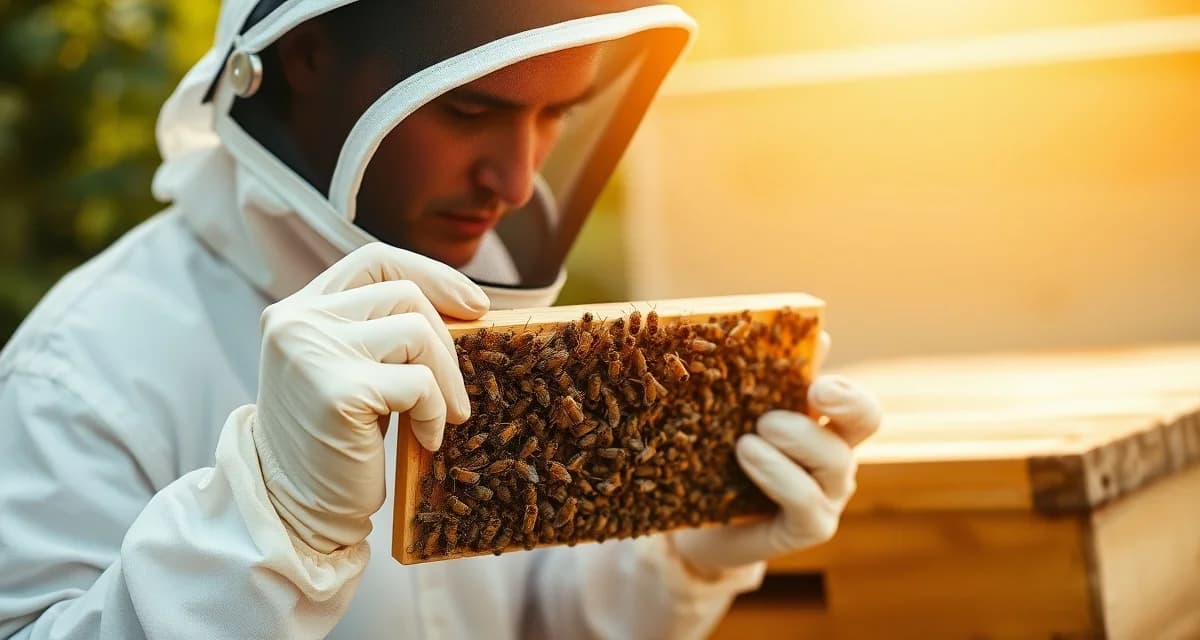
- Remove a frame from the center of the brood nest.
- Check that the queen is not on this frame (set it aside gently if she is, take the adjacent frame).
- Hold the frame over your jar and shake sharply. Nurse bees will fall.
- Aim for 300 bees (roughly half a 32oz Mason jar, or full if using smaller jar). More than 300 is fine; less reduces accuracy.
- Add enough isopropyl alcohol to submerge the bees.
- Secure the mesh lid and shake for 60 seconds.
- Pour the alcohol and mites through the mesh into your white tray. The bees stay in the jar; the mites wash through.
- Count the mites in the tray. A magnifying glass or reading glasses help.
- Add more alcohol and shake again for 30 seconds; pour again. This second rinse catches any remaining mites. Count and add to first count.
- Divide total mites by 300 and multiply by 100 for percentage.
Example: 9 mites in a 300-bee wash = 9/300 x 100 = 3% infestation
Bee welfare note: 300 bees is less than 3% of a typical active colony population. The loss is biologically insignificant to a healthy colony.
Sugar Roll (Acceptable for Trend Monitoring)
The sugar roll is a non-lethal alternative that returns 30-40% fewer mites than an alcohol wash on the same colony. This systematic undercount limits its value for precise treatment threshold decisions.
Accuracy: 60-70% sensitivity compared to alcohol wash. Useful for trend monitoring but not reliable for threshold-level decisions.
What you need:
- Wide-mouth jar with mesh screen lid
- Powdered sugar (pure, no cornstarch)
- 300-bee sample from brood nest
Process:
- Collect bees from brood nest as with alcohol wash.
- Add 2 tablespoons of powdered sugar.
- Replace mesh lid. Roll/shake to coat bees.
- Let sit 2 minutes.
- Shake mites out through mesh lid onto white surface.
- Count mites. Add more sugar and repeat.
- Calculate percentage.
Interpreting sugar roll results: Because sugar roll returns 30-40% fewer mites, a sugar roll count of 2% likely represents a true infestation of 2.8-3.2%. If you're using sugar roll for treatment decisions, apply a correction factor or use a more conservative treatment threshold (treat at 2% sugar roll count rather than 3%).
Sticky Board (Natural Mite Drop Monitoring)
A sticky board placed under a screened bottom board collects naturally-dropping mites for 24 hours. The drop count can be converted to an estimated infestation rate using published conversion tables.
Accuracy: 50-60% sensitivity for detecting threshold crossings. Wide seasonal variation makes interpretation difficult.
Best use: Trend monitoring between alcohol washes. Not reliable for precise threshold decisions.
Interpreting results: Natural daily mite drop depends heavily on season, colony temperature, and bee behavior. A published conversion table gives approximate percentage ranges for daily drop counts by season. VarroaVault labels sticky board entries as "trend indicators" rather than percentage calculations to prevent misinterpretation.
Sample Size: Why 300 Bees?
The 300-bee sample size is the research-validated standard from the Honey Bee Health Coalition and most university extension programs. Here's why it matters:
A 300-bee sample from a colony of 30,000-50,000 bees is a statistically reliable sample of the phoretic mite distribution. Counting errors and natural mite distribution variation create a confidence interval of approximately ±1 mite per 100 bees in the result.
If you count fewer bees: Accuracy drops. A 150-bee sample has roughly twice the counting error. You might get 4 mites (2.7%) when the true rate is 1.5%, or vice versa.
If you count more bees: Accuracy improves marginally but time investment increases significantly. 300 is the right balance.
Counting your bees: You don't need to count 300 bees individually before the wash. The commonly used field method is to use a jar that holds approximately 300 bees at 1/2-full capacity (for a half-pint jar). After a few practice counts, you'll recognize the volume. A more precise method is to count 100 bees into the jar, mark the level, and fill to triple that level.
When to Count: The Seasonal Schedule
Spring (April-May): Count at your first inspection when temperatures allow (above 55°F consistently). This baseline count tells you what mite load you're starting the season with. Most operations coming out of winter should be below 1% if they treated properly in the fall.
Early summer (June): Count again to track the post-buildup mite trend. Mite populations grow with the colony; a 0.5% April count can reach 1.5-2% by June.
Pre-treatment assessment (July-August): Count before deciding on your main summer/fall treatment. This is your most important count of the year. If you're above 2% in July, treat now. If you're at 1-2%, count again in 2 weeks to confirm the trend.
Post-treatment (14 days after OA/formic, 42 days after Apivar): Confirm efficacy. Target: 90%+ reduction from pre-treatment baseline.
Fall (September-October): Final count before winter prep. Target: below 2% by mid-October to protect the winter cluster. If above 2%, treat immediately.
Winter: Count after winter OA dribble (if you applied one) to confirm efficacy. A post-winter count also shows whether your colonies survived with low mite loads.
Reading Your Results
0-1%: Low infestation. Continue monitoring on schedule.
1-2%: Moderate. Monitor more frequently (every 2-3 weeks). If August-September, treat preemptively.
2-3%: At or approaching threshold depending on season. Treat if it's August or later. Monitor urgently if spring/early summer.
3%+: Above threshold in any season. Treat immediately.
5%+: Emergency. This colony is in distress and likely experiencing DWV symptoms and significant population decline. Treat immediately with the fastest-acting available product.
Logging Counts in VarroaVault
Every count should be logged immediately after counting. Waiting until you get home risks forgetting the number or confusing results between hives.
Log in VarroaVault:
- Hive name/ID
- Date and time
- Method (alcohol wash, sugar roll, sticky board)
- Sample size (number of bees)
- Mites counted
- Sampling location (brood nest, middle box, entrance)
VarroaVault automatically:
- Calculates infestation percentage
- Compares to your threshold setting
- Updates your count trend graph
- Flags if the count exceeds threshold
- Schedules your next count reminder based on your monitoring interval
Comparing Counts Over Time
A single count tells you where you are. A series of counts tells you where you're going. The trend is often more important than the absolute number.
A count of 2% that's been declining from 3.5% post-treatment is very different from a count of 2% that's been rising from 0.5% over six weeks. VarroaVault's trend graph shows both, along with a projected trajectory based on your recent trend slope.
Common Counting Mistakes and How to Avoid Them
Sampling from the entrance: Forager bees return 50% fewer mites than nurse bees. Always sample from the brood nest.
Not collecting enough bees: Less than 200 bees significantly reduces accuracy. Aim for 300.
Not washing thoroughly: One alcohol rinse may miss mites in the dead bee mass. Always do a second rinse.
Counting in poor light: Varroa mites on a white tray are easier to see than you'd expect, but poor light causes undercounts. Count in daylight or under bright artificial light.
Not repeating the rinse: A second 30-second agitation with fresh alcohol catches the mites you missed on the first wash. Add these to your count.
Frequently Asked Questions
What is the most accurate way to count varroa mites?
The alcohol wash using 300 bees sampled from the brood nest is the most accurate field method, with 95%+ sensitivity for threshold detection when done correctly. Sugar roll returns 30-40% fewer mites and is better for trend monitoring than precise threshold decisions. Sticky board counts have 50-60% sensitivity and are useful only for trend monitoring.
How do I get started with regular mite monitoring?
Set a counting schedule before your first count: monthly from April through October, plus post-treatment counts at the appropriate interval for each product. Get your supplies (jar, mesh lid, isopropyl alcohol) and practice on a colony before you need the count for a treatment decision. Log every count in VarroaVault from your first one so you build a trend record.
Does VarroaVault guide me through mite counting in the app?
Yes. VarroaVault's onboarding tutorial walks you through your first alcohol wash with step-by-step instructions. The count log form prompts you for all relevant fields. After you enter your mite count and sample size, VarroaVault calculates the percentage, compares it to your threshold, and schedules your next count reminder automatically.
How soon after treatment can I run a post-treatment mite count?
Wait 2-4 weeks after the treatment ends before running a post-treatment count. Counting too soon (within a week of treatment removal) may show mites still dying or emerging from the last brood cycle. Waiting 2-4 weeks allows emerging bees from brood that was capped during treatment to fully emerge and any surviving mites to become detectable in a new count.
What should I do if my mite count results seem unusually high or low?
If results seem surprising, repeat the count within 1-2 weeks before making a treatment decision based on a single outlier result. Confirm you sampled from the brood nest center (not outer frames), used the correct sample size (approximately 300 bees), and shook vigorously for the full 60 seconds. Consistent sampling technique is the most important factor in count accuracy.
Can I count mites from a sticky board instead of doing an alcohol wash?
Sticky board counts measure mite fall rate over 24-72 hours, which correlates with infestation level but is not a direct measure of infestation percentage. Sticky board results cannot be converted to an accurate percentage without calibration, and they are less reliable than alcohol wash for treatment decisions. Use sticky boards for general population monitoring but rely on alcohol wash counts for threshold decisions.
What is Complete Guide to Varroa Mite Counting for Beekeepers?
This guide is a comprehensive resource for beekeepers covering every aspect of varroa mite monitoring. It explains how to collect accurate bee samples, which counting method to use, how to calculate infestation percentages, when to act on results, and how to log data systematically. Using standardized methods as described here gives beekeepers 85% more accurate threshold breach detection, helping them catch mite problems while colonies can still be saved.
How much does Complete Guide to Varroa Mite Counting for Beekeepers cost?
The Complete Guide to Varroa Mite Counting is free educational content published on VarroaVault. There is no cost to read or apply its methods. VarroaVault also offers a free mite count logging tool so beekeepers can track trends over time. Some premium features may be available for advanced record-keeping and threshold alerts, but the core counting guidance, calculation formulas, and treatment thresholds are freely accessible to all beekeepers.
How does Complete Guide to Varroa Mite Counting for Beekeepers work?
The guide walks beekeepers through a repeatable monitoring process: collect a sample of approximately 300 bees from the brood nest, perform an alcohol wash or sugar roll to dislodge mites, count the mites, then apply the formula (mites ÷ bees × 100) to get an infestation percentage. Results are compared against action thresholds — 2% in spring and summer, 1% in fall — to determine whether treatment is needed.
What are the benefits of Complete Guide to Varroa Mite Counting for Beekeepers?
Consistent mite counting protects colony health by giving beekeepers objective data instead of guesswork. It enables early intervention before mite populations cause irreversible damage. The alcohol wash method covered here is 15–20% more accurate than sugar roll alternatives. Logging counts in VarroaVault builds a trend dataset that reveals whether mite levels are rising or stable, making treatment timing decisions far more precise and confident.
Who needs Complete Guide to Varroa Mite Counting for Beekeepers?
Any beekeeper managing one or more hives through active season needs this guide. It is especially valuable for newer beekeepers establishing a monitoring routine, experienced beekeepers looking to standardize their methods, and anyone whose colonies have previously collapsed from untreated varroa. Monthly counting is the baseline recommendation, with biweekly counts advised when levels approach the treatment threshold — making this guide relevant throughout the entire beekeeping season.
Related Articles
Sources
- American Beekeeping Federation (ABF)
- USDA ARS Bee Research Laboratory
- Honey Bee Health Coalition
- Penn State Extension Apiculture Program
- Project Apis m.
Get Started with VarroaVault
An alcohol wash gives you the number. VarroaVault turns that number into a decision. Log your count, get an instant threshold comparison, and build a monitoring history that shows you whether mite levels are rising or stable across your entire operation. See pricing and free tools at varroavault.com.