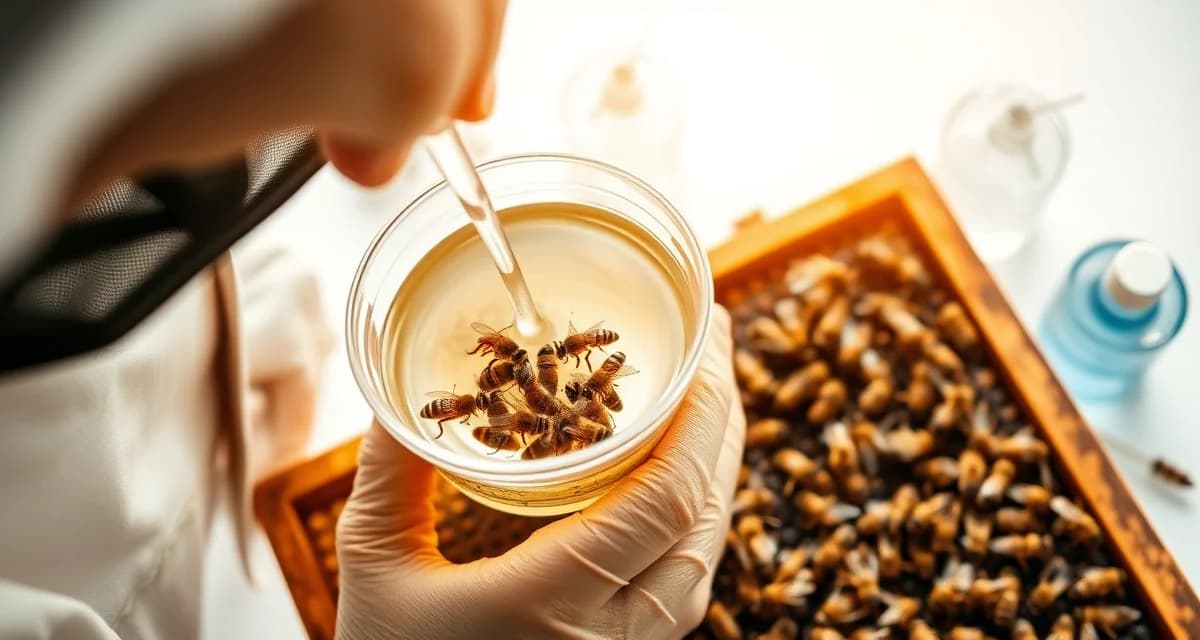
Alcohol Wash Instructions: Varroa Mite Monitoring Step-by-Step
The alcohol wash is the gold standard for varroa monitoring. It's 15-20% more accurate than sugar roll, takes about 10 minutes, and gives you the data you need to make a treatment decision.
Here are the complete instructions.
TL;DR
- The alcohol wash is 15-20% more accurate than the sugar roll method for varroa monitoring
- Use a half-cup scoop (approximately 300 bees) from the center of the brood nest for a valid sample
- Shake with 70% isopropyl alcohol for 30 seconds, rest, then shake again for 30 seconds
- Formula: (mites counted / bees sampled) x 100 = infestation percentage
- A result of 2% or above in spring/summer and 1% or above in fall signals a treatment decision
- Log results in VarroaVault for automatic threshold comparison and trend tracking
Materials
- Wide-mouth jar with lid (Mason jar works well)
- Separate container with fine mesh lid or paint strainer
- 70% isopropyl alcohol (rubbing alcohol), about 150ml
- Half-cup scoop or measuring cup
- White tray or white container
- VarroaVault app or paper notebook
Step 1: Pick the Right Frame
Go to the center of your brood nest. Choose a frame with open and capped brood, ideally a mix of eggs, young larvae, and capped cells. Bees attending this frame are nurse bees with higher mite loads than foragers.
Avoid the outer frames, entrance area, or frames with only empty comb.
Step 2: Collect Approximately 300 Bees
Shake or brush the bees from the frame into your collection jar. A loose half-cup is about 300 bees, the standard sample size.
Confirm the queen is not in the sample before proceeding. Losing a queen to a mite wash is preventable, find her on the frame before pulling bees.
If the colony is small (under 4 frames of bees), collect as many as you can without stripping the frame. Note the approximate count.
Step 3: Add Alcohol
Pour 150ml of 70% isopropyl alcohol into the jar with the bees. Enough to cover them completely.
Close the lid.
Step 4: Shake
Shake vigorously for 30 seconds.
Pause for 15 seconds.
Shake again for 30 seconds.
The shaking dislodges mites from bee bodies. The longer and more vigorous the shake, the more complete the mite release.
Step 5: Strain
Pour the alcohol through your mesh lid into the white tray. The mesh catches bees; mites and alcohol pass through.
Let the liquid spread across the white surface. Swirl gently.
Pour back through the mesh a second time to catch any remaining mites stuck to bees or the mesh.
Step 6: Count Mites
Varroa mites are reddish-brown ovals, approximately 1.5mm long. They're visible to the naked eye on a white background. Under a loupe or modest magnification, they're easy to distinguish.
Count every mite in the white tray. Move the tray slowly under good light.
Step 7: Calculate and Record
Formula: (Mites ÷ Bees) × 100 = Infestation %
A 300-bee sample with 5 mites = 5 ÷ 300 × 100 = 1.67%
Record:
- Date
- Hive ID
- Method (alcohol wash)
- Number of bees
- Mites counted
- Infestation rate
- Season threshold status
Log in VarroaVault and get instant threshold comparison.
Interpreting Results
| Result | Spring/Summer Action | Late Summer/Fall Action |
|--------|---------------------|------------------------|
| Under 1% | Monitor monthly | Near threshold, recount in 2 weeks |
| 1-2% | Monitor closely | At or above threshold, treat |
| 2%+ | At threshold, treat | Above threshold, treat immediately |
| 3%+ | Treat now | Treat now, emergency |
Related Articles
- Varroa Mite Count Video Guide: Watch Before Your First Alcohol Wash
- Sugar Roll Accuracy: How Reliable Is It Compared to Alcohol Wash?
- How to Calculate Varroa Mite Infestation Rate: Step-by-Step
FAQ
How do you dispose of bees after an alcohol wash?
The sampled bees don't survive the alcohol wash. Dispose of the bee-alcohol mixture away from the hive, don't pour it near the entrance where other bees could contact it. Most beekeepers bury the bees or dispose of them in a sealed bag in the trash.
What alcohol concentration should I use?
70% isopropyl alcohol (standard rubbing alcohol) is recommended. Higher concentrations (90%+) work but can make mites harder to dislodge from dried bees. Lower concentrations (below 60%) reduce efficacy. 70% is the standard.
Can I reuse the alcohol?
No. The bee material and any residue in the used alcohol can make mite counting inaccurate in subsequent uses. Use fresh alcohol for each sample.
Can I do an alcohol wash without killing the queen?
Yes, but you need to locate the queen before collecting your sample. Find her on the frame, set that frame aside, then shake or brush bees from the remaining frames into your collection jar. The queen is the only bee you need to actively protect; all other bees in the sample do not survive the alcohol wash.
Is 91% isopropyl alcohol better than 70% for an alcohol wash?
Not necessarily. Higher concentration alcohol (90%+) can cause bees to contract tightly, making it harder for mites to dislodge from body segments. Standard 70% isopropyl alcohol (rubbing alcohol) is the recommended concentration for consistent mite release and easy counting. It is also less expensive and widely available.
How do I know if my 300-bee sample is accurate enough?
A loose half-cup scoop from the brood nest is a reliable way to collect approximately 300 bees. If your count results in a very small number of mites (1-2) at the border of your threshold, a larger sample or a second count from a different hive location can improve confidence. For clear results -- well above or well below threshold -- a single 300-bee sample is statistically sufficient.
What is Alcohol Wash Instructions: Varroa Mite Monitoring Step-by-Step?
The Alcohol Wash Instructions: Varroa Mite Monitoring Step-by-Step is a practical guide for beekeepers to accurately measure varroa mite infestation levels in their hives. It walks you through collecting a sample of approximately 300 nurse bees from the brood nest, shaking them in 70% isopropyl alcohol, and calculating an infestation percentage. The alcohol wash is considered the gold standard method, offering 15-20% greater accuracy than the sugar roll technique, and takes about 10 minutes to complete.
How much does Alcohol Wash Instructions: Varroa Mite Monitoring Step-by-Step cost?
The Alcohol Wash Instructions: Varroa Mite Monitoring Step-by-Step guide is completely free to access on VarroaVault. The only costs involved are the inexpensive materials needed to perform the test itself — a Mason jar, 70% isopropyl alcohol (roughly 150ml per test), and a fine mesh strainer. These supplies are widely available and cost just a few dollars. VarroaVault also offers free result logging and automatic threshold comparison to help you track mite trends over time.
Sources
- American Beekeeping Federation (ABF)
- USDA ARS Bee Research Laboratory
- Honey Bee Health Coalition
- Penn State Extension Apiculture Program
- Project Apis m.
Get Started with VarroaVault
An alcohol wash gives you the number. VarroaVault turns that number into a decision. Log your count, get an instant threshold comparison, and build a monitoring history that shows you whether mite levels are rising or stable across your entire operation. See pricing and free tools at varroavault.com.