Sugar Roll Accuracy: How Reliable Is It Compared to Alcohol Wash?
Using sugar roll alone and treating only when above 2% misses 30% of colonies that are actually at threshold. That's not a theoretical concern for a few edge cases. It means if you're relying on sugar roll as your primary monitoring tool, you're making inaccurate treatment decisions for roughly 1 in 3 threshold-level colonies.
Here's what you need to know about sugar roll accuracy and when to switch to alcohol wash.
TL;DR
- Sugar roll is a non-lethal monitoring method but is 15-20% less accurate than alcohol wash
- It uses approximately 300 bees rolled in powdered sugar; mites fall off onto a white surface for counting
- Sugar roll is useful for beekeepers who prefer not to sacrifice bees, but results may undercount mite levels
- The 2% threshold in summer and 1% in fall apply regardless of monitoring method used
- Sample from the brood nest center -- not the outer frames or entrance -- for accurate results
- Log sugar roll results with method notation in VarroaVault so you can compare accuracy across methods
Why Sugar Roll Returns Fewer Mites
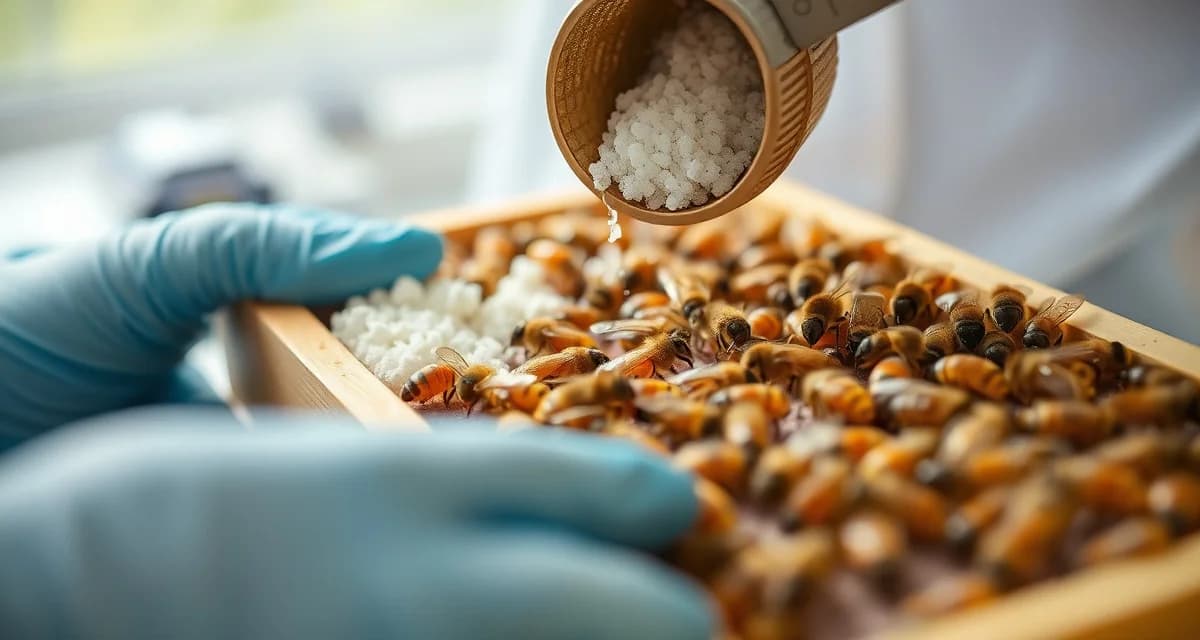
The sugar roll coats bees with powdered sugar, which causes mites to lose their grip and fall off when the jar is shaken. The mechanism is friction and adhesion disruption.
The problem is that sugar doesn't dislodge mites as completely as alcohol washing. Mites that are partially embedded between bee body segments, or that have strong grip on heavily sclerotized cuticle areas, may not be dislodged by sugar rolling even with repeated shaking. Alcohol wash kills bees and completely dissolves the grip mechanism, releasing virtually all mites.
Published comparisons show the sugar roll misses 30-40% of mites present compared to simultaneous alcohol washes on the same colony. This isn't a deficiency unique to any particular technique; it's a fundamental limitation of the physical dislodging mechanism versus the chemical dislodging mechanism.
What the 30-40% Undercount Means in Practice
If the true infestation rate (per alcohol wash) is 3%, a sugar roll on the same colony typically shows 1.8-2.1%.
At the 2% treatment threshold, this creates a systematic error:
- A colony truly at 3% (above threshold, needs treatment) might show 2% on sugar roll (at threshold) or 1.7-2% (potentially below your trigger point)
- A colony truly at 4% shows 2.4-2.8% on sugar roll, above a 2% threshold but underestimated
The practical result: beekeepers using sugar roll and treating at 2% are treating many colonies that are genuinely at 2.8-3.5% true infestation, often later than ideal.
When Sugar Roll Is Acceptable
Sugar roll has a legitimate use case. Here's when it's appropriate:
Trend monitoring between decisive counts: If you're checking whether counts are rising or falling between scheduled alcohol washes, a sugar roll gives you directional information. A change from 1.2% to 2.5% on sugar roll over 3 weeks indicates a rising trend, even if the absolute numbers are understated.
Teaching and demonstration: Sugar roll is less equipment-intensive and doesn't kill bees, which makes it useful for beginner workshops and introductory demonstrations.
Organic or treatment-free monitoring programs where high sensitivity isn't the goal: If you're observing rather than deciding, sugar roll data is usable.
When you've calibrated for the undercount: If you consistently apply a 1.4x correction factor (dividing sugar roll counts by 0.7) and treat at the adjusted figure, you can use sugar roll for threshold decisions with reasonable accuracy. This requires discipline to apply the correction consistently.
When to Use Alcohol Wash Instead
Use alcohol wash for all treatment threshold decisions. Specifically:
- Pre-treatment counts to establish your baseline for efficacy calculation
- Post-treatment counts to confirm efficacy
- Any count that determines whether you treat now or wait
- Fall counts before winter preparation (the highest-stakes count of the year)
The 10-15 minutes and 300 bees are worth it when the decision matters.
Converting Sugar Roll Counts
If you've been using sugar roll and want to understand what your counts likely represent as a true infestation rate:
True infestation estimate = Sugar roll count / 0.70
Examples:
- 1.4% sugar roll = approximately 2% true infestation (at threshold)
- 2.1% sugar roll = approximately 3% true infestation (above threshold)
- 1% sugar roll = approximately 1.4% true infestation (watch closely)
VarroaVault's method comparison tool shows this conversion factor for sugar roll counts and flags potential undercount risk when you log a sugar roll entry near threshold levels. When your sugar roll count falls between 1.5-2.5%, the app notes that the true infestation may be 2-3.5% and suggests confirming with an alcohol wash before making the treatment decision.
Frequently Asked Questions
Is a sugar roll accurate enough for treatment decisions?
Sugar roll is not ideal for treatment threshold decisions due to its systematic 30-40% undercount relative to alcohol wash. If you use sugar roll for threshold decisions, apply a 1.4x correction factor to estimate true infestation, or use a more conservative threshold (treat at 1.5% sugar roll count to catch colonies that are actually at 2-2.5% true infestation). For definitive threshold decisions, use alcohol wash.
How do I adjust a sugar roll count to compare with alcohol wash?
Divide your sugar roll count by 0.70 to estimate the equivalent alcohol wash count. A 1.5% sugar roll result represents approximately 2.1% true infestation. A 2% sugar roll represents approximately 2.9% true infestation. Apply this correction consistently if using sugar roll as your primary method.
Does VarroaVault flag sugar roll counts as potentially lower than actual?
Yes. VarroaVault labels sugar roll entries as "potentially understated" and shows the estimated alcohol wash equivalent alongside the raw sugar roll result. When a sugar roll count falls within 0.5% of your threshold, the app flags it and recommends confirming with an alcohol wash before making a treatment decision.
How do I know if my varroa treatment is working?
Run a mite count 2-4 weeks after the treatment ends and compare it to your pre-treatment count. The efficacy formula is: ((pre-count - post-count) / pre-count) x 100. A result above 90% indicates effective treatment. Results below 80% should trigger investigation for possible resistance, application error, or reinfestation. Log both counts in VarroaVault to track efficacy trends across treatment cycles.
How often should I check mite levels in my hives?
At minimum, once per month (every 3-4 weeks) during the active season. Increase to every 2 weeks when counts are near threshold or after a treatment to verify it worked. In fall, monitoring frequency matters most because the window to treat before winter bees are raised is narrow. VarroaVault's monitoring reminders can be set to your preferred interval for each apiary.
What records should I keep for varroa management?
Each record should include: date of count or treatment, hive identifier, monitoring method used, number of bees sampled, mites counted, infestation percentage, treatment product name and EPA registration number, dose applied, treatment start and end dates, and PHI end date. State apiarists typically expect this level of detail during inspections. VarroaVault captures all of these fields in a single log entry.
What is Sugar Roll Accuracy: How Reliable Is It Compared to Alcohol Wash??
Sugar roll accuracy refers to how reliably the sugar roll method detects varroa mites compared to alcohol wash. Research shows sugar roll undercounts mite levels by 15-20%, meaning it misses roughly 1 in 3 colonies that are actually at treatment threshold. While it's a useful non-lethal monitoring tool, beekeepers should understand its limitations and consider supplementing with alcohol wash when precise counts matter for treatment decisions.
How much does Sugar Roll Accuracy: How Reliable Is It Compared to Alcohol Wash? cost?
Sugar roll is a free monitoring technique requiring only basic supplies: a jar, powdered sugar, and a white surface. There is no cost associated with the method itself beyond the powdered sugar used. VarroaVault offers free tools to log and track your mite counts regardless of which method you use, helping you compare results over time and make more informed treatment decisions.
How does Sugar Roll Accuracy: How Reliable Is It Compared to Alcohol Wash? work?
Sugar roll works by coating approximately 300 bees in powdered sugar, which disrupts mite adhesion and causes varroa to fall off when the jar is shaken. The dislodged mites drop onto a white surface and are counted. Sample bees should come from the brood nest center for accurate results. Divide the mite count by the number of bees sampled to calculate the infestation percentage.
What are the benefits of Sugar Roll Accuracy: How Reliable Is It Compared to Alcohol Wash??
The primary benefit of sugar roll is that it is non-lethal — bees can be returned to the hive after sampling. This makes it appealing to beekeepers who are uncomfortable sacrificing bees for alcohol wash. It requires minimal equipment, is easy to perform in the field, and still provides useful trend data when performed consistently and results are logged with method notation for comparison.
Who needs Sugar Roll Accuracy: How Reliable Is It Compared to Alcohol Wash??
Any beekeeper who monitors for varroa should understand sugar roll accuracy, particularly those using it as their sole monitoring method. Hobbyist beekeepers with small apiaries often prefer it for its non-lethal approach. However, commercial beekeepers or anyone managing high-risk colonies approaching treatment thresholds in summer or fall should be aware that sugar roll may undercount mites and consider alcohol wash for more reliable threshold decisions.
Related Articles
- Varroa Mite Count Video Guide: Watch Before Your First Alcohol Wash
- Mite Alcohol Wash Step-by-Step: Video Walkthrough and Logging Guide
Sources
- American Beekeeping Federation (ABF)
- USDA ARS Bee Research Laboratory
- Honey Bee Health Coalition
- Penn State Extension Apiculture Program
- Project Apis m.
Get Started with VarroaVault
The information in this guide is most useful when you have your own mite count data to apply it to. VarroaVault stores every count, flags threshold crossings automatically, and builds the treatment history you need for state inspections and effective management decisions. See pricing and free tools at varroavault.com.