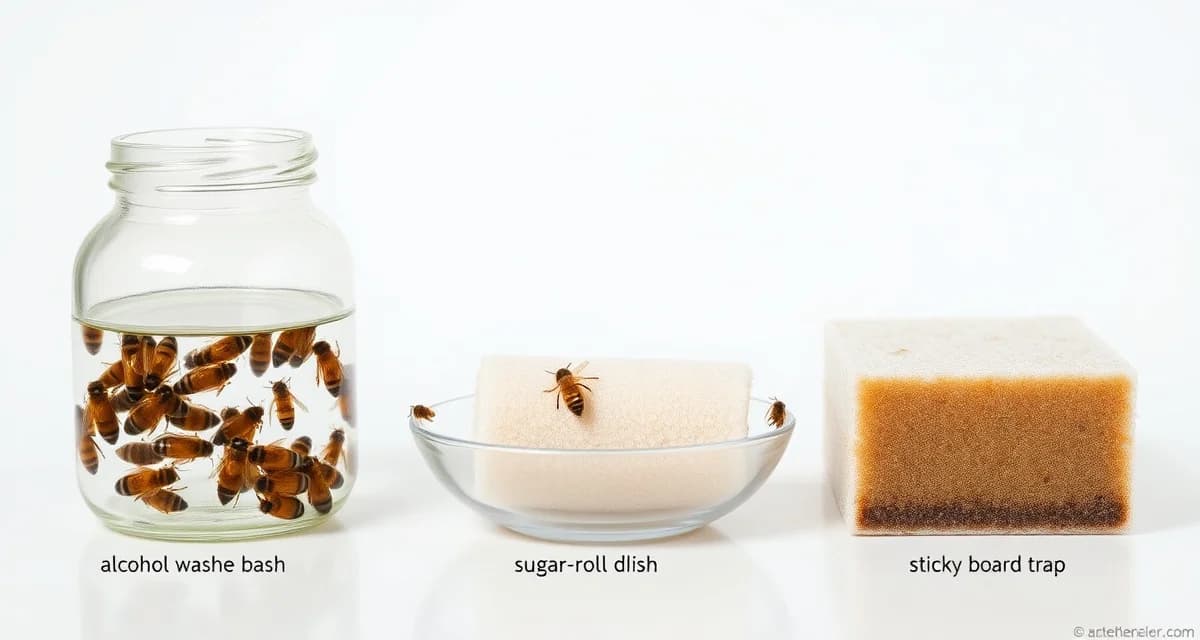
Varroa Counting Method Accuracy: A Comparison Table
Switching from sugar roll to alcohol wash for just one apiary-wide count per season dramatically improves threshold breach detection. That's not a minor methodological preference -- it reflects the significant difference in accuracy between the two most common field methods, a difference that has real consequences for management decisions.
This comparison table covers all major varroa counting methods across five criteria: sensitivity (ability to detect true positives), specificity (ability to avoid false negatives), practical difficulty, cost, and appropriate use cases. The method comparison table is embedded in VarroaVault's count entry form to help you choose the right method before logging.
TL;DR
- A valid mite count sample requires approximately 300 bees from the brood nest for statistically reliable results
- Alcohol wash is 15-20% more accurate than sugar roll for detecting mite infestation levels
- The calculation is: (mites counted / bees in sample) x 100 = infestation percentage
- A 2% threshold triggers treatment in spring/summer; 1% is the fall action threshold
- Count at least once per month during active season; increase to every 2 weeks if levels are near threshold
- Log every count in VarroaVault to build a trend dataset that shows whether populations are rising or stable
The Comparison Table
| Method | Sensitivity | Threshold Detection | Practical Difficulty | Cost | Kills Bees? |
|---|---|---|---|---|---|
| Alcohol wash | 95-99% | Most reliable | Low-moderate | Low | Yes |
| Sugar roll | 60-80% | Moderate | Low | Very low | No |
| Sticky board (24-hour) | 40-60% | Poor (highly variable) | Very low | Low | No |
| Natural mite drop | 30-50% | Unreliable | Very low | None | No |
| Visual inspection | 10-30% | Unreliable | Very low | None | No |
| Brood cell inspection | 85-95% (with enough cells) | Good for infestation rate | High | None | Disrupts brood |
Alcohol Wash: The Gold Standard
Sensitivity: 95-99% (depends on sample size and technique)
Best for: All monitoring purposes, especially threshold-based decisions
Sample size: 300 bees from the brood nest area
Method: Bees in jar of isopropyl alcohol, shaken 60 seconds, mites counted from liquid
Cost: Under $5 in materials; reusable jar and measuring cup
Alcohol wash is the most accurate method by a substantial margin and is the standard recommended by the Honey Bee Health Coalition, university extension programs, and virtually every evidence-based varroa management guide. At 300 bees, the statistical confidence in threshold breach detection (detecting a 2% population) is 95%.
The method kills bees, which some beekeepers resist psychologically. At 300 bees from a healthy colony with 20,000+ workers, the sacrifice represents less than 1.5% of the workforce and is well worth the information gained. The how to do a mite wash guide covers the complete technique.
Adjusting threshold interpretation based on counting method: VarroaVault adjusts its threshold alert for alcohol wash counts differently than for sugar roll counts, because the same percentage result from a sugar roll likely understates the true infestation level.
Sugar Roll: Acceptable with Caveats
Sensitivity: 60-80% (varies significantly with technique and bee agitation)
Best for: Educational demonstrations, situations where dead bees are unacceptable, quick field checks
Sample size: 300 bees
Method: Bees in jar with powdered sugar, rolled and counted, bees returned to hive
Cost: Under $2 per use
Sugar roll is the "returns the bees alive" alternative to alcohol wash, which gives it a psychological advantage with some beekeepers. But the accuracy trade-off is real. Published comparisons consistently show sugar roll underestimates infestation levels by 20-40% compared to alcohol wash on the same colonies.
The reason: powdered sugar dislodges mites through abrasion and bee agitation, but it doesn't achieve the complete mite removal that alcohol washing does. Mites clinging tightly to abdominal sclerites or buried in intersegmental membranes survive sugar rolling at higher rates than alcohol washing. A 2% true infestation may return a 1.2-1.5% sugar roll result -- close enough to be directionally useful, but below the action threshold even when treatment may be warranted.
Use sugar roll for educational demonstrations and directional tracking. Use alcohol wash for any count that will drive a treatment decision.
Sticky Board (Natural or Treated)
Sensitivity: 40-60% for threshold breach detection
Best for: Monitoring trends over time, not single-point threshold decisions
Method: Sticky board placed under screened bottom board, 24-72 hour mite fall counted
Cost: Low-moderate (commercial boards) to free (homemade)
Sticky boards are passive monitoring tools that capture mites falling naturally from bees. They're appealing because they require no bee handling, but their accuracy for threshold detection is significantly lower than active sampling methods.
The core problem is variability. Natural mite drop is highly sensitive to temperature, brood area, colony population, and random variation. A 24-hour sticky board count of 5 mites might mean 1% infestation or 3% infestation depending on the colony and conditions. The conversion factor from mite fall to infestation percentage is not reliable enough to use for treatment threshold decisions.
Sticky boards are better used for trend monitoring -- tracking whether mite fall is rising or falling over consecutive counts -- than for point-in-time threshold evaluation.
Natural Mite Drop and Visual Inspection
These methods are included for completeness, but neither should be used for management decisions.
Natural mite drop (counting mites on bottom board without a sticky board) is even more variable than sticky board counts and provides insufficient information for threshold decisions.
Visual inspection of adult bees underestimates infestation by 70-90% because most mites are in capped brood at any time. Seeing 0 mites on 10 bees is meaningless. Seeing 5 mites on 10 bees indicates an extremely severe infestation but tells you nothing about colonies below that crisis level.
Why Method Choice Matters for VarroaVault Logging
VarroaVault adjusts its threshold interpretation based on which counting method you report using. If you log a 1.8% result from an alcohol wash in August, the system interprets this as very close to the 2% threshold and may flag a near-threshold alert. If you log a 1.8% result from a sugar roll, the system adjusts the interpretation upward -- your true infestation may be 2.2-2.7%, which would be above threshold.
This adjustment isn't precise (there's no universal sugar roll correction factor), but acknowledging that method choice affects interpretation is more accurate than treating all count results as equivalent regardless of method.
When you log a count, select the method from the dropdown. The interpretation screen shows you the method-adjusted risk level rather than applying a single threshold to all methods equally.
Frequently Asked Questions
Which varroa counting method is most accurate?
Alcohol wash is the most accurate method, with 95-99% sensitivity for detecting threshold-level infestations when performed with a 300-bee sample. Sugar roll is the second most common field method but underestimates infestation levels by 20-40% compared to alcohol wash. Sticky boards are useful for trend monitoring but are not reliable for threshold-based treatment decisions. For any count result that will drive a treatment decision, alcohol wash is the right method.
Why is alcohol wash more accurate than sugar roll?
Alcohol wash achieves complete mite removal through chemical disruption of the mite's physical attachment to the bee. Mites dislodge completely when the bee is washed in alcohol and the alcohol solution is shaken. Sugar roll works by physical abrasion from powdered sugar particles, which is less complete -- mites that grip tightly to abdominal segments survive sugar rolling at higher rates than alcohol washing. Published comparisons consistently show alcohol wash recovers 20-40% more mites than sugar roll on the same colony samples.
Does VarroaVault adjust threshold interpretation based on which counting method I use?
Yes. When you log a count, VarroaVault asks which method you used. For alcohol wash results, the standard threshold alert fires at 2% in season and 1% in fall. For sugar roll results, the interpretation is adjusted to account for the known underestimation -- a 1.8% sugar roll result may trigger a near-threshold alert because the true infestation is likely 2.2-2.8%. This method-adjusted interpretation helps you make better decisions from imperfect methods rather than treating all count results as equally precise.
How soon after treatment can I run a post-treatment mite count?
Wait 2-4 weeks after the treatment ends before running a post-treatment count. Counting too soon (within a week of treatment removal) may show mites still dying or emerging from the last brood cycle. Waiting 2-4 weeks allows emerging bees from brood that was capped during treatment to fully emerge and any surviving mites to become detectable in a new count.
What should I do if my mite count results seem unusually high or low?
If results seem surprising, repeat the count within 1-2 weeks before making a treatment decision based on a single outlier result. Confirm you sampled from the brood nest center (not outer frames), used the correct sample size (approximately 300 bees), and shook vigorously for the full 60 seconds. Consistent sampling technique is the most important factor in count accuracy.
Can I count mites from a sticky board instead of doing an alcohol wash?
Sticky board counts measure mite fall rate over 24-72 hours, which correlates with infestation level but is not a direct measure of infestation percentage. Sticky board results cannot be converted to an accurate percentage without calibration, and they are less reliable than alcohol wash for treatment decisions. Use sticky boards for general population monitoring but rely on alcohol wash counts for threshold decisions.
What is Varroa Counting Method Accuracy: A Comparison Table?
VarroaVault's Varroa Counting Method Accuracy comparison table evaluates all major varroa mite counting methods across five key criteria: sensitivity, specificity, practical difficulty, cost, and appropriate use cases. It is built into the VarroaVault count entry form so beekeepers can select the right method before logging a count. The table highlights critical differences between common field methods like alcohol wash and sugar roll, helping beekeepers make more informed management decisions based on accurate infestation data.
How much does Varroa Counting Method Accuracy: A Comparison Table cost?
The comparison table is a free resource embedded directly within VarroaVault's count entry form. There is no separate cost to access it. It is part of VarroaVault's broader suite of tools designed to support beekeepers in monitoring and managing varroa mite infestations accurately. Beekeepers simply use the form as part of their normal count-logging workflow and the table is available at the point of method selection.
How does Varroa Counting Method Accuracy: A Comparison Table work?
The table works by rating each varroa counting method side by side across five measurable criteria: sensitivity, specificity, practical difficulty, cost, and use case fit. When logging a count in VarroaVault, beekeepers are shown the comparison before selecting their method. This ensures the chosen approach matches the monitoring goal—whether that is a quick routine check or a high-stakes count near treatment threshold. The table draws on field accuracy data, including the finding that alcohol wash is 15–20% more accurate than sugar roll.
What are the benefits of Varroa Counting Method Accuracy: A Comparison Table?
The primary benefit is improved threshold breach detection. Using the table to select the most accurate method for each situation reduces false negatives, which are missed infestations that delay treatment. Switching from sugar roll to alcohol wash for even one apiary-wide count per season meaningfully improves detection reliability. The table also helps beekeepers match method to context—balancing accuracy needs against cost and difficulty—so monitoring is both practical and statistically sound across a full season.
Who needs Varroa Counting Method Accuracy: A Comparison Table?
Any beekeeper actively monitoring for varroa mite infestations will benefit from this table, from hobbyists managing a single hive to commercial operators running multiple apiaries. It is especially valuable for beekeepers counting near treatment thresholds—2% in spring and summer, 1% in fall—where method accuracy directly affects whether a treatment decision is triggered. Beekeepers transitioning between counting methods or looking to standardize apiary-wide monitoring protocols will find it a practical reference at the moment it matters most.
Related Articles
Sources
- American Beekeeping Federation (ABF)
- USDA ARS Bee Research Laboratory
- Honey Bee Health Coalition
- Penn State Extension Apiculture Program
- Project Apis m.
Get Started with VarroaVault
An alcohol wash gives you the number. VarroaVault turns that number into a decision. Log your count, get an instant threshold comparison, and build a monitoring history that shows you whether mite levels are rising or stable across your entire operation. See pricing and free tools at varroavault.com.