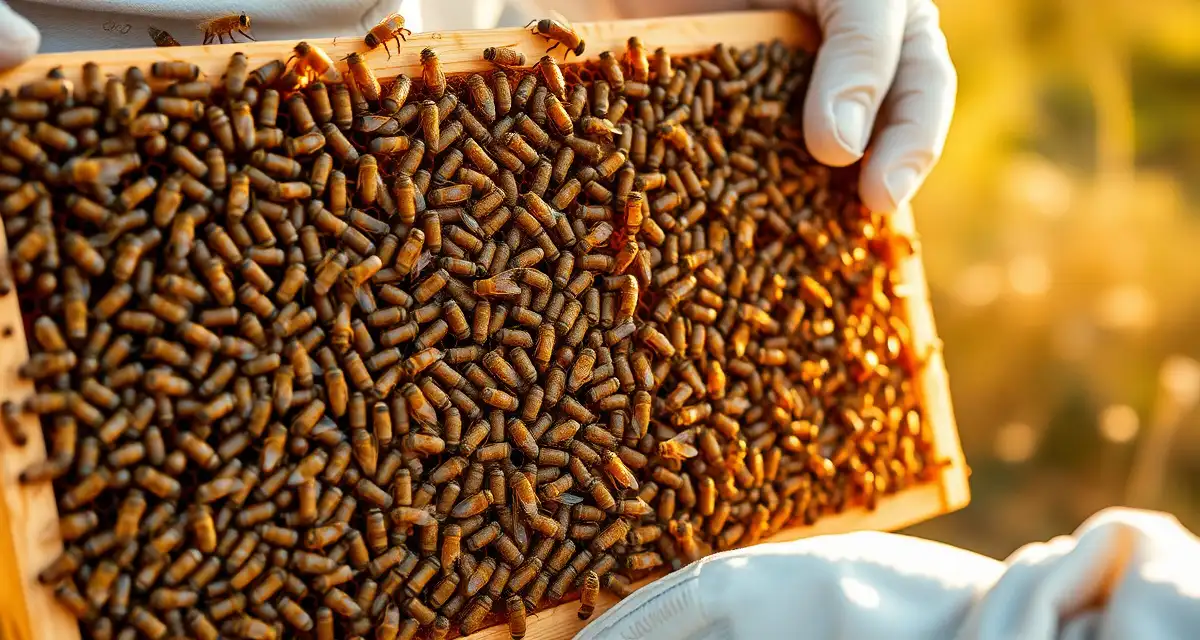
Colony Population Counting for Varroa: Estimating Bee Numbers
Overestimating colony strength by 2 frames results in an average 18% treatment under-dose. That's not a trivial error: an 18% under-dose of OA dribble means you're leaving significantly more mites alive than your label compliance and efficacy expectations account for. Accurate colony population estimates matter for every treatment decision involving a dose calculation.
Here's how to estimate colony population accurately for your varroa management records.
TL;DR
- This guide covers key aspects of colony population counting for varroa: estimating bee number
- Mite monitoring should happen at minimum every 3-4 weeks during active season
- The 2% threshold in spring/summer and 1% in fall are standard action points based on HBHC guidelines
- Always run a pre-treatment and post-treatment mite count to calculate efficacy
- Treatment records including product name, EPA number, dates, and counts are required for state inspection compliance
- VarroaVault stores all monitoring and treatment data with automatic threshold comparison and state export formatting
Why the Number Matters
Colony population drives two specific varroa management calculations:
OA dribble dose. The Api-Bioxal label specifies 5ml per seam of bees. "Seams" are the spaces between frames where bees cluster. Counting seams of bees is the operational way to estimate colony population for dribble dosing. If you estimate 8 seams and the colony actually has 10, you're applying 40ml instead of 50ml: an 18% under-dose.
Threshold interpretation. A 2% count means different things in different-sized colonies (see colony strength scoring). For standard threshold comparisons, the percentage itself is what matters. But for treatment urgency decisions, a small colony at 2% is in a worse position than a large colony at 2%, and that context affects how quickly you need to act.
Frame-Counting Method
This is the most accurate field method and the standard used in VarroaVault's dose calculator.
How to do it:
- Pull each frame from the hive.
- Look at both sides of each frame.
- Estimate what fraction of the frame's bee-available surface is covered by bees.
- Both sides fully covered = 1 frame equivalent
- Both sides 75% covered = 0.75 frame equivalent
- One side fully covered, other side empty = 0.5 frame equivalent
- Note the count for each frame.
- Sum all frames for your total bee population score.
Time required: 2-3 minutes per hive during a normal inspection. You're doing this assessment while pulling frames for your inspection anyway.
Accuracy: Frame-counting has approximately ±1 frame equivalent accuracy for experienced estimators. This is adequate for dose calculations. Beginners tend to overestimate; practice with photo calibration (photos of frames at known population levels) improves accuracy.
Seam-Counting Method (for OA Dribble)
For OA dribble specifically, you need a seam count rather than a frame count. Seams are the spaces between frames where bees cluster.
How to count seams:
Close the hive with the cover off and look from directly above (or through the crown board gap if you have one). Count the number of inter-frame spaces that have bees clustered in them. In winter, you can count seams without opening the full hive by looking through the entrance or the crown board.
In warm weather when bees are spread throughout the hive, seam counting is less precise because bees are also on frame surfaces, not just in the inter-frame spaces. Use the frame method during the active season and switch to seam counting for winter broodless dribble applications when the cluster is compact and seams are clearly defined.
Dribble dose calculation:
Number of bee-occupied seams x 5ml = total dribble volume. Maximum 50ml regardless of colony size. A colony with 10 bee-occupied seams gets 50ml (the maximum). A colony with 6 bee-occupied seams gets 30ml.
Weight-Based Estimation
You can estimate bee population from hive weight, but this method requires knowing your empty equipment weight and current food store weight, making it less practical for routine field use.
Rough weight benchmarks for a single Langstroth deep box:
- Bees alone: approximately 1.3-1.5 lbs per fully occupied frame
- Full box of honey: 30-35 lbs
- Full box of bees and honey: 50-60 lbs
For a scale-equipped operation, weighing before and after a spring feeding event (when bees, not stores, are the variable) can calibrate your weight-to-population estimates. For most operations, frame-counting is simpler and accurate enough.
Common Estimation Errors
Counting frames of comb rather than frames of bees. A box with 10 drawn frames doesn't mean 10 frames of bees. You're counting bee coverage, not frame count.
Not accounting for bees at the bottom of the hive or in honey supers. On a warm day, bees spread throughout the hive and supers. For population estimation purposes, focus on bees in the brood area. Bees in honey supers are foragers and stored nectar workers, not the nurse bee core that matters most for varroa management.
Assuming last inspection strength still applies. Colony strength can change significantly over 4-6 weeks. A colony that was 8 frames in June may be 12 frames in August or 5 frames after a swarm. Update your strength estimate at every inspection, not just when it seems to matter.
Using VarroaVault's Dose Calculator
When you enter a strength score or seam count in VarroaVault's inspection log, the OA dribble dose calculator updates automatically. The calculation displays: "Based on your estimated X seams, recommended dribble volume: Yml (maximum 50ml)."
You can also enter your strength estimate directly in the treatment log at time of application. The calculator runs the dose math and displays the result alongside your treatment entry.
For OA vaporization, enter the number of brood boxes being treated. The dose calculator shows: "X boxes x 1g per box = Xg Api-Bioxal total."
Frequently Asked Questions
How do I estimate my colony population for treatment?
Frame-counting is the most practical field method. Pull each frame and estimate what fraction of the bee-available surface is covered by bees. Sum across all frames in the brood area: a frame covered on both sides = 1 frame equivalent, one side = 0.5. For OA dribble specifically, count seams of bees (inter-frame spaces with bees clustered in them) and apply 5ml per seam to a maximum of 50ml. Update your estimate at every inspection since colony size changes significantly through the season.
Is frame count or weight a better colony strength estimate?
Frame count is better for most beekeeping operations. It's faster, doesn't require scale equipment, and is accurate enough for dose calculations (approximately ±1 frame equivalent for experienced estimators). Weight-based estimation is useful for scale-equipped commercial operations or winter weight monitoring, but requires knowing empty equipment weight and current food store weight to isolate the bee population variable. For varroa dose calculations, frame count is the standard.
Does VarroaVault use my colony strength estimate for dose calculations?
Yes. When you enter a strength score or seam count in VarroaVault's inspection log or treatment log, the dose calculator automatically calculates the recommended OA dribble volume (seams x 5ml, max 50ml) or OA vaporization amount (number of brood boxes x 1g). The calculator displays the result alongside your entry so you can verify the dose before applying. For Formic Pro, the calculator recommends one or two pads based on colony size.
How do I know if my varroa treatment is working?
Run a mite count 2-4 weeks after the treatment ends and compare it to your pre-treatment count. The efficacy formula is: ((pre-count - post-count) / pre-count) x 100. A result above 90% indicates effective treatment. Results below 80% should trigger investigation for possible resistance, application error, or reinfestation. Log both counts in VarroaVault to track efficacy trends across treatment cycles.
How often should I check mite levels in my hives?
At minimum, once per month (every 3-4 weeks) during the active season. Increase to every 2 weeks when counts are near threshold or after a treatment to verify it worked. In fall, monitoring frequency matters most because the window to treat before winter bees are raised is narrow. VarroaVault's monitoring reminders can be set to your preferred interval for each apiary.
What records should I keep for varroa management?
Each record should include: date of count or treatment, hive identifier, monitoring method used, number of bees sampled, mites counted, infestation percentage, treatment product name and EPA registration number, dose applied, treatment start and end dates, and PHI end date. State apiarists typically expect this level of detail during inspections. VarroaVault captures all of these fields in a single log entry.
What is Colony Population Counting for Varroa: Estimating Bee Numbers?
Colony population counting for varroa management is the practice of estimating how many adult bees occupy a hive in order to make accurate treatment decisions. The most common method counts occupied frame seams — the gaps between frames where bees cluster — and converts that number to a bee population estimate. Accurate counts directly affect oxalic acid dribble dosing, which is calculated per seam of bees. An overestimate of just two frames can result in an 18% under-dose, leaving significantly more varroa mites alive post-treatment.
How much does Colony Population Counting for Varroa: Estimating Bee Numbers cost?
Colony population counting itself is a free management technique requiring no special equipment beyond your standard hive inspection tools. The VarroaVault platform, which helps beekeepers record and track these counts alongside mite monitoring data, offers its own pricing structure. The counting method — estimating frame seams covered by bees — costs nothing to learn or apply. The real value is in the accuracy it provides, which reduces wasted treatments and improves mite kill rates across your operation.
How does Colony Population Counting for Varroa: Estimating Bee Numbers work?
To count colony population, open the hive during a normal inspection and count the number of frame seams — spaces between adjacent frames — where bees are clustered. Each well-covered seam represents roughly 300 bees. Multiply your seam count by 300 for a population estimate, or use it directly when calculating oxalic acid dribble volumes per the Api-Bioxal label (5ml per seam). Record your count alongside your mite wash results to give treatment decisions a consistent, repeatable foundation.
What are the benefits of Colony Population Counting for Varroa: Estimating Bee Numbers?
Accurate colony population counting prevents both over- and under-dosing of varroa treatments, particularly oxalic acid dribble applications. Under-dosing leaves mites alive and undermines treatment efficacy; over-dosing wastes product and may stress bees unnecessarily. Precise counts also improve your mite infestation rate calculations, since rates are expressed as mites per 100 bees. Better data leads to better threshold decisions, more timely interventions, and more reliable pre- and post-treatment efficacy comparisons that help you choose the right product for your operation.
Who needs Colony Population Counting for Varroa: Estimating Bee Numbers?
Any beekeeper using weight-based or volume-based varroa treatments needs reliable colony population estimates. This is especially critical for hobbyists and sideliners using oxalic acid dribble, where the Api-Bioxal label explicitly ties dose to seam count. Commercial operators managing many colonies benefit from standardized counting methods that reduce variability between inspectors. Beekeepers tracking mite infestation rates also need accurate bee population figures to calculate percentages correctly. If you're making any treatment decision that involves a dose calculation, colony population counting is a required input.
Related Articles
- Varroa Mites and Honey Bee Immunity: How Mites Suppress Immune Function
- Varroa and Local Bee Populations: Are Feral Colonies Building Resistance?
- Varroa Mites and Bee Nutrition: How Mite Damage Compounds Nutritional Deficits
Sources
- American Beekeeping Federation (ABF)
- USDA ARS Bee Research Laboratory
- Honey Bee Health Coalition
- Penn State Extension Apiculture Program
- Project Apis m.
Get Started with VarroaVault
The information in this guide is most useful when you have your own mite count data to apply it to. VarroaVault stores every count, flags threshold crossings automatically, and builds the treatment history you need for state inspections and effective management decisions. See pricing and free tools at varroavault.com.