How to Do a Mite Wash: Step-by-Step Instructions
A mite wash is the most accurate method for counting varroa mites in a beehive. Done correctly, it takes 10 minutes and gives you a reliable infestation percentage that tells you exactly where you stand against the treatment threshold.
Here's how to do it.
TL;DR
- A valid mite count sample requires approximately 300 bees from the brood nest for statistically reliable results
- alcohol wash is 15-20% more accurate than sugar roll for detecting mite infestation levels
- The calculation is: (mites counted / bees in sample) x 100 = infestation percentage
- A 2% threshold triggers treatment in spring/summer; 1% is the fall action threshold
- Count at least once per month during active season; increase to every 2 weeks if levels are near threshold
- Log every count in VarroaVault to build a trend dataset that shows whether populations are rising or stable
What You Need
- Wide-mouth jar with a mesh lid (or two containers, one with mesh, one for straining into)
- 70% isopropyl alcohol (rubbing alcohol), about 150ml per sample
- A half-cup scoop (roughly 300 bees)
- White tray or white container for counting
- A pen and paper or your VarroaVault app
Step 1: Find the Right Frame
Go to the center of the brood nest. You want a frame with open and capped brood. The bees on this frame are predominantly nurse bees, which carry the highest mite loads.
Don't sample from:
- Outer honey frames
- The entrance area (forager bees, lower mite load)
- A queenless area
Step 2: Collect the Bees
Shake or brush bees from the brood frame into your sample container. Aim for approximately 300 bees, about half a cup by loose volume.
Check that you haven't accidentally collected the queen before the next step. If you spot her on the frame, great. If you're unsure, check the sample quickly.
Step 3: Add Alcohol and Shake
Add approximately 150ml of 70% isopropyl alcohol to the container. Enough to fully cover the bees.
Close the lid and shake vigorously for 30 seconds. Rest 15 seconds. Shake again for 30 seconds. The goal is dislodging every mite from the bees' bodies.
Step 4: Strain and Count
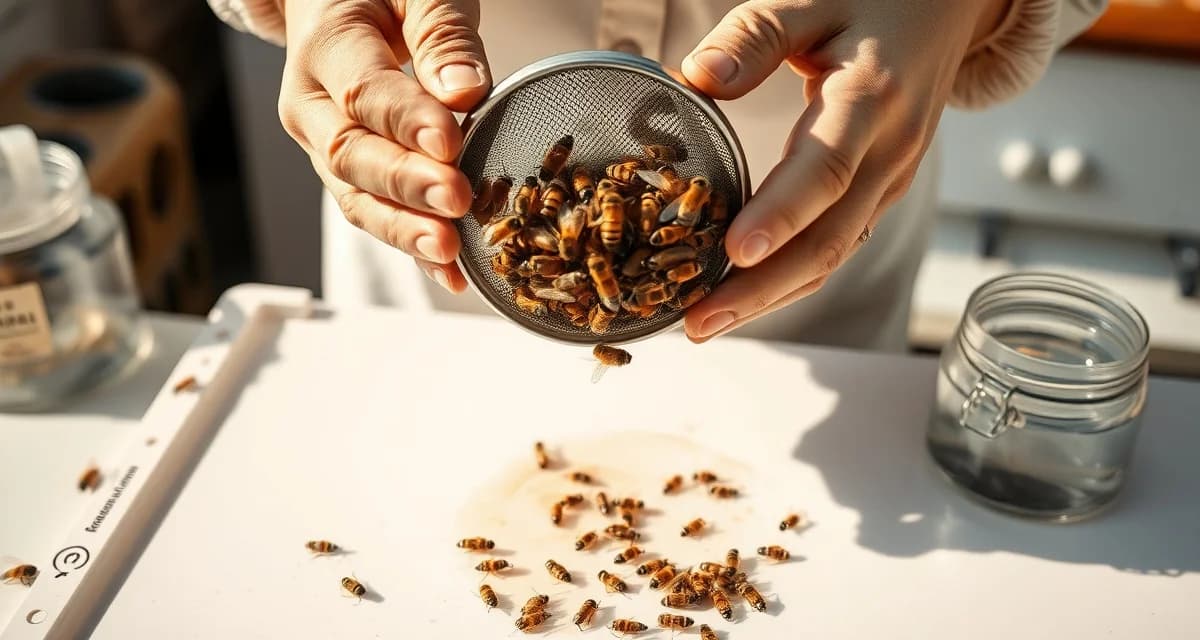
Pour the alcohol through the mesh lid into your white counting tray. The mesh catches bees; the alcohol and mites pass through.
Swirl the white tray gently. Varroa mites are reddish-brown oval shapes, 1-2mm long. They're visible to the naked eye on white background but easier to see clearly under modest magnification.
Count every mite. Don't rush, a careful count is worth taking.
Pour the remaining alcohol back through the mesh a second time to catch any mites still on the bee bodies or mesh.
Step 5: Calculate Infestation Rate
Mites counted ÷ bees in sample × 100 = infestation percentage
If you counted 300 bees and found 4 mites: 4 ÷ 300 × 100 = 1.3%
Compare to seasonal thresholds:
- 2%, treatment threshold for spring through summer
- 1%, treatment threshold for late summer through fall (pre-winter)
At 1.3% in August, you're above threshold. Treat.
At 1.3% in May, you're below threshold but monitor closely.
Step 6: Log Your Count
Write down: date, hive ID, method (alcohol wash), mite count, number of bees, and infestation rate.
Log it in VarroaVault and get an immediate threshold comparison for your current season.
Common Mistakes
Wrong sample frame: Forager bees have lower mite rates. Sample nurse bees from the brood nest.
Too few bees: Under 100 bees significantly reduces statistical reliability. Aim for 300.
Diluted alcohol: Use 70% isopropyl. Lower concentrations are less effective at dislodging mites.
Skipping the second pour: Some mites stick to bee bodies or mesh. Pour through a second time.
Related Articles
- How Many Bees Should I Use for a Mite Wash? Sample Size Explained
- Is Killing Bees for a Mite Wash Wrong? The Ethics and Practicalities
FAQ
How accurate is a mite wash?
Alcohol wash is the most accurate varroa counting method available. Studies show it detects 15-20% more mites than sugar roll. For threshold-level decisions, especially the tight 1% pre-winter threshold, alcohol wash is the only method with reliable enough accuracy.
What does 1% mite wash mean?
1% means 1 mite per 100 bees, or roughly 3 mites per 300-bee sample. In late summer (August-September), 1% is the treatment threshold, meaning you need to treat to protect your overwintering bee population. In spring, 1% is still below the 2% treatment threshold, but close enough to monitor weekly.
Can I do a mite wash without killing bees?
No, alcohol wash kills the sampled bees. About 300 bees (roughly 0.3% of a healthy 80,000-bee colony) is the cost. Sugar roll is non-lethal but less accurate. For critical threshold decisions, the accuracy tradeoff of alcohol wash is worth the small sample loss.
How soon after treatment can I run a post-treatment mite count?
Wait 2-4 weeks after the treatment ends before running a post-treatment count. Counting too soon (within a week of treatment removal) may show mites still dying or emerging from the last brood cycle. Waiting 2-4 weeks allows emerging bees from brood that was capped during treatment to fully emerge and any surviving mites to become detectable in a new count.
What should I do if my mite count results seem unusually high or low?
If results seem surprising, repeat the count within 1-2 weeks before making a treatment decision based on a single outlier result. Confirm you sampled from the brood nest center (not outer frames), used the correct sample size (approximately 300 bees), and shook vigorously for the full 60 seconds. Consistent sampling technique is the most important factor in count accuracy.
Can I count mites from a sticky board instead of doing an alcohol wash?
Sticky board counts measure mite fall rate over 24-72 hours, which correlates with infestation level but is not a direct measure of infestation percentage. Sticky board results cannot be converted to an accurate percentage without calibration, and they are less reliable than alcohol wash for treatment decisions. Use sticky boards for general population monitoring but rely on alcohol wash counts for threshold decisions.
What is How to Do a Mite Wash: Step-by-Step Instructions?
A mite wash is a hands-on beekeeping technique for accurately measuring varroa mite infestation levels in a hive. This step-by-step guide walks beekeepers through the full process: selecting the right frame, collecting a sample of approximately 300 bees, using 70% isopropyl alcohol to dislodge mites, and calculating your infestation percentage. It takes around 10 minutes and is considered 15–20% more accurate than a sugar roll method.
How much does How to Do a Mite Wash: Step-by-Step Instructions cost?
Performing a mite wash costs very little — most beekeepers spend under $10 on supplies. You'll need 70% isopropyl alcohol (around $3–5 at any pharmacy), a wide-mouth jar with mesh lid, a half-cup scoop, and a white tray for counting. These are reusable across many washes. Logging your results in VarroaVault is free, helping you track mite trends over the season without added expense.
Sources
- American Beekeeping Federation (ABF)
- USDA ARS Bee Research Laboratory
- Honey Bee Health Coalition
- Penn State Extension Apiculture Program
- Project Apis m.
Count With Confidence
A well-done mite wash gives you reliable data. Log your results in VarroaVault for automatic threshold comparison and treatment recommendations based on your count.
Get Started with VarroaVault
An alcohol wash gives you the number. VarroaVault turns that number into a decision. Log your count, get an instant threshold comparison, and build a monitoring history that shows you whether mite levels are rising or stable across your entire operation. See pricing and free tools at varroavault.com.