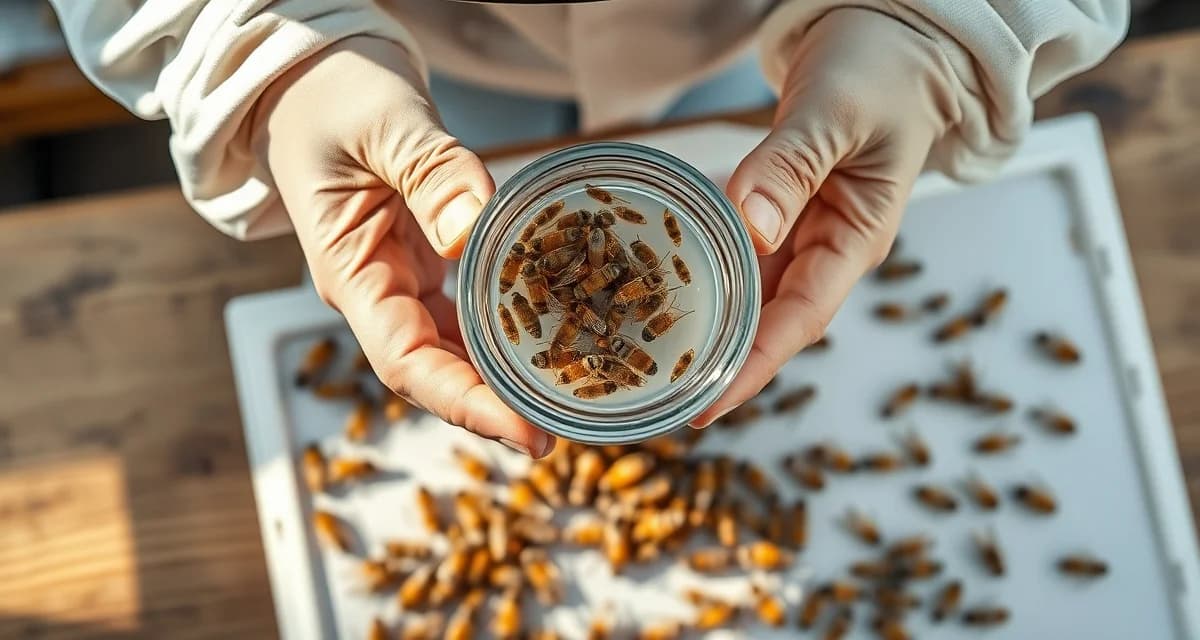
How to Calculate Varroa Mite Infestation Rate: Step-by-Step
The formula is simply this: mites found divided by bees washed, multiplied by 100, equals percent infestation. That's it. But getting that number right, and knowing what it means, is where most beekeepers need clarity.
This guide walks through the calculation, how to count bees accurately, what different percentages mean for your colony, and how VarroaVault calculates this automatically from your raw counts.
TL;DR
- This guide covers key aspects of how to calculate varroa mite infestation rate: step-by-step
- Mite monitoring should happen at minimum every 3-4 weeks during active season
- The 2% threshold in spring/summer and 1% in fall are standard action points based on HBHC guidelines
- Always run a pre-treatment and post-treatment mite count to calculate efficacy
- Treatment records including product name, EPA number, dates, and counts are required for state inspection compliance
- VarroaVault stores all monitoring and treatment data with automatic threshold comparison and state export formatting
Why the Percentage Matters More Than the Raw Count
Here's the mistake most newer beekeepers make: they count mites and compare numbers without accounting for sample size.
"I found 6 mites" doesn't tell you anything useful on its own. Six mites in a sample of 300 bees is 2% infestation, above threshold in most seasons. Six mites in a sample of 100 bees is 6% infestation, a serious emergency. Six mites in a sample of 600 bees is 1%, below threshold in spring and summer.
The raw count is meaningless without the denominator. Always calculate the percentage.
The Formula for Mite Infestation Rate
(Mites found ÷ Bees in sample) × 100 = % Infestation Rate
Worked examples:
- 6 mites ÷ 300 bees × 100 = 2.0%
- 3 mites ÷ 300 bees × 100 = 1.0%
- 9 mites ÷ 300 bees × 100 = 3.0%
- 4 mites ÷ 200 bees × 100 = 2.0%
- 0 mites ÷ 300 bees × 100 = 0% (great result, but verify with another count)
A simpler version of the math if you're always using a 300-bee sample: divide mites by 3 to get the percentage. (6 mites ÷ 3 = 2%.) This shortcut only works for the standard 300-bee sample size.
Step 1: Count Your Bees Accurately
You can have perfect math and a worthless result if your bee count is wrong. Here's how to get an accurate 300-bee sample.
Volume method: A half-cup (approximately 120mL) of adult nurse bees contains roughly 300 bees. This is the standard approach used by most beekeepers and recommended by the Honey Bee Health Coalition.
This assumes normal-sized bees (not bees that are artificially compressed or fluffed). Use a clean, wide-mouth jar or a commercial mite wash kit with volume markings.
Frame shake method: Shake bees from one frame into a container and count them visually in groups of 50 or 100 using a tally counter. More accurate than volume, but slower. Worth doing if you want to calibrate your volume estimates.
What to avoid:
- Don't sample from frames with the queen. You'll kill her
- Don't sample from honey frames where bees are older foragers
- Don't sample from the colony entrance. Foragers have lower mite loads
- Always sample from the edge of the brood nest where nurse bees are most concentrated
Step 2: Wash and Count Mites
For an alcohol wash:
- Transfer your bee sample into a jar with a mesh top
- Add enough 70% isopropyl alcohol or windshield washer fluid to fully submerge the bees
- Shake vigorously for 60 seconds
- Pour the liquid through the mesh into a white tray; retain the bees on the mesh
- Shake the liquid in the tray to disperse mites evenly
- Count all reddish-brown mite bodies you can see
Mites are small (about 1.6mm) and reddish-brown. They don't swim. They sink. In a clear tray with good light, they're visible without magnification, though a hand lens helps if your count is high.
For a sugar roll: same process, but use approximately 2 tablespoons of powdered sugar instead of alcohol. Shake for 60 seconds, sift through a mesh over a white tray, and count. Less accurate than alcohol wash but acceptable for monitoring.
Step 3: Calculate Your Infestation Rate
Once you have your mite count and bee count, apply the formula:
(Mites counted ÷ Bees in sample) × 100 = % Infestation
If you used the standard 300-bee sample, simply divide your mite count by 3.
Enter your results into the mite wash calculator. It takes your raw counts and outputs the percentage with seasonal threshold comparison automatically. Or log directly in VarroaVault's mite count entry field: enter mites found and bees sampled, and the infestation rate calculates and displays instantly.
Step 4: Interpret Your Result
Now that you have a percentage, here's what it means:
| Infestation Rate | Season | Status | Action |
|---|---|---|---|
| Below 1% | Spring | Excellent | Monitor monthly |
| 1-2% | Spring | Acceptable | Monitor closely; treat at 2% |
| 2%+ | Spring | At threshold | Treat now |
| Below 1% | Summer | Excellent | Monitor monthly |
| 1-2% | Summer | Monitor closely | Test every 2-3 weeks |
| 2%+ | Summer | At threshold | Treat now |
| Below 1% | Fall | Safe for winter | Optional OA dribble |
| 1%+ | Fall | At threshold | Treat now (critical window) |
| 2%+ | Fall | High risk | Treat urgently |
Sample Size and Statistical Accuracy
Here's something worth understanding: small samples have high error rates at low infestation levels.
At 0.5% infestation, a 300-bee sample statistically has about a 20% chance of returning a zero count (finding no mites even though they're present). At 1% infestation, a 100-bee sample has a 37% chance of returning zero mites.
This means:
- A zero-mite result doesn't mean zero mites in the colony
- Smaller samples are less reliable at low infestation rates
- Always use at least 200 bees; 300 is strongly preferred
If you get a zero count and you're suspicious, do a second sample from a different location in the brood nest. Two zero-count 300-bee samples from the same colony on the same day is much stronger evidence of very low mite levels.
What About Drone Brood Counts?
Some monitoring methods count mites in uncapped drone brood to detect mite presence early (before adult bee counts rise). This is useful for detecting varroa presence in a new colony but doesn't give you the same kind of actionable percentage as an adult bee wash.
Stick with adult bee alcohol wash for your primary monitoring. Drone brood inspection can be a supplemental early-detection tool, but your treatment threshold decisions should be based on adult bee counts.
Related Articles
- How to Do an Alcohol Wash Mite Count: Step-by-Step
- VarroaVault Treatment Reminder System: Never Forget a Protocol Step
FAQ
What is the formula for mite infestation rate?
(Mites found ÷ Bees in sample) × 100 = % infestation rate. For the standard 300-bee sample, this simplifies to: divide mites by 3. So 6 mites in a 300-bee sample equals 2% infestation. This percentage is what you compare against seasonal treatment thresholds, not the raw mite count.
How many bees should I use for an accurate count?
The standard and recommended sample size is 300 bees, which equals approximately half a cup by volume. A 300-bee sample provides good statistical accuracy at infestation rates above 1%. For very small spring colonies, 200 bees is acceptable; adjust your formula accordingly. Never use fewer than 100 bees for a treatment decision; the statistical error at that sample size is too high to be reliable.
How do I interpret my infestation percentage?
Compare your percentage to seasonal thresholds: 2% is the treatment threshold in spring and summer, 1% is the threshold in fall (when winter bees are being raised). A percentage below threshold means monitor and watch the trend. At or above threshold means treat now. A zero result doesn't necessarily mean zero mites. It means your sample didn't detect them. If you get zero on a 300-bee sample, it's good news but worth confirming with another count in 2-3 weeks.
How do I know if my varroa treatment is working?
Run a mite count 2-4 weeks after the treatment ends and compare it to your pre-treatment count. The efficacy formula is: ((pre-count - post-count) / pre-count) x 100. A result above 90% indicates effective treatment. Results below 80% should trigger investigation for possible resistance, application error, or reinfestation. Log both counts in VarroaVault to track efficacy trends across treatment cycles.
How often should I check mite levels in my hives?
At minimum, once per month (every 3-4 weeks) during the active season. Increase to every 2 weeks when counts are near threshold or after a treatment to verify it worked. In fall, monitoring frequency matters most because the window to treat before winter bees are raised is narrow. VarroaVault's monitoring reminders can be set to your preferred interval for each apiary.
What records should I keep for varroa management?
Each record should include: date of count or treatment, hive identifier, monitoring method used, number of bees sampled, mites counted, infestation percentage, treatment product name and EPA registration number, dose applied, treatment start and end dates, and PHI end date. State apiarists typically expect this level of detail during inspections. VarroaVault captures all of these fields in a single log entry.
What is How to Calculate Varroa Mite Infestation Rate: Step-by-Step?
Calculating your varroa mite infestation rate means dividing the number of mites found in your sample by the number of bees washed, then multiplying by 100 to get a percentage. This guide walks beekeepers through each step of that process — from collecting an accurate bee sample to interpreting your result against standard action thresholds (2% in spring/summer, 1% in fall). It also explains how VarroaVault automates the calculation from your raw counts and stores records for treatment tracking and state compliance.
How much does How to Calculate Varroa Mite Infestation Rate: Step-by-Step cost?
Calculating your varroa mite infestation rate is completely free — the math itself requires only a sample jar, alcohol or powdered sugar, and a few minutes. VarroaVault's mite wash calculator and infestation percentage tools are available at no cost, allowing beekeepers to input raw counts and get instant results with automatic threshold comparisons. Paid tiers may unlock additional features like treatment history exports and state inspection formatting, but the core monitoring calculations are accessible to all users without a subscription.
Sources
- American Beekeeping Federation (ABF)
- USDA ARS Bee Research Laboratory
- Honey Bee Health Coalition
- Penn State Extension Apiculture Program
- Project Apis m.
Making the Math Easy
The mite wash calculator on the VarroaVault site takes your raw numbers and does all the math. Enter bees sampled and mites found; it outputs the percentage, the seasonal threshold comparison, and a treatment recommendation.
But you don't need a calculator to do this in the field. Practice the mental math: count your bees, count your mites, divide mites by bees, multiply by 100. After a few counts, it becomes second nature.
And once the percentage is in your head, log it. A number you counted but didn't record is useless data. The value of mite counts is in the trend over time, which only exists if you write every number down every time.
Get Started with VarroaVault
The information in this guide is most useful when you have your own mite count data to apply it to. VarroaVault stores every count, flags threshold crossings automatically, and builds the treatment history you need for state inspections and effective management decisions. See pricing and free tools at varroavault.com.