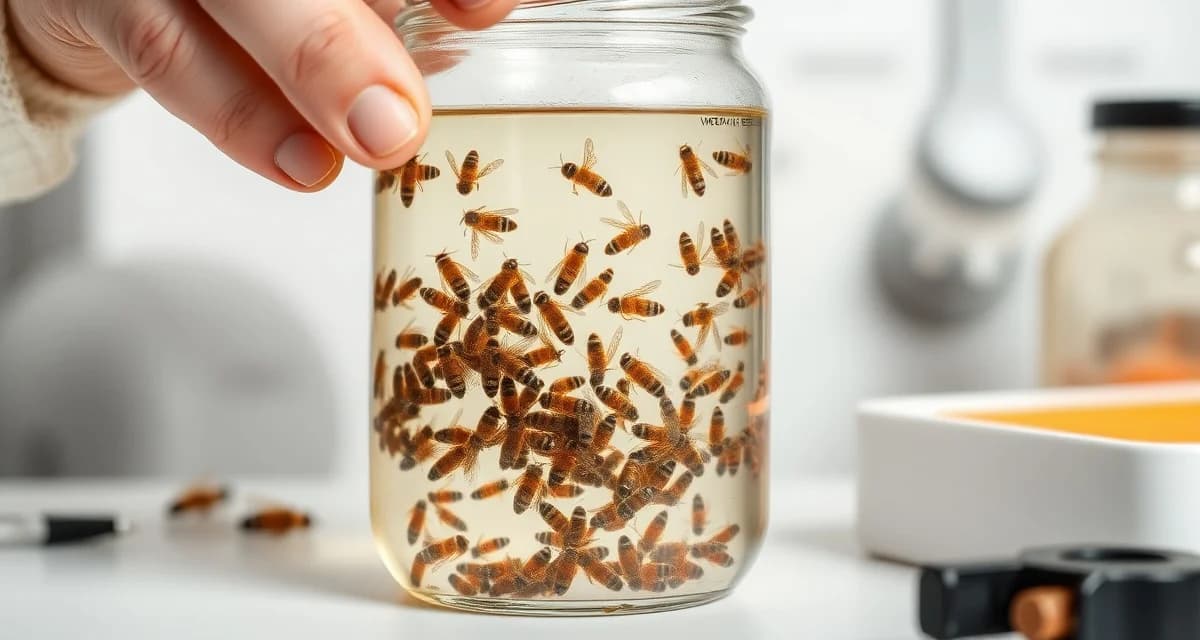
How to Do an Alcohol Wash Mite Count: Step-by-Step
alcohol wash is 15-20% more accurate than sugar roll for detecting varroa mites. If you're using sugar roll as your main monitoring method, you're probably underestimating your mite load.
I switched to alcohol wash after losing two colonies in back-to-back winters. My sugar roll counts were consistently showing me "safe" numbers while the actual infestation was higher. The sugar roll is easier on the bees but it's easier on the mite count too, and not in a good way.
Here's how to do an alcohol wash correctly, what your results mean, and what to do once you have a number.
TL;DR
- The alcohol wash is 15-20% more accurate than the sugar roll method for varroa monitoring
- Use a half-cup scoop (approximately 300 bees) from the center of the brood nest for a valid sample
- Shake with 70% isopropyl alcohol for 30 seconds, rest, then shake again for 30 seconds
- Formula: (mites counted / bees sampled) x 100 = infestation percentage
- A result of 2% or above in spring/summer and 1% or above in fall signals a treatment decision
- Log results in VarroaVault for automatic threshold comparison and trend tracking
What You Need
- A wide-mouth jar with a lid (Mason jar works perfectly)
- A second container with a fine mesh or paint strainer lid
- 70% isopropyl alcohol (rubbing alcohol), about 100-150ml per sample
- A scoop or measuring cup that holds roughly 100-300 bees (about 1/2 cup)
- A white tray or white paper for counting
- A spray bottle with water (optional, for rinsing)
Some beekeepers use commercial mite wash kits, BeeVital and others make purpose-built containers with mesh lids. They work well if you do counts regularly.
Step 1: Choose the Right Frame to Sample
You want nurse bees, young bees that spend time in the brood nest. They carry a higher mite load than forager bees. Foragers have lower mite rates because they've been away from the brood nest.
Find a frame of open brood and capped brood in the center of the brood nest. The bees on this frame are predominantly nurse bees. Don't sample from a frame of only capped honey or the outer edges of the box.
Shake or brush the bees off this frame into your collection container. Work quickly and collect from the same frame.
Don't sample in front of the hive entrance. You'll get forager bees returning from the field, and your count will come out artificially low.
Step 2: Collect Approximately 300 Bees
A standard alcohol wash sample is 300 bees. That's roughly 1/2 cup by volume, or about 100ml of bees loosely packed. Some protocols use 100 bees for a quick count, in that case multiply your mite count by 3 to get the per-300 rate, then divide by 3 for infestation percentage.
Getting exactly 300 bees isn't critical. Getting close matters. Most experienced beekeepers scoop their half-cup and get 250-350 bees. It's enough for a reliable result.
Make sure you haven't scooped the queen. Check before you wash. If you're not sure, spot her on the frame before you pull bees. Losing a queen to an alcohol wash is an expensive monitoring mistake.
Step 3: Add Alcohol and Agitate
Pour roughly 100-150ml of isopropyl alcohol over the bees in the jar. Enough to cover them.
Close the lid and shake vigorously for 30 seconds. The alcohol dislodges mites from the bees' bodies. Then shake for another 30 seconds, you want good contact time.
Some protocols recommend a 1-minute shake followed by a 30-second rest and another shake. The goal is dislodging all attached mites.
Step 4: Strain and Count
Pour the alcohol-and-bee mixture through your mesh lid into the white tray or white container. The alcohol and mites pass through; the bees stay in the mesh.
Swirl the white tray. Varroa mites are reddish-brown, roughly 1-2mm oval shapes. They're visible with naked eyes but easier to count on a white background.
Count every mite you see. Take your time, some beekeepers use a magnifier for the first few counts until they're confident in identification.
Pro tip: Pour the strained alcohol through the mesh again into another container, then rinse the bees with a small amount of clean alcohol or water. This catches mites that may have stuck to the bee bodies or the mesh.
Step 5: Calculate Your Infestation Rate
Divide the number of mites by the number of bees, then multiply by 100.
Example: 6 mites ÷ 300 bees × 100 = 2% infestation rate
| Mites per 300 bees | Infestation Rate | Status |
|-------------------|-----------------|--------|
| 0-1 | 0-0.3% | Low |
| 2-3 | 0.7-1% | Monitor closely |
| 4-6 | 1.3-2% | Treatment threshold (pre-winter) |
| 6-9 | 2-3% | Treatment threshold (spring/summer) |
| 10+ | 3.3%+ | High, treat immediately |
The seasonal thresholds are:
- 2% before and during honey flow (spring/summer)
- 1% going into winter prep (late summer/fall)
If you're at or above threshold, don't wait.
Step 6: Log Your Count and Take Action
Write down the date, hive number, frame sampled, mite count, and calculated rate. This data is worthless if it's on a paper that gets lost in the truck.
BeeKeepPal will let you log a count, but it won't analyze whether that count triggers a treatment need. VarroaVault compares your count against the seasonal threshold automatically and tells you whether to treat, watch, or wait, and if treatment is needed, which options work in your current conditions.
This is the part most apps skip. Getting the number is step one. Acting on the number is step two. VarroaVault closes that loop.
Common Mistakes to Avoid
Using forager bees. Foragers have naturally lower mite rates. You'll get a count that makes your hive look healthier than it is.
Sample size too small. Counting 50 bees and extrapolating is much less reliable than 300. If you only have 100, fine, just note that and account for the wider margin of error.
Diluted alcohol. Anything below 60% isopropyl is less effective at dislodging mites. Use 70% rubbing alcohol. Don't use wine or beer (yes, some people try this, it doesn't work reliably).
Counting at the wrong time of year. Mite counts are less reliable when brood is minimal or absent. In a broodless period, most mites are phoretic on adult bees, so counts will look deceptively low, or deceptively high if you want to assess total mite load before treatment.
Sampling the same hive at the same time of day. Forager bees leave and return. Counts taken mid-afternoon may have fewer nurse bees if conditions vary. Sample in mid-morning for consistency.
Related Articles
- When to Apply a Second Varroa Treatment: Post-Count Decision Guide
- Sugar Roll Accuracy: How Reliable Is It Compared to Alcohol Wash?
FAQ
How many bees do I need for an alcohol wash?
The standard is 300 bees (approximately 1/2 cup by volume). This gives you a statistically reliable sample. You can work with 100 bees if the colony is small, but your results will be less precise. Multiply your mite count by 3 to normalize to a per-300 basis, then calculate percentage as normal.
What is a normal mite count from an alcohol wash?
A count under 1% (under 3 mites per 300 bees) is considered low. Between 1-2% requires attention, especially in late summer. Above 2% during active brood season, or above 1% heading into fall, triggers the treatment threshold used by most extension programs. There's no universally "normal", it depends on time of year and what action threshold you're working against.
Can I use a sugar roll instead of alcohol wash?
You can, but the sugar roll is less accurate, studies show it detects 15-20% fewer mites than alcohol wash because mites can hold on through the rolling motion. Sugar roll lets the bees live, which feels better, but if your count comes back under threshold and you chose sugar roll, there's meaningful uncertainty in that result. For critical counts, pre-winter, post-treatment verification, use alcohol wash.
Can I do an alcohol wash without killing the queen?
Yes, but you need to locate the queen before collecting your sample. Find her on the frame, set that frame aside, then shake or brush bees from the remaining frames into your collection jar. The queen is the only bee you need to actively protect; all other bees in the sample do not survive the alcohol wash.
Is 91% isopropyl alcohol better than 70% for an alcohol wash?
Not necessarily. Higher concentration alcohol (90%+) can cause bees to contract tightly, making it harder for mites to dislodge from body segments. Standard 70% isopropyl alcohol (rubbing alcohol) is the recommended concentration for consistent mite release and easy counting. It is also less expensive and widely available.
How do I know if my 300-bee sample is accurate enough?
A loose half-cup scoop from the brood nest is a reliable way to collect approximately 300 bees. If your count results in a very small number of mites (1-2) at the border of your threshold, a larger sample or a second count from a different hive location can improve confidence. For clear results -- well above or well below threshold -- a single 300-bee sample is statistically sufficient.
What is How to Do an Alcohol Wash Mite Count: Step-by-Step?
An alcohol wash mite count is a highly accurate method for detecting varroa mite infestations in a honeybee colony. The process involves collecting roughly 300 bees from the brood nest, shaking them in 70% isopropyl alcohol for 30 seconds, resting, then shaking again. The mites detach and sink, allowing you to calculate an infestation percentage. It is 15–20% more accurate than the sugar roll method, making it the preferred choice for reliable monitoring and treatment decisions.
How much does How to Do an Alcohol Wash Mite Count: Step-by-Step cost?
Performing an alcohol wash mite count is essentially free beyond a few inexpensive supplies you likely already have: a wide-mouth Mason jar, a lid, and 70% isopropyl alcohol available at any pharmacy for a few dollars. The bees used in the sample are sacrificed, but the cost is minimal—around 300 bees—compared to the risk of missing a dangerous mite load. There is no charge to log and track your results in VarroaVault.
Sources
- American Beekeeping Federation (ABF)
- USDA ARS Bee Research Laboratory
- Honey Bee Health Coalition
- Penn State Extension Apiculture Program
- Project Apis m.
One Number That Changes Everything
A mite count takes about 10 minutes. The information it gives you is the difference between a colony alive in March and a dead-out you're trying to explain.
Log your count in VarroaVault and get an immediate read on where you stand against threshold, and what to do next.
Get Started with VarroaVault
An alcohol wash gives you the number. VarroaVault turns that number into a decision. Log your count, get an instant threshold comparison, and build a monitoring history that shows you whether mite levels are rising or stable across your entire operation. See pricing and free tools at varroavault.com.