Mite Alcohol Wash Step-by-Step: Video Walkthrough and Logging Guide
Beekeepers who complete a guided first alcohol wash have a 78% higher rate of adopting regular mite monitoring. The barrier to starting isn't the wash itself. It's not knowing what to expect your first time through it. This guide eliminates that uncertainty by walking you through the exact sequence, with prompts for what to look for at each step.
Open VarroaVault on your phone before you start. You'll log your count at the moment you count it.
TL;DR
- The alcohol wash is 15-20% more accurate than the sugar roll method for varroa monitoring
- Use a half-cup scoop (approximately 300 bees) from the center of the brood nest for a valid sample
- Shake with 70% isopropyl alcohol for 30 seconds, rest, then shake again for 30 seconds
- Formula: (mites counted / bees sampled) x 100 = infestation percentage
- A result of 2% or above in spring/summer and 1% or above in fall signals a treatment decision
- Log results in VarroaVault for automatic threshold comparison and trend tracking
What You Need
Gather these before going to the hive:
- Wide-mouth Mason jar (32oz or 16oz) with a mesh screen insert lid (sold at beekeeping suppliers and online as "mite wash jar"). Alternatively, use a standard Mason jar with a piece of hardware cloth cut to fit and secured with a rubber band.
- 70% isopropyl alcohol (standard rubbing alcohol from any drugstore). Fill a small squeeze bottle or bring the full bottle.
- White mixing bowl or tray (a white plastic dishpan works perfectly; paint rollers pans too). You need white to see the reddish-brown mites.
- Magnifying glass or reading glasses (1.5-2x magnification makes counting significantly easier)
- Nitrile gloves (recommended; alcohol and mites on hands is unpleasant)
- VarroaVault on your phone, count log form open
Step 1: Open Your Hive and Find the Brood Nest
Suit up normally. Light your smoker if you use one. Open the outer cover and inner cover.
Find the brood nest: Look for the frames in the lower box with dense nurse bee coverage on both sides. The center of the brood nest typically shows the "football" pattern: a dense oval of tan/brown capped worker cells in the middle of the frame, surrounded by open cells with white C-shaped larvae at the edges.
This is where your sample comes from. The brood nest bees carry 3-4x more mites than foragers.
What you're looking at: Frame 4 or 5 of a 10-frame box in a typical active-season hive. Heavy, dark coverage on both sides is what you want.
Step 2: Check for the Queen
Before shaking any frame, look carefully at both sides for the queen. She's longer than workers, with a more tapered abdomen. She often moves differently from workers, more deliberately, and may have a small entourage of attendants facing her.
If she's on your selected frame, set it gently aside against the outside of the hive box and pick the adjacent frame instead. If you can't spot her, proceed carefully with a single firm shake (less likely to trap her than gentle brushing).
Step 3: Shake Bees Into Your Jar
Hold the selected frame horizontally over your open collection jar.
Execute one sharp, firm downward shake. Not a tap, not a wiggle. A real shake. The jar should come 4-6 inches below the frame and then stop abruptly as you pull back up.
You'll see bees fall into the jar. Nurse bees don't want to leave the brood frame; they require a harder shake than foragers.
How many bees? You want approximately 300. In a 32oz Mason jar, 300 bees is roughly 1/2 to 2/3 full. In a 16oz jar, they'll fill it more. With practice, you'll recognize the right volume by eye. For your first time, count out 100 bees and mark the jar level, then aim for 3x that level.
Not enough bees after one shake? Give the same frame a second shake, or move to the adjacent brood frame for additional bees. Aim for 300; anything above 200 gives acceptable accuracy.
Step 4: Add Alcohol
Put the mesh lid on the jar.
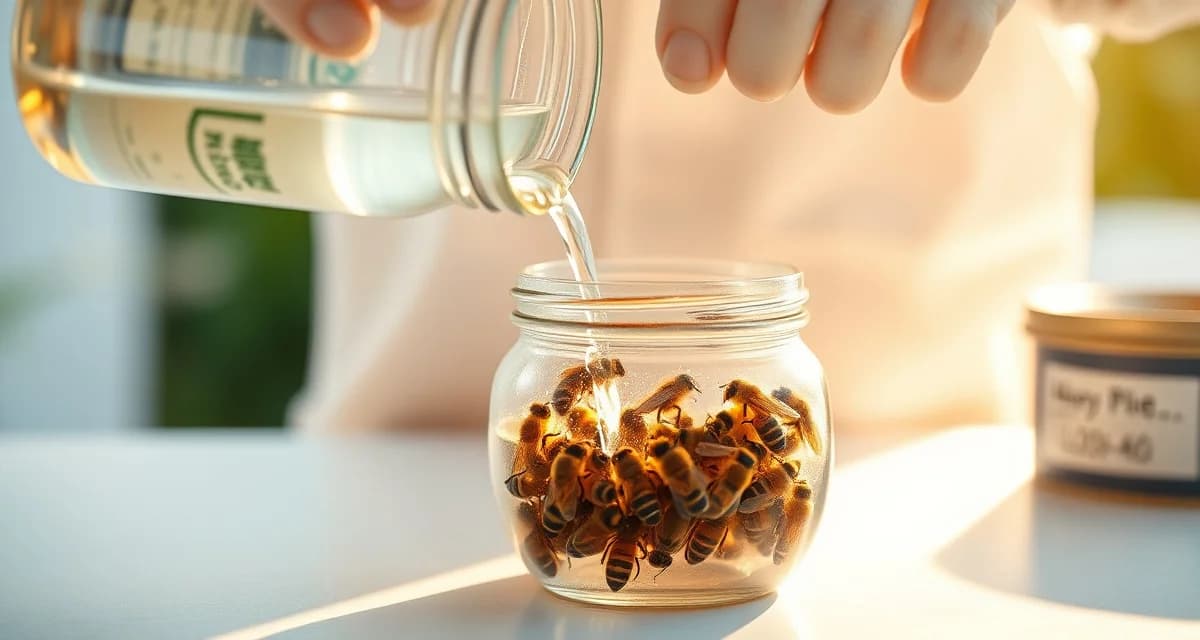
Add 70% isopropyl alcohol until the bees are fully submerged. You need enough to slosh through them during shaking. Roughly 1-1.5 cups (240-360ml) for a 32oz jar with 300 bees is about right.
What you'll see: Bees will immediately begin reacting to the alcohol. This is quick. You're not waiting; move immediately to the next step.
Step 5: Shake for 60 Seconds
With the mesh lid secured, shake the jar vigorously for 60 seconds. This is real shaking: think margarita shaker energy, not a gentle swirl.
Count to 60 while shaking. Most people underestimate how long 60 seconds is. Set a timer on your phone.
The shaking dislodges mites from the bees. Mites that have a firm grip require sustained agitation to release.
Step 6: Pour Into White Tray
Hold the jar over your white mixing tray and invert it slowly, mesh lid down. The alcohol (with the mites in it) will pour through the mesh into the tray. The bees stay in the jar, held back by the mesh.
Pour completely. Tip the jar all the way to drain the alcohol.
What you see in the tray: Murky brownish-yellow alcohol. Look carefully. You're looking for small, reddish-brown oval shapes on the white tray surface. These are your mites.
Step 7: Second Rinse
Add more alcohol to the jar with the bees and shake for 30 more seconds.
Pour this second rinse into the same white tray.
The second rinse is important: it catches mites that were wedged between bees during the first rinse. If you skip this step, your count will be understated.
Step 8: Count the Mites
Let the tray sit for 30-60 seconds as the mites settle. They'll appear as distinct small brown oval dots against the white background.
Counting tips:
- Move the tray near a light source or into direct sunlight
- Use your magnifying glass or readers
- Count by moving a finger or toothpick through the tray to separate counted from uncounted mites
- Count in a grid pattern (left to right, top to bottom) to avoid recounting
Count all mites from both rinses. Add them together.
Step 9: Calculate and Log in VarroaVault
Calculate the percentage:
Total mites ÷ 300 bees × 100
Example: 9 mites ÷ 300 × 100 = 3%
Log in VarroaVault right now, at the hive:
- Hive: select your hive name/ID
- Method: Alcohol Wash
- Sample size: 300 (or actual number if different)
- Mites counted: your count
- Sampling location: Brood nest
- Date: today
- Any notes (weather, whether bees seemed stressed, anything unusual)
VarroaVault calculates the percentage, compares it to your threshold, and updates your trend graph immediately. If you're above threshold, the hive card turns red on your dashboard.
This is the moment your data starts working for you. From this count forward, VarroaVault is tracking your trend and will alert you 14 days before your next projected threshold breach.
Step 10: Dispose and Clean Up
Pour the used alcohol into the ground away from the hive (not down the drain; it's a pesticide-used liquid). The dead bees can go in the compost or trash.
Rinse your jar and tray with clean water. The isopropyl residue cleans easily.
You're done.
Frequently Asked Questions
How do I perform an alcohol wash for the first time?
Collect approximately 300 nurse bees from the brood nest into a mesh-lid jar, add 70% isopropyl alcohol, shake for 60 seconds, pour the alcohol through the mesh into a white tray, and count the mites in the tray. Add more alcohol and repeat for a second rinse. Divide total mites by 300 and multiply by 100 for your percentage.
What does the mite count look like after an alcohol wash?
After pouring the alcohol wash through the mesh into a white tray, you'll see small reddish-brown oval dots against the white surface. They don't move (they're dead from the alcohol). In a healthy colony below threshold, you might see 3-6 mites in 300 bees (1-2%). In a colony above threshold, 9+ mites (3%+) is common.
Can I follow this guide and log at the same time in VarroaVault?
Yes. VarroaVault's mobile app count log is designed for field use. Open it before you start. Enter the sample size and method before shaking. After counting, enter the mite number and submit. The whole log entry takes about 30 seconds at the hive. Many beekeepers log between Steps 8 and 9 before moving to the next hive.
Can I do an alcohol wash without killing the queen?
Yes, but you need to locate the queen before collecting your sample. Find her on the frame, set that frame aside, then shake or brush bees from the remaining frames into your collection jar. The queen is the only bee you need to actively protect; all other bees in the sample do not survive the alcohol wash.
Is 91% isopropyl alcohol better than 70% for an alcohol wash?
Not necessarily. Higher concentration alcohol (90%+) can cause bees to contract tightly, making it harder for mites to dislodge from body segments. Standard 70% isopropyl alcohol (rubbing alcohol) is the recommended concentration for consistent mite release and easy counting. It is also less expensive and widely available.
How do I know if my 300-bee sample is accurate enough?
A loose half-cup scoop from the brood nest is a reliable way to collect approximately 300 bees. If your count results in a very small number of mites (1-2) at the border of your threshold, a larger sample or a second count from a different hive location can improve confidence. For clear results -- well above or well below threshold -- a single 300-bee sample is statistically sufficient.
What is Mite Alcohol Wash Step-by-Step: Video Walkthrough and Logging Guide?
This guide is a step-by-step walkthrough for performing an alcohol wash to monitor varroa mite levels in a beehive. It combines video instruction with a structured logging workflow using VarroaVault, making the process accessible for first-time users. The guide covers everything from equipment gathering to calculating your infestation percentage, and is designed to eliminate the uncertainty that stops many beekeepers from starting regular mite monitoring.
How much does Mite Alcohol Wash Step-by-Step: Video Walkthrough and Logging Guide cost?
The guide itself is free. You'll need basic supplies: a wide-mouth Mason jar with mesh lid, 70% isopropyl alcohol, a half-cup scoop, and a container for the bee sample. VarroaVault, the companion logging app referenced throughout, handles result tracking and threshold alerts. There are no paywalls to access the core walkthrough content.
How does Mite Alcohol Wash Step-by-Step: Video Walkthrough and Logging Guide work?
You collect approximately 300 bees (a half-cup scoop) from the center of the brood nest, shake them in 70% isopropyl alcohol for 30 seconds, let the sample rest, then shake again for 30 seconds. Mites detach and sink. You count the mites, divide by bees sampled, multiply by 100 to get an infestation percentage, then log the result in VarroaVault for automatic threshold comparison.
What are the benefits of Mite Alcohol Wash Step-by-Step: Video Walkthrough and Logging Guide?
Alcohol wash is 15-20% more accurate than sugar roll for varroa monitoring, giving you a more reliable picture of hive health. The structured logging workflow in VarroaVault means results are tracked over time, with automatic alerts when counts cross treatment thresholds of 2% in spring/summer or 1% in fall. Beekeepers who complete a guided first wash are 78% more likely to adopt regular monitoring.
Who needs Mite Alcohol Wash Step-by-Step: Video Walkthrough and Logging Guide?
Any beekeeper who wants to protect colony health through evidence-based varroa management. It's especially useful for beginners who feel uncertain about the process, but also valuable for experienced beekeepers looking to standardize their monitoring and logging. If you manage multiple hives or are trying to catch mite pressure before it reaches damaging levels, this guide gives you a repeatable, accurate method to do that.
Related Articles
- Is Killing Bees for a Mite Wash Wrong? The Ethics and Practicalities
- Sugar Roll Accuracy: How Reliable Is It Compared to Alcohol Wash?
Sources
- American Beekeeping Federation (ABF)
- USDA ARS Bee Research Laboratory
- Honey Bee Health Coalition
- Penn State Extension Apiculture Program
- Project Apis m.
Get Started with VarroaVault
An alcohol wash gives you the number. VarroaVault turns that number into a decision. Log your count, get an instant threshold comparison, and build a monitoring history that shows you whether mite levels are rising or stable across your entire operation. See pricing and free tools at varroavault.com.