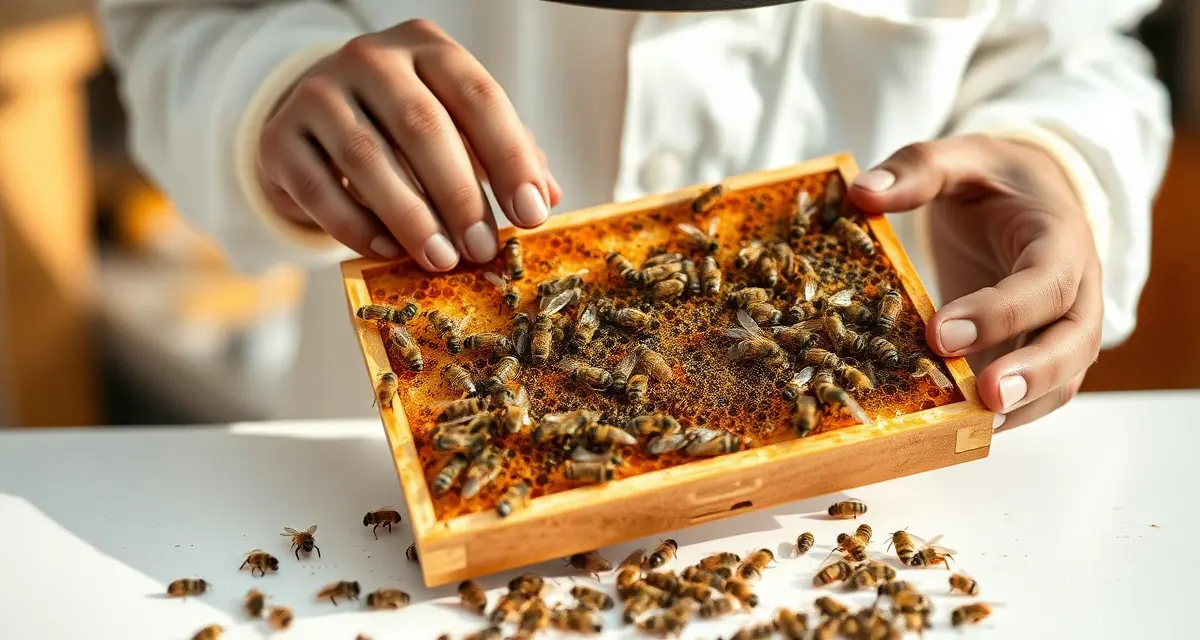
Varroa Mite Count Video Guide: Watch Before Your First Alcohol Wash
Beekeepers who watch a counting tutorial before their first count are 3x more likely to adopt regular monitoring. That uptake difference matters: beekeepers who count regularly are the ones who catch problems before they become colony losses. If you've never done an alcohol wash and aren't sure what to expect, this guide walks you through every step with the detail you need to do it right the first time.
TL;DR
- A valid mite count sample requires approximately 300 bees from the brood nest for statistically reliable results
- Alcohol wash is 15-20% more accurate than sugar roll for detecting mite infestation levels
- The calculation is: (mites counted / bees in sample) x 100 = infestation percentage
- A 2% threshold triggers treatment in spring/summer; 1% is the fall action threshold
- Count at least once per month during active season; increase to every 2 weeks if levels are near threshold
- Log every count in VarroaVault to build a trend dataset that shows whether populations are rising or stable
What You'll See in Your First Count
Before you start, it helps to know what a successful count looks like from beginning to end:
You're going to scoop about 300 bees into a jar of alcohol, shake them for a minute, drain the alcohol through a mesh screen onto a white surface, and count small reddish-brown specks. That's the complete process. It sounds simple because it is, once you've done it once.
What trips up first-timers is usually uncertainty: Am I collecting the right bees? How full should the jar be? What do the mites actually look like? This guide answers all of that.
What You Need Before You Start
The jar. A wide-mouth mason jar (quart or pint size) works well. You need a lid with mesh in it, fine enough to hold bees in but coarse enough to let liquid through. You can buy a purpose-built mite wash container from beekeeping suppliers, or you can make one by cutting a hole in a mason jar lid and gluing in a piece of window screen.
The alcohol. 70% isopropyl alcohol from any pharmacy. You need enough to fill the jar about halfway when you have 300 bees inside. A small flask or a spray bottle works for field use.
The counting surface. A white paper towel, a white plate, or a piece of white paper. Mites are reddish-brown and easy to see on white. They're almost invisible on brown or grey surfaces.
Your phone. For logging the result immediately in VarroaVault. Don't trust your memory.
PPE. Your normal beekeeping veil and gloves. You're opening the hive, so standard protection applies.
Step 1: Find the Right Frame
Open the hive. You're looking for a frame of capped brood with bees clustered on it. In the middle of the brood nest is where nurse bees concentrate, and nurse bees have the highest mite infestation rate.
Pull the second or third frame from the center of the brood area. It should have a mix of capped brood and nurse bees covering it. This is your sample frame.
Don't worry about finding the "perfect" frame. Any frame from the brood area with nurse bees on it gives you an accurate sample.
Step 2: Collect 300 Bees
Hold the jar upside down underneath the frame. Shake the frame with a firm, quick downward motion. Bees will fall into the jar. Cap it quickly.
How do you know if you have 300 bees? About half a cup by volume, or roughly filling 1/3 to 1/2 of a standard quart mason jar. You don't need to count exactly. 250-350 bees all give you a workable sample.
If you didn't get enough with one shake, hold the jar under the frame again and shake a second time. Then cap immediately.
The queen is almost never on a brood frame mid-hive during a routine inspection, but if you see her larger body shape in the jar, dump the bees back onto the frame and try again. You don't want to kill your queen.
Step 3: Add Alcohol and Shake
Add alcohol to the jar until the bees are submerged. About 1/2 cup is usually enough for a half-full quart jar.
Cap the jar securely. Shake vigorously for 60 seconds. You'll see the alcohol clouding as it picks up bee contents. This is normal.
The shaking dislodges mites from the bee bodies. The alcohol kills the bees. You're sacrificing about 300 bees for this count. That loss is a very small fraction of the colony population (a healthy colony has 20,000-60,000 bees) and is well worth the information you gain.
Step 4: Drain and Count
Hold the jar lid-down over your white surface. Pour slowly, letting the alcohol drain through the mesh and the bees stay inside. The mites wash through the mesh with the alcohol because they're small enough to pass through the screen openings.
Pour until most of the alcohol is drained. The mites appear on the white surface as small reddish-brown ovals, roughly the size of a medium-grain of sand. Count every one you can see. If there are more than 10-15, count in groups of five to keep track.
If you can't see any mites at all, your count is zero (or very close to zero).
Step 5: Calculate and Log
Divide your mite count by the number of bees you sampled. Multiply by 100.
Example: 9 mites, 300 bees = 9/300 x 100 = 3% infestation.
Open VarroaVault and log your count. Enter the hive ID, date, mite count, and sample size. The app calculates the percentage and compares it to your threshold setting. If you're at or above threshold, VarroaVault will recommend action.
What Your Count Result Means
0-1%: Good. Monitor monthly. No treatment needed now.
1-2%: Monitoring zone. Count again in 3 weeks to see if it's rising. If it's August or later, consider treating now even at this level given the approaching winter bee production window.
2-3%: At or above threshold depending on season and your specific threshold setting. Treatment warranted.
Above 3%: Treatment needed promptly. The higher the count, the more urgency.
Frequently Asked Questions
What do I need for my first mite count?
A wide-mouth mason jar with a mesh lid (purpose-built or homemade with window screen), 70% isopropyl alcohol, a white paper towel or plate for counting on, and your normal hive gear. A purpose-built mite wash kit from a beekeeping supplier is convenient if you plan to count regularly, but a mason jar setup works just as well. Bring your phone to log the result in VarroaVault immediately.
How long does my first mite count take?
Your first count will take 10-15 minutes as you work through each step carefully. Experienced beekeepers complete a count in under 5 minutes. The steps that take longest for beginners are finding a good sample frame (get comfortable and don't overthink this) and counting the mites (takes longer when you're new to what they look like). After 3-4 counts, the entire process from opening the hive to logged result takes less than 5 minutes.
Where do I log my count result in VarroaVault?
From the VarroaVault dashboard, tap the quick-entry button or go to Log Count in the hive record for the hive you just counted. Enter the mite count (raw number) and sample size. VarroaVault calculates the infestation percentage, compares it to your threshold, and updates your trend graph. Log it immediately at the hive before you do anything else, while the number is still in front of you.
How soon after treatment can I run a post-treatment mite count?
Wait 2-4 weeks after the treatment ends before running a post-treatment count. Counting too soon (within a week of treatment removal) may show mites still dying or emerging from the last brood cycle. Waiting 2-4 weeks allows emerging bees from brood that was capped during treatment to fully emerge and any surviving mites to become detectable in a new count.
What should I do if my mite count results seem unusually high or low?
If results seem surprising, repeat the count within 1-2 weeks before making a treatment decision based on a single outlier result. Confirm you sampled from the brood nest center (not outer frames), used the correct sample size (approximately 300 bees), and shook vigorously for the full 60 seconds. Consistent sampling technique is the most important factor in count accuracy.
Can I count mites from a sticky board instead of doing an alcohol wash?
Sticky board counts measure mite fall rate over 24-72 hours, which correlates with infestation level but is not a direct measure of infestation percentage. Sticky board results cannot be converted to an accurate percentage without calibration, and they are less reliable than alcohol wash for treatment decisions. Use sticky boards for general population monitoring but rely on alcohol wash counts for threshold decisions.
What is Varroa Mite Count Video Guide: Watch Before Your First Alcohol Wash?
This is a step-by-step video tutorial on VarroaVault designed to help beekeepers perform their first alcohol wash mite count correctly. It covers how to collect a valid 300-bee sample from the brood nest, calculate your infestation percentage, and interpret results. Beekeepers who watch a counting tutorial before their first attempt are three times more likely to adopt regular monitoring—making this guide a practical starting point for protecting colony health.
How much does Varroa Mite Count Video Guide: Watch Before Your First Alcohol Wash cost?
The Varroa Mite Count Video Guide on VarroaVault is completely free to access. There is no paywall or subscription required to watch the tutorial. VarroaVault also offers free mite count logging so you can track infestation trends over time. The goal is to remove every barrier between beekeepers and consistent varroa monitoring, since regular counting is one of the most cost-effective ways to prevent colony losses.
How does Varroa Mite Count Video Guide: Watch Before Your First Alcohol Wash work?
The guide walks you through an alcohol wash: you scoop approximately 300 bees from the brood nest into a jar of alcohol, shake to dislodge mites, then count the mites that settle. You divide mites counted by bees in the sample and multiply by 100 to get your infestation percentage. A result at or above 2% in spring or summer—or 1% in fall—signals that treatment is needed to protect the colony.
What are the benefits of Varroa Mite Count Video Guide: Watch Before Your First Alcohol Wash?
Watching this guide before your first count dramatically increases the likelihood you'll monitor consistently, and consistent monitoring is what prevents colony losses. Alcohol wash is 15–20% more accurate than sugar roll, so you get reliable data to act on. You'll also learn the correct treatment thresholds for each season and how to log results in VarroaVault to spot rising mite populations before they reach crisis levels.
Who needs Varroa Mite Count Video Guide: Watch Before Your First Alcohol Wash?
Any beekeeper preparing to do their first alcohol wash mite count will benefit from this guide. It's especially valuable for newer beekeepers who aren't sure what a valid sample looks like or how to calculate results. Experienced beekeepers switching from sugar roll to alcohol wash will also find it useful. If you manage multiple hives or have had unexplained losses, this guide provides the monitoring foundation needed to catch varroa problems early.
Related Articles
- When to Apply a Second Varroa Treatment: Post-Count Decision Guide
- Sugar Roll Accuracy: How Reliable Is It Compared to Alcohol Wash?
Sources
- American Beekeeping Federation (ABF)
- USDA ARS Bee Research Laboratory
- Honey Bee Health Coalition
- Penn State Extension Apiculture Program
- Project Apis m.
Get Started with VarroaVault
An alcohol wash gives you the number. VarroaVault turns that number into a decision. Log your count, get an instant threshold comparison, and build a monitoring history that shows you whether mite levels are rising or stable across your entire operation. See pricing and free tools at varroavault.com.