Is Killing Bees for a Mite Wash Wrong? The Ethics and Practicalities
alcohol wash kills 300 bees. Sugar roll does not. That difference bothers some beekeepers enough that they choose the sugar roll exclusively, even knowing it's less accurate. Whether that trade-off is worth making depends on understanding what the accuracy difference actually costs you and whether the ethical concern about killing 300 bees is proportionate to what's actually happening.
Killing 300 bees from a 50,000-bee colony represents 0.6% of the population, less than one minute of normal forager mortality.
TL;DR
- The alcohol wash is 15-20% more accurate than the sugar roll method for varroa monitoring
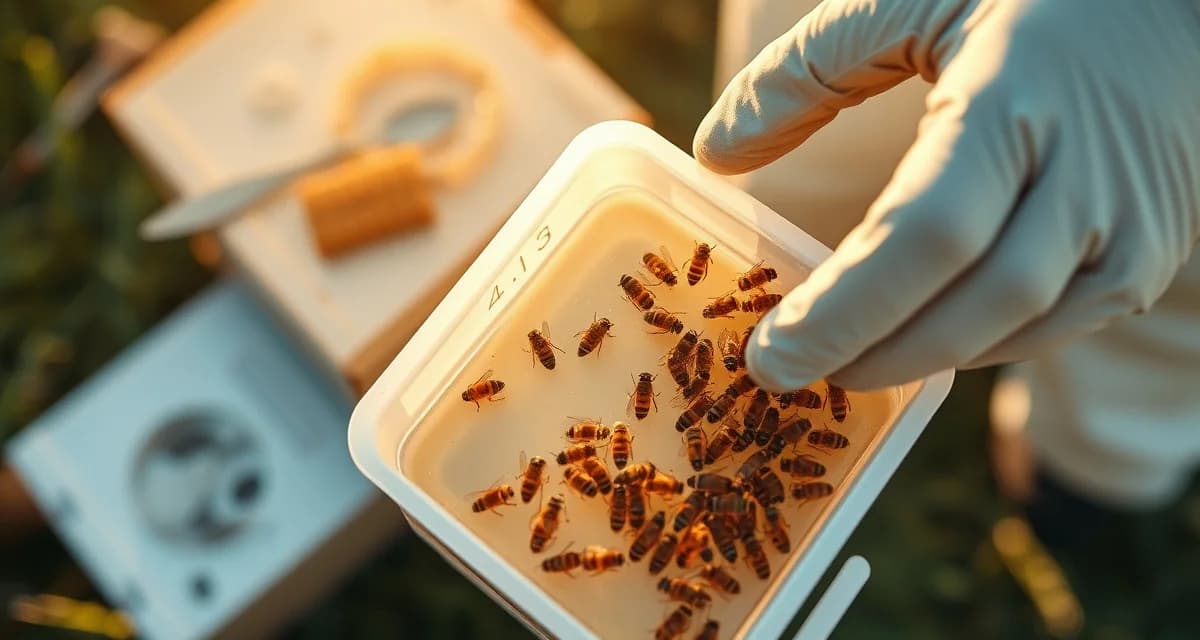
- Use a half-cup scoop (approximately 300 bees) from the center of the brood nest for a valid sample
- Shake with 70% isopropyl alcohol for 30 seconds, rest, then shake again for 30 seconds
- Formula: (mites counted / bees sampled) x 100 = infestation percentage
- A result of 2% or above in spring/summer and 1% or above in fall signals a treatment decision
- Log results in VarroaVault for automatic threshold comparison and trend tracking
The Scale of the Trade-Off
A summer honey bee colony loses hundreds of bees every day. Foragers die in the field regularly, from weather exposure, predation, pesticide contact, and exhaustion. A colony at full strength with active foraging may lose 1,000-2,000 bees per day during peak season.
The 300 bees you collect for an alcohol wash represent a mortality event smaller than what the colony experiences in a few minutes of normal forager activity. The bees you sample are nurse bees, not foragers, which means they're arguably further from natural mortality than the bees that die every hour in the field. But the numerical context is still relevant: 300 bees is not a meaningful fraction of a healthy colony.
The specific concern some beekeepers have is that nurse bees are "more important" than foragers because they tend brood and support colony function. This is true, and it's worth considering. But a colony with 50,000 bees has thousands of nurse bees. Removing 300 does not measurably change the colony's brood-care capacity. The hive replaces those bees through normal progression within hours to days.
The Accuracy Trade-Off
The ethical concern about alcohol wash becomes more complex when you consider what inaccurate monitoring costs.
Sugar roll has an efficacy rate of roughly 60-80% compared to alcohol wash. In practical terms, this means your sugar roll count regularly underestimates your true mite load. A colony at 3% infestation might return a sugar roll result of 1.8-2.4%. That difference is often the difference between treating and not treating.
Using an accuracy calculator, a sugar roll versus alcohol wash comparison at 2% infestation level:
- Alcohol wash result at 2% true infestation: approximately 2% (accurate)
- Sugar roll result at 2% true infestation: approximately 1.2-1.6% (underestimate)
If your threshold is 2%, a true 2% infestation returns a sugar roll count that suggests you're below threshold. You don't treat. The mite population continues to grow. By the next monitoring event, you're at 4% on an alcohol wash.
The 300 bees sacrificed for an accurate count are protecting the other 49,700 bees from the consequences of an inaccurate decision made on bad data.
When Sugar Roll Is Appropriate
Sugar roll still has legitimate uses:
Educational demonstrations: Sugar roll is much easier to show new beekeepers without handling alcohol. The method is a good teaching tool for a group visit or club event.
Very low threshold decisions: If you're monitoring a colony that's been well-managed and you expect counts far below threshold, a sugar roll gives you a reasonable indication that you're still in the clear. The accuracy problem matters most near the decision threshold.
Beekeepers with strong ethical objections: If killing bees for a count creates such a significant barrier that you'd rather not count at all, sugar roll is dramatically better than no monitoring. An imperfect count done regularly beats a perfect method that you never use.
Very small colonies and nucs: For a 2-frame nuc with 2,000 bees, killing 300 bees is a 15% mortality event. In this case, a sugar roll is genuinely more appropriate. VarroaVault's count entry lets you note the method used for each count.
The how to do a mite wash guide covers the full alcohol wash procedure. For a direct comparison of all monitoring methods including sticky boards, see our sugar roll instructions guide, which covers the sugar roll method alongside its accuracy limitations.
Frequently Asked Questions
Does an alcohol wash harm the colony?
In a colony of normal strength (20,000-60,000 bees), the loss of 300 nurse bees in an alcohol wash has no measurable effect on colony function, brood care, or population. The bees are replaced through normal progression within hours. Repeated counts across a season (4-6 per year) represent a total loss of 1,200-1,800 bees, well within the daily mortality range from normal forager activity.
Is killing bees for an alcohol wash ethical?
This is genuinely a question of values, and different beekeepers answer it differently. The practical consideration is that accurate monitoring prevents far more bee deaths than the 300 sacrificed for the count. A colony that crashes from undetected varroa loses tens of thousands of bees. The 300 bees in an accurate count are a proportionally tiny cost for information that protects the entire colony.
Can I get accurate results with a sugar roll to avoid killing bees?
Sugar roll returns results approximately 20-40% lower than the true infestation rate in most studies. For monitoring well below threshold (where you want confirmation you're at 0.5% when you're actually at 0.5%), it's adequate. Near the treatment threshold, that underestimation error leads to wrong treatment decisions. If accuracy near threshold matters, alcohol wash is the appropriate method. If you choose sugar roll, use a lower intervention trigger (for example, treat at 1.5% on sugar roll to account for the typical underestimate).
Can I do an alcohol wash without killing the queen?
Yes, but you need to locate the queen before collecting your sample. Find her on the frame, set that frame aside, then shake or brush bees from the remaining frames into your collection jar. The queen is the only bee you need to actively protect; all other bees in the sample do not survive the alcohol wash.
Is 91% isopropyl alcohol better than 70% for an alcohol wash?
Not necessarily. Higher concentration alcohol (90%+) can cause bees to contract tightly, making it harder for mites to dislodge from body segments. Standard 70% isopropyl alcohol (rubbing alcohol) is the recommended concentration for consistent mite release and easy counting. It is also less expensive and widely available.
How do I know if my 300-bee sample is accurate enough?
A loose half-cup scoop from the brood nest is a reliable way to collect approximately 300 bees. If your count results in a very small number of mites (1-2) at the border of your threshold, a larger sample or a second count from a different hive location can improve confidence. For clear results -- well above or well below threshold -- a single 300-bee sample is statistically sufficient.
What is Is Killing Bees for a Mite Wash Wrong? The Ethics and Practicalities?
The alcohol wash mite test involves sacrificing approximately 300 bees from your colony to accurately measure varroa mite infestation levels. While this sounds concerning, those 300 bees represent just 0.6% of a 50,000-bee colony — less than one minute of normal daily forager losses. This article examines whether that trade-off is ethically justified and how it compares to the less lethal but less accurate sugar roll method.
How much does Is Killing Bees for a Mite Wash Wrong? The Ethics and Practicalities cost?
There is no cost to performing a mite wash beyond basic supplies: a jar, 70% isopropyl alcohol, and a half-cup scoop. The alcohol wash is a DIY diagnostic technique any beekeeper can do at home for under a few dollars. The real 'cost' this article addresses is the ethical weight of sacrificing 300 bees — and whether that cost is proportionate given the survival benefit to the remaining colony.
How does Is Killing Bees for a Mite Wash Wrong? The Ethics and Practicalities work?
Scoop approximately 300 bees (a half-cup) from the center of the brood nest where nurse bees concentrate. Add 70% isopropyl alcohol to the jar, shake for 30 seconds, rest, then shake again for 30 seconds. Count the dislodged mites, then calculate: (mites ÷ bees sampled) × 100. A result of 2% or higher in spring/summer, or 1% or higher in fall, signals that treatment is needed.
What are the benefits of Is Killing Bees for a Mite Wash Wrong? The Ethics and Practicalities?
The alcohol wash is 15–20% more accurate than the sugar roll, making it the most reliable varroa diagnostic available to hobbyist beekeepers. That accuracy advantage translates directly into better treatment timing decisions. Treating too late because of a falsely low sugar roll result can cost an entire colony — thousands of bees. From a utilitarian standpoint, sacrificing 300 bees to save 50,000 is a strongly positive outcome for colony welfare.
Who needs Is Killing Bees for a Mite Wash Wrong? The Ethics and Practicalities?
Any beekeeper managing colonies should understand this trade-off, but it is especially relevant for those who have been avoiding the alcohol wash for ethical reasons and relying solely on sugar rolls. If you are uncomfortable killing bees for testing, this article helps you make an informed choice by quantifying exactly what the accuracy difference costs your colony — and whether the ethical concern scales appropriately with the actual biological impact.
Related Articles
Sources
- American Beekeeping Federation (ABF)
- USDA ARS Bee Research Laboratory
- Honey Bee Health Coalition
- Penn State Extension Apiculture Program
- Project Apis m.
Get Started with VarroaVault
An alcohol wash gives you the number. VarroaVault turns that number into a decision. Log your count, get an instant threshold comparison, and build a monitoring history that shows you whether mite levels are rising or stable across your entire operation. See pricing and free tools at varroavault.com.