How Many Bees Should I Use for a Mite Wash? Sample Size Explained
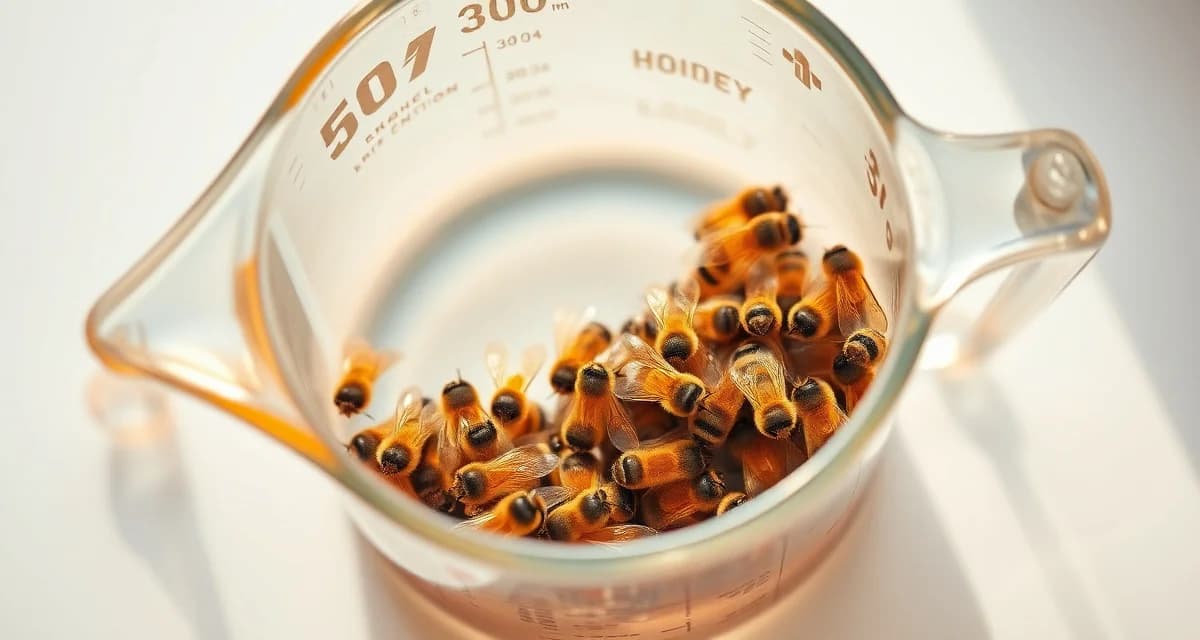
The standard sample size is 300 bees. That's roughly half a cup by volume. It's not an arbitrary number. The 300-bee sample was established because it's the minimum sample size at which the statistical error in your count result is small enough to make reliable threshold decisions.
Sampling 100 bees instead of 300 increases count variance by 73%, which means threshold decisions based on a 100-bee sample are unreliable. You might get a 1% result when the true infestation is 2.5%. Or you might get a 2% result from a colony that's actually at 0.8%. At those error levels, you're essentially guessing whether to treat.
TL;DR
- A valid mite count sample requires approximately 300 bees from the brood nest for statistically reliable results
- alcohol wash is 15-20% more accurate than sugar roll for detecting mite infestation levels
- The calculation is: (mites counted / bees in sample) x 100 = infestation percentage
- A 2% threshold triggers treatment in spring/summer; 1% is the fall action threshold
- Count at least once per month during active season; increase to every 2 weeks if levels are near threshold
- Log every count in VarroaVault to build a trend dataset that shows whether populations are rising or stable
The Statistics Behind 300 Bees
Mite monitoring is a sampling problem. You're taking a small sample from a large population and using it to estimate the true infestation rate. The accuracy of that estimate depends on sample size.
Statistical sampling theory tells us that error decreases as sample size increases, but with diminishing returns at larger samples. The Honey Bee Health Coalition and the research community converged on 300 bees as the point where:
- The statistical error is acceptably small for threshold decisions
- The sample is still manageable to collect in the field
- The number of bees lost represents a negligible proportion of the colony (0.6% or less of a full-strength colony)
A 300-bee sample gives you approximately ±1% accuracy at 95% confidence in most practical infestation scenarios. A 100-bee sample gives you approximately ±1.7% accuracy at the same confidence level. At 1.7% accuracy, a colony at threshold (2%) could plausibly test anywhere from 0.3% to 3.7%. That's not a useful measurement for decision-making.
What a Half Cup Looks Like in Practice
"Approximately 300 bees" sounds precise, but you're not counting them individually. You're estimating by volume. A half cup (approximately 120ml) of adult honey bees is close to 300 bees for a typical summer bee population.
Some beekeepers use a commercial mite wash container with a marked fill line at the half-cup level. Others use a mason jar and measure half a cup. The size of the bees varies slightly by season and colony genetics, which is why VarroaVault's count entry allows you to enter the actual number of bees rather than just mites found. If you collected 250 bees instead of 300, the percentage calculation adjusts accordingly.
Sampling Location Matters
Where you collect your bees from affects the accuracy of your sample as much as the quantity.
Best sampling location: Nurse bees from the brood-pollen interface of the brood nest. Nurse bees have the highest mite load because mites prefer to associate with nurse bees, which have predictable access to brood cells. Sampling nurse bees from the brood area gives you the highest and most consistent mite estimate.
Avoid: Entrance foragers, bees from honey frames, and bees from the top of the cluster in winter. Forager bees have lower mite loads because mites prefer the brood nest environment. Sampling foragers systematically underestimates your true infestation rate.
How to sample nurse bees: Find a frame at the edge of the brood area where nurse bees are clustered and working capped brood and open cells. Shake or brush bees from this frame into your collection jar. Avoid including the queen. If she falls in, release her before adding the alcohol.
What If You Can Only Get 200 Bees?
Sometimes a smaller colony, a nuc, or a difficult sampling situation means you can only collect 150-200 bees. Your count is still useful, but you should interpret it with awareness of the higher error margin.
If your 200-bee sample shows 3 mites, that's 1.5%. But the confidence interval at 200 bees is wider than at 300. That 1.5% result could reflect a true infestation of anywhere from 0.5% to 2.5% with reasonable probability. If you're near threshold, the right call with an undersized sample is to act as if you're above threshold, not to assume you're below it.
VarroaVault's mite count entry shows the confidence interval for counts under 300 bees, so you can see how much uncertainty your sample size introduces.
The mite wash calculator page handles the percentage calculation regardless of sample size. For a step-by-step guide to the full alcohol wash method, see our how to do a mite wash guide.
Frequently Asked Questions
Why is 300 bees the standard mite wash sample size?
300 bees is the minimum sample that produces statistically reliable threshold decisions. At 300 bees, count error is small enough (approximately ±1% at 95% confidence) to distinguish between above and below threshold in most practical situations. Smaller samples have wider error margins that can lead to incorrect treatment decisions. Larger samples are more accurate but harder to collect and represent a larger proportional loss from the colony.
What happens if I can only get 200 bees?
Your count is still useful, but interpret it conservatively. The error margin at 200 bees is approximately 1.7% instead of 1% at 300. If your 200-bee result is near threshold, treat as if you're above threshold rather than assuming you're below it. VarroaVault's count entry shows the confidence interval for your specific sample size, making the error margin visible rather than hidden.
Does VarroaVault adjust percentage calculations for sample sizes under 300?
Yes. VarroaVault's count entry accepts the exact number of bees sampled and calculates the precise infestation percentage based on your actual sample, not a fixed 300-bee assumption. For samples under 300, the system displays a confidence interval showing the possible range of true infestation given your sample size, helping you interpret near-threshold results appropriately.
How soon after treatment can I run a post-treatment mite count?
Wait 2-4 weeks after the treatment ends before running a post-treatment count. Counting too soon (within a week of treatment removal) may show mites still dying or emerging from the last brood cycle. Waiting 2-4 weeks allows emerging bees from brood that was capped during treatment to fully emerge and any surviving mites to become detectable in a new count.
What should I do if my mite count results seem unusually high or low?
If results seem surprising, repeat the count within 1-2 weeks before making a treatment decision based on a single outlier result. Confirm you sampled from the brood nest center (not outer frames), used the correct sample size (approximately 300 bees), and shook vigorously for the full 60 seconds. Consistent sampling technique is the most important factor in count accuracy.
Can I count mites from a sticky board instead of doing an alcohol wash?
Sticky board counts measure mite fall rate over 24-72 hours, which correlates with infestation level but is not a direct measure of infestation percentage. Sticky board results cannot be converted to an accurate percentage without calibration, and they are less reliable than alcohol wash for treatment decisions. Use sticky boards for general population monitoring but rely on alcohol wash counts for threshold decisions.
What is How Many Bees Should I Use for a Mite Wash? Sample Size Explained?
The standard mite wash sample size is 300 bees — roughly half a cup by volume. This number isn't arbitrary: it's the minimum required for statistically reliable results. Sampling fewer bees, such as 100, increases count variance by 73%, making threshold decisions unreliable. You could read 1% infestation when the true level is 2.5%, or vice versa — errors large enough to cause you to miss a treatment or treat unnecessarily.
How much does How Many Bees Should I Use for a Mite Wash? Sample Size Explained cost?
Mite washing itself requires only inexpensive household materials — a jar, rubbing alcohol or soapy water, and a mesh lid. There's no cost for the technique. VarroaVault offers free mite count logging so you can track trends over time. The real investment is your time: a proper 300-bee alcohol wash takes about 10 minutes per hive and should be done at least monthly during active season.
How does How Many Bees Should I Use for a Mite Wash? Sample Size Explained work?
Collect approximately 300 bees (half a cup) from the brood nest frames where mite loads are highest. Submerge them in alcohol or soapy water, agitate for 60 seconds, then count the mites that fall out. Divide mites by total bees and multiply by 100 to get your infestation percentage. Alcohol wash is 15–20% more accurate than sugar roll and is the recommended method for reliable threshold decisions.
What are the benefits of How Many Bees Should I Use for a Mite Wash? Sample Size Explained?
Using the correct 300-bee sample size gives you statistically valid infestation data, so treatment decisions are based on real numbers rather than guesswork. Reliable counts help you catch rising mite populations before they reach damaging levels, apply treatments at the right time, and avoid unnecessary chemical use. Logging results in VarroaVault builds a trend dataset that reveals whether your colony's mite load is stable, rising, or falling.
Who needs How Many Bees Should I Use for a Mite Wash? Sample Size Explained?
Any beekeeper who monitors Varroa mite levels needs to understand proper sample size. This is especially critical for newer beekeepers who may default to smaller, easier samples without realizing the statistical unreliability. It's also essential for anyone making treatment decisions near the 1–2% threshold, where count accuracy matters most. Even experienced beekeepers benefit from reviewing sample-size principles to ensure their monitoring data is actually actionable.
Sources
- American Beekeeping Federation (ABF)
- USDA ARS Bee Research Laboratory
- Honey Bee Health Coalition
- Penn State Extension Apiculture Program
- Project Apis m.
Get Started with VarroaVault
An alcohol wash gives you the number. VarroaVault turns that number into a decision. Log your count, get an instant threshold comparison, and build a monitoring history that shows you whether mite levels are rising or stable across your entire operation. See pricing and free tools at varroavault.com.