Mite Counts by Hive Strength: How Colony Size Affects Your Results
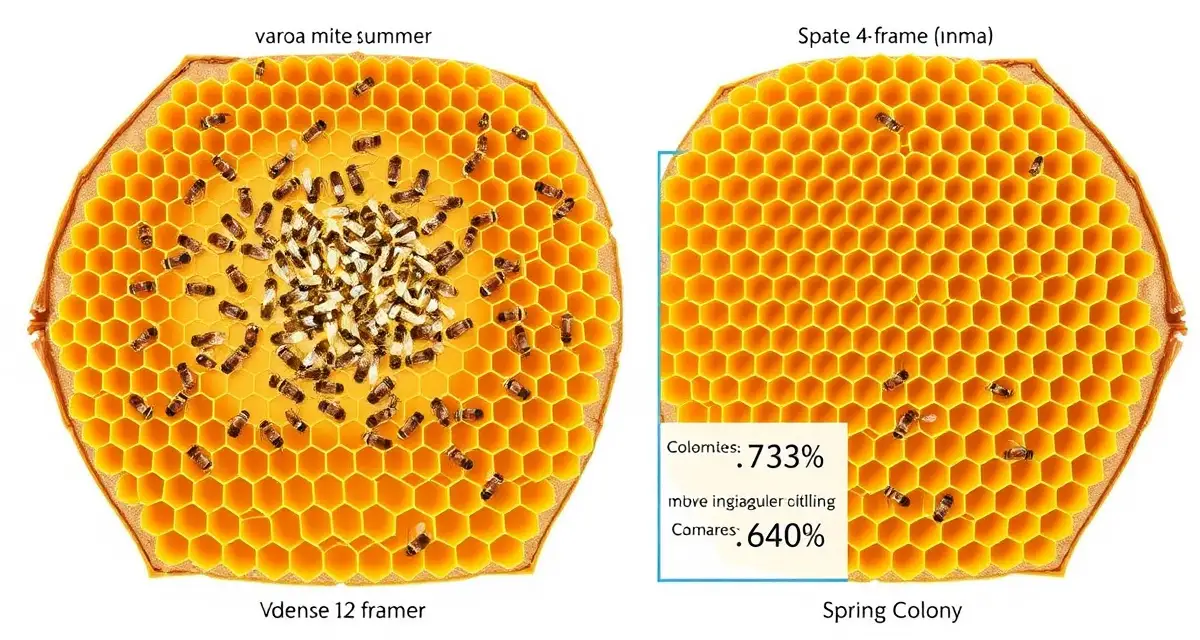
A 1% mite count in a 12-frame summer colony represents 3x as many mites as a 1% count in a 4-frame spring colony. Same percentage. Very different situations.
This is one of the most consistently misunderstood aspects of varroa mite count interpretation. Beekeepers learn the percentage thresholds, 2% in spring, 3% in summer, and apply them uniformly regardless of colony size. The problem is that percentage-based thresholds were calibrated for full-size colonies. They don't scale down cleanly to small populations.
Mite count by hive strength is more nuanced than a single table suggests. Here's how to think about it.
TL;DR
- A valid mite count sample requires approximately 300 bees from the brood nest for statistically reliable results
- alcohol wash is 15-20% more accurate than sugar roll for detecting mite infestation levels
- The calculation is: (mites counted / bees in sample) x 100 = infestation percentage
- A 2% threshold triggers treatment in spring/summer; 1% is the fall action threshold
- Count at least once per month during active season; increase to every 2 weeks if levels are near threshold
- Log every count in VarroaVault to build a trend dataset that shows whether populations are rising or stable
Why Colony Size Changes the Risk Picture
The percentage itself doesn't tell you the full story. Consider two colonies:
Colony A: 12 frames of bees (approximately 40,000 bees), 1% mite infestation. That's roughly 400 mites, distributed across a large population with strong brood production and a strong immune response.
Colony B: 4 frames of bees (approximately 12,000 bees), 1% mite infestation. That's roughly 120 mites, but in a colony with far less buffering capacity, fewer bees sharing the mite burden per capita, and less brood production to regenerate damaged bees.
Same percentage. But Colony B's mites are doing proportionally more damage because there are fewer healthy bees to absorb that damage.
The risk isn't just about absolute mite numbers, it's about the ratio of mite impact to colony resilience. And resilience scales with colony size.
How the Same Percentage Looks Different by Colony Size
| Colony Size | 1% Count = | Risk Interpretation |
|------------|-----------|-------------------|
| 3 frames (nuc) | ~36-45 mites | High risk, treat promptly |
| 6 frames (building colony) | ~72-90 mites | Moderate risk, monitor closely |
| 10 frames (full production) | ~120-150 mites | Standard summer threshold zone |
| 12+ frames (peak summer) | 144-180+ mites | Higher absolute number, stronger colony buffer |
Looking at this table, the nuance becomes clear: a nuc at 1% should trigger treatment consideration. A peak summer colony at 1% is below threshold. Same number, different response.
Why Does Colony Strength Matter for Mite Count Interpretation?
Colony strength affects mite count interpretation in three ways:
1. Total mite load. A larger colony at the same percentage has more total mites. More mites means more reproductive pressure and faster climb to critical loads if left untreated.
2. Colony buffering capacity. Large colonies can sustain some mite-damaged brood without the population declining. Small colonies have less redundancy, if mites damage 20% of the brood output, that's a more visible effect on overall population.
3. Speed of population decline. A colony at 3% in peak summer is usually safe for a few weeks. A nuc at 3% can collapse in that same window because population replacement capacity is far lower.
How VarroaVault Uses Colony Strength to Adjust Alerts
VarroaVault's colony strength at last inspection automatically adjusts the risk interpretation of your mite count result.
When you log a mite count, you also log the current colony strength, typically expressed as frames of bees or a size category (nuc, building colony, full colony). The system uses that recorded strength to:
- Adjust the threshold trigger: A count that's below threshold for a full colony may trigger an alert for a small colony
- Set the urgency level: A 2% count on a full summer colony gets a "monitor closely" rating; a 2% count on a nuc gets an "act promptly" rating
- Influence treatment recommendations: Smaller colonies have different treatment options and dosing considerations
This isn't a workaround, it's a more accurate representation of actual risk.
What Colony Strength Should I Record for Accurate Threshold Alerts?
Record your best estimate of frames of bees at the time of inspection. This doesn't need to be exact, a reasonable estimate is fine.
Guidelines:
- Nuc (3-5 frames of bees): Count individual frame coverage. A nuc is below 6 frames.
- Building colony (6-8 frames): Between nuc and full production
- Full colony (9-12 frames): Standard single-box production colony
- Strong colony (12+ frames): A two-box colony or an exceptional single-box
If you haven't done an inspection recently, use the most recent frame count in your records. VarroaVault carries forward the last recorded strength until you update it.
Practical Application: Reading Your Count in Context
When you get your mite count result, ask yourself two questions before deciding on a response:
1. What is the percentage? (The raw number)
2. What is the colony's current strength? (The context)
A 2% count in August in a full colony might mean: start thinking about the fall treatment window, it's approaching threshold and trending the right direction to treat in the next 2-3 weeks.
A 2% count in August in a 5-frame colony means: treat now, or this colony will not build sufficient winter population before the season ends.
Same percentage. Two different management responses.
Mite Count Accuracy and Colony Strength
There's also a practical accuracy issue. When you do an alcohol wash, you sample approximately 300 bees. In a small colony, 300 bees is a larger fraction of the total population than in a large colony.
In a nuc, sampling 300 bees might represent 2-3% of the adult bee population. In a large colony, 300 bees is under 1%. This doesn't invalidate the count, the method is still the gold standard, but it means that in very small colonies, the sample is a larger and more variable fraction of the whole.
For the mite count tracking system that keeps your full history and strength records organized, see the mite count tracking app. For the full threshold alert framework that explains how strength adjustments interact with seasonal thresholds, see the treatment threshold alerts guide.
Why does colony strength matter for mite count interpretation?
The same mite percentage represents different levels of risk depending on colony size. A 2% count in a 3-frame nuc means far fewer total mites but also far less colony resilience to absorb the damage, the colony has limited brood production to replace affected bees and less population buffer. A 2% count in a 12-frame summer colony is a higher absolute mite number but a colony with more buffering capacity. The percentage threshold tables that guide treatment decisions were calibrated for full-size colonies and don't scale directly to small populations.
How does VarroaVault use colony strength to adjust alerts?
When you log a mite count alongside a colony strength estimate, VarroaVault adjusts the threshold alert based on the combination of count percentage and colony size. A small colony triggers alerts at lower percentage thresholds than a full colony. The urgency level also adjusts, the same count percentage earns a more urgent response flag in a small colony than in a large one. The system uses the most recently recorded frame count unless you update it at the time of inspection.
What colony strength should I record for accurate threshold alerts?
Record your best estimate of frames of bees covered at the time of inspection. Nucs run 3-5 frames; building colonies 6-8 frames; standard production colonies 9-12 frames; strong two-box colonies 12+ frames. You don't need a precise count, a reasonable visual estimate captures the relevant size category for threshold adjustment. If you haven't inspected recently, use the last recorded frame count from your inspection history.
How soon after treatment can I run a post-treatment mite count?
Wait 2-4 weeks after the treatment ends before running a post-treatment count. Counting too soon (within a week of treatment removal) may show mites still dying or emerging from the last brood cycle. Waiting 2-4 weeks allows emerging bees from brood that was capped during treatment to fully emerge and any surviving mites to become detectable in a new count.
What should I do if my mite count results seem unusually high or low?
If results seem surprising, repeat the count within 1-2 weeks before making a treatment decision based on a single outlier result. Confirm you sampled from the brood nest center (not outer frames), used the correct sample size (approximately 300 bees), and shook vigorously for the full 60 seconds. Consistent sampling technique is the most important factor in count accuracy.
Can I count mites from a sticky board instead of doing an alcohol wash?
Sticky board counts measure mite fall rate over 24-72 hours, which correlates with infestation level but is not a direct measure of infestation percentage. Sticky board results cannot be converted to an accurate percentage without calibration, and they are less reliable than alcohol wash for treatment decisions. Use sticky boards for general population monitoring but rely on alcohol wash counts for threshold decisions.
FAQ
What is Mite Counts by Hive Strength: How Colony Size Affects Your Results?
Mite Counts by Hive Strength is a guide to interpreting varroa mite infestation percentages relative to your colony's actual population size. It explains why a 1% mite count in a large summer colony is far more dangerous than the same percentage in a small spring colony. Understanding this distinction helps beekeepers make smarter treatment decisions rather than applying one-size-fits-all thresholds that were originally calibrated for full-size colonies.
How much does Mite Counts by Hive Strength: How Colony Size Affects Your Results cost?
This is a free educational article published on VarroaVault. There is no cost to read it. VarroaVault offers free mite count logging tools alongside its content, so beekeepers can track trends over time without a paywall. Some advanced tracking or analytics features within the VarroaVault platform may require an account, but the core guidance on interpreting mite counts by colony size is freely accessible to all.
How does Mite Counts by Hive Strength: How Colony Size Affects Your Results work?
The approach works by factoring in colony frame count or estimated bee population when evaluating your mite percentage. You sample approximately 300 bees from the brood nest using an alcohol wash, calculate infestation percentage, then assess that figure against your colony's actual size. A 2% reading in a 4-frame nuc signals a very different mite load than 2% in a 12-frame colony, and treatment urgency is adjusted accordingly.
What are the benefits of Mite Counts by Hive Strength: How Colony Size Affects Your Results?
The primary benefit is more accurate treatment timing. By accounting for colony size, you avoid under-treating small colonies where standard percentage thresholds underestimate true risk, and you avoid over-treating large colonies unnecessarily. Secondary benefits include building a logged trend dataset in VarroaVault that reveals whether mite populations are rising or stabilizing, giving you predictive insight rather than reactive responses to individual counts.
Who needs Mite Counts by Hive Strength: How Colony Size Affects Your Results?
Any beekeeper managing colonies of varying sizes benefits from this approach, but it is especially critical for those running nucleus colonies, splits, or overwintered colonies with reduced populations. New beekeepers who have learned only the basic percentage thresholds will find this reframes their understanding significantly. Commercial and sideliner beekeepers managing mixed colony strengths throughout a season also benefit from applying size-adjusted interpretation consistently.
How long does Mite Counts by Hive Strength: How Colony Size Affects Your Results take?
The mite count itself takes roughly 10 to 15 minutes per hive using an alcohol wash. Interpreting results through a colony-strength lens adds minimal time — it mainly requires knowing your approximate frame count before evaluating the percentage. VarroaVault recommends counting at least monthly during the active season, increasing to every two weeks when counts approach threshold levels, so ongoing monitoring is a regular but manageable commitment.
What should I look for when choosing Mite Counts by Hive Strength: How Colony Size Affects Your Results?
Focus on sampling method accuracy first — alcohol wash is 15 to 20 percent more reliable than sugar roll and is the recommended technique. Ensure your sample genuinely contains around 300 bees from the brood nest area, not just house bees near the entrance. Record both your mite count and an honest frame estimate so your logged data remains comparable across inspections. Consistency in method matters more than occasional precision.
Is Mite Counts by Hive Strength: How Colony Size Affects Your Results worth it?
Yes. The standard percentage threshold approach is a useful starting point, but it fails to account for real differences in colony vulnerability based on population size. A small colony has less buffer against the same mite load that a large colony can temporarily sustain. Adjusting your interpretation to reflect hive strength makes your varroa management more responsive and accurate, reducing both colony losses from undertreating and unnecessary chemical interventions from overtreating.
Sources
- American Beekeeping Federation (ABF)
- USDA ARS Bee Research Laboratory
- Honey Bee Health Coalition
- Penn State Extension Apiculture Program
- Project Apis m.
Get Started with VarroaVault
An alcohol wash gives you the number. VarroaVault turns that number into a decision. Log your count, get an instant threshold comparison, and build a monitoring history that shows you whether mite levels are rising or stable across your entire operation. See pricing and free tools at varroavault.com.