How to Sample From the Brood Nest for the Most Accurate Varroa Count
Research shows brood nest samples have 95% sensitivity for threshold detection versus 60% for random hive body samples. That 35-percentage-point difference isn't marginal. It means that if you're sampling from the wrong location, you're making treatment decisions with unreliable data.
Here's exactly how to find the right frame, collect your sample, and use the result confidently.
TL;DR
- A valid mite count sample requires approximately 300 bees from the brood nest for statistically reliable results
- alcohol wash is 15-20% more accurate than sugar roll for detecting mite infestation levels
- The calculation is: (mites counted / bees in sample) x 100 = infestation percentage
- A 2% threshold triggers treatment in spring/summer; 1% is the fall action threshold
- Count at least once per month during active season; increase to every 2 weeks if levels are near threshold
- Log every count in VarroaVault to build a trend dataset that shows whether populations are rising or stable
Why the Brood Nest Is the Right Place to Sample
Phoretic varroa mites (the ones that are riding on adult bees and can be detected by a mite wash) are not distributed evenly across the colony. They concentrate where brood is, because their entire biology is oriented toward finding new brood cells to enter.
Nurse bees that tend brood cells are the highest-mite-load bees in the colony. They're in constant contact with the brood area, and phoretic mites hitch rides on them specifically because nurse bees are likely to re-enter brood cells. A 300-bee sample from the brood nest contains the representative mite load for treatment decisions.
A sample from the middle super, the honey frames, or the entrance collects bees that spend little time near the brood nest. These bees carry significantly fewer mites and produce counts that underestimate the true infestation.
How to Identify the Brood Nest
In a standard Langstroth hive:
- The brood nest is in the lower brood box (in a 2-box configuration)
- It's centered on the warmest frames, typically frames 3-7 of a 10-frame box (or frames 3-6 of an 8-frame box)
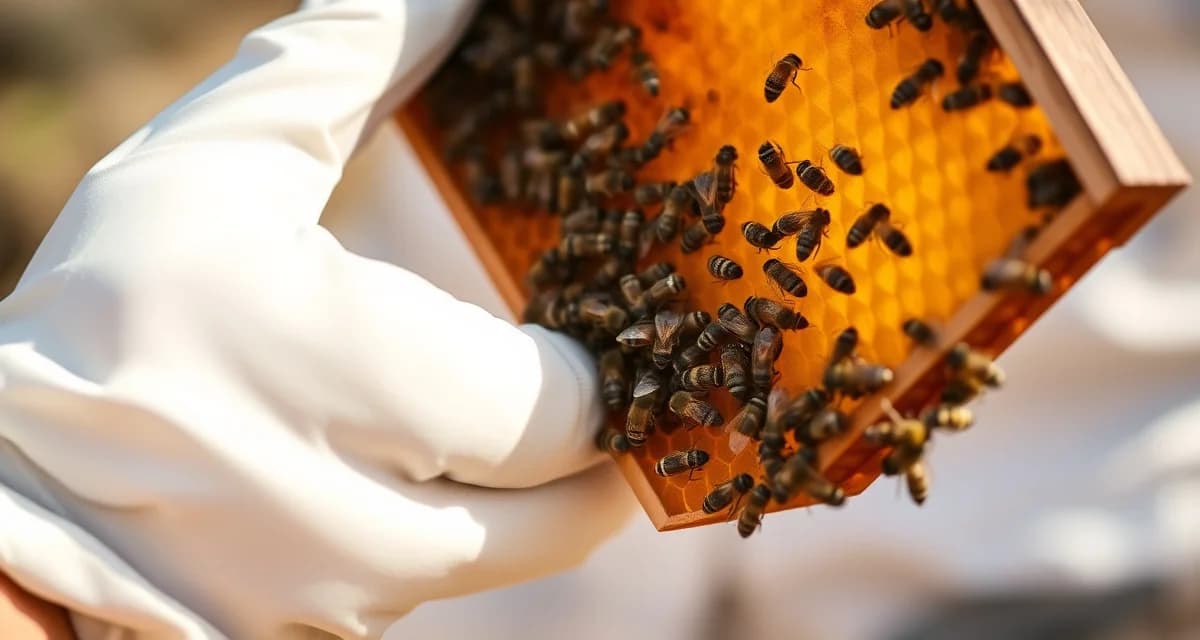
- Brood frames have a distinctive appearance: capped brown/tan cells in the center, open cells with larvae at the edges, pollen and honey at the outer edges
- On warm days, nurse bees cluster densely on brood frames and may be hard to see through
Visual cue: Look for the "football" pattern of capped brood, a dense oval of tan/brown capped cells in the center of the frame. This is the active brood zone.
In a top-bar or Warré hive, the brood nest occupies the rearmost portion of the bar arrangement or the lowest box in the stack.
Step 1: Choose the Right Frame
You want a frame from the center of the brood nest with active brood and dense nurse bee coverage.
What to look for:
- Heavy nurse bee coverage on both sides of the frame
- Mix of capped worker brood and open cells with white C-shaped larvae
- Not the frame with eggs only (young brood has fewer mites per bee)
- Not an outer frame with mostly honey and pollen
Frames 4 and 5 of a 10-frame box are typically ideal. In early season, the brood nest may be more compact; in mid-summer, it spans more frames.
Step 2: Check for the Queen
Before shaking any frame, scan both sides for the queen. The queen is usually in the brood nest area. Look for:
- A bee that's longer than workers with a longer, tapered abdomen
- Often surrounded by attendant bees facing her in a distinctive "retinue" pattern
- Moving more slowly and deliberately than workers
If you see the queen on the frame you've selected, gently set that frame aside against the outside of the hive or in a nuc box. Move to the adjacent frame for your sample. The queen is not a problem to have nearby; you just don't want her in your wash jar.
If you can't find the queen: Proceed carefully. Shake the sample frame sharply before slowly setting it down. If the queen is on the bottom or between frames, sharp shaking is less likely to catch her than if you're scraping bees into a cup. After the shake, look quickly for a clustering spot on the bottom board or nearby equipment; queens sometimes fall during shakes.
Step 3: Shake Bees Into Your Jar
Position your collection jar (mesh lid, 30-32oz Mason jar works well) below the selected frame.
Shaking technique:
- Hold the frame horizontally over the jar opening
- Execute one or two firm, sharp downward shakes
- Nurse bees on brood frames are more reluctant to fall than foragers; you need real force
- Don't tap or brush; a firm shake is more effective
After shaking, you should see a mass of bees in the bottom of the jar. Count or estimate the number:
- A half-full 32oz jar = approximately 300 bees
- Use a smaller jar (16oz) if you want to fill it with 300 bees for an obvious "full" indicator
If you don't get 300 bees: Add a second shake from the same frame, or move to an adjacent brood frame for additional bees. Avoid mixing bees from very different locations in the hive.
Step 4: Check Your Sample for the Queen
Before capping the jar and adding alcohol, look into the jar for a few seconds. If you see a long, tapered queen bee walking through the mass, carefully hold the jar on its side and let her walk toward the rim, then flick her back onto the frame. Better to lose a few mites than lose your queen.
After confirming no queen is present, add isopropyl alcohol to submerge the bees and proceed with the wash.
Step 5: Log Your Sampling Location in VarroaVault
After performing the wash and counting your mites, log in VarroaVault:
- Count result (number of mites per 300 bees)
- Method: alcohol wash
- Sampling location: brood nest (this is the key field)
- Date
- Hive ID
VarroaVault uses the sampling location to assess count quality. Counts from the brood nest are treated as accurate infestation estimates. Counts from other locations receive a flag noting potential underestimation.
The sampling quality flag also appears in efficacy calculations. If you log a brood nest count pre-treatment and a brood nest count post-treatment, VarroaVault's efficacy calculation is fully reliable.
Frequently Asked Questions
Why is the brood nest the best place to sample for mite wash?
Nurse bees in the brood nest carry 3-4x more phoretic mites than foragers or bees from other parts of the hive, because phoretic mites concentrate where brood is located. Sampling from the brood nest gives you the most representative count of the colony's true mite load. Research shows brood nest samples have 95% sensitivity for threshold detection versus 60% for random hive body samples.
How do I collect 300 bees from the brood nest without the queen?
Select a central brood frame with heavy nurse bee coverage, scan both sides for the queen, and if she's present, use the adjacent frame instead. Hold the frame over your jar and execute one or two firm downward shakes to dislodge nurse bees. After collecting bees but before adding alcohol, do a quick visual check of the jar surface for the queen's distinctive elongated body before sealing.
Does VarroaVault ask me to record where I sampled?
Yes. VarroaVault's count log includes a sampling location field. You can record brood nest, middle box, entrance, or other location. When you log from the brood nest, the count is treated as an accurate infestation estimate. Counts from other locations receive a flag indicating potential underestimation, so you interpret them correctly.
How soon after treatment can I run a post-treatment mite count?
Wait 2-4 weeks after the treatment ends before running a post-treatment count. Counting too soon (within a week of treatment removal) may show mites still dying or emerging from the last brood cycle. Waiting 2-4 weeks allows emerging bees from brood that was capped during treatment to fully emerge and any surviving mites to become detectable in a new count.
What should I do if my mite count results seem unusually high or low?
If results seem surprising, repeat the count within 1-2 weeks before making a treatment decision based on a single outlier result. Confirm you sampled from the brood nest center (not outer frames), used the correct sample size (approximately 300 bees), and shook vigorously for the full 60 seconds. Consistent sampling technique is the most important factor in count accuracy.
Can I count mites from a sticky board instead of doing an alcohol wash?
Sticky board counts measure mite fall rate over 24-72 hours, which correlates with infestation level but is not a direct measure of infestation percentage. Sticky board results cannot be converted to an accurate percentage without calibration, and they are less reliable than alcohol wash for treatment decisions. Use sticky boards for general population monitoring but rely on alcohol wash counts for threshold decisions.
What is How to Sample From the Brood Nest for the Most Accurate Varroa Count?
Brood nest sampling is a precise method for measuring varroa mite infestation levels in a honey bee colony. Rather than collecting bees randomly, you target the frame with the most capped brood — where phoretic mites concentrate. You collect roughly 300 bees, perform an alcohol wash or sugar roll, and calculate your infestation percentage. This targeted approach achieves 95% detection sensitivity, compared to just 60% for random hive body sampling.
How much does How to Sample From the Brood Nest for the Most Accurate Varroa Count cost?
Brood nest varroa sampling is free. You need basic equipment: a wide-mouth jar, isopropyl alcohol or powdered sugar, a mesh lid, and a container to count mites. The alcohol wash method is the most accurate and costs only a few dollars in supplies. VarroaVault's logging tools to track and trend your counts over time are also free to use for beekeepers who want data-driven mite management.
How does How to Sample From the Brood Nest for the Most Accurate Varroa Count work?
Locate the frame with the highest density of capped worker brood — this is where mites concentrate. Shake or brush approximately 300 bees (roughly half a cup) into a jar. For an alcohol wash, add isopropyl alcohol, shake for 60 seconds, and pour through a mesh screen to count dislodged mites. Divide mites by bees sampled, multiply by 100, and you have your infestation percentage to compare against treatment thresholds.
What are the benefits of How to Sample From the Brood Nest for the Most Accurate Varroa Count?
Sampling from the brood nest gives you the most statistically reliable mite count possible — 35 percentage points more accurate than random sampling. This accuracy means fewer false negatives, so you're not skipping treatment when mite loads are actually dangerous. It removes guesswork from treatment timing, helps you catch rising populations early, and when logged consistently in VarroaVault, builds a trend dataset that reveals whether your colony is stable or deteriorating.
Who needs How to Sample From the Brood Nest for the Most Accurate Varroa Count?
Every beekeeper managing colonies through spring, summer, and fall needs this technique — from hobbyists with a single hive to commercial operators running hundreds. If you make treatment decisions based on inaccurate counts, you risk colony losses from unchecked mite populations. New beekeepers benefit most from learning brood nest sampling early, since it establishes the correct habit from the start and ensures treatment thresholds are applied to trustworthy data.
Related Articles
- How to Do an Alcohol Wash Mite Count: Step-by-Step
- Varroa Brood Inspection Guide: What to Look for in Open and Capped Brood
Sources
- American Beekeeping Federation (ABF)
- USDA ARS Bee Research Laboratory
- Honey Bee Health Coalition
- Penn State Extension Apiculture Program
- Project Apis m.
Get Started with VarroaVault
An alcohol wash gives you the number. VarroaVault turns that number into a decision. Log your count, get an instant threshold comparison, and build a monitoring history that shows you whether mite levels are rising or stable across your entire operation. See pricing and free tools at varroavault.com.