Mite Count Before and After Treatment: How to Measure Efficacy
You wouldn't take medicine and then never check whether it worked. But that's exactly what most beekeepers do with varroa treatments. They apply Apivar strips, or do an OA dribble, and then trust that the treatment did what it was supposed to do. No follow-up count, no verification. Just hope.
That's how resistance develops and spreads without anyone noticing. It's also how colonies die despite being treated.
The minimum standard for responsible varroa management is simple: count before treatment, count after treatment, and calculate whether the treatment worked. Every time.
TL;DR
- A valid mite count sample requires approximately 300 bees from the brood nest for statistically reliable results
- alcohol wash is 15-20% more accurate than sugar roll for detecting mite infestation levels
- The calculation is: (mites counted / bees in sample) x 100 = infestation percentage
- A 2% threshold triggers treatment in spring/summer; 1% is the fall action threshold
- Count at least once per month during active season; increase to every 2 weeks if levels are near threshold
- Log every count in VarroaVault to build a trend dataset that shows whether populations are rising or stable
Why You Need a Pre-Treatment Count
You need a baseline to measure against. Without a count the day before or day of treatment, you're guessing at efficacy later.
The pre-treatment count also tells you what you're dealing with. A colony at 1.8% needs to drop to below 0.2% to hit 90% efficacy. A colony at 6% needs to drop below 0.6%. The math changes depending on where you start, and you can't do the math without the starting number.
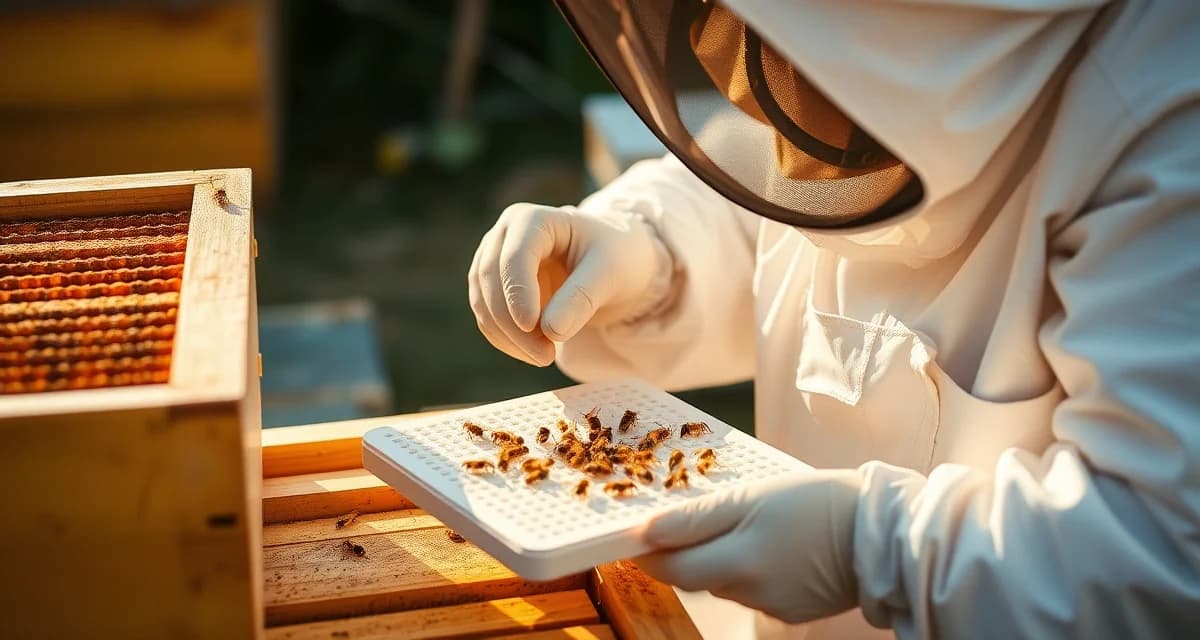
Do your pre-treatment alcohol wash using a consistent sample of 300 bees (roughly half a cup). Record the count and the date in your hive records. This is your efficacy baseline.
Timing Your Post-Treatment Count
Different treatments require different follow-up timing.
oxalic acid dribble or vaporization (broodless colonies): Count 5-7 days after treatment. Broodless colonies with a single OA treatment clear mites quickly. A count within a week confirms whether efficacy was achieved.
Oxalic acid extended release (Vaporox, ApiVar OA pads): Count at 42-56 days, after the treatment has completed its full release period.
Amitraz (Apivar strips): Count at 42-56 days, allowing the full 6-8 week treatment period to complete.
Formic acid (MAQS or Formic Pro): Count 7-14 days after treatment strips are removed. Formic acid works on both phoretic and capped-brood mites, but efficacy confirmation still needs a wash.
Thymol (ApiLife VAR, Apiguard): Count 7-14 days after the final treatment application.
The EPA label for every registered varroa treatment claims at least 90% efficacy under proper application conditions. That's the benchmark. If your post-treatment count doesn't reflect a 90%+ reduction from your pre-treatment baseline, something went wrong.
Calculating Treatment Efficacy
The calculation is straightforward:
Efficacy % = (Pre-treatment count - Post-treatment count) / Pre-treatment count x 100
If you had 3% before treatment and 0.2% after, that's (3 - 0.2) / 3 x 100 = 93.3% efficacy. That's a pass.
If you had 3% before and 0.8% after, that's (3 - 0.8) / 3 x 100 = 73.3% efficacy. That's a problem.
VarroaVault automatically calculates the efficacy score when you log a post-treatment count within 14 days of a recorded treatment. You don't have to do the math. You enter the count, and the platform tells you whether you passed or need to investigate further.
This feature is particularly useful for keeping mite count records organized over multiple treatment cycles. Over time you'll see whether a particular treatment is consistently working in your colonies or showing declining efficacy, which is an early warning sign for resistance.
What Low Efficacy Means
A single low-efficacy result doesn't automatically mean resistance. Rule out the simpler explanations first.
Application errors. Was the dose correct? Were the temperature and humidity conditions right for that treatment type? Were strips positioned correctly? Was the colony broodless when it needed to be?
Reinfestation. Did the count spike back up because of incoming mites from neighboring colonies rather than treatment failure? Compare the timing of your post-treatment count against when reinfestation would realistically have had time to occur.
Method selection. Some treatments have lower efficacy in the presence of capped brood. OA dribble, in particular, doesn't penetrate capped cells. If you dribbled OA on a colony that wasn't fully broodless, low efficacy is expected.
Once you've ruled out application and method issues, a pattern of consistently low efficacy with the same treatment class points toward resistance. At that point, rotating to a different active ingredient is the right call. Log all your treatment history in VarroaVault and use the mite resistance management guidance to plan your rotation.
Step-by-Step: Running a Before-and-After Protocol
Step 1: Pre-Treatment Count
- Collect 300 bees from the brood nest in a jar with 70% isopropyl alcohol or a teaspoon of dish soap in water
- Agitate for 1 minute
- Strain and count mites in the wash liquid
- Divide mite count by 3 to get percentage (mites per 100 bees)
- Log count, date, and collection method in VarroaVault
Step 2: Apply Treatment
Apply your chosen treatment per label instructions. Log the treatment in VarroaVault, including product name, lot number, application date, and dose applied.
Step 3: Post-Treatment Count
Wait the appropriate interval for your treatment type (see timing guide above). Return with the same sampling method and collect a fresh 300-bee sample from the same colony.
Log the count in VarroaVault. The platform will calculate your efficacy score automatically and flag the result as pass or investigate.
Step 4: Interpret and Respond
If efficacy is 90%+, you're done. Schedule your next monitoring reminder in 3-4 weeks to watch for reinfestation.
If efficacy is below 90%, investigate the cause using the checklist above. If application issues are ruled out, consider a different treatment product and add a resistance note to the hive record.
Step 5: Track Over Time
After 2-3 treatment cycles with consistent before-and-after tracking, you'll have a clear picture of which treatments work in your apiary and which are losing effectiveness. That information is more valuable than anything else in your hive record.
Frequently Asked Questions
What efficacy should I expect from varroa treatments?
EPA labels for all registered varroa treatments claim at least 90% efficacy under proper application conditions. That's the benchmark to use when evaluating your post-treatment counts. Formic acid products typically achieve 90-95% in correct conditions. Amitraz strip treatments achieve 90-95%. Oxalic acid on a confirmed broodless colony achieves 95-97%. A result below 90% warrants investigation into application conditions before concluding resistance is present.
How long after treatment should I do a follow-up count?
It depends on the treatment. For oxalic acid on a broodless colony, count 5-7 days after treatment. For Apivar strips or extended-release OA products, wait 42-56 days for the full treatment period to complete. For MAQS formic acid, count 7-14 days after the strips come out. Counting too early or too late can make a good treatment look worse than it was, so timing your follow-up correctly matters as much as doing one.
Does VarroaVault calculate my treatment efficacy automatically?
Yes. When you log a mite count within 14 days of a recorded treatment entry in VarroaVault, the platform automatically pairs the two records and calculates your efficacy percentage. The result appears in your hive dashboard with a pass/investigate flag. Over time, your efficacy history is stored so you can review whether a particular treatment is maintaining its effectiveness in your operation.
How soon after treatment can I run a post-treatment mite count?
Wait 2-4 weeks after the treatment ends before running a post-treatment count. Counting too soon (within a week of treatment removal) may show mites still dying or emerging from the last brood cycle. Waiting 2-4 weeks allows emerging bees from brood that was capped during treatment to fully emerge and any surviving mites to become detectable in a new count.
What should I do if my mite count results seem unusually high or low?
If results seem surprising, repeat the count within 1-2 weeks before making a treatment decision based on a single outlier result. Confirm you sampled from the brood nest center (not outer frames), used the correct sample size (approximately 300 bees), and shook vigorously for the full 60 seconds. Consistent sampling technique is the most important factor in count accuracy.
Can I count mites from a sticky board instead of doing an alcohol wash?
Sticky board counts measure mite fall rate over 24-72 hours, which correlates with infestation level but is not a direct measure of infestation percentage. Sticky board results cannot be converted to an accurate percentage without calibration, and they are less reliable than alcohol wash for treatment decisions. Use sticky boards for general population monitoring but rely on alcohol wash counts for threshold decisions.
What is Mite Count Before and After Treatment: How to Measure Efficacy?
Mite Count Before and After Treatment: How to Measure Efficacy is a practical beekeeping guide published on VarroaVault that walks beekeepers through the process of sampling varroa mite levels before applying a treatment and again afterward. It explains how to calculate infestation percentages, interpret results, and determine whether a treatment actually worked—helping beekeepers move from hope-based management to data-driven colony care.
How much does Mite Count Before and After Treatment: How to Measure Efficacy cost?
The guide itself is free to read on VarroaVault. The tools needed to follow its methods—alcohol wash supplies, a kitchen scale, and a fine-mesh jar—cost very little and are reusable. VarroaVault's mite count logging and efficacy calculator features are available on the platform, making it easy to record and track results over time without additional expense.
How does Mite Count Before and After Treatment: How to Measure Efficacy work?
The process involves collecting roughly 300 bees from the brood nest, performing an alcohol wash or sugar roll to dislodge mites, then counting mites and calculating infestation rate using the formula: (mites counted ÷ bees in sample) × 100. You repeat the count 4–6 weeks after treatment and compare results. A significant drop confirms efficacy; a flat or rising count signals possible treatment failure or resistance.
What are the benefits of Mite Count Before and After Treatment: How to Measure Efficacy?
Counting before and after treatment confirms whether your chosen product actually worked, helping you catch treatment resistance early before it spreads. It removes guesswork from colony management, gives you a clear action threshold (2% in spring/summer, 1% in fall), and builds a historical trend dataset in VarroaVault. Over time this data helps you make smarter intervention decisions and avoid colony losses from undetected mite buildup.
Who needs Mite Count Before and After Treatment: How to Measure Efficacy?
Any beekeeper managing colonies during the active season should follow this protocol—from hobbyists with a single hive to commercial operators running hundreds. It is especially critical for beekeepers who have experienced unexplained colony losses, those in areas with known treatment resistance, and anyone preparing colonies for winter. If you are applying any varroa treatment without confirming it worked, this guide is for you.
Sources
- American Beekeeping Federation (ABF)
- USDA ARS Bee Research Laboratory
- Honey Bee Health Coalition
- Penn State Extension Apiculture Program
- Project Apis m.
Get Started with VarroaVault
An alcohol wash gives you the number. VarroaVault turns that number into a decision. Log your count, get an instant threshold comparison, and build a monitoring history that shows you whether mite levels are rising or stable across your entire operation. See pricing and free tools at varroavault.com.