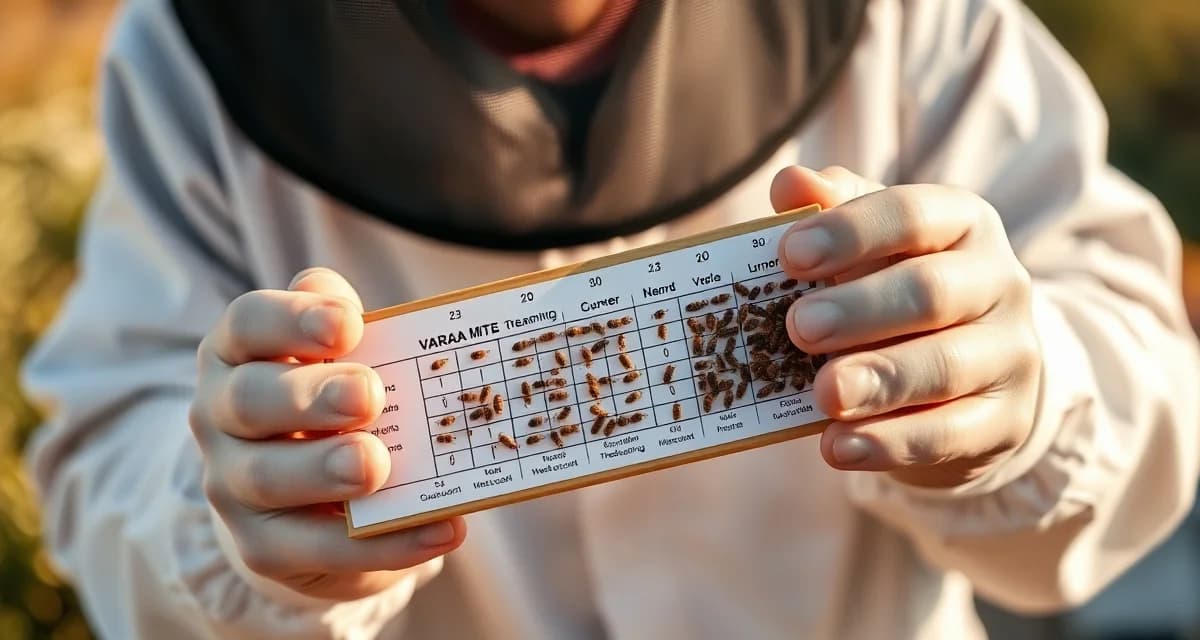
How to Evaluate Varroa Treatment Efficacy: Pre and Post Count Protocol
EPA label claims for registered acaricides specify a minimum 90% efficacy. If your post-treatment count shows less than 90% reduction, that's not a record-keeping technicality. It's a signal that something went wrong, and it may be the first sign of treatment resistance in your area.
Here's the step-by-step protocol for evaluating whether your varroa treatment actually worked.
TL;DR
- This guide covers key aspects of how to evaluate varroa treatment efficacy: pre and post coun
- Mite monitoring should happen at minimum every 3-4 weeks during active season
- The 2% threshold in spring/summer and 1% in fall are standard action points based on HBHC guidelines
- Always run a pre-treatment and post-treatment mite count to calculate efficacy
- Treatment records including product name, EPA number, dates, and counts are required for state inspection compliance
- VarroaVault stores all monitoring and treatment data with automatic threshold comparison and state export formatting
Why Pre and Post Counts Matter
A lot of beekeepers treat without doing a pre-treatment count. They see an inspecting beekeeper mention high mites on social media, they see a mite or two crawling during an inspection, and they apply treatment. Then they hope for the best.
Without a pre-treatment count, you have no baseline. You can't calculate efficacy percentage. You can't compare your result to label claims. You can't detect resistance. You've spent money on a treatment and have no way to evaluate its value.
A pre-treatment count takes 10-15 minutes. The information it provides is foundational.
Step 1: Pre-Treatment Count (48-72 Hours Before)
Perform an alcohol wash or sugar roll from the brood nest area 48-72 hours before treatment. Collect 300 adult bees from a frame near the center of the brood nest, avoiding the queen frame.
Record the result as a percentage: mites found / 300 bees x 100.
Example: 9 mites in a 300-bee wash = 3% infestation.
Log this in VarroaVault as a pre-treatment count with the date and the note "pre-treatment baseline."
Why 48-72 hours? This is close enough to the treatment that it reflects the infestation level you're treating, but not so close that you're disrupting the colony right before application.
Step 2: Apply Treatment Per Label
Apply your chosen treatment following label instructions exactly. Temperature requirements, dose, positioning, and timing all affect efficacy. An off-label application doesn't give you valid efficacy data.
Log the treatment in VarroaVault with the product name, date, dose, and applicator.
Step 3: Post-Treatment Count (14 Days After)
For most treatments, 14 days post-application gives you a reliable efficacy reading. For Apivar, you may want to count at day 42 instead, since the strips work over a 42-56 day period.
Specific guidelines by product:
- OA vaporization (extended protocol, 3+ treatments): Count at 7 days after the final application.
- OA dribble (broodless period): Count at 7-14 days post-application.
- MAQS/Formic Pro: Count at 14 days post-removal (strips are in for 7 days).
- Apivar: Count at day 42 from application date.
- Apiguard: Count at day 14 after the second tray application.
Perform the same type of count as your pre-treatment baseline (same method, same location in the colony, same sample size).
Calculating Efficacy Percentage
The formula is straightforward:
Efficacy % = ((Pre-treatment % - Post-treatment %) / Pre-treatment %) x 100
Example: Pre = 3%, Post = 0.3%
Efficacy = ((3 - 0.3) / 3) x 100 = 90%
This is exactly at the EPA label minimum. You'd want to see 90%+ to confirm the treatment worked as expected.
VarroaVault automatically calculates your efficacy percentage when you log a count within 14 days of a treatment entry. The app shows the pre-treatment baseline, your post-treatment result, and the calculated efficacy, flagging anything below 90% for review.
What a Low Efficacy Result Means
If your efficacy comes in below 90%, consider these possibilities before concluding you have resistance:
Application error: Was the temperature appropriate for the product? Was the dose correct? Were Apivar strips positioned in the cluster? Were there honey supers on during a treatment that should have been super-free?
Timing error: Was there heavy brood present when you used OA dribble (which only works on phoretic mites)? Did you apply formic acid during a cold snap that reduced evaporation?
Reinfestation: In high-pressure areas, colonies can pick up new mites from neighboring operations within days of treatment. A high post-treatment count may partly reflect new mites, not treatment failure.
Genuine resistance: If you've ruled out application and timing errors and you're seeing consistent sub-90% results across multiple colonies, that's a resistance signal. Report it to your state apiarist and switch treatment class immediately.
Reporting Potential Resistance
USDA and state apiarists want to know about treatment failures. Tracking resistance emergence helps researchers understand where resistance is developing and how quickly it spreads. If you have a well-documented treatment failure with pre and post counts, that's exactly the kind of data that's useful.
VarroaVault's resistance flag alert notifies you when your efficacy calculation falls below 90% and provides a prompt to report the failure to the surveillance network if you choose.
Frequently Asked Questions
What percentage mite reduction indicates a treatment worked?
EPA label claims for registered acaricides specify a minimum 90% efficacy. A result of 90% or higher indicates the treatment performed as expected. Results of 80-89% suggest possible application issues worth investigating. Results below 80% warrant immediate investigation for application error, reinfestation, or resistance.
When should I do my post-treatment count?
Timing varies by product. Count at day 7-14 after the final OA vaporization or OA dribble application. Count at day 14 after MAQS/Formic Pro strip removal. Count at day 42 for Apivar. Count at day 14 after the second Apiguard tray. Log the count in VarroaVault and it will automatically calculate efficacy against your pre-treatment baseline.
Does VarroaVault calculate treatment efficacy automatically?
Yes. When you log a mite count within 14 days of a treatment entry, VarroaVault automatically identifies the relevant pre-treatment baseline, calculates efficacy percentage, and flags the result if it falls below 90%. You don't need to do the math manually.
How do I know if my varroa treatment is working?
Run a mite count 2-4 weeks after the treatment ends and compare it to your pre-treatment count. The efficacy formula is: ((pre-count - post-count) / pre-count) x 100. A result above 90% indicates effective treatment. Results below 80% should trigger investigation for possible resistance, application error, or reinfestation. Log both counts in VarroaVault to track efficacy trends across treatment cycles.
How often should I check mite levels in my hives?
At minimum, once per month (every 3-4 weeks) during the active season. Increase to every 2 weeks when counts are near threshold or after a treatment to verify it worked. In fall, monitoring frequency matters most because the window to treat before winter bees are raised is narrow. VarroaVault's monitoring reminders can be set to your preferred interval for each apiary.
What records should I keep for varroa management?
Each record should include: date of count or treatment, hive identifier, monitoring method used, number of bees sampled, mites counted, infestation percentage, treatment product name and EPA registration number, dose applied, treatment start and end dates, and PHI end date. State apiarists typically expect this level of detail during inspections. VarroaVault captures all of these fields in a single log entry.
What is How to Evaluate Varroa Treatment Efficacy: Pre and Post Count Protocol?
The Pre and Post Count Protocol is a standardized method for measuring whether a varroa mite treatment actually worked. It involves counting mite levels before applying an acaricide, then recounting afterward to calculate percent reduction. EPA label claims require at least 90% efficacy, and this protocol gives beekeepers objective data to confirm treatment success or identify potential resistance issues early.
How much does How to Evaluate Varroa Treatment Efficacy: Pre and Post Count Protocol cost?
The protocol itself is free — it's a monitoring methodology, not a product. You'll need basic supplies like an alcohol wash jar or sugar roll kit, which typically cost under $20. VarroaVault offers digital logging, automatic efficacy calculation, and state-compliant export formatting as part of its platform, making it easier to track and act on your results consistently across multiple hives.
How does How to Evaluate Varroa Treatment Efficacy: Pre and Post Count Protocol work?
The protocol works in two steps: run a pre-treatment mite count using an alcohol wash or sticky board, record your baseline infestation rate, then apply your registered acaricide per label instructions. After the treatment window closes, repeat the count using the same method. Divide post-treatment mites by pre-treatment mites, subtract from 1, and multiply by 100 to get your efficacy percentage.
What are the benefits of How to Evaluate Varroa Treatment Efficacy: Pre and Post Count Protocol?
Running pre and post counts removes guesswork from mite management. You get confirmation that treatment worked, early warning of resistance if efficacy falls below 90%, and documented records for state inspection compliance. It also prevents unnecessary retreatment and helps you compare product performance across your apiary over multiple seasons, building a data-driven picture of your local mite pressure.
Who needs How to Evaluate Varroa Treatment Efficacy: Pre and Post Count Protocol?
Any beekeeper managing colonies during active varroa season should follow this protocol — from hobbyists with two hives to commercial operations with hundreds. It's especially critical for beekeepers in regions with reported oxalic acid or amitraz resistance, those preparing for state inspections, and anyone who has previously lost colonies to mite overload despite having treated.
Related Articles
Sources
- American Beekeeping Federation (ABF)
- USDA ARS Bee Research Laboratory
- Honey Bee Health Coalition
- Penn State Extension Apiculture Program
- Project Apis m.
Get Started with VarroaVault
The information in this guide is most useful when you have your own mite count data to apply it to. VarroaVault stores every count, flags threshold crossings automatically, and builds the treatment history you need for state inspections and effective management decisions. See pricing and free tools at varroavault.com.