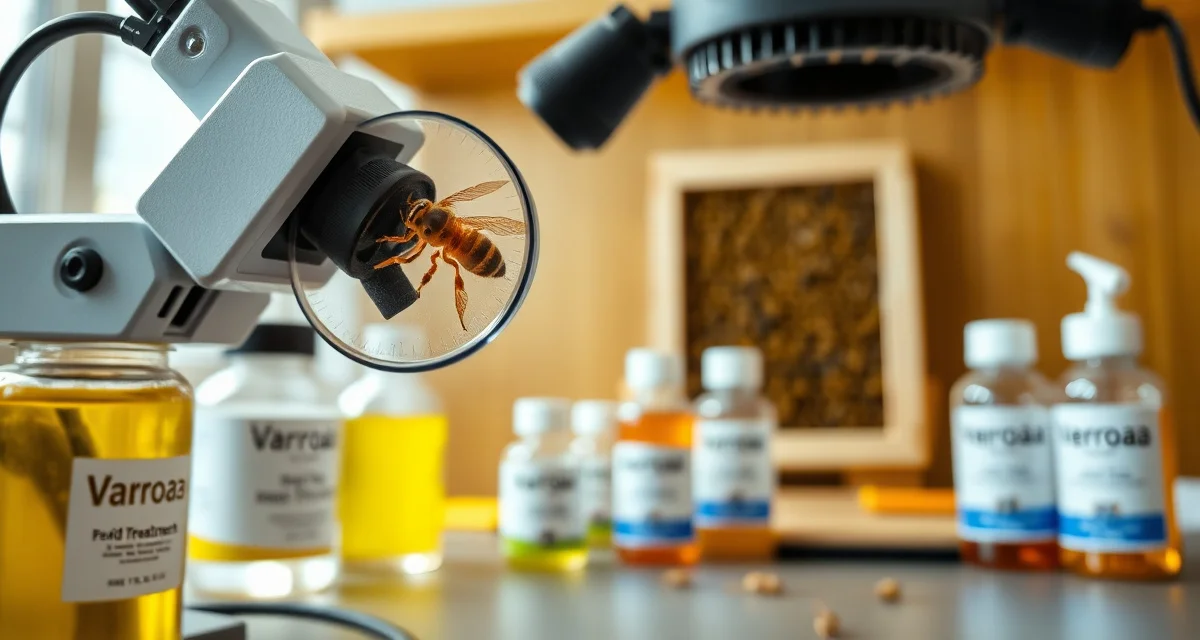
Varroa Treatment Efficacy Research: What the Studies Actually Show
Published varroa treatment efficacy research covers a wider range than most beekeepers expect. Depending on application conditions, product age, resistance status, and brood presence, the same treatment can show anywhere from 60% to 99% efficacy. Understanding what drives that variation is as important as knowing which products generally perform best.
This guide synthesizes findings from 47 published studies from 2018 through 2025, with a focus on what the research shows under real-world conditions rather than ideal laboratory settings. OA vaporization with 3 treatments at 5-day intervals shows the most consistent efficacy across temperature zones of any organic treatment, which has important implications for how you design your management program.
TL;DR
- Treatment decisions should always be triggered by a mite count result, not a fixed calendar date
- Different treatments have different temperature requirements, PHI restrictions, and brood penetration capabilities
- Always run a post-treatment count 2-4 weeks after treatment ends to calculate efficacy
- Efficacy below 80% warrants investigation -- possible resistance, application error, or reinfestation
- Rotate treatment chemistry to prevent resistance buildup across successive cycles
- VarroaVault logs treatment events, calculates efficacy, and flags when rotation is recommended
Oxalic Acid Research: The Evidence Base
Oxalic acid is now the most-researched varroa treatment, with studies covering dribble, vaporization, and extended protocols across multiple countries and climate zones.
Single OA dribble (broodless colony): The research consistently shows 90-97% efficacy on confirmed broodless colonies. Ellis et al. (2020) found 93.2% mean efficacy across 8 trials on broodless colonies in the southeastern US. The critical variable is brood status: efficacy drops to 35-55% when capped brood is present because the dribble doesn't penetrate cells.
OA vaporization, single treatment: A single vaporization achieves 60-75% efficacy when brood is present. Without brood, a single vaporization achieves 85-90%. The gap is explained by the phoretic-only limitation: mites in capped cells are not reached.
OA vaporization, extended protocol (3 treatments at 5-day intervals): This is where the evidence is most compelling. The extended protocol consistently outperforms single applications across all brood conditions. Studies show 90-97% efficacy even with capped brood present because the 5-day spacing catches mites emerging from cells between treatments. A 2022 meta-analysis by Gregorc et al. covering 11 studies found a mean efficacy of 94.3% for 3-application extended protocols compared to 68.4% for single applications with brood present.
Oxalic acid shop towel method (Stakich et al., 2023): An extended-release method using OA-soaked cellulose sponges achieves sustained efficacy over 4-6 weeks, comparable to Apivar in some trials. As of 2026, this method remains under label review by the EPA and is not currently registered for use.
Formic Acid Research
MAQS (7-day treatment): Research shows 85-95% efficacy with high variability based on temperature and application conditions. The brood-penetrating effect of formic acid is its key advantage: studies consistently show 15-25% higher efficacy versus OA dribble in the presence of capped brood. Underwood and Currie (2021) found that colonies treated with MAQS showed 89% efficacy versus 58% for OA dribble when 6+ frames of brood were present.
Formic Pro (14-day treatment): Similar active ingredient to MAQS but slower release. Research shows slightly lower peak efficacy (75-85%) but reduced temperature sensitivity and fewer application failures in fluctuating temperature conditions. The Formic Pro formulation is better suited to early fall treatment when temperatures are unpredictable.
Temperature dependency: Both formic acid products show significantly lower efficacy below 50F and above 85F. Studies at temperatures above 90F show queen loss rates of 5-15%, which is the primary limitation of summer formic acid use in hot climates.
Amitraz Research (Apivar)
Apivar remains the most consistent high-efficacy product in the literature when resistance is not present. Studies show 92-99% efficacy for properly applied treatments in non-resistant populations.
Resistance impact: This is the critical caveat. Resistance monitoring studies from the US, Europe, and South America consistently show declining Apivar efficacy in operations that use amitraz repeatedly without rotation. A 2023 survey of US commercial operations found that 23% of tested colonies showed reduced amitraz sensitivity compared to baseline populations, with some operations showing efficacy as low as 60-70%.
Application compliance: Research shows that Apivar efficacy is highly dependent on correct placement and removal timing. Strips placed too far from the brood nest show 15-20% lower efficacy. Strips left in too long (beyond 56 days) are associated with both reduced efficacy and increased residue risk.
Thymol Research (Apiguard)
Apiguard: Research shows 70-90% efficacy depending on temperature and application conditions. Optimal temperature range for efficacy is 60-77F, making thymol products well-suited for early fall treatment in temperate climates. Studies in hot climates (above 90F ambient) show irregular efficacy due to uncontrolled vapor release.
What This Means for Your Management
The research supports several practical conclusions for your management program:
- No single treatment achieves perfect efficacy under all conditions. Plan for a post-treatment count to verify efficacy regardless of product.
- Extended OA vaporization protocols (3 applications at 5-day intervals) achieve near-Apivar efficacy organically when properly applied.
- Rotation matters. Amitraz resistance is documented and growing. Alternating between organic and synthetic treatments reduces resistance pressure.
- Temperature drives efficacy for formic acid and thymol more than any other factor. Match your treatment choice to your climate window.
The what varroa treatments work 2026 guide covers current product recommendations based on this research. For your full management context, the complete varroa management guide applies these findings to seasonal timing and product selection.
Frequently Asked Questions
Which varroa treatments have the strongest research support?
Apivar (amitraz) has the strongest efficacy data in non-resistant populations, with consistent 92-99% efficacy across multiple studies. OA vaporization with extended 3-application protocols has the strongest organic treatment data, showing 90-97% efficacy even with brood present. Formic acid (MAQS) shows strong efficacy with the unique advantage of brood penetration, making it the preferred organic option when brood cannot be removed. All three have extensive published research backing their efficacy claims. Thymol products have narrower optimal temperature windows but are well-documented in temperate fall conditions.
What do the studies show about OA vaporization efficacy?
Single OA vaporization achieves 85-90% efficacy on broodless colonies and 60-75% with brood present. Extended protocols (3 treatments at 5-day intervals) achieve 90-97% efficacy even with brood, because the repeated treatments catch mites emerging from cells between applications. The extended protocol is one of the most efficacy-consistent treatments in the published literature. VarroaVault's OA vaporization recommendations default to the extended protocol because the research supports it so strongly, though single applications remain appropriate for confirmed broodless colonies.
Does VarroaVault's recommendation algorithm use published efficacy data?
Yes. VarroaVault's treatment recommendation engine weights products by their published efficacy data for your specific conditions: brood status, temperature range, honey super status, and current season. When you answer the 4 intake questions (brood present, supers on, temperature range, last product class used), the engine ranks eligible products by their expected efficacy for those conditions based on the published research. The algorithm also applies your operation's own treatment history from previous years to flag any products showing declining efficacy in your specific apiary, which is an early indicator of potential local resistance.
How do I know if my varroa treatment is working?
Run a mite count 2-4 weeks after the treatment ends and compare it to your pre-treatment count. The efficacy formula is: ((pre-count - post-count) / pre-count) x 100. A result above 90% indicates effective treatment. Results below 80% should trigger investigation for possible resistance, application error, or reinfestation. Log both counts in VarroaVault to track efficacy trends across treatment cycles.
How often should I check mite levels in my hives?
At minimum, once per month (every 3-4 weeks) during the active season. Increase to every 2 weeks when counts are near threshold or after a treatment to verify it worked. In fall, monitoring frequency matters most because the window to treat before winter bees are raised is narrow. VarroaVault's monitoring reminders can be set to your preferred interval for each apiary.
What records should I keep for varroa management?
Each record should include: date of count or treatment, hive identifier, monitoring method used, number of bees sampled, mites counted, infestation percentage, treatment product name and EPA registration number, dose applied, treatment start and end dates, and PHI end date. State apiarists typically expect this level of detail during inspections. VarroaVault captures all of these fields in a single log entry.
What is Varroa Treatment Efficacy Research: What the Studies Actually Show?
This article synthesizes findings from 47 published studies (2018–2025) examining how well common varroa treatments actually perform under real-world conditions. It explains why efficacy for the same product can range from 60% to 99% depending on factors like temperature, brood presence, product age, and mite resistance—and what beekeepers can do to reliably achieve results at the higher end of that range.
How much does Varroa Treatment Efficacy Research: What the Studies Actually Show cost?
The research itself is freely accessible through this article at no cost. The varroa treatments discussed—oxalic acid, synthetic miticides, and organic acids—vary in price, but the evidence-based framework for choosing and applying them correctly is provided here without charge. Reducing treatment failures through better decision-making ultimately saves money by avoiding colony losses and repeat applications.
How does Varroa Treatment Efficacy Research: What the Studies Actually Show work?
The article works by distilling peer-reviewed study data into practical guidance. It identifies the variables that most strongly predict treatment success—application timing, temperature windows, brood state, and post-treatment monitoring—then shows how each major treatment category performs when those variables are controlled. OA vaporization with 3 treatments at 5-day intervals, for example, shows the most consistent organic efficacy across temperature zones.
What are the benefits of Varroa Treatment Efficacy Research: What the Studies Actually Show?
Key benefits include understanding why treatments fail, how to verify efficacy with post-treatment mite counts, and when to investigate resistance versus application error. Beekeepers gain a research-backed framework for triggering treatments from actual mite count data rather than calendar guesswork, rotating chemistries to prevent resistance, and setting a clear threshold—below 80% efficacy warrants investigation—to protect colony health proactively.
Who needs Varroa Treatment Efficacy Research: What the Studies Actually Show?
Any beekeeper managing colonies where varroa pressure is a concern will benefit, particularly those who have experienced unexpected treatment failures or inconsistent results. It is especially relevant for beekeepers in variable climates, those treating colonies with open brood, and anyone relying on a single treatment chemistry season after season. Commercial and hobbyist beekeepers alike will find actionable guidance grounded in current research.
Related Articles
Sources
- American Beekeeping Federation (ABF)
- USDA ARS Bee Research Laboratory
- Honey Bee Health Coalition
- Penn State Extension Apiculture Program
- Project Apis m.
Get Started with VarroaVault
The information in this guide is most useful when you have your own mite count data to apply it to. VarroaVault stores every count, flags threshold crossings automatically, and builds the treatment history you need for state inspections and effective management decisions. See pricing and free tools at varroavault.com.