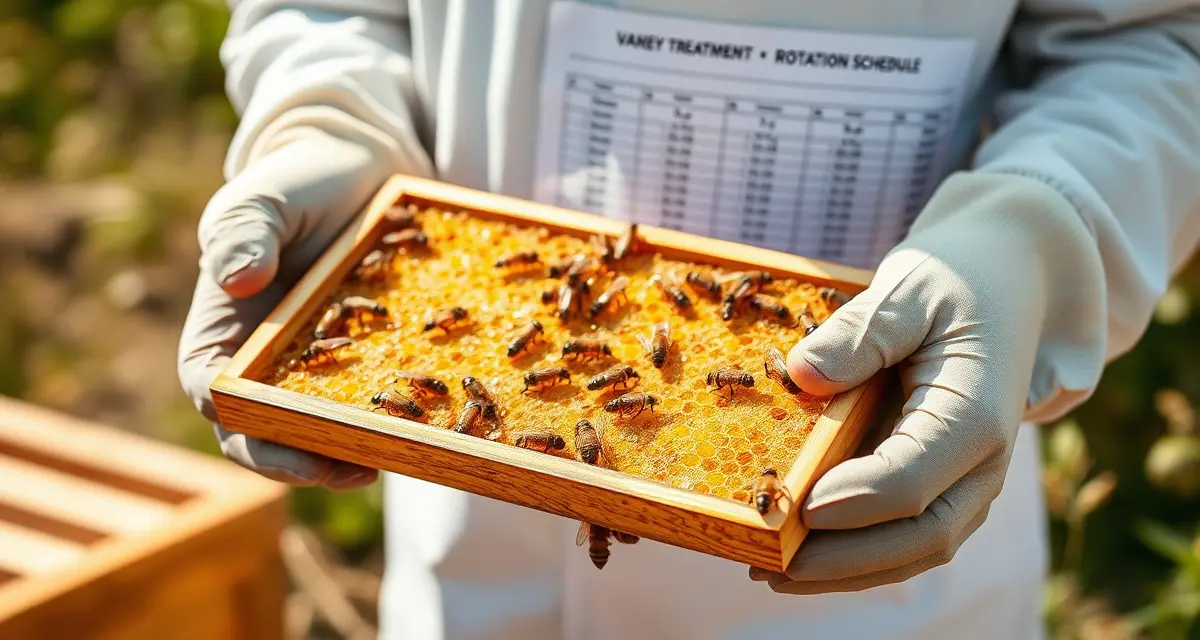
3-Year Varroa Treatment Rotation Plan: Protecting Long-Term Efficacy
Operations that implement a documented 3-year rotation plan show 40% less resistance development than annual repeaters. That's a significant advantage in a landscape where amitraz resistance is already documented in multiple US states and resistance to tau-fluvalinate is widespread.
Here's a practical 3-year rotation framework and how to implement it.
TL;DR
- Treatment rotation means alternating varroa treatment modes of action across successive cycles to prevent resistance
- Amitraz (Apivar) should not be used for more than 2 consecutive treatment cycles before rotating to a different chemistry
- A three-year rotation alternates amitraz with organic acids and thymol across spring and fall windows
- Rotation prevents any single resistant genotype from dominating the mite population over multiple generations
- Temperature constraints in your region may limit which treatments fit which seasons
- VarroaVault's rotation planner builds a personalized schedule based on your actual treatment history and efficacy scores
Why Rotation Prevents Resistance
Resistance develops when a subpopulation of mites with genetic tolerance to a treatment survives and reproduces. Using the same active ingredient repeatedly selects for that subpopulation. Within 3-5 years, the tolerant individuals can dominate the local mite population, making the treatment ineffective.
Rotation disrupts this selection process. By switching to a different mode of action, you eliminate the survivors of the previous treatment cycle before they can establish dominance. The resistance trait that helped mites survive amitraz is irrelevant when the next treatment is oxalic acid.
The key is to rotate between distinct modes of action, not just different brand names:
- Group 1: Organic acids (oxalic acid, formic acid): similar mode of action
- Group 2: Terpenoids (thymol via Apiguard/ApiLife VAR): different mode of action
- Group 3: Synthetic acaricides (amitraz via Apivar): distinct mode of action
A rotation that cycles between these groups provides the most durable long-term efficacy.
The 3-Year Rotation Template
Year 1: Organic Acids Foundation
Spring: OA vaporization extended protocol (3-5 treatments, 5-7 days apart)
Summer/Post-harvest: Formic acid (MAQS or Formic Pro)
Winter: OA dribble during confirmed broodless period
This is the "organic-first" year. You're establishing a clean baseline with no synthetic residue and no selection pressure from amitraz.
Year 2: Synthetic Plus Organic Combination
Spring: Apivar (amitraz strips, 42-56 days) - your synthetic treatment year
Post-harvest (after Apivar removal): OA vaporization (3 treatments, 5-7 days apart) to catch any surviving mites
Winter: OA dribble during broodless period
Year 2 introduces the synthetic treatment. The Apivar spring treatment achieves 95%+ efficacy in amitraz-susceptible populations. Following it with OA vaporization post-removal reduces any survivors and slows resistance establishment.
Important: Log your Apivar application date in VarroaVault. The app automatically schedules the day-42 strip check reminder and the post-Apivar count.
Year 3: Thymol Plus Organic Rotation
Spring: OA vaporization extended protocol
Summer/Post-harvest: Apiguard or ApiLife VAR (thymol gel) - requires above 59°F
Winter: OA dribble during broodless period
Year 3 introduces thymol as the primary post-harvest treatment. Apiguard requires two trays 2 weeks apart and at least 4 weeks of appropriate temperature (above 59°F) to complete. This means you need to start by early August in most northern regions to finish before cold weather arrives.
Repeat the cycle: Year 4 = Year 1, Year 5 = Year 2, and so on.
Customizing the Rotation for Your Operation
The template above is a starting point. Your rotation may need adjustment based on:
Climate: If you're in a warm climate without a reliable broodless period, the winter OA dribble may not be feasible. Replace it with an OA vaporization sequence in your management plan.
Organic certification: If you need to maintain USDA NOP compliance, remove Apivar (Year 2) from your rotation entirely. Substitute a second formic acid or thymol treatment cycle instead.
Resistance in your area: If your state apiarist has reported amitraz resistance locally, delay or skip the Apivar year until resistance levels are known. Your state bee lab can provide current resistance data.
Mite pressure: High-pressure operations (urban areas, proximity to weak operations, warm climates) may need more frequent treatments within the rotation. The template above assumes moderate mite pressure. Add treatments as needed while maintaining the rotation principle.
Setting Up the 3-Year Rotation in VarroaVault
VarroaVault's treatment planner allows you to set up a 3-year rotation template with one click. Here's how:
- Go to Treatment Planning > Rotation Template in your VarroaVault account.
- Select "3-Year Rotation" from the template library.
- Customize: choose your Year 1, 2, and 3 treatment products, enter your location and climate zone.
- Save the template. VarroaVault generates a 36-month treatment calendar with recommended dates based on your climate zone and typical seasonal patterns.
- Set up treatment reminders for each event. The calendar syncs with your notification settings.
The rotation template displays on your dashboard as a progress tracker. As you log treatments, the completed steps are marked, and upcoming steps are highlighted.
Customizing dates: VarroaVault's recommended dates are based on your climate zone's historical frost and flow patterns. You can adjust individual treatment dates to match your actual conditions each year.
Tracking Resistance Over Time
One of the most valuable uses of a 3-year rotation logged in VarroaVault is resistance monitoring. After 3 or 6 years of documented rotations, you have:
- Efficacy data for each product at each treatment event
- Any declining efficacy trends that might suggest developing resistance
- A comparison of your operation's efficacy data against regional patterns
If your Apivar efficacy drops from 95% in Year 2 to 75% in Year 5, that's a trend worth noting and reporting. VarroaVault's annual data summary flags year-over-year efficacy trends for each product class.
Frequently Asked Questions
What should a 3-year varroa treatment rotation include?
An effective 3-year rotation cycles through distinct modes of action: organic acids (OA, formic acid), terpenoids (thymol), and synthetic acaricides (amitraz) in a documented sequence. A common structure is Year 1 (OA + formic acid), Year 2 (Apivar + OA), Year 3 (OA + thymol), then repeat. Winter OA dribble should appear in all three years during the broodless period.
How do I set up a 3-year rotation schedule in VarroaVault?
Go to Treatment Planning > Rotation Template and select the 3-Year Rotation option. Customize your product choices for each year, enter your location, and VarroaVault generates a 36-month treatment calendar with climate-adjusted dates. Set up reminders for each event to ensure you don't miss a rotation step.
Can I customize the rotation template for my specific products?
Yes. VarroaVault's rotation template is fully customizable. You can swap in or out any of the seven registered treatment products, adjust the timing of each event, and modify the rotation cycle to match your climate, certification requirements, or regional resistance patterns.
How do I know if my varroa treatment is working?
Run a mite count 2-4 weeks after the treatment ends and compare it to your pre-treatment count. The efficacy formula is: ((pre-count - post-count) / pre-count) x 100. A result above 90% indicates effective treatment. Results below 80% should trigger investigation for possible resistance, application error, or reinfestation. Log both counts in VarroaVault to track efficacy trends across treatment cycles.
How often should I check mite levels in my hives?
At minimum, once per month (every 3-4 weeks) during the active season. Increase to every 2 weeks when counts are near threshold or after a treatment to verify it worked. In fall, monitoring frequency matters most because the window to treat before winter bees are raised is narrow. VarroaVault's monitoring reminders can be set to your preferred interval for each apiary.
What records should I keep for varroa management?
Each record should include: date of count or treatment, hive identifier, monitoring method used, number of bees sampled, mites counted, infestation percentage, treatment product name and EPA registration number, dose applied, treatment start and end dates, and PHI end date. State apiarists typically expect this level of detail during inspections. VarroaVault captures all of these fields in a single log entry.
What is 3-Year Varroa Treatment Rotation Plan: Protecting Long-Term Efficacy?
A 3-Year Varroa Treatment Rotation Plan is a structured approach to alternating varroa mite treatments across different modes of action over three years. Rather than repeating the same chemical each season, beekeepers cycle through amitraz (Apivar), organic acids like oxalic acid, and thymol-based treatments across spring and fall windows. Operations using a documented rotation show 40% less resistance development than those repeating the same treatment annually, preserving long-term efficacy as resistance spreads across the US.
How much does 3-Year Varroa Treatment Rotation Plan: Protecting Long-Term Efficacy cost?
A 3-Year Varroa Treatment Rotation Plan is a beekeeping management strategy, not a product with a purchase price. The cost depends on which treatments you use each year — Apivar strips, oxalic acid vaporization equipment, and thymol-based treatments vary in price. Organic options like oxalic acid are generally low-cost, while synthetic options like amitraz run higher. VarroaVault's rotation planner tool is available to help you build a personalized schedule based on your treatment history.
How does 3-Year Varroa Treatment Rotation Plan: Protecting Long-Term Efficacy work?
A 3-Year Varroa Treatment Rotation Plan works by cycling through varroa treatments with different modes of action across successive spring and fall treatment windows. Year one might use amitraz, year two an organic acid like oxalic acid, and year three a thymol-based treatment. This prevents any single resistant mite genotype from surviving multiple generations and dominating the population. Temperature constraints in your region determine which treatments fit which seasons, making local customization essential.
What are the benefits of 3-Year Varroa Treatment Rotation Plan: Protecting Long-Term Efficacy?
The primary benefit is resistance prevention — documented rotations produce 40% less resistance development compared to repeating the same treatment annually. This matters because amitraz resistance is already confirmed in multiple US states and tau-fluvalinate resistance is widespread. Rotation preserves the effectiveness of your entire treatment toolkit long-term, giving you more options as mite pressure evolves. It also encourages better record-keeping and monitoring, which improves overall colony health management across seasons.
Who needs 3-Year Varroa Treatment Rotation Plan: Protecting Long-Term Efficacy?
Any beekeeper treating for varroa should consider a rotation plan, but it's especially critical for operations that have used the same treatment — particularly amitraz (Apivar) — for multiple consecutive cycles. Hobbyists, sideliners, and commercial beekeepers in regions where resistance is already documented face the highest risk. If you've never tracked your treatment history or noticed declining efficacy from a previously reliable product, a structured 3-year rotation plan is the right next step.
Related Articles
Sources
- American Beekeeping Federation (ABF)
- USDA ARS Bee Research Laboratory
- Honey Bee Health Coalition
- Penn State Extension Apiculture Program
- Project Apis m.
Get Started with VarroaVault
A treatment rotation plan is only useful if you stick to it across multiple seasons. VarroaVault's rotation planner builds your schedule based on actual treatment history and efficacy scores, and reminds you when it is time to switch chemistry. See pricing and free tools at varroavault.com.