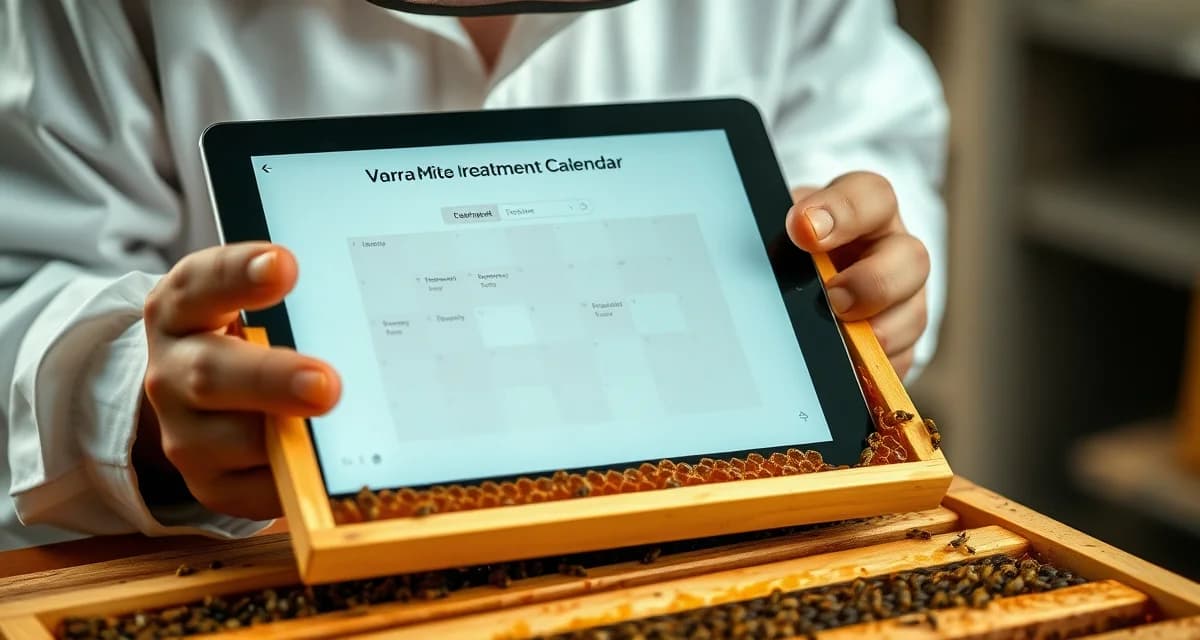
VarroaVault Treatment Plan Generator: Get a Custom Varroa Calendar
Beekeepers who start with a personalized treatment plan log their first mite count 11 days earlier than those starting without a plan. That head start matters. A count in mid-April instead of late April is the difference between catching a spring buildup mite increase in time to treat before the honey flow versus discovering it after.
The VarroaVault treatment plan generator creates a 12-month varroa management calendar tailored to your specific operation in about 2 minutes.
TL;DR
- Treatment decisions should always be triggered by a mite count result, not a fixed calendar date
- Different treatments have different temperature requirements, PHI restrictions, and brood penetration capabilities
- Always run a post-treatment count 2-4 weeks after treatment ends to calculate efficacy
- Efficacy below 80% warrants investigation -- possible resistance, application error, or reinfestation
- Rotate treatment chemistry to prevent resistance buildup across successive cycles
- VarroaVault logs treatment events, calculates efficacy, and flags when rotation is recommended
The 5 Questions the Generator Asks
The generator collects exactly the information needed to build a meaningful plan. Here's what each question is for and how it affects your plan:
Question 1: Where are you located?
Your zip code or county determines:
- Your USDA hardiness zone and climate zone
- Your average first frost date (critical for broodless period timing)
- Your typical nectar flow dates (determines when supers go on and come off)
- Your local mite pressure level (some regions have higher endemic pressure)
A beekeeper in central Florida and a beekeeper in northern Minnesota operate in completely different seasonal realities. The Florida beekeeper has no reliable broodless period and needs a year-round management program. The Minnesota beekeeper has a reliable November-January broodless window and a short active season. The plans look completely different.
Question 2: How many hives do you manage?
Your hive count determines:
- Whether to recommend batch logging versus individual hive logging
- Whether team features are relevant for your operation
- Scale-appropriate product purchasing guidance
- Whether commercial or hobby plan features better fit your needs
A 3-hive backyard beekeeper and a 150-hive sideliner both need the same core management logic, but the operational tools they need are different.
Question 3: What are your honey production goals?
This determines PHI management requirements:
- "I produce honey for personal use only": PHI compliance is less critical (not selling commercially, though still important for your own consumption)
- "I sell honey at farmers markets or direct retail": PHI compliance is legally required; the plan includes PHI management steps
- "I sell to commercial buyers or distributors": Full PHI audit trail required; plan includes compliance documentation steps
- "I don't harvest honey (observation or pollination hives)": PHI management simplified; no harvest timing constraints
Question 4: What is your organic certification status?
This determines which products are available to include in your plan:
- "Not certified organic": All seven registered treatments available
- "Certified organic or in transition": Only USDA NOP-approved treatments (OA, formic, thymol, hop beta acids) included; Apivar excluded
- "Considering organic certification": Plan shows current treatment options plus notes on what changes certification would require
Question 5: Have you been managing varroa for more than one season?
This calibrates the plan's complexity:
- "First year": Simplified calendar with detailed step guidance. First-year defaults apply (more explanation per step).
- "2+ years": Full rotation planning, efficacy comparison, resistance monitoring integration. Assumes familiarity with basic counting methods.
What the Generated Plan Includes
After answering the 5 questions, VarroaVault generates a 12-month calendar PDF delivered to your email within 2 minutes:
Monthly monitoring schedule:
- Count dates for each month of your active season
- Method recommendation (alcohol wash for threshold decisions, sugar roll acceptable for interim checks)
- Notes specific to your climate zone for each count event
Treatment events:
- Recommended product for each treatment window
- Temperature compliance check for your climate zone
- Super management requirements for each product
- Timing linked to your local nectar flow dates
PHI management:
- PHI calculation for each planned treatment
- Honey harvest window flagged relative to treatment timing
- Compliance notes for your production model
Resistance rotation guidance:
- Your starting rotation position based on any prior treatment history you shared
- Year-over-year rotation plan showing which product class to use each year
Winter preparation steps:
- Broodless period monitoring protocol for your zone
- OA dribble timing recommendation
- Winter cluster health checks
Starting Your Free Trial After the Plan
The personalized plan emails a 12-month calendar PDF and auto-starts a 14-day free trial of VarroaVault. The trial is pre-configured with:
- Your apiary location set
- Your monitoring schedule loaded as default reminders
- Your recommended treatment plan as an active treatment calendar
- Thresholds set for your region and production model
You can start logging your first count the same day you receive your plan. No setup questions, no configuration to figure out.
Customizing Your Plan After Receiving It
The generated plan is a starting point, not a constraint. In VarroaVault, you can:
- Adjust any treatment date based on your actual schedule
- Swap a recommended product for another appropriate option
- Change threshold levels for specific hives
- Add or remove monitoring events
- Modify the plan for mid-season adjustments (new colonies acquired, unexpected mite pressure, etc.)
The plan is yours. The generator builds it based on best practices; you adapt it based on what actually works in your apiary.
Frequently Asked Questions
How does the VarroaVault treatment plan generator work?
Answer 5 questions about your location, hive count, honey production goals, organic certification status, and management experience. VarroaVault generates a 12-month treatment calendar tailored to your specific operation, delivering a PDF via email and auto-starting a 14-day free trial pre-configured for your apiary.
What 5 questions does the generator ask?
Location (zip code or county), hive count, honey production goals (personal use/retail/commercial/no harvest), organic certification status (not certified/certified/considering), and management experience (first year/2+ years). Each answer adjusts the generated plan.
Can I customize my generated plan after receiving it?
Yes. The generated plan is a best-practice starting point. In VarroaVault, you can adjust treatment dates, swap products, change thresholds for specific hives, and modify the monitoring schedule based on your actual conditions. The plan is fully editable from your first day with the app.
How do I know if my varroa treatment is working?
Run a mite count 2-4 weeks after the treatment ends and compare it to your pre-treatment count. The efficacy formula is: ((pre-count - post-count) / pre-count) x 100. A result above 90% indicates effective treatment. Results below 80% should trigger investigation for possible resistance, application error, or reinfestation. Log both counts in VarroaVault to track efficacy trends across treatment cycles.
How often should I check mite levels in my hives?
At minimum, once per month (every 3-4 weeks) during the active season. Increase to every 2 weeks when counts are near threshold or after a treatment to verify it worked. In fall, monitoring frequency matters most because the window to treat before winter bees are raised is narrow. VarroaVault's monitoring reminders can be set to your preferred interval for each apiary.
What records should I keep for varroa management?
Each record should include: date of count or treatment, hive identifier, monitoring method used, number of bees sampled, mites counted, infestation percentage, treatment product name and EPA registration number, dose applied, treatment start and end dates, and PHI end date. State apiarists typically expect this level of detail during inspections. VarroaVault captures all of these fields in a single log entry.
What is VarroaVault Treatment Plan Generator: Get a Custom Varroa Calendar?
VarroaVault Treatment Plan Generator is a free tool that creates a personalized 12-month varroa management calendar for your beehive operation. In about 2 minutes, it uses your location, hive setup, and treatment preferences to generate a custom mite monitoring schedule and treatment timeline — helping you stay ahead of varroa buildup before it threatens your colonies.
How much does VarroaVault Treatment Plan Generator: Get a Custom Varroa Calendar cost?
VarroaVault's Treatment Plan Generator is free to use. The platform offers a free trial of the full VarroaVault app, which includes treatment logging, mite count tracking, efficacy calculation, and resistance rotation alerts. There are no hidden fees to generate your custom varroa calendar and get your 12-month management plan.
How does VarroaVault Treatment Plan Generator: Get a Custom Varroa Calendar work?
The generator asks five targeted questions about your operation — including your location, hive count, honey flow timing, and treatment history. It uses your answers to schedule mite count reminders, recommend temperature-appropriate treatments, flag pre-harvest interval restrictions, and build a rotation plan that reduces resistance risk across successive varroa treatment cycles.
What are the benefits of VarroaVault Treatment Plan Generator: Get a Custom Varroa Calendar?
A personalized plan gets you counting mites up to 11 days earlier than starting without one — a critical difference during spring buildup. Benefits include treatment decisions triggered by actual mite counts rather than guesswork, automatic post-treatment efficacy calculations, chemistry rotation reminders, and a full audit trail of every count and treatment event logged in one place.
Who needs VarroaVault Treatment Plan Generator: Get a Custom Varroa Calendar?
Any beekeeper managing one or more hives benefits from a structured varroa plan, but it's especially valuable for hobbyists who miss the early spring mite window and for sideliners juggling multiple apiaries. If you've ever treated too late, seen efficacy drop below 80%, or lost a colony to varroa collapse, this tool gives you the structure to prevent it.
Related Articles
Sources
- American Beekeeping Federation (ABF)
- USDA ARS Bee Research Laboratory
- Honey Bee Health Coalition
- Penn State Extension Apiculture Program
- Project Apis m.
Get Started with VarroaVault
The information in this guide is most useful when you have your own mite count data to apply it to. VarroaVault stores every count, flags threshold crossings automatically, and builds the treatment history you need for state inspections and effective management decisions. See pricing and free tools at varroavault.com.