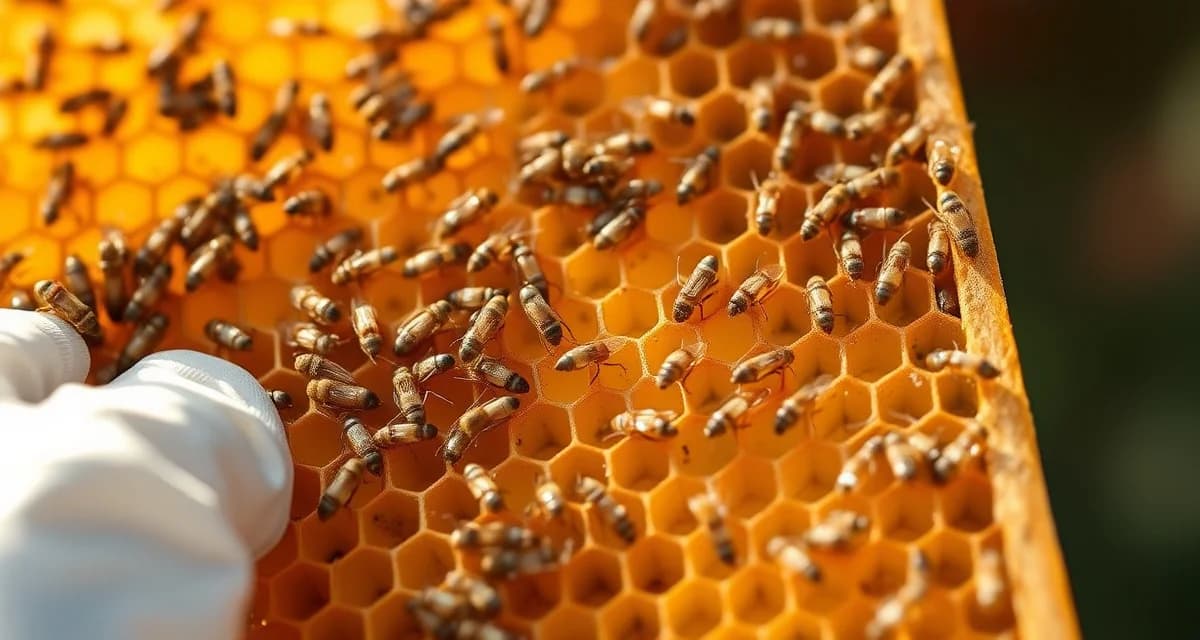
Why Mite Counts Vary So Much Between Hives in the Same Apiary
High-variance apiaries often have a single mite-bomb colony that infests neighbors through robbing and drifting. That one outlier colony can skew your apiary average upward and drag down neighboring hives that were otherwise well-managed. Understanding why counts vary so dramatically between adjacent hives is essential to treating correctly.
Within a single apiary, you can realistically see counts ranging from 0.5% to 8% in the same inspection round. That's not a measurement error. It's a real biological pattern with identifiable causes.
TL;DR
- A valid mite count sample requires approximately 300 bees from the brood nest for statistically reliable results
- alcohol wash is 15-20% more accurate than sugar roll for detecting mite infestation levels
- The calculation is: (mites counted / bees in sample) x 100 = infestation percentage
- A 2% threshold triggers treatment in spring/summer; 1% is the fall action threshold
- Count at least once per month during active season; increase to every 2 weeks if levels are near threshold
- Log every count in VarroaVault to build a trend dataset that shows whether populations are rising or stable
Why Counts Vary So Much Between Adjacent Hives
Colony genetics. Colonies with VSH (Varroa Sensitive Hygiene) genetics suppress mite reproduction inside capped brood. A VSH-expressing colony sitting next to a non-VSH colony will consistently show lower mite counts even under identical reinfestation pressure. If you've requeen some colonies and not others, you'll see this difference clearly.
Queen laying rate and brood amount. Colonies with prolific queens have more brood frames, giving mites more reproductive opportunities. A colony with 8 frames of brood provides far more reproductive sites than one with 4 frames. Higher brood volume means faster mite population growth.
Colony age and history. A colony that received a late treatment last fall starts the spring with a lower foundational mite population. Another colony that was late treated or missed entirely enters spring already carrying more mites. Six months later, those starting differences compound.
Drifting and robbing dynamics. Bees don't stay in their assigned hive. Drifting is constant, and mites hitch rides on drifting bees. Hives positioned at the ends of a row receive more drifting bees than middle hives and often show higher mite counts for this reason alone.
The mite-bomb effect. When one colony reaches a high infestation level (above 6-8%), it becomes a source colony. Robbing bees from neighboring hives enter it, pick up mites, and carry them home. This is the mechanism behind the high-variance apiary: one untreated or treatment-resistant colony drives up counts in neighboring hives even after those neighbors were treated.
Should You Treat All Hives When Only Some Are Above Threshold?
This depends on which hives are above threshold and why.
If only one or two hives are above your treatment threshold (2% pre-winter, 3% during active season), treat those hives and continue monitoring the others. You don't need to treat hives that are at 1% just because a neighbor is at 4%.
However, if you have a mite-bomb colony in the apiary, you should treat that colony immediately regardless of what the others show. A high-mite colony is actively exporting mites to its neighbors. Treating only the neighbors while leaving the source colony high is largely futile.
Also consider the season. In late July and August, when winter bee production is beginning, the risk calculation changes. If several hives are at 2-2.5% with an August first frost date approaching, treating all of them proactively is reasonable even if not all are technically above threshold. The cost of an unnecessary treatment is lower than the cost of inadequate winter bee protection.
Identifying the Mite-Bomb Colony
Signs a colony is functioning as a mite-bomb:
- Count is dramatically higher than its immediate neighbors (4%+ when others are 1-2%)
- Mite counts in neighboring hives increase rapidly after a treatment cycle despite good efficacy
- The high-count colony shows DWV (deformed wing virus) symptomatic bees more frequently than neighbors
When you find a mite-bomb colony, it needs the highest priority treatment. Consider whether this colony is worth saving or whether it should be combined with a strong colony after treating and confirming efficacy.
Using VarroaVault to Manage High-Variance Apiaries
The apiary variance chart in VarroaVault shows all hive counts for a single apiary on one graph, making outlier colonies immediately visible. When you log a count round, each hive appears on the chart. A colony that sits significantly above the apiary average is automatically flagged.
VarroaVault also tracks individual hive count trends over time. If Hive 7 consistently shows counts 3-4x higher than the apiary average across multiple count rounds, that's a pattern, not noise. The trend data helps you distinguish a temporary spike from a chronically high-mite colony.
For multi-apiary operations, the dashboard shows each apiary's variance range alongside its average. An apiary with a tight cluster of counts (1-2%, 1.5%, 1.8%, 2%) is different from one with a wide spread (0.5%, 1%, 3%, 7%), even if the averages look similar.
Frequently Asked Questions
Why do different hives in my apiary have such different mite counts?
Mite counts vary between hives in the same apiary due to differences in colony genetics (especially VSH expression), queen laying rate, colony history, and drifting dynamics. The single biggest driver is often a high-mite "mite-bomb" colony that exports mites to neighbors through robbing and drifting bees. Colonies at the ends of rows typically show higher counts than middle-positioned hives due to increased drifting.
Should I treat all hives when only some are above threshold?
Treat hives that are above threshold individually. You don't need to treat hives that are well below threshold just because a neighbor is high. The exception is when a mite-bomb colony exists in the apiary: that colony should be treated immediately regardless of surrounding counts, because it's actively driving up its neighbors' mite loads. In late summer approaching the winter bee production window, erring toward treating borderline hives is reasonable given the seasonal stakes.
Does VarroaVault flag high-variance apiaries for investigation?
Yes. The apiary variance chart in VarroaVault plots all hive counts from a single apiary on one graph, making outlier colonies visually obvious. Hives that sit significantly above the apiary average are flagged. Persistent high-count colonies across multiple count rounds are identified in the trend analysis, helping you distinguish chronic mite-bomb hives from temporary spikes.
How soon after treatment can I run a post-treatment mite count?
Wait 2-4 weeks after the treatment ends before running a post-treatment count. Counting too soon (within a week of treatment removal) may show mites still dying or emerging from the last brood cycle. Waiting 2-4 weeks allows emerging bees from brood that was capped during treatment to fully emerge and any surviving mites to become detectable in a new count.
What should I do if my mite count results seem unusually high or low?
If results seem surprising, repeat the count within 1-2 weeks before making a treatment decision based on a single outlier result. Confirm you sampled from the brood nest center (not outer frames), used the correct sample size (approximately 300 bees), and shook vigorously for the full 60 seconds. Consistent sampling technique is the most important factor in count accuracy.
Can I count mites from a sticky board instead of doing an alcohol wash?
Sticky board counts measure mite fall rate over 24-72 hours, which correlates with infestation level but is not a direct measure of infestation percentage. Sticky board results cannot be converted to an accurate percentage without calibration, and they are less reliable than alcohol wash for treatment decisions. Use sticky boards for general population monitoring but rely on alcohol wash counts for threshold decisions.
What is Why Mite Counts Vary So Much Between Hives in the Same Apiary?
Mite count variation between hives in the same apiary is a well-documented biological phenomenon where adjacent colonies can show infestation levels ranging from 0.5% to 8% in a single inspection round. This variation stems from differences in colony genetics, brood cycle timing, population size, and exposure to mite-bomb colonies that spread varroa through robbing and drifting. Understanding this variation is critical to treating each hive individually rather than relying on an apiary-wide average that can mask dangerous outliers.
How much does Why Mite Counts Vary So Much Between Hives in the Same Apiary cost?
Understanding why mite counts vary between hives costs nothing beyond your time and a basic monitoring setup. Alcohol wash equipment runs roughly $20-40, and logging your counts in VarroaVault is free to get started. The real cost of ignoring hive-to-hive variation is colony loss — a single untreated mite-bomb colony can reinvest neighbors and collapse multiple hives in a season, making consistent per-hive monitoring one of the highest-return investments in apiary management.
How does Why Mite Counts Vary So Much Between Hives in the Same Apiary work?
Mite count variation works through several interconnected mechanisms. Colonies with hygienic or varroa-sensitive hygiene (VSH) genetics naturally suppress mite reproduction. Brood breaks — whether intentional or due to swarming — temporarily reduce mite population growth. Meanwhile, high-mite colonies become sources of infestation as foragers drift between hives and robbers carry mites back to otherwise healthy colonies. Tracking each hive individually with monthly alcohol washes reveals which colonies are sources versus victims in this dynamic.
What are the benefits of Why Mite Counts Vary So Much Between Hives in the Same Apiary?
Tracking per-hive mite counts rather than apiary averages lets you treat only the hives that need it, reduce unnecessary chemical exposure, and identify your most genetically resilient colonies for future queen rearing. It also reveals mite-bomb outliers before they crash neighboring hives. Logging counts over time in a tool like VarroaVault builds a trend dataset that shows whether a colony's mite load is stable, rising, or responding to treatment — turning reactive management into proactive prevention.
Who needs Why Mite Counts Vary So Much Between Hives in the Same Apiary?
Any beekeeper managing two or more hives in the same apiary needs to understand per-hive mite variation. If you treat all hives together based on one or two sample counts, you will overtreated low-mite colonies and potentially under-treat dangerous outliers. This knowledge is especially critical for hobbyists with 3-10 hives, sideline beekeepers running 50+ colonies, and anyone breeding queens, since mite tolerance traits are highly heritable and worth identifying in your best-performing hives.
Related Articles
Sources
- American Beekeeping Federation (ABF)
- USDA ARS Bee Research Laboratory
- Honey Bee Health Coalition
- Penn State Extension Apiculture Program
- Project Apis m.
Get Started with VarroaVault
An alcohol wash gives you the number. VarroaVault turns that number into a decision. Log your count, get an instant threshold comparison, and build a monitoring history that shows you whether mite levels are rising or stable across your entire operation. See pricing and free tools at varroavault.com.