Sticky Board Mite Counts: How Accurate Are They and When to Use Them
Natural mite drop varies with season, temperature, and bee behavior, making per-day count conversion tables approximate at best. This is the core limitation of sticky board monitoring, and it's why VarroaVault labels sticky board entries as trend indicators rather than percentage calculations.
Here's a clear-eyed look at what sticky boards can and can't tell you.
TL;DR
- This guide covers key aspects of sticky board mite counts: how accurate are they and when to
- Mite monitoring should happen at minimum every 3-4 weeks during active season
- The 2% threshold in spring/summer and 1% in fall are standard action points based on HBHC guidelines
- Always run a pre-treatment and post-treatment mite count to calculate efficacy
- Treatment records including product name, EPA number, dates, and counts are required for state inspection compliance
- VarroaVault stores all monitoring and treatment data with automatic threshold comparison and state export formatting
How Sticky Board Monitoring Works
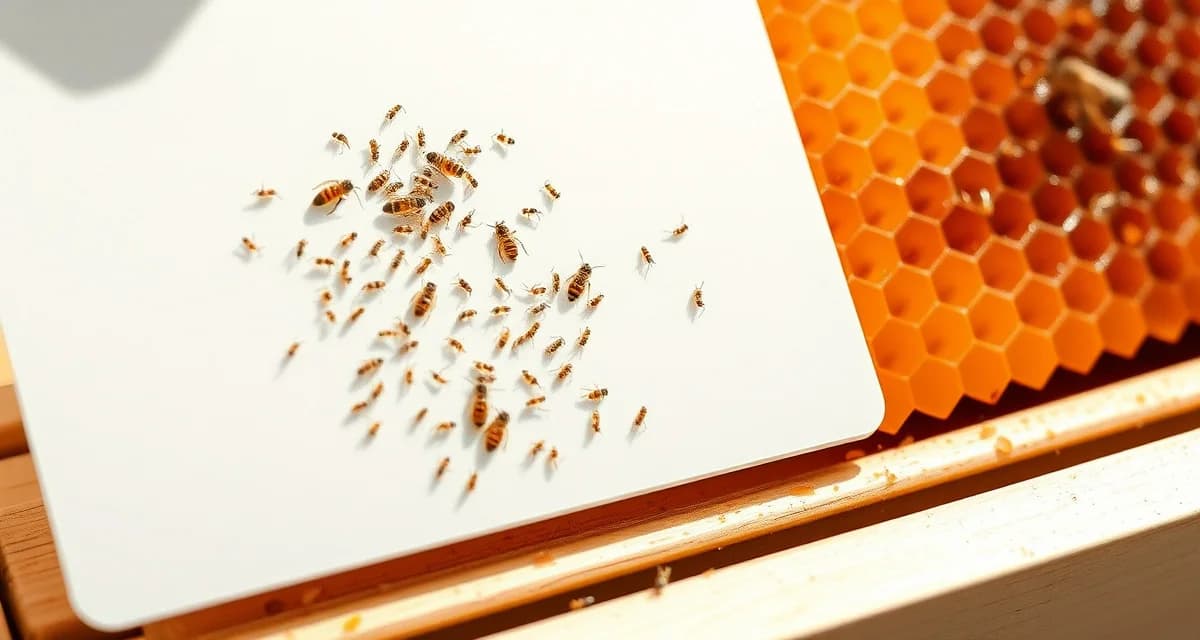
A sticky board is placed under a screened bottom board for 24 hours (or 48 hours, with the result divided by 2 for daily average). Mites that naturally fall off bees during grooming, brood emergence, and movement through the hive land on the sticky surface and are counted.
The idea is that the number of mites falling per day correlates with the total mite population in the colony. Published conversion tables relate daily mite drop counts to estimated infestation percentages.
The problem is that correlation between natural drop and infestation percentage is weak, highly variable, and season-dependent.
Why Drop Count to Percentage Conversion Is Unreliable
The natural mite drop rate changes with several factors that have nothing to do with the infestation level:
Season: Mites drop more frequently in summer when bees are more active. The same 3% infestation shows higher natural drop in July than in October. Conversion tables published as single values (e.g., "1 mite/day = 1% infestation") don't capture this seasonal variation.
Bee behavior: Grooming intensity, brood emergence rate, and hive traffic all affect daily drop. A colony emerging from a treatment has elevated drop as mites die; a colony with low grooming behavior has lower drop despite the same infestation level.
Temperature: Cool temperatures slow bee activity and reduce natural drop. A sticky board count on a cool October day will show lower numbers than the same colony on a warm August day at the same infestation rate.
Colony population: A large colony at 2% has more total mites falling per day than a small colony at 2%, because it has more bees and more total mites.
Published research puts the sensitivity of sticky board monitoring for threshold breach detection at 50-60%. That means 40-50% of colonies above threshold won't be identified by sticky board alone.
What Sticky Boards Are Good For
Despite these limitations, sticky boards have legitimate uses:
Trend monitoring: If your daily drop count goes from 3 to 12 mites per day over three weeks, something is happening. You may not know the exact percentage, but you know counts are rising and you should do an alcohol wash to confirm.
Post-treatment mite kill assessment: The days after OA vaporization or Apivar application show elevated drop counts as mites die. This gives you a visual confirmation that the treatment is killing mites, even before you do a formal post-treatment count.
Screening for obviously high infestations: A daily drop of 30+ mites is a signal that you're dealing with a seriously high infestation, even if you can't calculate the exact percentage. In this case, treat rather than waiting to do a precise count.
Low-cost background monitoring: If you're monitoring many apiaries and want a background signal between scheduled alcohol washes, a sticky board gives you something to look at. It won't replace the scheduled washes, but it tells you if something unusual is happening between them.
How to Read a 24-Hour Sticky Board Count
Place a clean sticky board (or greased white cardboard) under a screened bottom board in the evening. Retrieve it the following evening. Count all mites (brown, oval, 1-2mm in diameter).
Rough interpretation guidelines (active season, summer, normal temperatures):
- 0-2 mites/day: likely below 1-2% infestation
- 3-5 mites/day: may be approaching threshold; do an alcohol wash to confirm
- 6-10 mites/day: likely above 2% threshold; do an alcohol wash and treat
- 10+ mites/day: high infestation likely; treat urgently
These ranges have wide uncertainty. Use them as prompts for alcohol wash confirmation, not as standalone decision data.
Logging Sticky Board Results in VarroaVault
VarroaVault's count log includes a "sticky board" method option. When you select this method, the app records the daily drop count and notes it as a trend indicator. The log explicitly labels this data as approximate, not a percentage calculation, to prevent misinterpretation.
You'll see sticky board entries on your count trend graph as a secondary data type, visually distinct from alcohol wash and sugar roll entries. The graph shows the daily drop count on a secondary axis, making it easy to see whether drop is rising or falling relative to your scheduled alcohol washes.
VarroaVault does not attempt to convert sticky board counts to infestation percentage, because the conversion is too variable to be reliably useful. Instead, sticky board trends are shown alongside your precise counts so you can see whether background monitoring is confirming your scheduled results.
Frequently Asked Questions
When should I use a sticky board versus an alcohol wash?
Use sticky boards for background trend monitoring between scheduled alcohol washes, for post-treatment mite kill observation, and as a low-labor supplement to your regular monitoring program. Use alcohol wash for all treatment threshold decisions, pre-treatment baselines, and post-treatment efficacy verification. Sticky boards cannot replace alcohol wash for precise threshold decisions.
How do I interpret a 24-hour sticky board drop count?
A daily drop of 0-2 mites in active season suggests a low infestation; 3-10 suggests moderate to high; 10+ suggests high infestation. These ranges have wide seasonal uncertainty. Treat any count of 6+ per day as a prompt to do an immediate alcohol wash rather than as a definitive treatment trigger. Use the drop count directionally, not precisely.
Does VarroaVault calculate infestation percentage from sticky board counts?
No. VarroaVault logs sticky board drop counts as trend indicators and does not convert them to infestation percentages. The variability of natural drop with season, temperature, and colony behavior makes such conversions unreliable. Sticky board data appears on your trend graph as a secondary layer alongside your precise alcohol wash counts.
How do I know if my varroa treatment is working?
Run a mite count 2-4 weeks after the treatment ends and compare it to your pre-treatment count. The efficacy formula is: ((pre-count - post-count) / pre-count) x 100. A result above 90% indicates effective treatment. Results below 80% should trigger investigation for possible resistance, application error, or reinfestation. Log both counts in VarroaVault to track efficacy trends across treatment cycles.
How often should I check mite levels in my hives?
At minimum, once per month (every 3-4 weeks) during the active season. Increase to every 2 weeks when counts are near threshold or after a treatment to verify it worked. In fall, monitoring frequency matters most because the window to treat before winter bees are raised is narrow. VarroaVault's monitoring reminders can be set to your preferred interval for each apiary.
What records should I keep for varroa management?
Each record should include: date of count or treatment, hive identifier, monitoring method used, number of bees sampled, mites counted, infestation percentage, treatment product name and EPA registration number, dose applied, treatment start and end dates, and PHI end date. State apiarists typically expect this level of detail during inspections. VarroaVault captures all of these fields in a single log entry.
What is Sticky Board Mite Counts: How Accurate Are They and When to Use Them?
Sticky board mite counts are a passive varroa monitoring method where a sticky sheet placed under a screened bottom board catches mites that naturally fall from bees over 24–48 hours. This guide evaluates their accuracy, explains the seasonal variables that affect natural mite drop, and outlines when sticky boards are useful as trend indicators versus when more precise methods like alcohol wash or sugar roll are needed for treatment decisions.
How much does Sticky Board Mite Counts: How Accurate Are They and When to Use Them cost?
Sticky boards themselves are low-cost beekeeping tools, often under $10, and the monitoring method requires no special equipment beyond the board and a screened bottom board. VarroaVault's monitoring and record-keeping platform, which stores sticky board counts alongside treatment records and threshold comparisons, offers subscription plans — check VarroaVault.com for current pricing on their digital hive management tools.
How does Sticky Board Mite Counts: How Accurate Are They and When to Use Them work?
Place a sticky board under a screened bottom board for 24 hours, then count the mites on the surface. Divide a 48-hour count by 2 for a daily average. The daily mite drop is then compared against seasonal conversion tables to estimate infestation levels. Because natural drop varies with temperature, season, and colony behavior, results are best interpreted as trend data rather than precise infestation percentages.
What are the benefits of Sticky Board Mite Counts: How Accurate Are They and When to Use Them?
Sticky boards offer a non-invasive, low-effort way to monitor mite levels without disturbing the colony or sacrificing bees. They're particularly useful for tracking trends over time, spotting sudden increases in mite drop, and providing a baseline before and after treatment to gauge efficacy. When used consistently and logged with dates and counts, they build a clear infestation history that supports smarter, timely treatment decisions throughout the season.
Who needs Sticky Board Mite Counts: How Accurate Are They and When to Use Them?
Any beekeeper managing colonies with screened bottom boards can benefit from sticky board monitoring, especially those new to varroa management who want a low-barrier entry point. They're also valuable for hobbyists monitoring multiple hives on a budget, and for beekeepers required to maintain treatment records for state inspection compliance. Commercial and sideliner operations use them alongside alcohol washes for a layered monitoring approach across large numbers of hives.
Related Articles
Sources
- American Beekeeping Federation (ABF)
- USDA ARS Bee Research Laboratory
- Honey Bee Health Coalition
- Penn State Extension Apiculture Program
- Project Apis m.
Get Started with VarroaVault
The information in this guide is most useful when you have your own mite count data to apply it to. VarroaVault stores every count, flags threshold crossings automatically, and builds the treatment history you need for state inspections and effective management decisions. See pricing and free tools at varroavault.com.