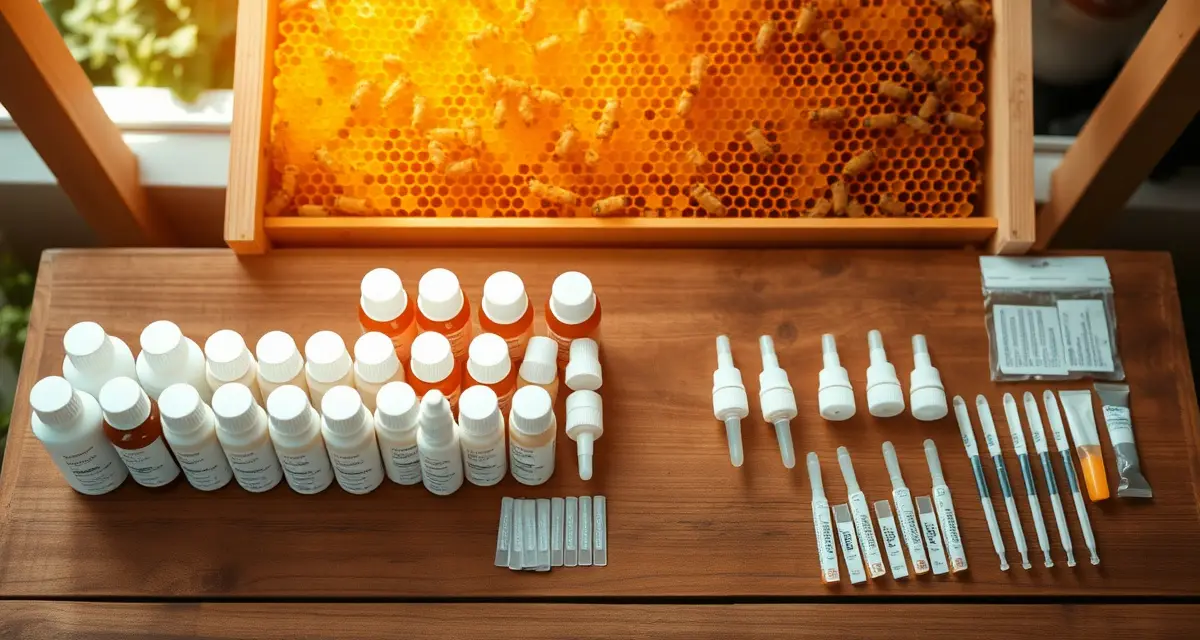
Varroa Treatment Comparison Table: Every Product Side by Side
Choosing a varroa treatment involves more variables than most beekeepers realize. Brood status, ambient temperature, honey super presence, certification status, resistance history, and budget all factor into the decision. This side-by-side comparison covers all 9 EPA-registered products across the key criteria that actually matter for your treatment decision.
The treatment table embedded in VarroaVault's treatment planner allows side-by-side comparison before you select a product to log -- so you can make an informed choice at the moment of decision, not after.
TL;DR
- Treatment decisions should always be triggered by a mite count result, not a fixed calendar date
- Different treatments have different temperature requirements, PHI restrictions, and brood penetration capabilities
- Always run a post-treatment count 2-4 weeks after treatment ends to calculate efficacy
- Efficacy below 80% warrants investigation -- possible resistance, application error, or reinfestation
- Rotate treatment chemistry to prevent resistance buildup across successive cycles
- VarroaVault logs treatment events, calculates efficacy, and flags when rotation is recommended
Critical Facts to Know First
Only formic acid penetrates capped brood cells; all other treatments only reach phoretic mites on adult bees. This single fact should shape every treatment decision you make. If you have capped brood and need the highest possible efficacy, formic acid (MAQS or Formic Pro) is your only organic option. Apivar (amitraz) in strips works effectively in brood-present colonies because the 42-56 day treatment period exposes newly emerged mites repeatedly over multiple brood cycles.
Full Treatment Comparison
Api-Bioxal (Oxalic Acid Dihydrate)
| Criterion | Value |
|---|---|
| Active ingredient | Oxalic acid |
| Class | Organic acid |
| Brood penetration | No -- phoretic mites only |
| Efficacy (broodless) | 90-97% |
| Efficacy (brood present, extended vaporization) | 70-85% |
| Temperature range | Dribble: any (cluster intact); Vapor: 32-100°F |
| PHI | 0 days |
| Can treat with supers on | Yes (per label) |
| Organic certification eligible | Yes (OMRI) |
| Resistance documented | No known resistance |
| Cost per hive (materials) | $3-8 |
| Best use case | Broodless fall treatment; year-round vaporization protocol |
Notes: The gold standard for broodless period treatment. Dribble is a single application; vaporization requires 3 treatments at 5-day intervals when brood is present.
Apivar (Amitraz)
| Criterion | Value |
|---|---|
| Active ingredient | Amitraz |
| Class | Formamidine (synthetic acaricide) |
| Brood penetration | Indirect -- strips remain through multiple brood cycles |
| Efficacy | 90-95% when applied correctly |
| Temperature range | Above 50°F preferred |
| PHI | 14 days after strip removal |
| Can treat with supers on | No -- strips must go in before supers, or supers removed |
| Organic certification eligible | No |
| Resistance documented | Yes -- documented in some US regions |
| Cost per hive (strips) | $4-6 |
| Best use case | Active season treatment; spring or fall with brood present |
Notes: Most forgiving synthetic option. 42-56 day strip treatment covers multiple mite reproductive cycles. Must be removed before honey supers are placed.
Apistan (Tau-Fluvalinate)
| Criterion | Value |
|---|---|
| Active ingredient | Tau-fluvalinate |
| Class | Pyrethroid (synthetic) |
| Brood penetration | No |
| Efficacy | Variable -- 50-90% due to widespread resistance |
| Temperature range | Any |
| PHI | 30 days after strip removal |
| Can treat with supers on | No |
| Organic certification eligible | No |
| Resistance documented | Widespread in the US |
| Cost per hive | $3-5 |
| Best use case | Only in areas with confirmed low resistance |
Notes: Largely superseded by Apivar due to resistance. Do not use as a primary treatment without resistance testing in your area.
CheckMite+ (Coumaphos)
| Criterion | Value |
|---|---|
| Active ingredient | Coumaphos |
| Class | Organophosphate (synthetic) |
| Brood penetration | No |
| Efficacy | 80-92% |
| Temperature range | Any |
| PHI | Follow label carefully; supers must be off |
| Can treat with supers on | No |
| Organic certification eligible | No |
| Resistance documented | Yes -- resistance well-documented |
| Cost per hive | $4-6 |
| Best use case | Limited use; not recommended as primary treatment |
Notes: Coumaphos residue persists in wax for years. Resistance documented. Most integrated management programs minimize or eliminate this option.
MAQS (Formic Acid 68.2%)
| Criterion | Value |
|---|---|
| Active ingredient | Formic acid |
| Class | Organic acid |
| Brood penetration | Yes -- kills mites in capped brood cells |
| Efficacy | 80-95% |
| Temperature range | 50-85°F (do not apply above 85°F) |
| PHI | 0 days |
| Can treat with supers on | Yes (per label, within temperature limits) |
| Organic certification eligible | Yes |
| Resistance documented | No known resistance |
| Cost per hive | $6-10 |
| Best use case | Mid-season brood-present treatment; spring treatment |
Notes: The only organic treatment that penetrates capped brood. Can cause brace comb and sometimes brood loss or queen injury at temperature extremes. 7-day treatment.
Formic Pro (Formic Acid 46.7%)
| Criterion | Value |
|---|---|
| Active ingredient | Formic acid |
| Class | Organic acid |
| Brood penetration | Yes |
| Efficacy | 75-90% |
| Temperature range | 50-79°F |
| PHI | 0 days |
| Can treat with supers on | Yes |
| Organic certification eligible | Yes |
| Resistance documented | No known resistance |
| Cost per hive | $6-10 |
| Best use case | Moderate temperature treatment; lower brood damage risk than MAQS |
Notes: Lower concentration than MAQS means reduced risk of brood/queen injury but stricter upper temperature limit. 10-day treatment. Good choice when temperatures are moderate and stable.
Apiguard (Thymol 25%)
| Criterion | Value |
|---|---|
| Active ingredient | Thymol |
| Class | Essential oil |
| Brood penetration | No |
| Efficacy | 70-93% |
| Temperature range | 59-69°F optimal; ineffective below 59°F |
| PHI | 2 weeks after second tray removed |
| Can treat with supers on | No -- remove 2 weeks before applying |
| Organic certification eligible | Yes |
| Resistance documented | No |
| Cost per hive | $5-8 |
| Best use case | Fall treatment in moderate climate zones |
Notes: Temperature dependent. Strong odor. Two-tray protocol applied 2 weeks apart. Not effective in hot or cold extremes.
ApiLife VAR (Thymol Blend)
| Criterion | Value |
|---|---|
| Active ingredient | Thymol 74.1%, eucalyptol, L-menthol, camphor |
| Class | Essential oil blend |
| Brood penetration | No |
| Efficacy | 70-90% |
| Temperature range | 64-69°F optimal |
| PHI | Follow label |
| Can treat with supers on | No |
| Organic certification eligible | Yes |
| Resistance documented | No |
| Cost per hive | $5-8 |
| Best use case | Moderate temperature fall treatment |
Notes: Narrower temperature window than Apiguard. Multiple application tabs. Good option for organic operations in the right conditions.
HopGuard 3 (Hop Beta Acids)
| Criterion | Value |
|---|---|
| Active ingredient | Potassium salts of hop beta acids |
| Class | Botanical |
| Brood penetration | No |
| Efficacy | 50-70% |
| Temperature range | Any |
| PHI | 0 days |
| Can treat with supers on | Yes (check your state -- some restrictions apply) |
| Organic certification eligible | Yes |
| Resistance documented | No |
| Cost per hive | $6-9 |
| Best use case | Supplemental treatment; broodless period; flow-period option |
Notes: Lower efficacy than most other options. Best used as a supplement or in a broodless period when combined with other methods. Approved for use during honey flow in most states.
How to Use This Table
This comparison covers the static criteria. Your actual decision also depends on what you have in stock, what you used last season (for rotation purposes), and your specific hive conditions right now. The [treatment rotation planning](/treatment-rotation-planning) guide walks through the rotation logic in detail.
For a fully interactive version of this table that filters by your current conditions, see the what kills varroa mites overview, which links each product to its full guide.
Frequently Asked Questions
Which varroa treatment penetrates capped brood?
Only formic acid penetrates capped brood cells. MAQS and Formic Pro both use formic acid as their active ingredient, and both have documented brood penetration that kills mites in the capped (phoretic stage) reproductive phase. All other registered varroa treatments -- including oxalic acid, amitraz strips, coumaphos, thymol, and hop acids -- only affect phoretic mites on adult bees. This makes formic acid particularly valuable for mid-season treatment when brood is always present.
What is the cheapest registered varroa treatment?
On a per-hive material cost basis, Api-Bioxal oxalic acid is typically the cheapest option, running $3-8 per hive depending on method and colony count. Oxalic acid crystals are inexpensive, and the dribble method has essentially no equipment cost beyond a syringe. Vaporization requires a vaporizer (one-time cost of $50-200), but the per-hive material cost remains very low over time. Apivar strips at $4-6 per hive are the cheapest synthetic option.
Can I see this comparison table inside VarroaVault?
Yes. VarroaVault's treatment planner includes an interactive version of this comparison table. When you open a new treatment record, you can view a filtered version of the table based on your current hive conditions -- brood status, temperature, super status, and certification requirements -- which narrows the options to products that are appropriate for your specific situation right now. The full table is also accessible from the product reference section.
How do I know if my varroa treatment is working?
Run a mite count 2-4 weeks after the treatment ends and compare it to your pre-treatment count. The efficacy formula is: ((pre-count - post-count) / pre-count) x 100. A result above 90% indicates effective treatment. Results below 80% should trigger investigation for possible resistance, application error, or reinfestation. Log both counts in VarroaVault to track efficacy trends across treatment cycles.
How often should I check mite levels in my hives?
At minimum, once per month (every 3-4 weeks) during the active season. Increase to every 2 weeks when counts are near threshold or after a treatment to verify it worked. In fall, monitoring frequency matters most because the window to treat before winter bees are raised is narrow. VarroaVault's monitoring reminders can be set to your preferred interval for each apiary.
What records should I keep for varroa management?
Each record should include: date of count or treatment, hive identifier, monitoring method used, number of bees sampled, mites counted, infestation percentage, treatment product name and EPA registration number, dose applied, treatment start and end dates, and PHI end date. State apiarists typically expect this level of detail during inspections. VarroaVault captures all of these fields in a single log entry.
What is Varroa Treatment Comparison Table: Every Product Side by Side?
The Varroa Treatment Comparison Table is a side-by-side reference covering all 9 EPA-registered varroa mite treatments. It compares key decision factors including temperature requirements, brood penetration capability, pre-harvest intervals, organic certification status, resistance history, and cost — giving beekeepers a complete picture of every available option before selecting a treatment to log in VarroaVault's treatment planner.
How much does Varroa Treatment Comparison Table: Every Product Side by Side cost?
The comparison table itself is free to use within VarroaVault. The individual treatment products vary in price depending on type and brand — oxalic acid options tend to be the most affordable, while extended-release formic acid strips and amitraz treatments fall in a mid-range. VarroaVault's treatment planner, which integrates the table and tracks efficacy over time, is available as part of the platform's core feature set.
How does Varroa Treatment Comparison Table: Every Product Side by Side work?
The table works by organizing all 9 EPA-registered varroa treatments across the criteria that most affect real-world decisions: ambient temperature windows, honey super restrictions, whether the product penetrates capped brood, PHI requirements, and organic eligibility. Within VarroaVault, the table is embedded directly in the treatment planner so beekeepers can compare options at the moment they're ready to log a treatment event.
What are the benefits of Varroa Treatment Comparison Table: Every Product Side by Side?
Using this comparison table helps beekeepers avoid common treatment mistakes — choosing a product outside its effective temperature range, applying during an open honey flow, or repeating the same chemistry cycle after cycle. It supports informed rotation to reduce resistance risk, ensures post-treatment efficacy counts are scheduled correctly, and helps beekeepers catch reinfestation or resistance early when efficacy drops below 80%.
Who needs Varroa Treatment Comparison Table: Every Product Side by Side?
Any beekeeper managing varroa mite loads needs this resource — from hobbyists running a few hives to commercial operators managing hundreds. It's especially valuable for those new to mite management, anyone switching treatments after a resistance concern, certified organic producers who must stay within approved chemistries, and beekeepers in regions with variable seasonal temperatures that constrain which products are safe and effective to apply.
Sources
- American Beekeeping Federation (ABF)
- USDA ARS Bee Research Laboratory
- Honey Bee Health Coalition
- Penn State Extension Apiculture Program
- Project Apis m.
Get Started with VarroaVault
If your current app is logging treatments without tracking efficacy, you're missing the data that actually tells you whether your varroa management is working. VarroaVault adds automatic efficacy calculation, resistance flagging, and state inspection export to the standard beekeeping app feature set. See pricing and free tools at varroavault.com.