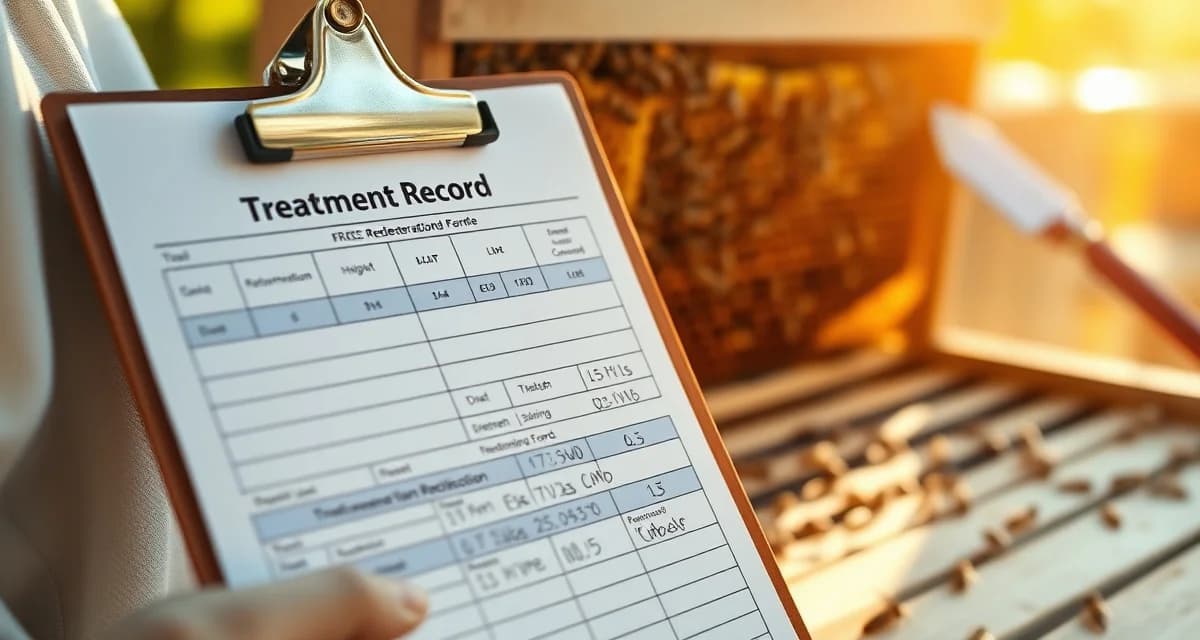
Varroa Treatment Record: Exactly What 7 Fields to Include Every Time
Most beekeepers who keep treatment records don't keep the right ones. They note the date and product, which is a start, but state inspectors in 23 states have reported rejecting treatment records that didn't include the product's EPA registration number. That rejection can mean penalties, failed inspections, or honey that can't be sold because provenance can't be established.
A legally defensible treatment record has exactly 7 required fields. VarroaVault's treatment log automatically captures all 7 and pre-fills EPA registration numbers for all registered products so you never have to look one up at the apiary.
TL;DR
- Treatment decisions should always be triggered by a mite count result, not a fixed calendar date
- Different treatments have different temperature requirements, PHI restrictions, and brood penetration capabilities
- Always run a post-treatment count 2-4 weeks after treatment ends to calculate efficacy
- Efficacy below 80% warrants investigation -- possible resistance, application error, or reinfestation
- Rotate treatment chemistry to prevent resistance buildup across successive cycles
- VarroaVault logs treatment events, calculates efficacy, and flags when rotation is recommended
The 7 Required Fields
1. Date of treatment application
Not approximate, not "mid-August." The exact date: August 14, 2026. For multi-day treatments like Apivar (which stays in the hive for 42-56 days), record the application start date and the planned removal date. When you remove strips, log that date as well.
2. Product name (brand name)
Write the brand name as it appears on the label: "Apivar" not "amitraz strips." "Api-Bioxal" not "oxalic acid." "MAQS" not "formic acid pads." State inspectors match product names to their registered product list. Non-standard abbreviations or informal names create ambiguity that inspectors may flag.
3. EPA registration number
This is the number most beekeepers miss. It appears on the product label as "EPA Reg. No. XXXXX-XXXX." For reference:
- Apivar: EPA Reg. No. 86243-3
- Api-Bioxal: EPA Reg. No. 87243-1
- MAQS: EPA Reg. No. 81824-1
- Formic Pro: EPA Reg. No. 87831-1
- Apiguard: EPA Reg. No. 70299-12
VarroaVault pre-fills this number automatically when you select the product from the registered product list, which is why the product selector matters.
4. Dose and application method
Record the exact dose applied, not just "one treatment." For Apivar: "2 strips per colony." For Api-Bioxal dribble: "50ml of 3.2% solution, 5ml per seam." For MAQS: "2 pads, one per side of brood nest." For OA vaporization: "1g per brood box, single vaporization."
Application method matters for inspectors reviewing whether the treatment was applied in accordance with label directions.
5. Colony ID
Each colony treated needs to be identified by a name or number that matches your colony registry. "Hive 4" is sufficient if Hive 4 is consistently used as that colony's identifier across all your records. What's not acceptable is a treatment record with no colony identifier at all.
6. Reason for treatment
"Pre-emptive fall treatment per annual management plan" or "Count of 3.2% on 8/12 exceeded 2% threshold" are both valid. This field creates the context that shows your treatment decisions were based on management logic rather than random application. It also protects you if an inspector questions why you treated when you did.
7. PHI start date
For any treatment with a pre-harvest interval, record the date from which PHI begins. For Apivar and Apistan (strip treatments), PHI runs from the date of strip removal, not the date of application. For MAQS (7-day treatment with 0-day PHI for honey), PHI considerations apply to certain uses. For Api-Bioxal (0-day PHI), the PHI start date is the treatment date itself. This distinction is critical: many compliance errors come from beekeepers who calculate PHI from application date for strip treatments.
Using the State Inspection Requirements for Treated Hives
Different states have different specific requirements on top of these 7 fields. Some states require the beekeeper's registration number on every treatment record. Some require records to be retained for 2 years; others require 5. Check your state's requirements via your state apiarist's website.
The beekeeping record keeping requirements guide has a state-by-state summary of record retention and format requirements.
Frequently Asked Questions
What are the 7 required fields in a varroa treatment record?
The 7 required fields are: (1) exact treatment date, (2) product brand name as it appears on the label, (3) EPA registration number from the product label, (4) dose and application method in specific quantities, (5) colony ID matching your colony registry, (6) reason for treatment, and (7) PHI start date calculated correctly for that product. All 7 fields are needed for a legally defensible record that will pass a state inspection. Missing any one of them creates a compliance gap that inspectors may reject.
Does VarroaVault automatically capture the EPA registration number?
Yes. When you select a registered varroa product from VarroaVault's product list, the app pre-fills the EPA registration number automatically. You never need to look it up in the field or transcribe it from the label. VarroaVault's product list is maintained with current EPA registration data and updated when registrations change. If you're treating with a registered product that you can't find in VarroaVault's list, contact support: the product may have been recently registered or the name may appear under a different listing.
How do I ensure my treatment records are legally defensible?
Use VarroaVault's treatment log for every treatment, every time. The log forces completion of all 7 required fields before a record can be saved, which means you can't accidentally skip the EPA number or forget to record the dose. After logging, VarroaVault generates a compliance-ready export in the format accepted by state apiarists in 27 states. For states not currently in the pre-approved list, the export format includes all standard required fields and can be submitted in most state inspection formats. Keep records for a minimum of 2 years, or 5 years if your state requires it.
How do I know if my varroa treatment is working?
Run a mite count 2-4 weeks after the treatment ends and compare it to your pre-treatment count. The efficacy formula is: ((pre-count - post-count) / pre-count) x 100. A result above 90% indicates effective treatment. Results below 80% should trigger investigation for possible resistance, application error, or reinfestation. Log both counts in VarroaVault to track efficacy trends across treatment cycles.
How often should I check mite levels in my hives?
At minimum, once per month (every 3-4 weeks) during the active season. Increase to every 2 weeks when counts are near threshold or after a treatment to verify it worked. In fall, monitoring frequency matters most because the window to treat before winter bees are raised is narrow. VarroaVault's monitoring reminders can be set to your preferred interval for each apiary.
What records should I keep for varroa management?
Each record should include: date of count or treatment, hive identifier, monitoring method used, number of bees sampled, mites counted, infestation percentage, treatment product name and EPA registration number, dose applied, treatment start and end dates, and PHI end date. State apiarists typically expect this level of detail during inspections. VarroaVault captures all of these fields in a single log entry.
What is Varroa Treatment Record: Exactly What 7 Fields to Include Every Time?
A varroa treatment record is a standardized log documenting every mite treatment applied to a beehive. The 7 required fields ensure the record is legally defensible and useful for tracking efficacy over time. These fields include the treatment date, product name, EPA registration number, application method, colony identifier, mite count that triggered treatment, and post-treatment efficacy count. Without all 7 fields, records may be rejected by state inspectors in 23 states, risking penalties or honey sales issues.
How much does Varroa Treatment Record: Exactly What 7 Fields to Include Every Time cost?
VarroaVault's treatment logging tool is free to use for core record-keeping. The platform pre-fills EPA registration numbers for all registered varroa treatments, saving time at the apiary. Premium features include efficacy trend analysis, resistance rotation alerts, and exportable inspection-ready reports. Pricing details are available on the VarroaVault plans page, but basic compliant logging costs nothing to start.
How does Varroa Treatment Record: Exactly What 7 Fields to Include Every Time work?
When you log a treatment in VarroaVault, the system captures all 7 required fields automatically. It pre-fills EPA registration numbers, timestamps the entry, and links it to your pre-treatment mite count. After treatment ends, you enter a post-treatment count and VarroaVault calculates efficacy automatically. If efficacy falls below 80%, the platform flags the result and prompts investigation into resistance, application error, or reinfestation.
What are the benefits of Varroa Treatment Record: Exactly What 7 Fields to Include Every Time?
Keeping complete 7-field treatment records protects you during state inspections, supports honey provenance documentation, and helps identify resistance patterns early. Tracking pre- and post-treatment mite counts lets you calculate whether a treatment actually worked. Over multiple seasons, the data reveals whether your chosen chemistry is losing effectiveness, prompting timely rotation before a resistance problem compounds and colony losses increase.
Who needs Varroa Treatment Record: Exactly What 7 Fields to Include Every Time?
Any beekeeper who sells honey, operates in a state with inspection requirements, or manages more than a handful of hives needs complete treatment records. Commercial and sideliner beekeepers benefit most, since incomplete records can block honey sales or trigger regulatory penalties. Hobbyists gain too — proper records make it easy to spot treatment failures early and make informed decisions about rotating varroa management chemistry each season.
Related Articles
Sources
- American Beekeeping Federation (ABF)
- USDA ARS Bee Research Laboratory
- Honey Bee Health Coalition
- Penn State Extension Apiculture Program
- Project Apis m.
Get Started with VarroaVault
The information in this guide is most useful when you have your own mite count data to apply it to. VarroaVault stores every count, flags threshold crossings automatically, and builds the treatment history you need for state inspections and effective management decisions. See pricing and free tools at varroavault.com.