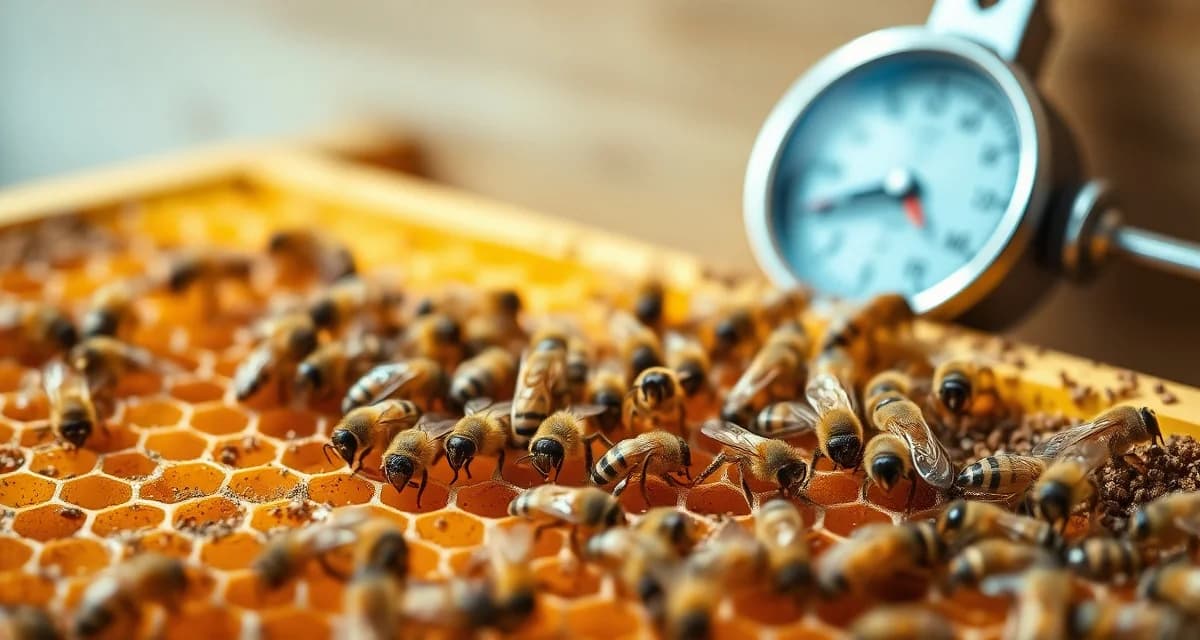
Temperature and Varroa Treatment: How Weather Affects Every Product
More than 40% of formic acid treatment failures are associated with applications outside the recommended temperature range. That's not a small fraction. It means that when beekeepers report MAQS or Formic Pro "didn't work," nearly half the time the product wasn't the problem. The weather was.
Here's a complete temperature guide for every registered varroa treatment, with the practical implications for treatment planning.
TL;DR
- This guide covers key aspects of temperature and varroa treatment: how weather affects every
- Mite monitoring should happen at minimum every 3-4 weeks during active season
- The 2% threshold in spring/summer and 1% in fall are standard action points based on HBHC guidelines
- Always run a pre-treatment and post-treatment mite count to calculate efficacy
- Treatment records including product name, EPA number, dates, and counts are required for state inspection compliance
- VarroaVault stores all monitoring and treatment data with automatic threshold comparison and state export formatting
Why Temperature Matters for Organic Treatments
Organic varroa treatments work through chemical exposure, either by direct contact (OA dribble), vapor contact (OA vaporization, thymol, formic acid), or slow release (Apivar strips, which have no temperature sensitivity). The vapor-based treatments are temperature-dependent because evaporation rate changes with temperature:
- Too cold: Insufficient vapor production. The treatment sits in the hive without reaching mites effectively.
- Too hot: Excessive vapor. Can cause bee stress, brood abandonment, queen loss, and in extreme cases, colony mortality.
The window for each product is calibrated to maintain effective concentration without toxicity to bees.
Temperature Requirements by Product
Oxalic Acid Dribble (Api-Bioxal dribble method)
Range: Works at any temperature above freezing (32°F / 0°C) when bees are present and clustered.
Notes: No meaningful temperature sensitivity for the dribble method. The efficacy of OA dribble depends on brood status (must be broodless for high efficacy), not temperature. You do need temperatures above 45-50°F for safe hive opening and application, but the OA itself functions in cold weather. This makes it ideal for winter treatment.
Temperature-related failure mode: None specific to the product. Temperature matters for timing (confirming broodlessness) but not for the treatment mechanism.
Oxalic Acid Vaporization (sublimation method)
Range: Best above 50°F (10°C) ambient for even vapor distribution. Can be performed at lower temperatures with reduced penetration into the cluster.
Notes: OA vaporization works by sublimating solid OA crystals to gas using a heating element. The vapor distributes through the hive. In very cold weather (below 40°F), the vapor cools and condenses quickly, reducing penetration into the cluster. Most experienced OA vaporizers prefer ambient temperatures above 50°F for consistent results.
Temperature-related failure mode: Below 40°F, reduced vapor distribution can lower efficacy from 90%+ to 75-80% in very cold conditions.
Formic Acid - MAQS Strips
Range: 50-85°F (10-30°C) daytime highs, with nighttime temperatures above 50°F for the first 24 hours.
Notes: MAQS provides the fastest formic acid release of the registered products. This makes it highly effective when temperature is right, but also means overheating risk is higher than with Formic Pro. Above 85°F, formic acid vapor can damage brood and stress queens. Above 92°F, colony mortality risk increases.
Temperature-related failure mode: Below 50°F, formic acid evaporation is insufficient. Above 85°F, efficacy remains but bee and queen stress increases significantly.
Practical note: MAQS can be used with honey supers on per the label, but beekeepers in very hot climates often remove supers anyway to avoid formic acid absorption into honey.
Formic Acid - Formic Pro
Range: 50-85°F (10-30°C) daytime highs.
Notes: Formic Pro uses a gel matrix that releases formic acid more slowly than MAQS, reducing overheating risk in warm weather. The effective window is essentially the same (50-85°F), but the colony stress in hot weather is lower.
Temperature-related failure mode: Same as MAQS but with slightly wider practical tolerance. Below 50°F: insufficient release. Above 85°F: stress concern, but lower risk than MAQS.
Thymol - Apiguard
Range: Minimum 59°F (15°C) daytime highs for effective vapor release.
Notes: Thymol has a higher minimum temperature requirement than formic acid. Below 59°F, almost no thymol evaporates from the gel and efficacy drops to approximately 20%. This is the product most commonly misapplied in cooler conditions.
Temperature-related failure mode: The 59°F minimum is a hard threshold. Efficacy at 55°F is dramatically lower than at 65°F. Always check your forecast for the full 28-day treatment period before starting Apiguard.
Thymol - ApiLife VAR
Range: 59-99°F (15-37°C).
Notes: ApiLife VAR is a thymol-based tablet that also contains eucalyptus oil and camphor. Temperature requirements are similar to Apiguard. ApiLife VAR has a slightly higher maximum tolerance due to the tablet format's controlled release.
Temperature-related failure mode: Same as Apiguard below 59°F. Less bee stress risk above 85°F than Apiguard gel.
Amitraz - Apivar Strips
Range: No temperature sensitivity. Works at any normal hive temperature.
Notes: Apivar releases amitraz through contact from plastic strips. This contact mechanism is independent of ambient temperature. The strips function the same at 45°F as at 90°F. This temperature independence is one of Apivar's practical advantages for spring and fall use when organic treatments may be temperature-constrained.
Temperature-related failure mode: None. Placement error and duration are the primary Apivar failure modes, not temperature.
Hop Beta Acids - HopGuard III
Range: Active at hive temperatures (above 57°F ambient).
Notes: HopGuard III releases hop beta acids in direct contact with bees. Effective across a wider temperature range than thymol or formic treatments, including with honey supers on.
Temperature Compliance Check in VarroaVault
VarroaVault's temperature compliance check shows real-time treatment viability based on your local forecast at the time of logging a treatment. When you select a treatment product in the logging form, the app queries your location's weather forecast and displays:
- Current treatment viability (green: in range, amber: marginal, red: out of range)
- Forecast for the next 14 days showing any temperature windows that fall outside product requirements
- A note if a planned multi-day treatment (like Apiguard's 28-day period) has cold weather forecast that may reduce efficacy
This check doesn't prevent you from logging a treatment outside the temperature window, but it flags the risk so you can make an informed decision.
Frequently Asked Questions
What temperature is required for oxalic acid treatment?
OA dribble works at any temperature above freezing and is the only registered varroa treatment that can be applied in winter at colony temperatures. OA vaporization works best above 50°F ambient for good vapor distribution. Neither method has the temperature sensitivity of organic acid or thymol treatments.
Can I use MAQS in cold weather?
MAQS requires a minimum of 50°F daytime highs. Below this threshold, formic acid evaporation drops to levels that produce insufficient vapor for effective mite control. If your daytime temperatures are consistently below 50°F, wait for a warmer window or switch to a temperature-independent treatment like Apivar.
Does VarroaVault check the temperature before I log a treatment?
Yes. VarroaVault's temperature compliance check queries your local weather forecast when you select a temperature-sensitive treatment product. It shows current viability (green, amber, or red) and the 14-day forecast for treatments with extended application periods. This helps you confirm weather conditions are appropriate before committing to a treatment.
How do I know if my varroa treatment is working?
Run a mite count 2-4 weeks after the treatment ends and compare it to your pre-treatment count. The efficacy formula is: ((pre-count - post-count) / pre-count) x 100. A result above 90% indicates effective treatment. Results below 80% should trigger investigation for possible resistance, application error, or reinfestation. Log both counts in VarroaVault to track efficacy trends across treatment cycles.
How often should I check mite levels in my hives?
At minimum, once per month (every 3-4 weeks) during the active season. Increase to every 2 weeks when counts are near threshold or after a treatment to verify it worked. In fall, monitoring frequency matters most because the window to treat before winter bees are raised is narrow. VarroaVault's monitoring reminders can be set to your preferred interval for each apiary.
What records should I keep for varroa management?
Each record should include: date of count or treatment, hive identifier, monitoring method used, number of bees sampled, mites counted, infestation percentage, treatment product name and EPA registration number, dose applied, treatment start and end dates, and PHI end date. State apiarists typically expect this level of detail during inspections. VarroaVault captures all of these fields in a single log entry.
What is Temperature and Varroa Treatment: How Weather Affects Every Product?
This article is a comprehensive guide explaining how ambient temperature affects the efficacy of every registered varroa mite treatment, including formic acid products like MAQS and Formic Pro. It reveals that over 40% of formic acid treatment failures are linked to applications outside recommended temperature ranges, and provides beekeepers with practical temperature guidelines for each product to improve treatment outcomes and colony health.
How much does Temperature and Varroa Treatment: How Weather Affects Every Product cost?
The article itself is free educational content on VarroaVault. The treatments discussed—such as MAQS, Formic Pro, and oxalic acid products—vary in cost depending on supplier and colony count, typically ranging from a few dollars to $30+ per application. VarroaVault also offers a monitoring and records platform; pricing for that tool should be checked directly on the VarroaVault website.
How does Temperature and Varroa Treatment: How Weather Affects Every Product work?
The guide works by mapping each registered varroa treatment to its specific temperature requirements, explaining why those thresholds exist, and showing how weather conditions either enable or inhibit the chemical exposure mechanisms that kill mites. Beekeepers can use the temperature ranges provided to time applications correctly, avoiding the common mistake of treating during weather conditions that render a product ineffective or unsafe.
What are the benefits of Temperature and Varroa Treatment: How Weather Affects Every Product?
The primary benefit is dramatically improved treatment success rates. By understanding temperature requirements before applying any product, beekeepers can avoid the nearly 50% of formic acid failures caused by weather-related misuse. Additional benefits include better colony survival, reduced wasted product costs, more accurate interpretation of treatment results, and smarter treatment scheduling that aligns with both mite pressure thresholds and seasonal weather windows.
Who needs Temperature and Varroa Treatment: How Weather Affects Every Product?
Any beekeeper managing colonies with varroa mites—from hobbyists with a few hives to commercial operators with hundreds—needs this guidance. It is especially critical for beekeepers who have experienced unexplained treatment failures, those in regions with volatile spring or fall temperatures, and anyone preparing to treat during shoulder seasons when temperatures fluctuate and the risk of applying outside the safe range is highest.
Related Articles
Sources
- American Beekeeping Federation (ABF)
- USDA ARS Bee Research Laboratory
- Honey Bee Health Coalition
- Penn State Extension Apiculture Program
- Project Apis m.
Get Started with VarroaVault
The information in this guide is most useful when you have your own mite count data to apply it to. VarroaVault stores every count, flags threshold crossings automatically, and builds the treatment history you need for state inspections and effective management decisions. See pricing and free tools at varroavault.com.