120v vaporizer varroa mite treatment: the complete field guide
TL;DR
- A 120v oxalic acid vaporizer heats OA crystals to a gas that kills phoretic varroa mites on contact.
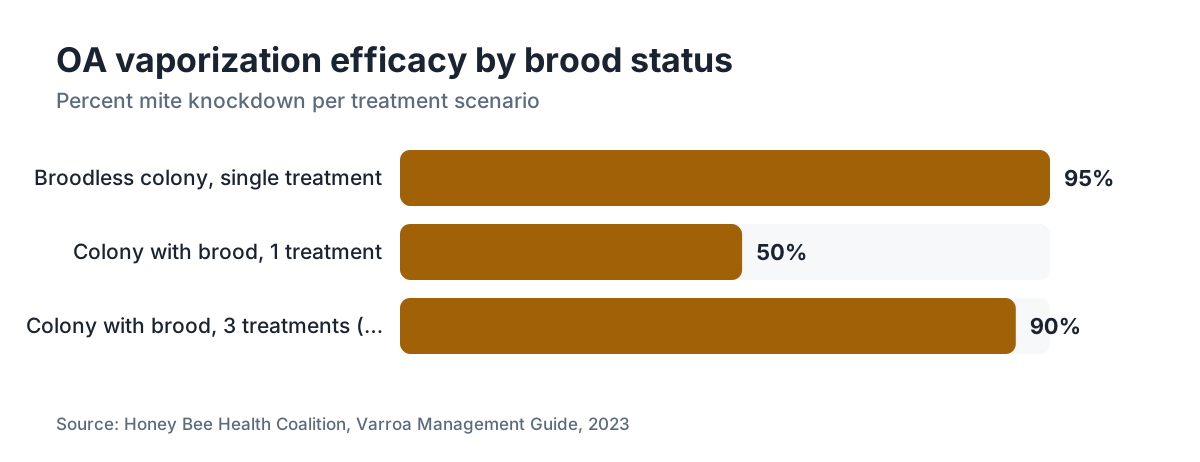
- In broodless colonies, a single treatment can knock down mite loads by 90% or more.
- With brood present, three to four treatments spaced seven days apart are standard.
- The 120v models heat faster and hold temperature more consistently than 12v battery units, making them the better tool for sideliner beekeepers treating multiple hives.
What is a 120v vaporizer and how does it treat varroa mites?
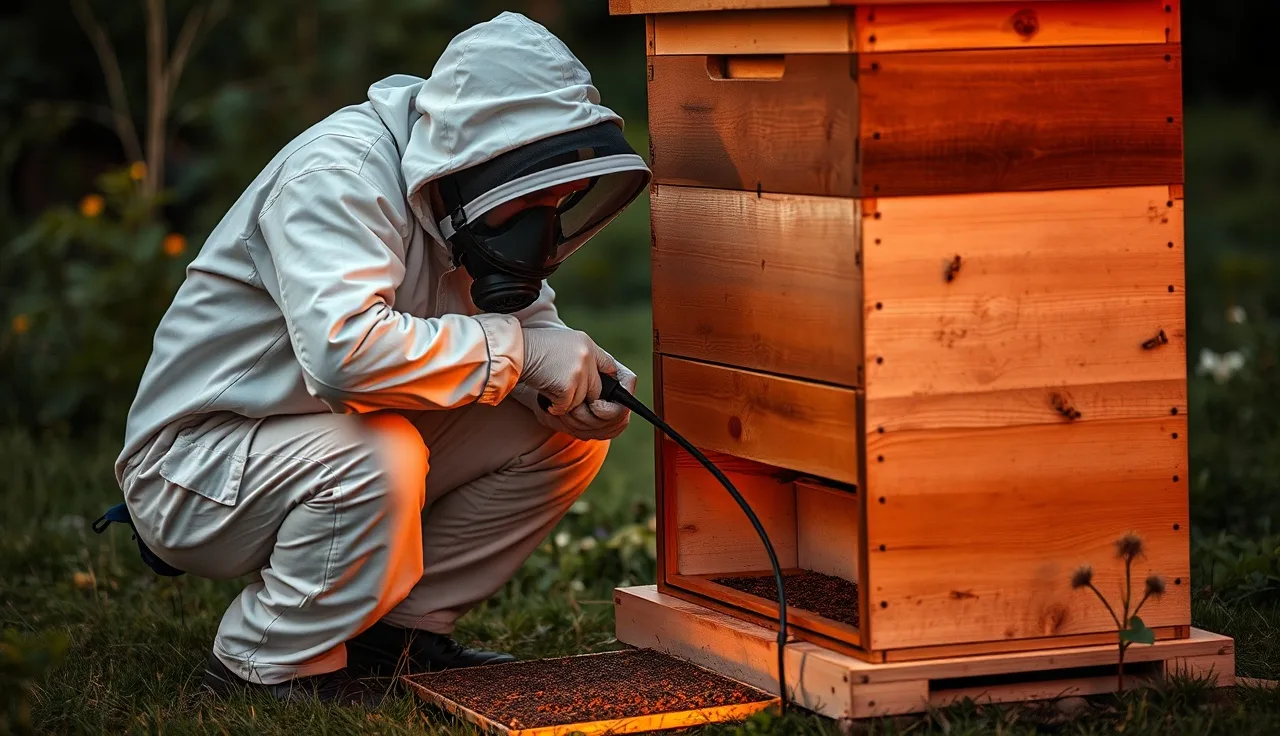
A 120v oxalic acid vaporizer is a resistively heated pan, wand, or probe that plugs into standard household current and converts a measured dose of oxalic acid dihydrate crystals into a gas. You seal the hive entrance, slide the pan in, let the acid vaporize for about two minutes, then leave the entrance sealed another couple of minutes so the gas deposits on every surface the bees touch. Mites die on contact with the condensed crystals. Bees tolerate the dose at the label-approved rate of 1 gram of OA per brood box.
Oxalic acid kills phoretic mites, meaning mites riding adult bees outside of capped cells. It does not penetrate cappings. That biology is the whole ballgame. If you have capped brood, mites hiding inside those cells survive, which is why timing and repeat treatments matter so much.
The 120v designation just tells you the power source. These vaporizers run on a standard wall outlet or extension cord, drawing roughly 100 to 200 watts depending on the model. That sustained power means the heating element reaches the 190 to 220°C target range faster and holds it more steadily than most 12v vaporizer varroa mite treatment setups, which depend on a car or truck battery that sags as it discharges. If you're treating ten or more hives in a session, 120v wins on convenience and consistency.
The active ingredient, oxalic acid dihydrate, is registered under EPA Registration No. 97176-1 for use in honey bee hives [1]. The label is the law. You are legally required to follow it exactly, including dose, treatment timing, and the prohibition on treating supers with honey intended for human consumption.
Is oxalic acid vaporization actually effective against varroa?
Yes, and the data are solid. The Honey Bee Health Coalition's Varroa Management Guide reports efficacy of 90 to 99% mite knockdown in broodless colonies with a single oxalic acid vaporization treatment [2]. With capped brood present, you need multiple applications to catch the mites emerging from cells between treatments.
A 2017 study published in PLOS ONE by Gregorc et al. found that repeated oxalic acid vaporization in colonies with brood achieved cumulative mite reduction comparable to synthetic miticide treatments when applications were spaced seven days apart [3]. That spacing tracks the worker bee brood cycle: a capped cell stays capped for about 12 days, so a seven-day interval means mites emerging from one round of cells are exposed before a new cohort of mites cap in with the next.
Nobody claims vaporization is perfect. Some studies show more variance in efficacy than dribble or trickle methods in high-brood situations. The honest answer is that vaporization does its best work in winter and late fall when brood is minimal, and it stays a solid choice year-round if you commit to the multi-treatment schedule.
For small colonies or nucs, the math gets trickier. A tiny cluster in a five-frame nuc may not distribute the vapor evenly to all frames. Sealing matters a lot.
How does a 120v vaporizer compare to a 12v battery vaporizer?
| Feature | 120v AC vaporizer | 12v DC vaporizer |
|---|---|---|
| Power source | Wall outlet or generator | Car/truck battery |
| Heat-up time | 30 to 90 seconds (typical) | 2 to 5 minutes |
| Heat consistency | High (stable AC current) | Drops as battery drains |
| Portability | Needs cord or generator | Fully portable |
| Best for | Stationary or semi-stationary apiaries | Remote yards, no power access |
| Price range | $150 to $350 (most common models) | $50 to $200 |
| Hives per session | 20+ realistic | 10 to 15 before battery recharge |
The 12v option genuinely makes sense for remote yards where you're not near power. For a backyard or farm apiary where you can run an extension cord, the 120v setup is faster, more consistent, and easier on you physically. You're not lugging a heavy battery or waiting for it to recharge between sessions.
Some beekeepers pair a portable generator with their 120v vaporizer to get stable power in remote locations. A small 1,000-watt inverter generator is overkill for a 150-watt vaporizer, but it works fine and you can treat a full yard in a morning without touching a battery.
Price is the other factor. A decent 12v wand like the Varrocleaner or Varrox Edge (12v version) runs $90 to $180. The 120v Varrox Edge or ProVap 110 runs closer to $200 to $350 [4]. For someone with more than a dozen hives, the time savings on a 120v unit pays back quickly. For two hives in the backyard, either works fine.
What are the EPA-approved dosing rules for oxalic acid vaporization?
The current EPA label for oxalic acid used in vaporizers (Api-Bioxal, EPA Reg. No. 97176-1) specifies 1 gram of oxalic acid dihydrate per brood box [1]. That means one brood box gets 1 gram, two brood boxes get 2 grams. Do not exceed 2.5 grams total per hive per treatment, regardless of stack height.
The label allows up to three treatments per year when brood is present. Each treatment must be spaced at minimum seven days apart. In broodless colonies, a single treatment is usually sufficient, though the label does allow a follow-up.
Do not treat hives with honey supers in place if that honey is intended for human consumption. The label is explicit on this [1]. Pull supers before treating or wait until you've harvested and removed them. This is one of the most common mistakes I see in online forums, and it's more than a regulatory issue: oxalic acid residues in honey can affect flavor and quality.
Weigh your crystals. Eyeballing 1 gram of OA is not accurate. A basic digital scale that reads to 0.1 gram costs about $10 at any kitchen store and is one of the most useful pieces of beekeeping supplies you can own. The precision matters more than most people think because over-dosing doesn't increase mite kill but does increase bee stress.
When should you use a 120v vaporizer for varroa treatment?
Timing is everything with vaporization. The best single-treatment window is during a broodless period, typically mid-winter in most of the US (December through January in the South, November through February in the North). One good treatment during broodlessness can reset your mite load to near zero heading into spring.
Outside of a natural broodless period, you can force broodlessness by caging the queen for 24 days, which halts new capped brood and lets existing brood emerge. Then treat. This is a more involved operation, but it's devastatingly effective. Cornell University's honey bee extension pages recommend this approach for heavily infested colonies where a mite bomb situation is likely [5].
For colonies with active brood, the three-treatment schedule at seven-day intervals works, but plan it carefully. You want to start the series when your overall mite load is still manageable, not after you've already lost a third of your bees to DWV or sacbrood. The Honey Bee Health Coalition recommends treating when your alcohol wash or sticky board count hits 2% infestation (roughly 2 mites per 100 bees) [2].
Summer treatments get complicated by the honey flow. You're working around supers, heat, and active brood all at once. Some beekeepers split the colony first, treat the queenless split (which quickly goes broodless), then recombine. It's extra work but it avoids super removal issues and can be done mid-season.
Don't skip fall treatment. The mites you allow to carry into winter ride on the bees that form the winter cluster. A high mite load in September or October means a collapse by February. Treat in August or early September, after the main honey flow but while there's still a population of bees to rebuild on [7].
How do you use a 120v vaporizer safely and correctly?
Safety first, and this is not negotiable. Oxalic acid vapor is a respiratory irritant. Wear a properly fitted N95 or P100 respirator every single time, not a paper dust mask. Wear nitrile gloves and eye protection. Stand upwind. If you're treating inside an enclosed space like a garage, don't. Treat outdoors.
Here's the actual procedure:
- Weigh your OA crystals (1 gram per brood box, up to 2.5 grams maximum).
- Load the measured crystals into the vaporizer pan or chamber.
- Close all hive entrances except the main bottom entrance.
- Plug in the 120v unit and let it heat to operating temperature (most units have an indicator light or audible signal; budget another 60 to 90 seconds after the light triggers for the element to fully stabilize).
- Insert the wand or pan into the hive entrance per the manufacturer's instructions, keeping the heating element fully inside the hive.
- Hold for the manufacturer's recommended time, typically 2 to 2.5 minutes after the crystals begin vaporizing (you'll see the entrance stop emitting vapor as the crystals are exhausted).
- Seal the entrance with foam or a folded cloth for 3 to 5 minutes.
- Remove the vaporizer and let the hive ventilate naturally.
Don't rush step 7. That sealed period lets vapor penetrate deeper into the cluster and reaches far more than the bees near the entrance.
Let the vaporizer cool completely before storing it. OA residue left in the pan can crystallize and crack a ceramic heating element if reheated unevenly. Some beekeepers run a quick burn-off heat cycle with an empty pan after each session to clean the residue.
What safety gear do you need for oxalic acid vaporization?
Respiratory protection is the non-negotiable item. The EPA label for Api-Bioxal requires a minimum of an N95 disposable respirator for vaporization applications [1]. A P100 half-face respirator offers more protection and is reusable. If you're treating more than a handful of hives, the P100 is worth the $30 investment. Oxalic acid vapor at treatment concentrations causes throat and lung irritation, and repeated unprotected exposure is the kind of thing that catches up with you years later.
Beyond the respirator:
- Chemical splash goggles (better than safety glasses, since OA mist can get under the sides of standard glasses)
- Nitrile gloves (at least 4 mil thickness)
- Long sleeves (OA crystals and residue on skin cause mild irritation)
Your bee suit handles the bee stings, but it doesn't protect your lungs. Treat these two hazards separately.
Store OA crystals in a cool, dry, labeled container away from food. Api-Bioxal is sold in sealed foil packets calibrated for specific doses, which makes storage and measurement simpler. Bulk OA from non-beekeeping sources is not EPA-labeled for this use and is not legal for treating honey bee colonies in the US, regardless of chemical purity.
Which 120v vaporizer models are worth buying?
I'll give you honest opinions here, not a sponsored ranking.
The Varrox Edge (120v version) is the most widely tested unit among serious beekeepers and research programs. It heats quickly, the ceramic element holds up over multiple seasons, and replacement parts are available. It runs about $250 to $300 depending on supplier. If you're treating 20 or more hives, this is what I'd buy.
The ProVap 110 from Provita is the other well-regarded option. It's a probe-style design that some beekeepers prefer for hives with narrow entrances. Prices are similar. The heating element geometry is different from the Varrox pan design, so the vapor dispersal pattern is slightly different, though efficacy at label rates is comparable.
There are several Chinese-made units on Amazon and eBay in the $80 to $120 range. Some work fine. The risks are inconsistent temperature control, heating elements that burn out after one or two seasons, and no calibration documentation. If you have four hives and you're experimenting, one of these might be acceptable. For a sideliner operation, buy something with a track record.
Whatever you buy, confirm it includes a temperature-controlled heating cycle or has documented temperature specs. A pan that stays too cool won't fully vaporize the OA. A pan that runs too hot decomposes OA into formic acid and other byproducts, which changes the chemistry.
For a current list of reputable beekeeping supply companies that carry vetted 120v vaporizer models, check your state's beekeeping association supplier list or the USDA's apiculture resources page.
Can you use a 120v vaporizer during honey flow or with supers on?
The EPA label is explicit: do not apply oxalic acid vaporization when honey supers are present if the honey is intended for human consumption [1]. This means you need to either remove supers before treating or accept that the supers you treat on cannot be sold or used as human food honey.
Practically speaking, most beekeepers remove supers, treat, then replace them after 24 to 48 hours. Oxalic acid off-gasses fairly quickly from wood surfaces, and bee traffic through the hive dilutes residue rapidly. There's no evidence that a brief treatment window with supers removed and then replaced causes detectable OA elevation in harvested honey, but the label is the legal standard and it says remove them.
During a strong nectar flow, mite population growth also accelerates because the colony is building rapidly. This is exactly when many beekeepers underestimate mite loads. Keep monitoring even during flow. If your counts are climbing past 2%, you have to make a decision: pull supers and treat, split the colony, or apply a different registered treatment (like Mite-Away Quick Strips for formic acid, which have different label restrictions around supers).
The Honey Bee Health Coalition's Varroa Management Guide has a helpful decision matrix for choosing treatments based on season and brood status, and it's free to download [2]. Use it.
How does oxalic acid vaporization fit into a full varroa management protocol?
Vaporization is a tool, not a complete program. The best outcomes come from integrating it with monitoring, cultural controls, and other registered treatments used on a rotation.
A common sideliner protocol looks something like this:
Early spring (February to March): alcohol wash or sugar roll to get a baseline mite count. If counts are above 2%, treat with an OA vaporizer (brood may still be minimal, making this a high-efficacy window).
Pre-flow (April to May): monitor monthly. If mites are building, consider a split combined with OA treatment of the queenless split.
Post-flow (August to September): this is the most important treatment window of the year for most beekeepers in temperate climates. Mite populations peak in late summer. Use OA vaporization with a three-treatment schedule or consider a longer-acting treatment like oxalic acid extended-release (Hopguard or MAQS depending on your temperature and brood situation). Treat before the winter bees are raised, because the bees that will carry the colony through winter are born in September and October [7].
Winter broodless: a single OA vaporization treatment as a clean-up shot.
Resistance to OA has not been documented in varroa populations as of this writing, which is one reason it's valuable. Synthetic pyrethroids (tau-fluvalinate, coumaphos) have clear resistance issues in many varroa populations in North America [2]. Rotating to OA-based treatments is more than an organic preference, it's practical resistance management.
VarroaVault's free protocol tool can help you build a calendar based on your region, colony count, and monitoring results. It's worth bookmarking alongside the Honey Bee Health Coalition guide.
The bigger picture: no single treatment solves varroa. Beekeepers who treat reactively, only after they see visible mite damage or deformed-wing virus symptoms, are already behind. Treat proactively based on counts, and vaporization fits naturally into that system because it has no resistance concerns, no complicated mixing or disposal, and no waiting periods for honey harvest beyond pulling supers during treatment.
What are the rules about using oxalic acid vaporizers in your state?
Federal EPA registration (EPA Reg. No. 97176-1) covers the use of oxalic acid in honey bee hives across the US [1]. You do not need a pesticide applicator license to use Api-Bioxal for your own hives in most states, though requirements vary.
Some states layer additional restrictions on top of the federal label. California, for instance, has stricter pesticide reporting requirements through the California Department of Pesticide Regulation [10]. Some states require registration of your apiary with the state department of agriculture before you can legally treat for pests. Check with your state's department of agriculture apiculture program before purchasing or treating.
The USDA Agricultural Marketing Service has information on organic certification standards if you're a certified organic producer. OA vaporization is allowed under the National Organic Program when used per the label, but your certifier makes the final call on documentation requirements [6].
For hobbyists with one to five hives, the practical answer is: buy Api-Bioxal (the labeled product, not raw bulk OA), follow the label, and you're legal under federal rules. Check your state ag department's website to confirm no additional permit is required in your specific state.
If you're a sideliner selling honey commercially, get your label compliance right from day one. A single inspection finding OA treatment without proper records can complicate your state apiary registration.
How do you know if your varroa treatment is actually working?
Treat, then verify. A 24-hour natural mite drop on a sticky board after vaporization gives you a rough efficacy check. A big drop means the treatment hit a real mite population. A small drop in a suspected high-load colony might mean your vaporizer isn't reaching temperature, the seal was poor, or the dose was off.
The definitive check is an alcohol wash three to five days post-treatment. The University of Minnesota Bee Lab recommends a 300-bee sample (roughly half a cup of bees) washed in 70% isopropyl alcohol, then counted [8]. If your pre-treatment count was 4% and your post-treatment count is 0.3%, the treatment worked. If you're still seeing 3%, something went wrong: timing, dose, seal, or equipment temperature.
For the varroa mite problem broadly, monitoring frequency matters as much as treatment choice. At minimum, count in February, May, August, and November. More often if you've had a collapse or you're in a high-pressure area.
One thing I'd flag: if you treat and see a big natural mite drop (thousands of mites on the sticky board), that's reassuring but it also tells you the infestation was severe and you should monitor more aggressively for signs of viral load in the colony. Deformed-wing virus, sacbrood, and other viruses vectored by varroa can persist after mite populations drop, especially if the infestation was high for an extended period before you caught it [9].
Frequently asked questions
Do I need a license to use a 120v oxalic acid vaporizer on my hives?
In most US states, no license is required for hobbyist beekeepers treating their own hives with Api-Bioxal per the EPA label (Reg. No. 97176-1). Some states have additional apiary registration requirements before you can legally apply any pesticide treatment. Check with your state department of agriculture to confirm local rules before your first treatment.
How long does it take to treat one hive with a 120v vaporizer?
From loading the vaporizer to reopening the entrance, a single hive takes about 7 to 10 minutes: 60 to 90 seconds of heat-up, 2 to 2.5 minutes of active vaporization, 3 to 5 minutes sealed, then ventilation. A 120v unit resets faster than a 12v battery setup because it doesn't need to recharge, so a ten-hive yard takes about 90 minutes comfortably, including travel between hives.
Can I use a 120v vaporizer in cold weather?
Yes. Winter broodless treatment is actually the ideal time to use an OA vaporizer. The vaporizer itself handles cold fine since it generates its own heat. The cluster helps distribute vapor through the hive. Aim for a day when temps are above 40°F (4°C) so bees remain clustered rather than flying, which keeps more bees in contact with the vapor. Do not treat during a hard freeze when the cluster is too tight to allow vapor penetration.
How many grams of oxalic acid do I use per hive?
The EPA label for Api-Bioxal specifies 1 gram of oxalic acid dihydrate per brood box, with a maximum of 2.5 grams per hive per application. A standard two-brood-box hive gets 2 grams. Weigh your crystals on a digital scale accurate to 0.1 gram. Eyeballing is not accurate enough and over-dosing stresses bees without improving mite kill.
How many times per year can I vaporize with oxalic acid?
The current EPA label allows up to three treatments per year when brood is present, with each treatment spaced at least seven days apart. In broodless colonies, one treatment is usually sufficient though a follow-up is permitted. These limits exist to protect bees, more than mites: repeated high-dose applications can reduce queen laying and stress adult bees even at labeled rates.
What respirator do I need for oxalic acid vaporization?
The EPA label requires at minimum an N95 disposable respirator during OA vaporization. A P100 half-face respirator offers better protection and is worth the investment if you treat more than a handful of hives. A simple dust mask is not adequate. Wear chemical splash goggles and nitrile gloves as well. Always treat outdoors or in well-ventilated areas and stand upwind of treated hives.
Will oxalic acid vaporization harm my queen?
At label-approved doses (1 gram per brood box, max 2.5 grams per hive), oxalic acid vaporization has low reported queen loss rates in research studies. Queens on open comb are exposed to the vapor but generally tolerate it. Some beekeepers report elevated queen loss with multiple repeated treatments in quick succession. Stick to the label schedule and verify queen presence a week after treating a new package or recently re-queened colony.
Can I make my own oxalic acid solution to use in a vaporizer?
No. Using bulk oxalic acid not registered under EPA Reg. No. 97176-1 to treat honey bee colonies is illegal in the US regardless of purity. Api-Bioxal is the labeled product. The cost difference between Api-Bioxal and raw bulk OA is real, but the legal and honey marketability risks of using an unlabeled product are not worth it, especially for sideliner beekeepers selling honey commercially.
How does oxalic acid vaporization compare to Apivar (amitraz strips) for varroa control?
Apivar (amitraz) works for 6 to 8 weeks, penetrates capped cells indirectly, and is effective with brood present. OA vaporization works faster per treatment but needs three applications with brood present. Amitraz resistance is emerging in some populations. OA has no documented resistance. Many beekeepers use OA for broodless-period clean-up and reserve Apivar or formic acid products for high-brood summer situations where repeat vaporization is impractical.
What is the mite infestation level at which I should start treating?
The Honey Bee Health Coalition recommends treating when an alcohol wash shows 2% infestation, meaning 2 or more mites per 100 bees, during brood-rearing season. During winter, 1% (1 mite per 100 bees) is the action threshold because mite populations grow faster relative to shrinking bee populations. Don't wait for visible symptoms like deformed-wing virus. By the time you see DWV, the infestation is already severe.
Is a 12v vaporizer good enough if I only have a few hives?
For two to five hives, a 12v battery vaporizer works perfectly well. The main limitation is that battery voltage sags over repeated treatments, which can reduce heating consistency. Use a fully charged, large-capacity battery (at least 35 amp-hours) and check your mite drops post-treatment to confirm efficacy. For ten or more hives, the 120v setup saves significant time and delivers more consistent results.
How do I seal the hive for vaporization?
Close all upper entrances and ventilation gaps with foam, folded cloth, or tape before inserting the vaporizer. The goal is to trap vapor inside the hive for at least 3 to 5 minutes after the vaporization is complete. Screened bottom boards should be either closed with an insert or left open depending on your vaporizer manufacturer's guidance: some recommend closed to retain vapor, others say an open screened bottom is acceptable because vapor is heavier than air. Check your specific unit's manual.
Can I treat a hive that has honey supers on it?
Not legally if that honey is for human consumption. The EPA label for Api-Bioxal explicitly prohibits vaporization application when honey supers are in place and the honey is intended for human food. Remove supers before treating, treat, then replace after 24 to 48 hours. Some beekeepers designate a set of supers as 'treated' and spin them separately, but the cleaner practice is simply removing them for the treatment window.
Sources
- US EPA, Api-Bioxal Oxalic Acid Label (EPA Reg. No. 97176-1): EPA-registered label specifying 1 gram OA per brood box, maximum 2.5 grams per hive, up to three treatments per year with brood present, and prohibition of treatment when honey supers intended for human consumption are present
- Honey Bee Health Coalition, Varroa Management Guide (2023 edition): 90 to 99% mite knockdown efficacy in broodless colonies with a single OA vaporization; 2% alcohol wash threshold as treatment action level; pyrethroids have resistance issues in many North American varroa populations
- Gregorc A et al., PLOS ONE, 2017, Oxalic Acid Treatments in Honey Bee Colonies: Repeated oxalic acid vaporization in colonies with brood at seven-day intervals achieved cumulative mite reduction comparable to synthetic miticide treatments
- Dadant & Sons, Beekeeping Equipment Catalog (current pricing reference): 120v OA vaporizer models (Varrox Edge, ProVap 110) retail in the $200 to $350 range; 12v models in the $90 to $200 range
- Cornell University Department of Entomology, Honey Bee Extension Program: Queen caging for 24 days to force broodlessness combined with OA vaporization recommended for heavily infested colonies
- USDA Agricultural Marketing Service, National Organic Program: Oxalic acid vaporization is permitted under the National Organic Program when used per the EPA label, with documentation requirements determined by the certifying agent
- Penn State Extension, Varroa Mite Management: Standard treatment timing guidance: treat post-honey flow in August to September before winter bees are raised; broodless winter treatment as a clean-up application
- University of Minnesota Bee Lab, Varroa Mite Resources: Alcohol wash of 300-bee sample (half cup) in 70% isopropyl alcohol as the recommended monitoring method; count mites, divide by 300 for percentage infestation
- USDA ARS Beltsville Bee Lab, Varroa Destructor Biology and Control: Varroa mites spend phoretic phase on adult bees between reproductive cycles; oxalic acid kills phoretic mites on contact but does not penetrate capped brood cells
- California Department of Pesticide Regulation, Pesticide Use Requirements: California has additional pesticide reporting requirements that apply to oxalic acid vaporization treatments beyond the federal EPA label requirements
Last updated 2026-07-09