Aggressive varroa mite treatment schedule for northeast NY beekeepers
TL;DR
- Northeast New York beekeepers should run at least three treatment windows a year: a late-summer oxalic acid or Apivar round once the honey super comes off (August), a broodless late-fall oxalic dribble or vaporization (November), and a late-winter treatment before spring buildup.
- Keep mite loads under 2 per 100 bees using alcohol wash checks every 2 to 4 weeks.
Why does northeast New York need a more aggressive schedule than most regions?
Northeast NY winters are cold enough to kill weak colonies and long enough to let varroa rebound twice before you notice. That combination is the trap.
The Adirondacks, Capital Region, Hudson Valley, and North Country all get a real broodless stretch from late November into early March. That window is the best treatment chance of your year. Oxalic acid (OA) kills phoretic mites riding on adult bees with efficacy near 95%, but it does almost nothing to mites sealed inside capped brood [1]. Miss the broodless window and you are fighting mites with one hand tied.
The bigger problem is spring. Colonies here start building hard in April and May, often peaking on brood by late June. Varroa breed inside capped cells, so every capped worker cell is a mite nursery. Walk into August at a 2% load and you often sit at 4 to 6% by September. At that level the colony already has parasitic mite syndrome: deformed wings, stunted abdomens, and a winter cluster that quietly collapses before March [2].
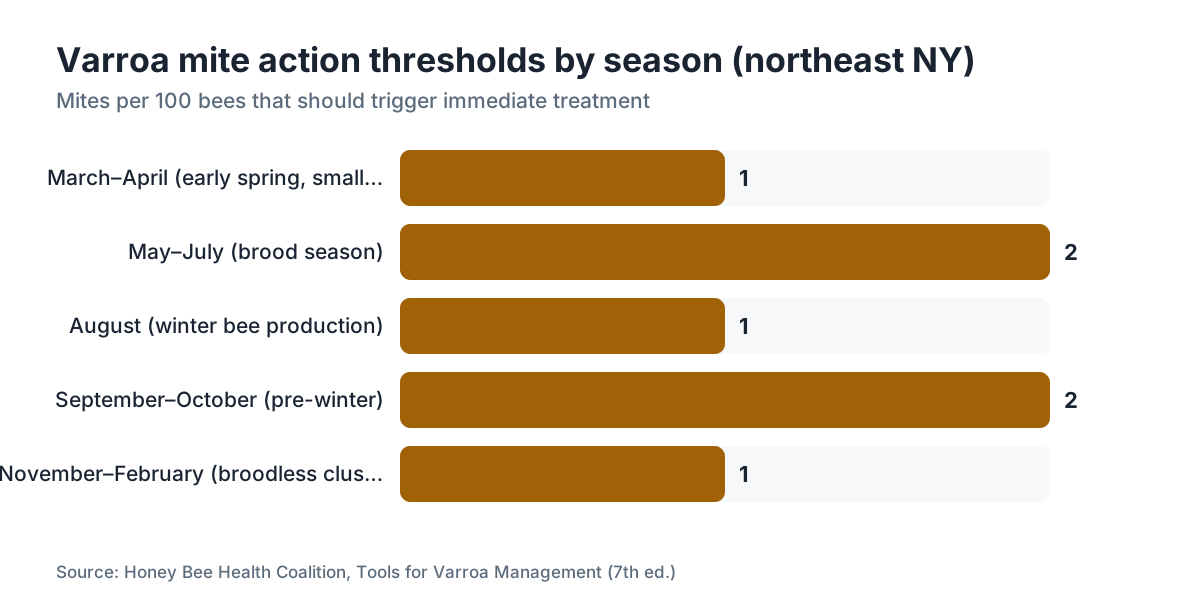
The Honey Bee Health Coalition's "Tools for Varroa Management" guide sets the economic injury threshold at 2 mites per 100 bees during brood rearing and 1 to 2 mites per 100 bees going into winter prep, which in the northeast means roughly August [3]. Those numbers are not cautious. Hit 2% in July and you are already behind.
What mite monitoring method actually works, and how often should you check?
Use the alcohol wash. Every 2 weeks from April through mid-October, plus a late-October pre-winter check and a late-February confirmation. That cadence catches spikes before they wreck your winter bees.
The sticky board (natural mite drop) is easy and unreliable for decisions. That drop number swings with colony size, season, hygienic behavior, and temperature. The Honey Bee Health Coalition says plainly, "The alcohol wash is currently the most reliable method available to the beekeeper for monitoring mite levels" [3]. The powdered sugar roll is broodless-safe but undercounts mites by 30 to 50% against alcohol wash in side-by-side trials [4].
Here is the northeast NY cadence:
- Every 2 weeks from April 1 through October 15
- Once in late October before winter prep treatment
- Once in late February or early March to confirm survival and catch early buildup
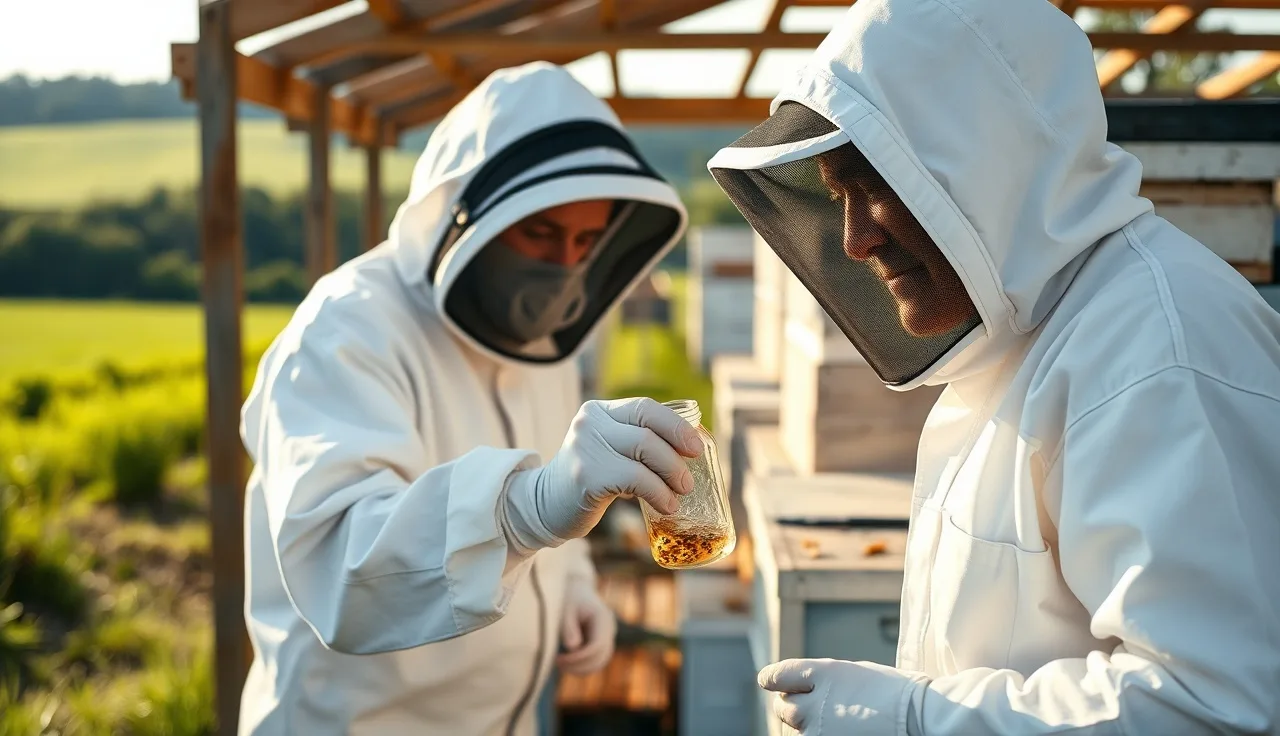
How to do an alcohol wash. Pull a frame of open brood from the center of the nest, where nurse bees cluster. Scoop about 300 adult bees (roughly half a cup) into a jar with rubbing alcohol or windshield washer fluid. Shake for 60 seconds. Pour through a mesh screen into a white tray. Count the mites. The math is simple: 300 bees is your denominator, so 6 mites is a 2% load.
A count of 3 mites on 100 bees is a 3% load. In July that is a crisis. Treat that day and recheck in 28 days.
Log every wash date and result somewhere you trust. VarroaVault's free monitoring calendar does exactly this, so you always know where each yard stands across the season.
Month-by-month aggressive treatment schedule for northeast New York
Here is the full calendar. Aggressive does not mean reckless. It means treating on threshold, not on hope, and never skipping a window because conditions are inconvenient.
January to February
The colony is clustered. If you ran a solid oxalic acid vaporization (OAV) in November or December, mite levels are near zero. Do nothing unless you see dead bees with deformed wings on the landing board, which warrants emergency action if temperatures allow. Use this stretch to order supplies and confirm your spring chemicals.
March (late winter check)
Do a late-February or early-March alcohol wash on any colony you can safely open. Clusters break around 50 degrees F. Mite levels should still be under 1%. If they are not, the colony got through winter without a clean broodless treatment, and an oxalic acid dribble while brood is minimal is worth considering.
April to May (spring buildup)
Monitor every two weeks. The queen is laying hard and mites climb with the brood. Your action threshold is 1 mite per 100 bees in April (the colony is fragile and about to expand) and 2 per 100 from May on [3]. Hit threshold and Apivar (amitraz strips) is the most effective option in brood-heavy conditions. It needs a minimum 42-day exposure and must come out before honey supers go on [5]. Read the label. You cannot run supers with strips in the hive.
June to July (honey flow)
Supers are usually on. Most chemical treatments are off the table with supers in place, which is exactly why your spring treatment has to finish before the flow. Keep monitoring. Blow past threshold mid-flow and you have two legal moves: a single-strip reduced-dose Formic Pro (formic acid) application, approved with supers on in some formulations (check the current EPA label, guidance has changed) [6], or a brief super removal for an emergency Apivar placement. Neither is great. The better move is not landing here.
Late July to August (the most important treatment of the year)
Pull supers around August 1 to 15. Northeast NY main flows are mostly done by then. Do an alcohol wash right away and treat by August 15 at the latest. Every week you wait in August is a week of mite reproduction inside the winter bees you are raising right now.
Winter bees get made in August and September, and they need to emerge fat and healthy [2]. A mite-damaged winter bee has thinner fat body stores and a shorter life. You will not see it until February, when the cluster fades. Apivar is the standard here: 2 strips per colony body, 42-day minimum exposure, efficacy around 90 to 95% in field trials when applied right [5]. Formic Pro works too, but its efficacy drops above 85 degrees F, a real problem for August in the Capital Region.
September (post-treatment check)
Pull Apivar strips once 42 days are up. Do an alcohol wash. Still above 2%? You have a problem: reinvasion from collapsing neighbor colonies (robbing), resistance, or poor contact. Run an OAV series or a Formic Pro round. Do something other than wait.
October (pre-winter prep)
Do a final alcohol wash. Under 1%, plan an OAV treatment for November once brood is minimal. Above 2%, treat now with whatever product still fits your temperature range.
November to December (broodless window treatment)
This is your most efficient window. Once the cluster goes broodless, usually late November into December here, run 3 to 5 oxalic acid vaporization treatments 5 days apart [1]. Each pass hits the phoretic mites on adult bees. With no capped brood to hide in, repeated applications reach 95%-plus kill. The oxalic acid label allows up to 3 treatments per year, and each treatment can include multiple applications within one broodless period [1]. Read the EPA label for your specific product. Label language controls.
Which varroa treatments are registered and legal to use in New York State?
New York beekeepers answer to the NYS Department of Agriculture and Markets, and every varroa treatment is regulated at the federal level by the EPA as a pesticide, or, for oxalic acid, as a minimum-risk pesticide under FIFRA Section 25(b) [7][12]. Registration is free and required for all NY hives.
Here is the quick reference for the treatments you will actually reach for:
| Treatment | Active Ingredient | Approved with Supers? | Temp Range | Efficacy on Capped Brood |
|---|---|---|---|---|
| Apivar strips | Amitraz | No | 50-105 F | Yes (contact over 42+ days) |
| Formic Pro | Formic acid | Yes (single strip only, check label) | 50-85 F | Partial |
| MAQS (Mite Away Quick Strips) | Formic acid | Yes | 50-85 F | Partial |
| Api-Bioxal OAV/dribble | Oxalic acid dihydrate | No | 40 F+ for dribble and vaporization | No (phoretic only) |
| HopGuard 3 | Hop beta acids | Yes | No minimum stated | Limited |
| Apilife VAR | Thymol blend | No | 59-69 F ideal | Limited |
"Approved with supers" means the current EPA label allows the product in a hive with honey supers meant for human consumption. Verify against the specific product label at time of use, not a third-party summary including this one. Labels change.
New York does not require a prescription for these products, and amitraz is not a restricted-use pesticide here as of 2024. Some states do restrict it, so check current NYS DAM guidance if you are unsure [7].
What mite count threshold should trigger immediate treatment in NY?
Two mites per 100 bees during brood season, and 1 per 100 in August. Those are the numbers that decide your year. The Honey Bee Health Coalition threshold table, the most widely cited standard in U.S. beekeeping, gives 2% during brood rearing (March through July) [3].
August is where I split from the standard. The University of Minnesota Bee Lab reports that winter bee quality drops sharply once mite loads pass 1% in August, which makes the 2% trigger too generous for that decision [2]. I treat at 1% or above in late July and August. Gambling the winter cluster on two more weeks of monitoring is not worth it.
For spring (March through May), be aggressive at 1%. The colony is small, the bees are worth a lot, and any mite reproduction now compounds fast.
One more thing. If you see deformed wing virus symptoms, bees with shriveled, crumpled wings near the entrance, treat without even counting. By the time symptoms show, you are looking at a 4%-plus load. Count and treat the same day.
How does reinfestation from neighboring colonies affect your schedule?
A perfect August treatment means nothing if a neighbor's untreated hive implodes in September three hundred feet from your apiary. Reinfestation is the reason a rigid "treat once and done" plan fails in high-density areas.
Northeast New York has a lot of hobbyist beekeepers, especially around the Hudson Valley and Saratoga. Mostly great. Also a reinfestation risk.
Varroa spread by drifting bees and by robbing. When a nearby colony collapses in late summer, surviving bees loaded with mites rob out the hive and haul mites back to your healthy colony. Cornell research on drift and robbing indicates that a large share of a colony's fall mite load can come from outside the hive through this route [8].
You cannot control your neighbors. You can:
- Reduce entrances to the smallest opening in August and September to limit robbing.
- Never leave burr comb, wet supers, or open feeders sitting out in the yard during this window.
- Recheck mite loads in September even if your August post-treatment wash came back clean.
- Know your neighborhood. If you suspect untreated colonies nearby, plan a second September OAV series once brood winds down.
The mites find you again. Build your schedule around that fact.
Can you run an oxalic acid-only program and skip Apivar in northeast NY?
You can, but only if you execute it without a single miss. Some beekeepers want to avoid amitraz on principle or for organic certification. An OAV-only program is possible in northeast NY, and it is far less forgiving than a mixed approach.
The math. Oxalic acid kills phoretic mites at roughly 95% per broodless treatment [1]. It does nothing under capped brood. So an OA-only plan in a brood-active hive means either continuous vaporization every 5 days for the entire time brood is present (exhausting, and hard on bees at high frequency) or very careful timing around broodless and near-broodless windows.
Extended OAV during brood season. The Api-Bioxal label now allows extended vaporization (up to 3 applications, 5 days apart, once per year), but that program is built for the broodless window [1]. Repeated applications during full brood season knock phoretic mites down without clearing the hive.
Brood breaks by caging the queen. Some OA-only programs cage the queen for 21 days and vaporize during the artificial broodless gap. It works on paper. It also risks queenlessness gone wrong, and in a short northeast NY season you burn brood-rearing time you cannot spare. Reasonable for experienced beekeepers with the time and skill.
The honest answer: for most hobbyist and sideliner operations here, an Apivar round in late summer paired with an OAV broodless series in November or December beats OAV alone for reliability. If amitraz resistance worries you (it exists in some U.S. populations, though it is not yet well documented in NY), rotate to formic acid products or the OAV plus brood-break route instead of running Apivar every cycle.
What should your records include to actually improve year over year?
The beekeepers who get better at mites every year are almost always the ones who write things down. Nothing elaborate. Just enough to answer three questions come late October: what were my mite loads at each check, when did I treat, and how did the colony look at winterization?
For each hive, record:
- Date of alcohol wash and result (mites per 100 bees)
- Treatment applied, product name, lot number, date in, date out
- Colony strength at treatment (frames of bees, frames of brood)
- Any reinvasion events or unusual mite spikes
Lot numbers matter for one reason. If a treatment fails to drop mites, you want to know whether it was application error, resistance, or a bad batch. EPA product labels carry lot numbers for exactly that kind of traceability [7].
Managing more than five hives? A simple spreadsheet beats memory every time. VarroaVault's free protocol tools include printable hive record cards and a season-view monitoring log built for multi-hive operations.
You can find full-season record templates and monitoring calculators through our beekeeping supplies resources, or directly through extension programs like Cornell's apiculture pages.
How do you treat a colony that is already showing mite damage symptoms?
Count before you treat, even here. Deformed wing bees, bald brood, or a patchy laying pattern alongside a high mite count means the colony is in active mite syndrome, and your approach shifts. Know the actual load first. A colony showing symptoms at 2% needs treatment. A colony showing symptoms at 7% may be past saving depending on the date and its size.
Before August 15, with a decent population (at least 5 frames of bees), treat with Apivar right away. Pull any honey supers. The colony can still recover if it has 6 to 8 weeks of laying time to raise clean winter bees. Mark it as a watch colony and check every two weeks.
After September 15, with a high mite load and small population, combine it with a healthy colony instead of trying to save it. A small, mite-damaged colony in October in the northeast almost never sees April, and in the meantime it is a mite reservoir draining your stronger hives. Hard call. It is the right one more often than not.
One move that does not help: treating a symptomatic colony with oxalic acid alone while brood is present. You kill some phoretic mites, the brood-associated mites emerge in 10 to 12 days, and you are back where you started.
For more on varroa biology and why timing matters this much, see our full guide on the varroa mite life cycle.
What role does queen quality and genetics play in your varroa management?
Genetics are real, and they are not a free pass. Some bee lines have measurably better hygienic behavior and varroa-sensitive hygiene (VSH), and USDA and university breeding programs have documented 30 to 50% lower mite replication in VSH colonies versus standard stock [9]. That reduces how often you treat. It does not end monitoring.
The practical question for northeast NY is whether you can source VSH or hygienic queens locally. Cornell University and several NY queen producers offer hygienic-tested stock, though supply is limited. Minnesota Hygienic lines, USDA Baton Rouge VSH stock, and some locally selected survivor bees all show meaningful VSH traits.
Be skeptical of any queen sold as "mite resistant" with no documentation. Resistance runs on a spectrum. A colony with some hygienic behavior still needs chemical treatment, just less often or at a higher threshold. No commercial queen sold today removes the need to monitor and intervene.
The Honey Bee Health Coalition guide is direct on this: resistant stock "can reduce the frequency or intensity of chemical treatments but should not be used as a replacement for monitoring" [3]. That framing is right.
If you are requeening anyway, and northeast NY beekeepers often do in spring to replace winter-failed queens, a hygienic line is worth the extra cost. Figure $35 to $60 for a marked, mated queen from a reputable supplier against losing the colony and all its equipment.
Where can northeast NY beekeepers get training, inspections, and support?
New York runs a working apiary inspection program, and registration is free. The NYS Department of Agriculture and Markets Bureau of Plant Industry handles apiary registration (required for anyone keeping colonies in NY) and disease inspections [7]. If you have never registered your hives, do it now. State inspectors identify varroa infestations and other diseases, and they provide written documentation that matters if a liability or insurance question ever comes up.
Cornell University's Department of Entomology has been a steady resource for NY beekeepers, including research on varroa-resistant genetics and integrated pest management. Its small farms program and extension pages carry practical, NY-specific guidance [10].
The Eastern Apicultural Society (EAS) holds its annual conference in the northeast and is one of the best in-person learning events in the country for hobbyist and sideliner beekeepers. Many northeast NY clubs are affiliated with EAS.
Local bee clubs in the Capital Region, the Adirondacks, and the Catskills often hold treatment workshops in late July and early August, right when you need them. Ask your county Cornell Cooperative Extension office for a referral.
For treatments and equipment, options run from local farm supply stores to online vendors. Our beekeeping supply companies roundup lists suppliers that carry the core treatment products with reliable stock.
Frequently asked questions
When should I pull honey supers in northeast NY to start varroa treatment?
Pull supers by August 1 to 15. The main flows in northeast New York, mostly goldenrod and clover, are largely done by late July. Pulling by early August gives you a 6 to 8 week Apivar window before the first hard frosts, and those weeks set the health of the winter bees being raised right now. Every week you delay costs winter bees.
How cold does it need to be before I stop treating with oxalic acid vaporization?
The Api-Bioxal label does not name a lower temperature cutoff for vaporization, but most practitioners stop below 40 degrees F because cluster behavior and vaporizer performance get unreliable. For the dribble method, 40 degrees F or above is the commonly cited minimum. In northeast NY, your dependable OAV window runs from late November through December before temperatures drop below that range consistently.
Do I need a prescription or license to use Apivar in New York?
As of 2024, Apivar (amitraz) is not a restricted-use pesticide in New York, so you do not need a pesticide applicator license to buy or use it. You do have to follow the EPA label exactly. Verify current NYS Department of Agriculture and Markets guidance before buying, since pesticide registration status can change.
How many oxalic acid vaporizations should I do during the broodless window?
Most experienced beekeepers run 3 to 5 applications spaced 5 days apart during a confirmed broodless period. The logic: any mites under capped brood when you started will have emerged by day 12 to 15, and later applications catch them. The Api-Bioxal label allows up to 3 treatments per year, and many beekeepers read a single broodless series as one treatment event. Read your specific product label and follow it.
What is the difference between Formic Pro and MAQS for varroa treatment?
Both use formic acid and both penetrate capped brood to kill mites, which oxalic acid cannot do. Formic Pro uses a different release matrix than MAQS and can be applied as a single strip rather than two. Both carry temperature limits (roughly 50 to 85 degrees F) that cut their usefulness in hot August weather or cold northeast NY falls. Check the current EPA labels for exact application rates.
Can Apivar strips cause resistance if I use them every year?
Yes. Amitraz resistance in varroa is documented in some U.S. populations, though its prevalence in northeast New York is not well characterized. Rotate chemical classes: alternate Apivar years with formic acid or oxalic acid cycles. A simple rotation is Apivar in summer, OAV in winter, then Formic Pro the next summer. If Apivar stops working as expected, switch products immediately and contact your state apiarist.
Is a 3% mite load in July considered an emergency?
Yes. A 3% load in July in northeast New York means the colony will almost certainly reach 6 to 8% by September without action, and the winter bees being raised right now are already being parasitized. Treat immediately with Apivar if supers are off, or evaluate Formic Pro options if supers are on. Recheck in 28 to 42 days. Do not wait for the next scheduled check.
Should I treat every hive in my yard at the same time?
Yes. Treating all colonies at once reduces the robbing-and-reinfestation cycle. Treat only your high-mite colonies and the healthy ones can get reinfested within weeks through drift and robbing. The Honey Bee Health Coalition recommends synchronizing treatments across an apiary and, where possible, coordinating with nearby beekeepers. A clean yard can be re-contaminated from 1,000 feet away.
What happens if I miss the August treatment window in northeast NY?
Missing August is the single most damaging scheduling error northeast NY beekeepers make. The winter bees raised in August and September enter winter already mite-damaged, with depleted fat bodies and shorter lifespans. Even a successful November OAV cannot repair bees that were already parasitized. The colony often looks fine through January, then crashes in February or March. Treat in August. There is no clean recovery path if you miss it.
How do I know if my colony is truly broodless in November?
Inspect quickly on a day above 45 to 50 degrees F. Pull the top and inner cover and look for capped cells in the cluster area. A truly broodless colony has no capped brood at all, though you may find a small patch if the queen restarted during a warm snap. You can also uncap a few capped cells near the cluster edge. If they hold white larvae or pupae, the colony is not broodless yet.
Are sticky boards useful at all in northeast NY?
Sticky boards are good for one thing: confirming mites are present at all. See zero drop over 24 hours in July and something is wrong with the method (or the box has no bees). For treatment decisions or comparing hives, sticky boards are too variable to trust. The alcohol wash gives you actionable percentage data. The sticky board does not.
Can I use HopGuard 3 as my primary summer treatment?
HopGuard 3 has one clear advantage: it is approved with honey supers in place. But its efficacy against varroa runs well below Apivar or formic acid in most field trials, and it has no residual effect in capped brood. It is a reasonable tool for emergency mid-flow suppression or as part of an integrated plan, not a primary summer treatment when better options exist. Use it as a bridge, not a solution.
Does cold weather in northeast NY naturally reduce varroa populations?
Not reliably enough to skip treatment. Cold slows bee brood production, which lowers the mite reproduction rate, but phoretic mites on adult bees ride out winter in the cluster just fine. A colony going into November at a 4% load still has a real mite problem in February even with no brood to breed in. The broodless window matters because treatment efficacy is near total, not because cold kills mites on its own.
What should a northeast NY beekeeper's varroa supply kit include?
At minimum: a reliable alcohol wash kit (a jar with mesh lid or a commercial Varroa EasyCheck), Apivar strips for summer and fall, Api-Bioxal for broodless OAV, a propane or electric vaporizer rated for oxalic acid, nitrile gloves, and a respirator rated for organic vapors when vaporizing. Keep Formic Pro as a backup or rotation product. Budget roughly $150 to $250 for a full season of supplies per apiary.
Sources
- EPA, Api-Bioxal Product Label (Oxalic Acid Dihydrate): Api-Bioxal oxalic acid kills phoretic mites with near 95% efficacy in broodless conditions; label allows vaporization applications 5 days apart in a single broodless period
- University of Minnesota Bee Lab, Varroa Mite Research: Winter bee quality declines significantly when mite loads exceed 1% in August; mite-damaged winter bees have reduced fat body stores and shortened lifespan
- Honey Bee Health Coalition, Tools for Varroa Management Guide (7th edition): Action threshold is 2 mites per 100 bees during brood season; alcohol wash is the most reliable method for monitoring; resistant stock reduces but does not replace monitoring
- Delaplane, K.S., et al., University of Georgia, comparison of mite monitoring methods: Powdered sugar roll consistently undercounts mites by 30-50% compared to alcohol wash in side-by-side trials
- Elanco Animal Health, Apivar (Amitraz) Product Label: Apivar requires minimum 42-day exposure; must be removed before honey supers are placed; average efficacy 90-95% in properly applied field conditions
- EPA, Formic Pro Product Label (Formic Acid): Single-strip Formic Pro application approved for use with honey supers in place under specific label conditions; temperature range 50-85 F
- New York State Department of Agriculture and Markets, Bureau of Plant Industry, Apiary Program: NYS requires apiary registration; state inspectors conduct disease and pest inspections; pesticide product label compliance required under NY law
- Seeley, T.D. and Smith, M.L., Cornell University, varroa reinfestation via robbing and drifting bees: Studies indicate a large share of a colony's fall mite load can originate from outside the hive through drift and robbing from collapsing colonies
- USDA ARS Baton Rouge Bee Breeding Lab, Varroa-Sensitive Hygiene (VSH) Research: VSH bee lines document 30-50% lower mite replication rates compared to standard commercial stock in controlled trials
- Cornell University Department of Entomology, Honey Bee Extension Program: Cornell provides NY-specific varroa management guidance, varroa-resistant queen genetics research, and small farms extension resources for NY beekeepers
- Honey Bee Health Coalition, Varroa Management Decision Tool: Threshold of 1-2 mites per 100 bees recommended going into winter preparation in August; threshold chart covers all seasonal periods
- EPA, FIFRA Section 25(b), Minimum Risk Pesticides: Oxalic acid is regulated as a minimum-risk pesticide under FIFRA Section 25(b) when used in registered formulations for varroa control
Last updated 2026-07-09