Apivar varroa mite treatment 12-pack: the complete guide
TL;DR
- Apivar (amitraz 3.3%) is a proven strip treatment for Varroa destructor.
- The 12-pack holds enough strips for six full-sized colonies (two strips per hive) and costs roughly $55 to $75.
- Treatment runs 6 to 8 weeks.
- It works well applied correctly, but resistance builds fast if you reach for it every cycle.
- Rotate it.
What is Apivar and how does it kill varroa mites?
Apivar is a plastic strip loaded with amitraz at 3.3% concentration. The strip releases amitraz slowly. Bees walk across it, pick up the chemical on their bodies, and spread it through the colony. Mites take in amitraz on contact. The compound scrambles their octopamine receptor system, and the mite dies of neurological failure. [1]
Amitraz belongs to a chemical family called the formamidines. That mode of action has nothing in common with oxalic acid (which attacks mite mitochondrial function) or thymol products like Apilife VAR. The difference matters the moment you sit down to plan a resistance rotation, which I get into below.
Apivar is EPA-registered, and no hobby beekeeper in the US needs a special license to buy or use it. The active ingredient has run through livestock and crop use since the 1970s, so there's a long paper trail on both how well it works and how the residue behaves. [2]
Here's the catch worth flagging early. Amitraz builds up in beeswax, and researchers have measured residues in commercial wax after repeated treatments. [11] That's not a reason to swear off Apivar. It's a reason to rotate products and stop reaching for it every single cycle.
What comes in the Apivar 12-pack and how many hives does it treat?
The 12-pack holds 12 individual plastic strips. The EPA label calls for 2 strips per full-sized colony (two brood boxes, or a single deep with a super). Do the arithmetic and a 12-pack treats exactly 6 full colonies. Not seven. [1]
Run nucleus colonies or single boxes under five frames of bees, and the label allows 1 strip per nuc. On paper that stretches a 12-pack to 12 nucs, though you'd rarely have 12 nucs needing treatment on the same day.
Strips come individually sealed with a shelf life of about 2 years from the manufacturing date printed on the package. Keep them at room temperature, out of direct sun and heat. Don't freeze them. Once you break the seal, use them soon; the manufacturer doesn't want strips sitting out in the air between uses.
On price: as of mid-2025, the 12-pack retails between $55 and $75 at the big US suppliers. [3] The next size up, a 50-pack, runs $180 to $220, which pencils out to roughly $3.60 to $4.40 a strip against $4.60 to $6.25 a strip in the 12-pack. Fifteen or more colonies? The 50-pack wins the math almost every time. Two to six hives? Buy the 12-pack.
You'll find the 12-pack at most beekeeping supply companies, and several offer free shipping on honey bee supply orders above a threshold that a 12-pack order usually clears.
How do you apply Apivar strips correctly?
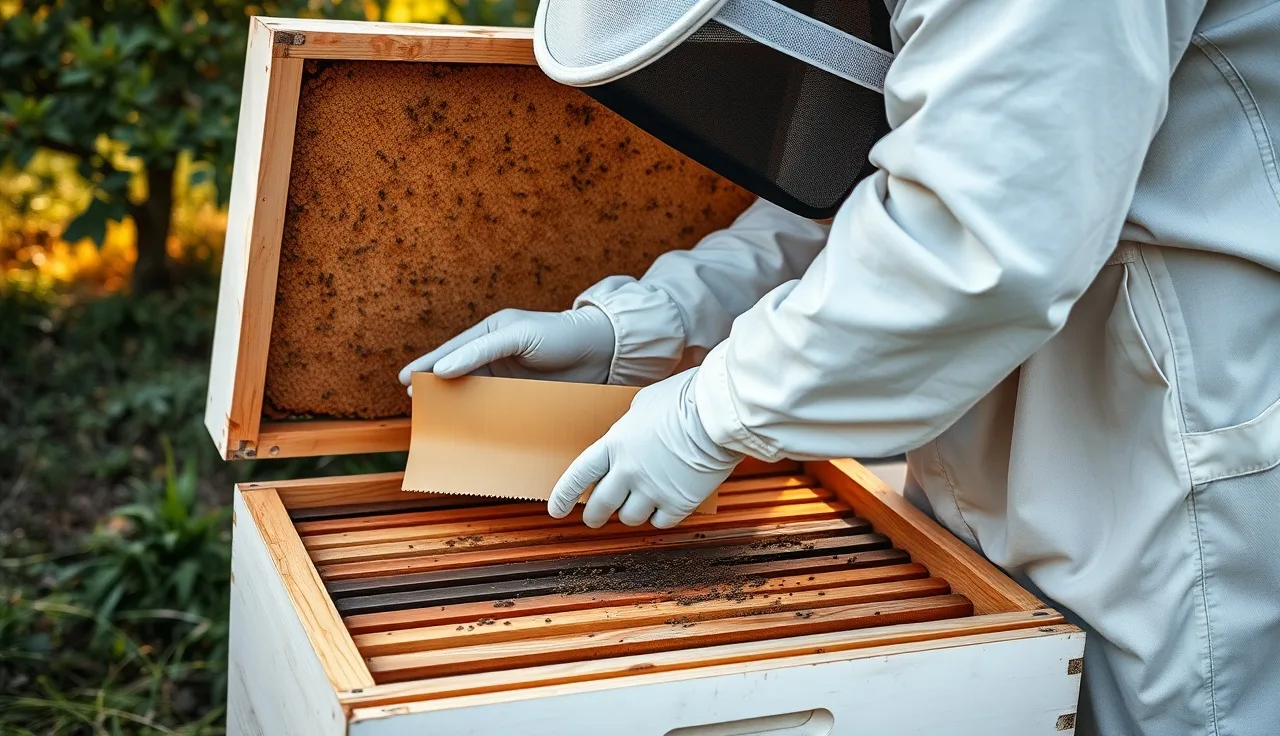
Glove up first. Amitraz absorbs through skin and brings on headaches, nausea, and dizziness at real exposure. Nitrile gloves work. Latex doesn't give you a reliable barrier. The label requires gloves, and this is one label line worth obeying to the letter. [1]
Hang the strips between frames in the brood nest, never in a honey super. Target the two most brood-dense spaces in the box. Frame spacing decides everything here: the strip has to sit in a bee space where workers actually traffic it. A strip dangling in a dead gap with no bee contact does close to nothing.
Standard placement in a 10-frame box is between frames 3 and 4, and between frames 6 and 7. For 8-frame equipment, go between frames 2 and 3, and between 5 and 6. You want the busiest, warmest part of the brood nest, with the most bees rubbing against the strip.
Leave the strips in for 6 weeks minimum, 8 weeks maximum. Six weeks is the floor because mites tucked under capped brood are shielded from contact, and you need at least two full brood cycles to reach the ones that were hiding when you inserted the strips. Pull them at 8 weeks no matter what your gut says. Extra time in the hive just speeds up resistance selection. [1]
Pull used strips and throw them out. Don't compost them. Don't leave them in. Don't reuse them. Wrap them in paper and put them in the trash.
After you pull the strips, run an alcohol wash or a sticky board count 48 to 72 hours later to check your work. You want a post-treatment load under 2 mites per 100 bees. Still above 3 per 100? Something failed: poor contact, heavy resistance, or brood that never got exposed.
When is the best time of year to use Apivar?
Apivar has no real temperature restriction, which sets it apart from oxalic acid vapor (best below 50°F ambient) and thymol products (which want 60 to 105°F). Use Apivar any time bees are actively moving on the strips. That flexibility is one of its best features across the seasons. [2]
Still, most experienced beekeepers time the main Apivar treatment for late summer into early fall, roughly August through October depending on where you keep bees. The logic is simple. You want mite loads down before the colony raises its fat, long-lived winter bees, the ones born August through October that carry the cluster through to spring. Mite-damaged winter bees die young and catch viruses like Deformed Wing Virus more easily. A colony heading into winter above 2 to 3 mites per 100 bees is already in trouble. [4]
A second good window is early spring, once brood is active but before a major honey flow. The 8-week duration slots neatly into the pre-flow buildup in most temperate US climates.
Stay off Apivar during honey super season. The label bans it while supers are on the hive. Pull the supers before you treat, and don't put them back until every strip is out and the colony has aired for a few days. Amitraz in honey is a legal and food-safety problem, not a hypothetical one. [1]
The Honey Bee Health Coalition's Tools for Varroa Management guide says to treat by mite threshold rather than calendar. Their action point is 2% infestation (2 mites per 100 bees) during brood-rearing season. [4] Don't skip the pre-treatment count just because the calendar says fall. If a colony sits at 0.5% in August, dosing it with a harsh chemical it doesn't need is bad beekeeping.
What mite infestation level should trigger Apivar treatment?
The Honey Bee Health Coalition puts the action threshold at 2 mites per 100 bees (2%) during brood-rearing season, and tightens it to 1 to 2% in August, because late-summer colonies raising winter bees tolerate mite damage poorly. [4]
Count before you treat. Every time. An alcohol wash on a sample of roughly 300 adult bees from the brood nest is the most reliable method going. Sticky boards undercount badly (they miss mites reproducing inside cells) and only tell you relative change, not whether you've crossed a threshold.
Come in at 1% or below in spring or early summer, and you can reasonably wait and recount in 3 to 4 weeks. Hit 3% or above any time from July onward, and treat now. At 5% or above, the colony is in crisis. Treat the same day you count.
One Apivar treatment usually cuts mite loads by 90 to 99% when applied well and resistance isn't a factor. [5] That number sounds airtight, but a colony starting at 5% (5 mites per 100 bees) can still land near 0.5% afterward. Acceptable, not zero. Follow up with a post-treatment wash to confirm.
Track your counts over time with the varroa mite monitoring tools at VarroaVault, which let you log counts, flag threshold crossings, and watch trends across the whole apiary.
Is amitraz resistance in varroa mites a real problem?
Yes. Amitraz resistance in Varroa destructor is documented in several countries, the United States included. A 2022 study confirmed resistant mite populations in multiple US apiaries, most of them in regions where amitraz products ran continuously for years with no rotation. [5]
Resistance is just selection at work. Every treatment kills the susceptible mites and leaves behind whatever mites happen to shrug off amitraz a little better. Use Apivar every single cycle without rotating your mode of action, and you're breeding a resistant population in your own yard.
The fix is rotation. Don't use Apivar (or any amitraz product) more than once a year. Alternate with oxalic acid or a thymol product for your other treatment windows. The Honey Bee Health Coalition and most university extension programs now say plainly to rotate chemical classes to slow resistance. [4]
Watch for a few signs that resistance may already be in your colonies. Post-treatment counts that barely move. Mites still visibly active on bees after 4 to 5 weeks of strip exposure. Efficacy noticeably under 90%. See those, switch products and think about sending mite samples to a lab. The USDA Bee Research Laboratory in Beltsville handles varroa diagnostics, though turnaround and cost vary. [10]
Resistance isn't a reason to drop Apivar. It's a reason to use it with a plan.
How does Apivar compare to other varroa treatments?
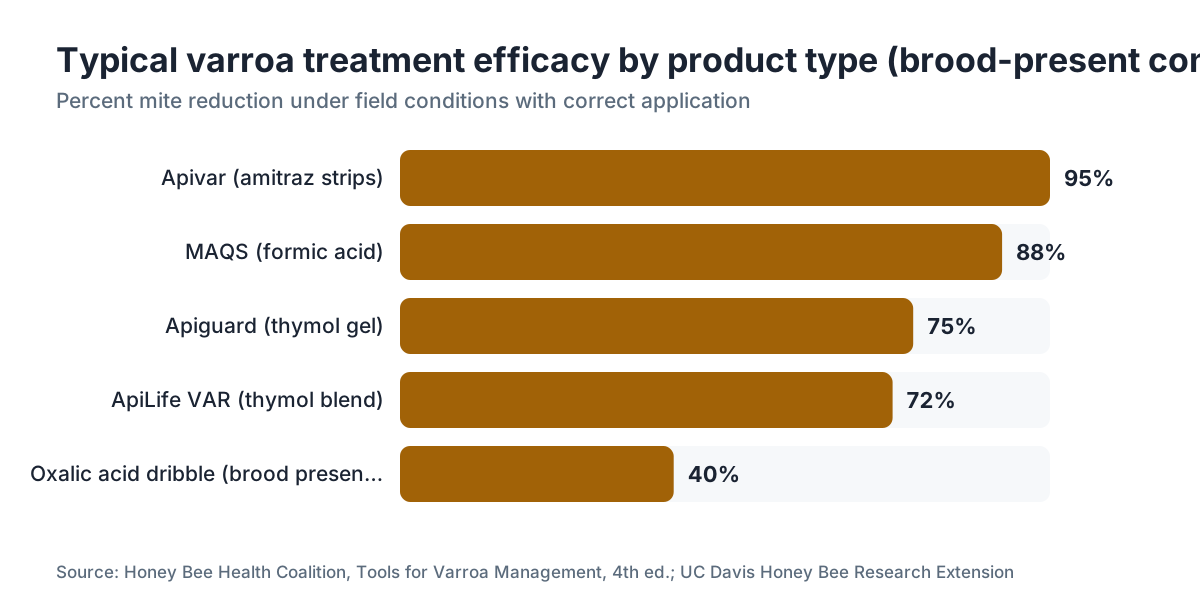
Here's a practical side-by-side of the main registered varroa treatments US hobbyists reach for. The data comes from EPA label requirements, the Honey Bee Health Coalition guide, and university extension resources. [1][4][6]
| Treatment | Active Ingredient | Temp Range | Brood Efficacy | Treatment Duration | Honey Super Restriction |
|---|---|---|---|---|---|
| Apivar strips | Amitraz 3.3% | None (needs active bees) | Good (2 cycles) | 6 to 8 weeks | Yes, remove supers |
| Oxalic acid vapor | Oxalic acid | Best under 50°F | Poor (brood-present) | 1 treatment (broodless) | No restriction |
| Oxalic acid dribble | Oxalic acid | Above 40°F | Poor (brood-present) | 1 treatment | No restriction |
| Mite Away Quick Strips | Formic acid | 50 to 79°F | Good (penetrates caps) | 7 days | Remove supers |
| ApiLife VAR | Thymol blend | 59 to 69°F | Moderate | 3 to 4 weeks | Remove supers |
| Apiguard | Thymol gel | Above 59°F | Moderate | 4 weeks | Remove supers |
Apivar's strengths are its wide temperature tolerance and its track record. It works in cold springs, hot summers, and fall. It also forgives minor application slip-ups in a way oxalic acid vapor (which wants broodless conditions for full effect) never will.
The downsides: the honey super restriction, the wax residue, and the resistance risk from overuse. Formic acid (MAQS) is the only product on the list that punches through capped brood and can run during a honey flow (with restrictions), so in a mid-summer crisis MAQS beats Apivar outright.
Oxalic acid is the natural rotation partner. It's cheap, leaves no wax residue at recommended doses, and has zero documented field resistance so far. Apivar for a brood-present fall or spring treatment, oxalic acid vapor for a broodless winter knockdown, and you've covered the colony year-round with two different modes of action.
Can you use Apivar in a hive with honey supers on?
No. The EPA label flatly prohibits applying Apivar while honey supers are on the hive. This is a legal requirement, not a suggestion, and selling honey from a hive treated with supers in place breaks federal pesticide law. [1]
Amitraz and its breakdown product DMPF can contaminate honey. The worry isn't mainly human health at the concentrations usually found. It's regulatory compliance and market access. European honey carries tighter amitraz residue limits than US honey, which matters the moment you sell to an export packer or a natural food retailer with strict specs.
The protocol is easy. Pull all supers before the strips go in. Run the full 6 to 8 week treatment. Remove the strips, wait a few days, then add supers back for the next flow. In most temperate US climates, a late July strip removal followed by an August treatment still leaves you room to catch a September goldenrod or aster flow.
Got a colony that truly needs treatment during an active summer flow and you can't pull supers? That's the moment MAQS (formic acid) earns its keep, not Apivar.
Does Apivar harm the queen or affect colony development?
Used at label rate (2 strips per full colony for 6 to 8 weeks), Apivar has a low documented rate of queen loss or colony disruption. Queen sensitivity to amitraz is real, though. Beekeepers have reported it anecdotally for years, and lab work shows high amitraz concentrations affecting queen reproductive physiology. [7]
So the risk at label rate is low but not zero. Colonies already stressed (fresh off a swarm, newly requeened, running a small cluster) show higher rates of queen trouble during treatment. Just requeened, or sitting on a small cluster? Weigh whether a different treatment window makes more sense.
Don't exceed 2 strips in a single-story hive. There's always a temptation to pack in extra strips for a badly infested colony on the theory that more is better. It isn't. Overdosing pushes more amitraz at the queen and brood without meaningfully raising the mite kill, because the limiting factor is bee-to-mite contact, not how much amitraz floats in the air.
Brood and egg-laying usually snap back within 2 to 4 weeks of strip removal. See a long laying gap or a spotty brood pattern afterward, and check whether the queen is still there and laying well before you blame the treatment.
Is the Apivar 12-pack worth buying for a small apiary?
For a hobbyist running 3 to 6 hives and treating twice a year, yes. The 12-pack is the right buy. Run the math: two strips per colony, six colonies per pack. Treat once in spring and once in fall, and two 12-packs cover a six-colony apiary for the whole year at roughly $110 to $150, or about $18 to $25 per colony per year for amitraz coverage. That's a fair cost of doing business in modern beekeeping.
Got 1 to 2 hives? A 12-pack still makes sense because the unused strips keep for about 2 years. Buy the pack, treat your two hives (four strips), store the other eight properly. They'll hold up for your next cycle and the one after.
Eight or more hives? Run the per-strip cost. The 50-pack comes out roughly $1 to $2 cheaper per strip, which stacks up when you're placing 16 to 20 strips a cycle.
One honest caveat. Don't buy more strips than you can burn through in 2 years. Amitraz degrades, and old strips lose punch. Buying a 50-pack for two hives is false economy.
To handle timing and keep track of which hives you treated and when, VarroaVault's free protocol tools let you log strip-in and strip-out dates, set reminders for the 6-week and 8-week marks, and record pre- and post-treatment counts across the apiary. Worth a bookmark if you're juggling colonies.
What do university extension programs and the Honey Bee Health Coalition say about Apivar?
Most major US university extension apiculture programs list Apivar as a first-line treatment for brood-present varroa management. Penn State Extension, UC Davis, and the University of Minnesota Bee Lab all put it in their recommended rotation protocols. [6][8][9]
The Honey Bee Health Coalition's Tools for Varroa Management guide (now in its fourth edition) calls amitraz strip treatments effective when timed and applied right, then warns hard against leaning on any single product class because of resistance. Their language: "Rotating among miticides with different modes of action is recommended to delay development of resistance." [4]
UC Davis's apiculture extension reports that Apivar typically hits 90 to 99% efficacy under good conditions, with lower numbers in apiaries that have a documented history of continuous amitraz use. [6]
The Penn State Apiary Program recommends Apivar for the late-summer window (August, September) ahead of winter bee production, paired with a broodless oxalic acid treatment in November or December. That two-product, two-window approach is probably the most widely recommended US protocol right now for temperate climates. [8]
State apiary inspection programs vary in their guidance, but nearly all of them cite the HBHC thresholds (2% during brood season, 1% in August) as the standard for when to treat.
How do you track whether Apivar treatment actually worked?
Pull the strips after 6 to 8 weeks, then wait 48 to 72 hours before you sample. This wait matters. Mites killed by amitraz take time to drop off the bees, and sampling the moment you pull strips undercounts the survivors.
Run an alcohol wash on about 300 bees from a brood nest frame. Count the mites in the alcohol, divide by the bee count, and you have your infestation percentage. A post-treatment level at or below 1 to 2% is acceptable. Below 1% is good. Above 2% after a full treatment is a flag: either the treatment underperformed (poor placement, resistance), or you pulled in fresh mites from a neighbor colony through drift or robbing.
Keep records. Write down the pre-treatment count, the date strips went in, the date they came out, and the post-treatment count. Over a few years you'll see whether your Apivar treatments keep landing at 90% or higher, or slowly slipping. Slipping efficacy across several years in the same apiary is a resistance signal worth acting on before it turns into a crisis.
Run multiple hives? Compare post-treatment counts across colonies. One that stays stubbornly high while the rest dropped clean is worth isolating and watching. It may carry a resistant mite population, or it may be pulling in outside mites through robbing or drift.
For a closer look at the mite's biology, the varroa mite guide walks through the reproductive cycle that explains exactly why the 6-week minimum duration exists.
Frequently asked questions
How many hives does the Apivar 12-pack treat?
Exactly 6 full-sized colonies, using 2 strips per hive as required by the EPA label. If you're treating nucleus colonies (fewer than 5 frames of bees), 1 strip per nuc is permitted, so a 12-pack could cover up to 12 nucs. Never use more than 2 strips in a single standard colony. It doesn't improve mite kill and it raises queen risk.
How long do Apivar strips stay in the hive?
A minimum of 6 weeks and a maximum of 8 weeks. The 6-week floor covers two full brood cycles, which you need to reach mites that were under capped brood when you applied the strips. Leaving strips in past 8 weeks doesn't improve efficacy and increases selection pressure for amitraz resistance. Set a calendar reminder the day you insert them.
Can I use Apivar during a honey flow?
No. The EPA label requires removing all honey supers before inserting Apivar strips. Using Apivar with supers in place violates federal pesticide law, and amitraz residues can contaminate honey meant for sale. If a colony needs treatment during an active flow, formic acid products like MAQS are the registered option that can run during a honey flow under specific conditions.
Does Apivar work in cold weather?
Better than most alternatives. Apivar has no meaningful lower temperature limit as long as bees are actively moving on the strips. That makes it one of the few brood-present treatments that works reliably in cool fall or early spring, when thymol products lose efficacy below 59°F and formic acid products are restricted to 50 to 79°F.
Can varroa mites become resistant to Apivar?
Yes, and it's already documented in US apiaries. Amitraz resistance in Varroa destructor has been confirmed in multiple US states. The main driver is repeated exclusive use of amitraz with no rotation to other chemical classes. Rotate Apivar with oxalic acid or thymol treatments, and don't use amitraz more than once a year, to slow resistance in your apiary.
What's the correct placement for Apivar strips in the hive?
Hang strips vertically between frames in the brood nest, never in a honey super or empty box. Place one between frames 3 and 4, another between frames 6 and 7 in a 10-frame box. The strip has to sit in active bee space where foragers and nurse bees traffic regularly. A strip with no bee contact is wasted. Adjust for 8-frame or deep setups accordingly.
How much does the Apivar 12-pack cost?
Retail price in mid-2025 runs roughly $55 to $75 at US beekeeping suppliers, about $4.60 to $6.25 per strip. A 50-pack runs $180 to $220, roughly $3.60 to $4.40 per strip. For 1 to 6 hives, the 12-pack is the practical size. Run 8 or more colonies, and the 50-pack's per-strip savings add up meaningfully over a full year of treatments.
Is Apivar safe to use around brood and developing bees?
At label rate (2 strips per colony for 6 to 8 weeks), Apivar has a low documented rate of brood harm. Exceeding the label rate raises risk to larvae and queens without improving mite kill. Some beekeepers report brief laying disruption or spotty brood during treatment; it usually clears within 2 to 4 weeks after strip removal. Colonies under heavy stress carry higher queen-loss risk during treatment.
Do I need a prescription or license to buy Apivar?
No. Apivar is an EPA-registered over-the-counter product for beekeepers. No prescription, veterinary oversight, or commercial applicator license is required for hobbyist or sideliner use in the United States. It is regulated as a pesticide, so follow the label: gloves during handling, no supers during treatment, and proper strip disposal.
What is the shelf life of unused Apivar strips?
About 2 years from the manufacturing date printed on the package. Store strips at room temperature, away from heat and direct sunlight. Don't freeze them. Once the foil seal is open, use them soon. Old or badly stored strips may have degraded amitraz content, which cuts efficacy and can trick you into diagnosing a resistance problem when it's really a storage problem.
When should I apply Apivar for winter preparation?
Late summer through early fall, generally August through October depending on your region and when your colony raises winter bees. The goal is to cut mite loads before the colony produces the long-lived winter bees that sustain it through winter. High mite loads during winter bee production make virus-damaged, short-lived bees and high winter mortality. The Honey Bee Health Coalition sets 2% as the summer action threshold and 1 to 2% in August.
Can I use Apivar in a nuc or small colony?
Yes. For nucleus colonies or any colony under 5 frames of bees, the label allows 1 strip per nuc. Don't use 2 strips in a small cluster; the higher amitraz exposure per bee raises queen and brood risk without a matching gain in mite kill. Confirm the single strip sits in the active brood area, since a nuc's brood nest is more compact than a full colony's.
How do I know if Apivar treatment worked?
Run an alcohol wash on 300 bees from the brood nest 48 to 72 hours after strip removal. A post-treatment rate at or below 1 to 2% means the treatment worked. Still above 2 to 3% after a proper 6 to 8 week treatment, and you should suspect poor strip placement, real resistance, or re-infestation from neighboring colonies through robbing or drift. Compare results across your hives to spot outliers.
What should I do with used Apivar strips?
Remove them after 8 weeks maximum, wrap them in paper, and put them in household trash. Don't compost used strips; amitraz is toxic to soil invertebrates. Don't leave strips in the hive after treatment ends; extended exposure selects for resistance and keeps dosing the queen and brood with no benefit. Never reuse strips from a previous treatment cycle.
Sources
- EPA, Apivar Amitraz 3.3% strip label (Registration No. 84922-5): Label requirements for strip placement, number of strips per colony, honey super restriction, treatment duration, and PPE requirements
- EPA, Amitraz Registration Review: Amitraz is a registered formamidine acaricide with no ambient temperature restrictions for Apivar application
- Mann Lake Ltd, Apivar product page: Retail pricing range for Apivar 12-pack and 50-pack at major US beekeeping suppliers
- Honey Bee Health Coalition, Tools for Varroa Management Guide, 4th edition: Action threshold of 2% infestation during brood season; 1-2% in August; recommendation to rotate chemical classes to delay resistance
- Morfin N, Goodwin PH, et al., Frontiers in Ecology and Evolution, 2022, amitraz resistance in Varroa destructor: Amitraz resistance in Varroa destructor documented in US apiaries; 90-99% typical efficacy under good conditions without resistance
- UC Davis Department of Entomology and Nematology, Honey Bee Research Extension: Apivar achieves 90-99% efficacy under good conditions; lower efficacy observed with continuous amitraz use
- Milani N, Gnudi G, et al., Ecotoxicology and Environmental Safety, amitraz effects on honey bee queens: Lab evidence that high amitraz concentrations affect queen reproductive physiology; label-rate field risk is low but not zero
- Penn State Extension, Honey Bee Varroa Mite Management: Penn State recommends Apivar for the late-summer treatment window paired with a broodless oxalic acid treatment
- University of Minnesota Bee Lab, Varroa Treatment Options: University of Minnesota includes Apivar as a first-line brood-present treatment option in rotation protocols
- USDA Agricultural Research Service, Bee Research Laboratory, Beltsville MD: USDA Bee Research Laboratory accepts varroa samples for diagnostics; turnaround and cost vary
- Bogdanov S, Charriere JD, et al., Apidologie, amitraz residues in beeswax: Amitraz accumulates in beeswax; detectable residues found in commercial wax following repeated use
Last updated 2026-07-09