Apiguard 10 pack for varroa mite control: what you need to know
TL;DR
- Apiguard is a thymol gel that kills varroa.
- Each tray holds 50 grams.
- The standard course is two trays per hive, three to four weeks apart, in weather above 59°F (15°C).
- A 10-pack treats five colonies through one full course.
- Peer-reviewed trials show 74 to 93 percent mite reduction when the temperature cooperates.
What is Apiguard and what does it actually contain?
Apiguard is a slow-release thymol gel registered by the EPA to control Varroa destructor in honey bee colonies. Each tray holds 50 grams of gel. The active ingredient is thymol at 25 percent. Thymol comes from thyme oil, and it kills mites mostly through the vapor it gives off inside the hive. That vapor irritates and kills mites riding on adult bees and, to a smaller extent, reaches mites in capped brood.
The carrier gel meters thymol out slowly over roughly two to four weeks. That's why the label tells you to leave the tray in the hive instead of dumping it in all at once. Slow release is also why temperature matters so much, a point plenty of beekeepers ignore until their first failed treatment.
Apiguard is made by Vita (Europe) Ltd and registered in the United States under EPA Registration Number 72997-1. Thymol appears on the National Organic Program's National List as allowed for organic production under specific conditions. Confirm your certifier's rules before you count on that.[1][2]
Want the biology of the pest first? Our varroa mite overview walks through the full life cycle and explains why no single treatment hits every life stage.
How does a 10-pack translate to actual hive treatments?
The math is simple. One full Apiguard course takes two trays per colony. A 10-pack treats exactly five colonies through one complete course. Keep that number in your head when you decide how much to order.
Beekeepers get burned by ordering for the number of hives they have and forgetting the colonies that spike mid-season and need a second round. Six hives, one comes back over the 2 percent threshold after your first pass, and now you're short.
Here's what I'd do. Running five to eight hives? Buy two 10-packs at the start of the season. The extra trays keep well (refrigerated shelf life runs about two years from manufacture; room-temperature shelf life is shorter, so check the lot date on your package), and you won't be hunting for stock in August when suppliers sell out.
Apiguard shows up at most beekeeping supply companies. Check whether vendors offer free shipping on honey bee supply orders if you're stocking up, because shipping can eat the savings on a bulk buy.
What temperature range does Apiguard require, and why does it matter so much?
The label sets a minimum ambient temperature of 59°F (15°C) for effective use, and efficacy climbs as temperatures reach the 65 to 80°F range (18 to 27°C).[3] This is the single most common failure point. Below 59°F the gel barely volatilizes, and the mites live.
The upper limit matters too. Above roughly 105°F (40°C) inside the hive, thymol can vaporize so fast that bees abscond or the queen stops laying. In hot country, apply in the morning and put your hives in shade to hold peak hive temperatures down.
Across most of the northern United States and Canada, Apiguard works best from late July into early September. That window lands right when mite populations are building toward their late-summer peak, so the timing fits the biology of the problem. In the southern states you may get a usable window in spring and again in early fall. Either way, you need a thermometer and some discipline to confirm conditions before you treat instead of hoping.
The Honey Bee Health Coalition's Varroa management guide tells you to monitor mite levels before choosing any treatment and to match the treatment to the season and the temperatures in front of you.[4] That's not bureaucratic hedging. No treatment works in the wrong conditions.
What does the Apiguard label protocol actually require?
The EPA-registered US label calls for two applications:
- Place one 50 g tray (opened, foil peeled back to expose about half the gel surface) on top of the brood frames, directly under the crown board or inner cover. Never below the brood cluster.
- Leave the first tray in place 10 to 14 days.
- Remove it and place the second tray in the same spot.
- Leave the second tray another 10 to 14 days, then remove it.
The label also requires pulling honey supers before treatment. Thymol taints honey, and the FDA treats thymol-tainted honey as adulterated. There's no wiggle room here, on food safety or on the law.[3]
Beekeepers ask whether one tray is enough. The research says no. A single-tray application consistently underperforms the full two-tray course. The second dose catches mites that emerged from capped brood during the gap between trays. Skip it and you leave a mite reservoir behind.
Ventilation matters too. Apiguard works partly by letting thymol vapor build up inside the hive. If you run a fully open screened bottom board with a removable insert, slide the insert in during treatment so vapor can concentrate. Some beekeepers do the opposite in hot weather, sealing things up to trap vapor, which drives temperatures up and causes absconding. The target is normal ventilation with the entrance at full width.
How effective is Apiguard compared to other varroa treatments?
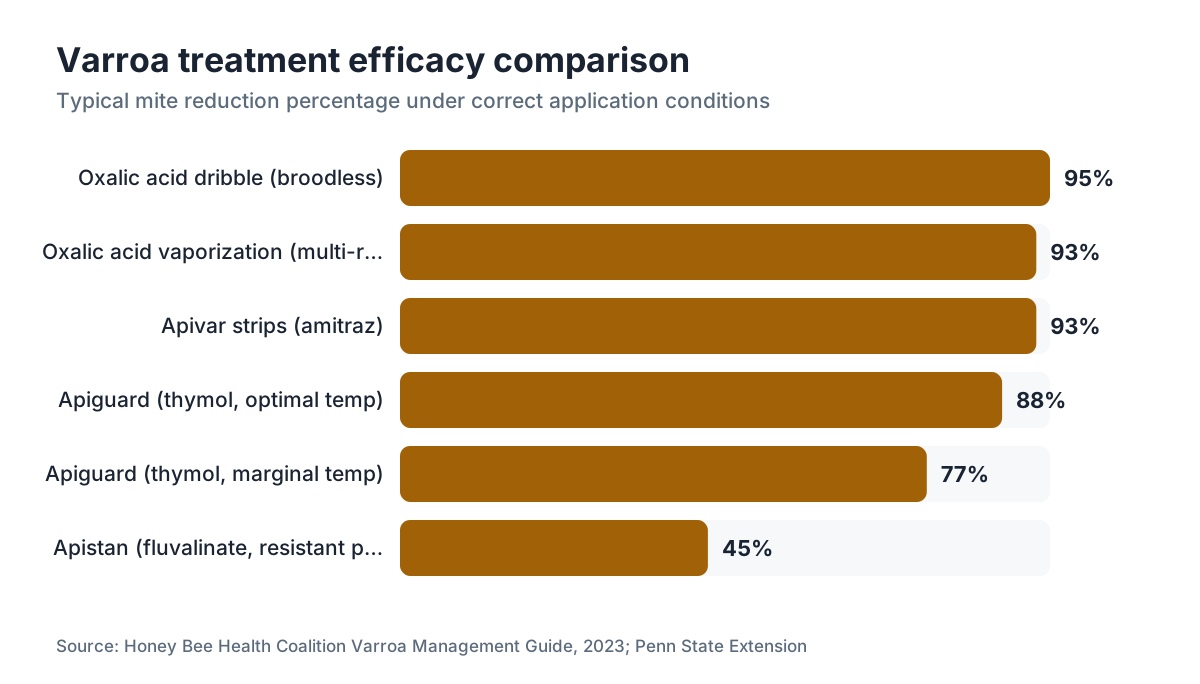
Apiguard works well when conditions are right, but it isn't the top scorer in head-to-head trials. Here's the honest picture from published research and extension data.
A study in the Journal of Apicultural Research found thymol-based treatments cut mites by roughly 74 to 93 percent, with the spread tied mostly to temperature during treatment.[5] Oxalic acid dribble in broodless colonies hits 90 to 99 percent in most published studies. Apivar (amitraz strips) lands at 90 to 97 percent.[4]
So why reach for Apiguard? A few real reasons. Thymol is organic-approved, which matters to certified producers. There's no documented thymol resistance in North American varroa, while resistance to fluvalinate (Apistan) is widespread and amitraz resistance has turned up in some populations.[4][9] And thymol doesn't build up in wax the way synthetic miticides do, which has long-term implications for colony health that are hard to pin down but are real.
The tradeoff is temperature dependence. If you can't hold the window, you can't hold the result. That's a real limitation, not a marketing footnote.
| Treatment | Active Ingredient | Typical Efficacy Range | Requires Broodless? | Temp Constraint? |
|-----------|-----------------|----------------------|---------------------|------------------|
| Apiguard | Thymol 25% | 74 to 93% | No | Yes (59 to 105°F) |
| Oxalic acid dribble | Oxalic acid | 90 to 99% | Yes (broodless) | No |
| Oxalic acid vapor | Oxalic acid | 90 to 99% | No (multiple rounds) | No |
| Apivar strips | Amitraz | 90 to 97% | No | No |
| Apistan strips | Fluvalinate | Variable (resistance widespread) | No | No |
Sources: Honey Bee Health Coalition Varroa Management Guide (2023), Penn State Extension.[4][6]
When in the season should you use Apiguard?
Short answer: late summer, after the main honey flow and before the colony shrinks for winter.
The longer answer is about population dynamics. Mite loads run relatively low in spring, when bee numbers climb fast and there are more bees per mite. By midsummer the ratio flips. Bee populations flatten or start falling while mites keep breeding. By late August across much of the country, a colony that started spring at 1 percent infestation can sit at 4 to 6 percent, the range where winter collapse gets likely.[4]
Apiguard fits this window. Temperatures across most of the country stay in the usable range from late July through September, and supers are usually off or coming off as the flow ends. The two-tray course runs about four weeks, so starting in early August wraps up by early September, leaving time for the colony to raise healthy winter bees before the first hard frost.
Spring use works in southern states but demands careful management of temperature swings. Fall use past mid-September in the northern tier is a gamble, because nighttime lows often drop below 59°F before the second tray finishes.
Trying to decide whether your timing works? The Honey Bee Health Coalition's guide has a treatment timing chart broken out by region.[4] The University of Minnesota Bee Lab pushes the same late-summer logic to protect the winter bee cohort raised in September and October.[7]
Does Apiguard affect queens, brood, or colony strength?
This is a fair concern, not paranoia. Thymol is biologically active, and at high concentrations it can trigger brood removal, queen interruptions, and irritable bees.
At label rate with proper ventilation, the main documented side effects are temporary. Bees may cluster more heavily near the entrance, and some colonies show a 10 to 15 percent bump in bee mortality for the first few days of each tray. Most colonies settle back within a week.
The brood risk is real when it's hot. When internal hive temperatures spike above about 105°F, thymol vapor gets concentrated enough to cause real brood removal. It shows up most in hives baking in full afternoon sun in hot climates, and it's more likely in small or weak colonies that can't thermoregulate well.
Queen loss gets reported anecdotally, but I haven't seen controlled data showing it at any meaningful rate under normal conditions. The cases people describe usually involve either brutal heat or a queen that was already failing.
The practical takeaway: don't treat a nucleus or any colony with fewer than four to five frames of bees. Small colonies can't buffer the vapor and they're the ones that get into trouble. For those, oxalic acid dribble is the better fit.
Nobody has great data on the long-term sublethal effects of thymol on queen reproductive quality. The closest evidence points to transient effects under normal conditions, but I'd hesitate to call that question settled.
Can you use Apiguard with honey supers on?
No. Full stop.
The EPA label requires that honey supers come off before application and stay off until treatment is done. Thymol taints honey at concentrations well below toxic but well above palatable. People can taste thymol in honey at a few parts per million, and regulators treat thymol-tainted honey as adulterated.
This is one of Apiguard's real limitations. If you're in a region with a summer flow that runs into August, you face a choice: delay treatment and let mites climb while the flow continues, or pull supers early. Neither one is painless.
A lot of experienced beekeepers in that spot treat the first round after pulling supers, write off some late-flow honey, and put winter bee health ahead of maximum yield. A colony that dies in November from untreated varroa produces zero honey next year. The math favors treating.
How should you monitor mite levels before and after an Apiguard treatment?
Before you treat, run an alcohol wash or sugar roll to set your baseline. The Honey Bee Health Coalition and most university extension programs recommend treating at 2 percent in summer, roughly 2 mites per 100 bees in a wash sample.[4][6]
The alcohol wash protocol: collect about 300 adult bees from a frame with open brood, where nurse bees gather. Add isopropyl alcohol, shake, and count mites in the liquid against the bees in the sample. Divide mites by bees, multiply by 100, and you have your percentage.
After treatment, recheck 48 to 72 hours after you pull the second tray. Started at 2 percent and back under 1 percent? It worked. Still sitting at 1.5 percent or higher? You probably had a temperature problem, a tray-placement mistake, or an infestation so high one course couldn't clear it.
VarroaVault's free monitoring protocol calculator helps you work out sample timing, treatment windows, and retreatment thresholds for your setup. That kind of seasonal structure is what separates beekeepers who overwinter every year from the ones who lose colonies on a cycle.
One rule: never skip the post-treatment check and assume it worked. The 74 to 93 percent efficacy range in the literature[5] means some colonies get 74 percent knockdown and some get 93. You don't know which one you got until you count.
What are the legal and storage requirements for Apiguard in the US?
Apiguard is an EPA-registered pesticide under registration number 72997-1.[1] In most states, buying and using it doesn't require a pesticide applicator license, because it's registered for general use. A handful of states set stricter rules for any miticide, so confirm with your state department of agriculture if you're unsure. Your state apiary inspector is a good first call.
Storage, from the label: keep it between 41°F and 77°F (5°C and 25°C), away from food and feed, in the original containers. Refrigeration stretches shelf life to about two years from the manufacture date. Do not freeze.
Disposal: toss spent trays according to local solid waste rules. The gel residue in a used tray is generally treated as non-hazardous at those concentrations, but don't dump spent trays where foraging bees can reach them.
Keep records. Apiguard doesn't require a license, but the USDA and some state grant programs for beekeeping ask for treatment records. A simple logbook noting application date, tray count, temperature at application, colony ID, and pre- and post-treatment mite counts is good practice and costs you almost nothing.
Is Apiguard worth buying in a 10-pack versus smaller quantities?
On cost alone, the 10-pack wins if you're treating five or more colonies. Per-tray cost in the 10-pack usually runs 15 to 25 percent below individual trays or 4-packs, based on pricing at major US beekeeping suppliers as of 2025. Individual tray equivalents run roughly $3.50 to $5.00 per tray in small quantities versus $2.80 to $4.00 per tray in the 10-pack, though prices vary by vendor and shift with the season.
The shelf-life caveat from earlier holds. If you run two or three hives and won't use a full 10-pack in one season, count the cost of trays that expire before you get to them.
Sideliners running 15 to 50 colonies routinely buy two or three 10-packs at the start of treatment season. It guarantees supply when you need it, since popular treatments sell out fast in August.
Compare pricing and availability across beekeeping supply companies, and check whether any offer free shipping on honey bee supply orders before you finalize the math.
What are the main reasons Apiguard treatments fail?
In rough order of how often they come up in extension clinics and beekeeper forums:
- Temperature too low. Applied in September when nights already dip below 59°F. The gel barely volatilizes. Mites survive.
- Supers left on. The beekeeper didn't pull supers, or forgot a shallow. Now the treatment is compromised, legally and practically.
- Tray placed wrong. Set below the brood cluster, or under a screened floor where vapor escapes, or with the foil left fully sealed. Bees can't reach the gel and vapor can't build in the brood area.
- Only one tray used. Ran out, or assumed one was enough. The second application isn't optional. It's the mechanism that breaks the reinfestation cycle.
- Mite load too high going in. A colony already at 8 to 10 percent in August won't be saved by Apiguard alone, and probably not by any single course. Those colonies need aggressive help, maybe a combination approach or oxalic acid vaporization alongside or after the thymol.
- Weak colony. Small or queenless colonies handle thymol vapor poorly and may abscond or lose brood, leaving you worse off than you started.
None of these are reasons to write off the product. They're reasons to be deliberate about conditions and about following the protocol.
Frequently asked questions
How many hives does a 10-pack of Apiguard treat?
A 10-pack treats exactly five colonies through one full two-tray course. Each colony needs two 50 g trays applied roughly two to four weeks apart. If a follow-up mite wash shows incomplete control and a colony needs retreatment, you'll need more trays, so beekeepers running five hives often buy extra to cover that.
What temperature does Apiguard need to work?
The label sets a minimum of 59°F (15°C) ambient temperature. Below that, the gel doesn't volatilize enough to reach effective thymol levels inside the hive. The practical sweet spot is 65 to 80°F. Above about 105°F inside the hive, thymol vaporizes too fast, which can cause brood removal or absconding.
Can I use Apiguard with honey supers on the hive?
No. The EPA label requires removing honey supers before application and keeping them off until treatment is done. Thymol taints honey at very low concentrations, making it unpalatable and legally adulterated. Supers stay off for the full four to six weeks of the two-tray course.
How effective is Apiguard at killing varroa mites?
Published research shows 74 to 93 percent mite reduction with a full two-tray course under proper temperatures. The low end usually reflects cooler ambient temperatures or protocol slips. For comparison, oxalic acid in broodless colonies hits 90 to 99 percent and Apivar strips typically hit 90 to 97 percent.
Does Apiguard kill varroa mites in capped brood cells?
Only partly. Thymol vapor penetrates cappings to a limited degree, which is why the second tray matters so much. Mites that sat under cappings during the first tray emerge by the second application and get exposed then. It's also why Apiguard underperforms during very heavy brood, when a large mite reservoir stays hidden under cappings.
Is Apiguard safe to use in organic beekeeping?
Thymol, the active ingredient, appears on the USDA National Organic Program's National List as a substance allowed for organic livestock operations under certain conditions. Certified organic beekeepers must confirm with their certifier before use, since certification body rules can run stricter than the NOP baseline.
How do I place the Apiguard tray correctly in the hive?
Peel back about half the foil cover to expose the gel. Set the tray gel-side up directly on top of the brood frames, centered over the cluster, under the inner cover or crown board. Never on the bottom board or under the brood nest. Leave 1 to 2 centimeters of space above the tray so bees can reach the gel and vapor can circulate.
What mite count should trigger an Apiguard treatment?
The Honey Bee Health Coalition recommends treating at 2 percent infestation during summer brood rearing, roughly 2 mites per 100 bees in an alcohol wash. Some researchers push treating at 2 percent in July or August to protect the long-lived winter bees raised in September and October. Don't wait for visible mite damage.
Can Apiguard harm the queen?
Queen loss gets reported anecdotally but isn't well documented in controlled research under normal conditions. The main risk shows up in very hot weather, when thymol concentrations spike inside the hive. Following the label temperature guidelines and keeping ventilation adequate during treatment cuts the risk to the queen substantially.
How long does one Apiguard treatment course take?
The full two-tray course takes about four to six weeks. The first tray stays 10 to 14 days, then you swap in the second for another 10 to 14 days. Always follow up with an alcohol wash 48 to 72 hours after removing the second tray to confirm the treatment reached adequate mite reduction.
Can I use Apiguard in the fall to protect winter bees?
Yes, but timing decides it. Start in late summer, typically early August in the northern tier, so the full four to six week course finishes before nighttime temperatures settle below 59°F. Starting in late September up north is too late. In southern states the fall window runs later, into October in some areas.
Does varroa develop resistance to Apiguard or thymol?
No documented resistance to thymol has been reported in North American varroa as of current published literature. That's a real advantage over synthetic miticides like fluvalinate, where resistance is widespread, and it's one reason thymol products stay a useful rotation option for managing mites over the long term.
How should I store unused Apiguard trays?
Store unopened trays between 41°F and 77°F in the original packaging. Refrigeration stretches shelf life to about two years from the manufacture date. Do not freeze. Keep away from food. Check the lot date on arrival, since some discounted product is old stock near expiration, which cuts potency.
Sources
- EPA Pesticide Registration, Apiguard registration page: Apiguard is registered under EPA Registration Number 72997-1 for control of Varroa destructor in honey bee colonies
- USDA National Organic Program, National List of Allowed Substances: Thymol appears on the NOP National List as allowed under certain conditions for organic livestock production
- Vita (Europe) Ltd, Apiguard US Product Label: Minimum application temperature of 59°F (15°C) and requirement to remove honey supers before treatment
- Honey Bee Health Coalition, Varroa Management Guide (2023): Recommends treating at 2 percent infestation threshold in summer; provides treatment efficacy comparisons and timing guidance by region
- Journal of Apicultural Research, thymol efficacy trials: Thymol-based treatments delivered 74 to 93 percent mite reduction across trials, with variability correlated to temperature during treatment
- Penn State Extension, Varroa Mite Management in Honey Bee Colonies: Alcohol wash protocol and 2 percent summer treatment threshold for varroa management
- University of Minnesota Extension, Bee Lab Varroa Management: Late-summer treatment timing recommendations to protect winter bee cohort raised in September and October
- Oregon State University Extension, Integrated Pest Management for Varroa: Comparison of varroa treatment options including thymol, oxalic acid, and amitraz efficacy and residue profiles
- USDA Agricultural Research Service, Bee Research Laboratory: Amitraz resistance reported in some varroa populations; fluvalinate resistance widespread in North America
- North Carolina State University Apiculture Program, Varroa Mite Treatments: Oxalic acid dribble achieves 90 to 99 percent efficacy in broodless colonies; Apivar achieves 90 to 97 percent
Last updated 2026-07-09