Apiguard varroa mite treatment: the complete field guide
TL;DR
- Apiguard is a thymol-based gel applied in two 50g doses, 10-14 days apart, when ambient temperatures stay between 59°F and 105°F.
- Independent trials report 74-93% efficacy.
- It leaves no chemical residues in honey if the final dose is removed before the honey flow.
- It's one of the cheapest and safest soft treatments available, but temperature sensitivity is its biggest limitation.
What is Apiguard and how does it kill varroa mites?
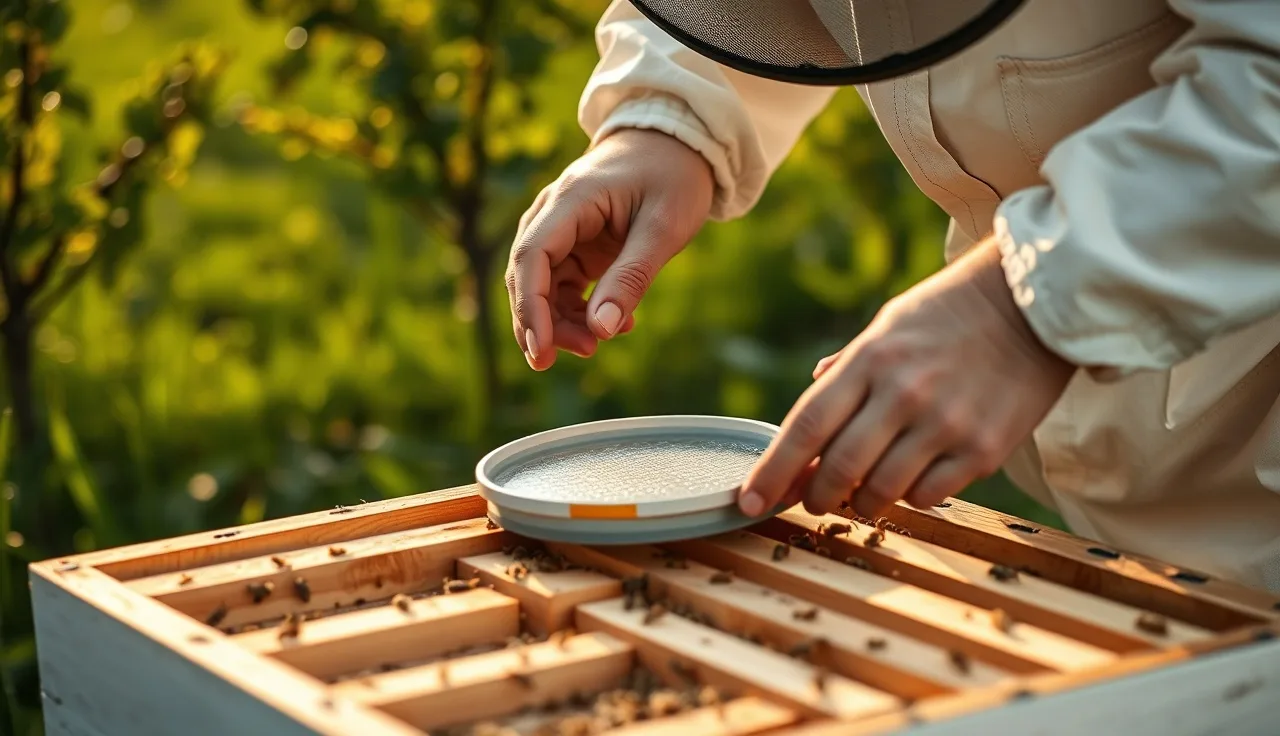
Apiguard is a slow-release thymol gel made by Vita (Europe) Ltd. Thymol is a natural compound found in thyme oil. It vapourizes at hive temperatures. The bees spread it through the colony as they groom the gel and fan the hive, and the vapor hits mites at concentrations that wreck their nervous system and breathing. [1]
The gel formulation matters. Early thymol treatments used raw crystals, which were hard to dose consistently. The gel releases vapor at a steady rate over 10 days or so, keeping concentrations high enough to kill mites without spiking so hard that bees reject the product or the queen quits laying. Bees don't like it, though. They'll try to haul the tray out of the hive, which is part of why the two-dose protocol works: the colony gets a sustained hit across three to four weeks.
Apiguard is registered as a pesticide in the United States (EPA Registration No. 71422-2) and approved for use in honey bee colonies. [2] The active ingredient is 25% thymol by weight. Each tray holds 50 grams of gel, which delivers 12.5 grams of thymol per application.
Because thymol comes from a plant, Apiguard counts as an "organic" or "soft" varroa treatment. That matters to beekeepers who want to keep synthetic residues out of wax and honey, and to anyone selling colonies or nucs under treatment-history rules.
How effective is Apiguard against varroa mites?
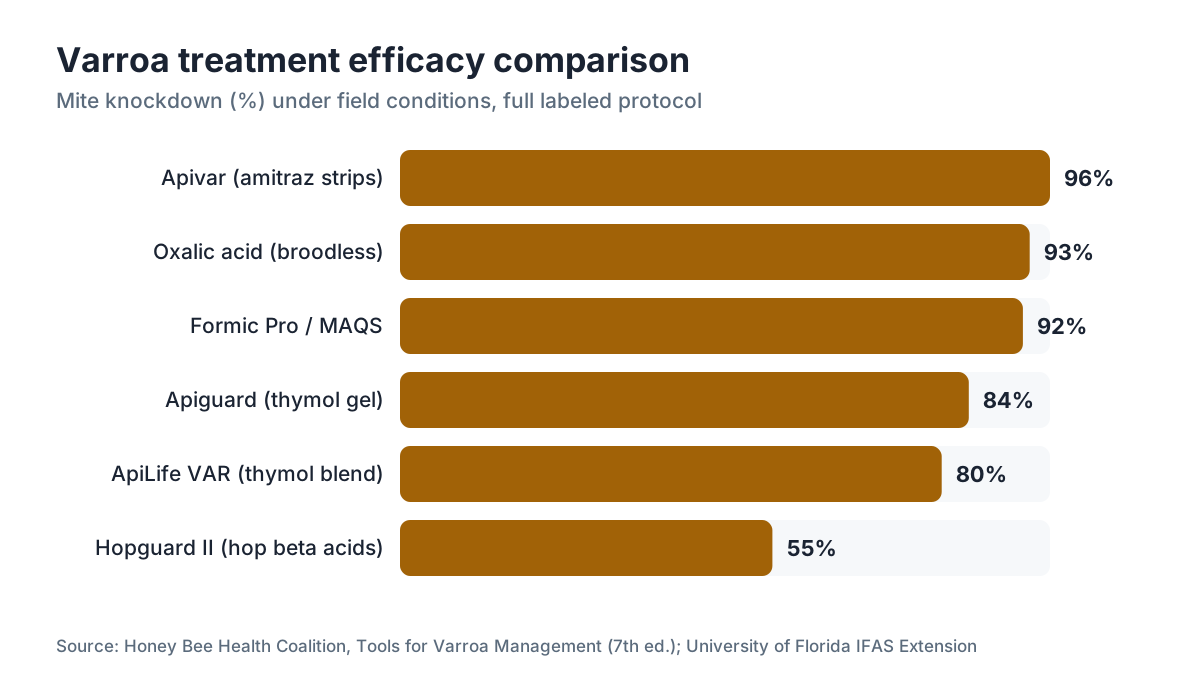
Apiguard drops mite loads by roughly 74% to 93% when you complete the full two-dose protocol at the right temperatures. The numbers in the literature swing that wide because field conditions push thymol around more than most treatments. That's the honest range across peer-reviewed and extension trials. [3][4]
A 2001 Vita-commissioned study reported efficacy above 90% under good temperature conditions. A University of Florida IFAS extension summary puts the realistic field range at 74-93%, and notes that cool temperatures (below 65°F) cut vapor release and therefore kill rate. [4] The Honey Bee Health Coalition's "Tools for Varroa Management" guide lists thymol products including Apiguard as effective options, with the caveat that efficacy depends on temperature. [5]
Some context. Oxalic acid dribble in broodless colonies hits 90-95% or better. Apiguard is not that. But for a colony with open brood, where oxalic acid dribble is contraindicated, Apiguard competes well. A single application won't reach mites under capped brood, which is exactly why the two-dose protocol exists: it catches mites that emerge from capped cells between treatments.
Apply Apiguard correctly, in warm weather, with both doses, and you should knock mite loads down by at least three-quarters. That's often enough to carry a colony through summer into fall, when you follow up with a more complete treatment before the winter cluster forms.
What temperature range does Apiguard require?
Temperature is the single biggest constraint. The Apiguard EPA label says to use the product when ambient temperatures sit between 59°F (15°C) and 105°F (40°C). [2] The sweet spot most beekeepers and extension sources cite is 60°F to 85°F daytime highs.
Below 60°F, thymol barely vapourizes. You get almost no efficacy and you waste your money. Above 105°F, vapor can build too high, stressing bees and sometimes killing queens. In the American South, most beekeepers using Apiguard treat in early spring or very early fall to dodge peak summer heat. In northern states and Canada, the main window runs late July through September, before nights settle below 50°F.
Storage matters too. Don't leave trays in a hot car or shed above 77°F for long; the gel can degrade and the thymol may partly volatilize before you ever open the foil.
Here's the tip that circulates among experienced beekeepers: check the 10-day forecast before you start. A cold snap in week one means your first dose underperforms and you burn a tray for almost nothing. Starting a week later to catch a warm window is worth it.
How do you apply Apiguard correctly? Step-by-step protocol
The labeled protocol is two 50g trays, applied 10-14 days apart. Here's how to run it without wasting trays or stressing the colony.
Start by scoring or opening the foil cover on the tray. The label says to open about half the foil. I'd open the whole top or score it heavily. Skimpy foil opening is the most common reason people get poor results with this product. More open surface means more vapor.
Set the tray face-up on the top bars of the brood nest, centered. Move any comb or equipment that would block bees from reaching and grooming the tray. In a standard Langstroth setup, put the tray right on the brood box frames and add a super or empty box above it so the bees have headspace to work around it. Run it under a crown board or inner cover with no space and you'll choke the airflow, and the bees will chew through the bottom of the tray to dump it faster.
Leave the first tray in place for 10-14 days. Don't open the hive over and over during treatment; every inspection bleeds off heat and vapor. After 10-14 days, scrape out any leftover gel from the first tray (or pull the whole tray if it's empty) and drop a fresh 50g tray in the same spot. Leave the second tray another 10-14 days.
Once the second dose is done, remove the tray and any remaining gel. Keep records: date applied, temperature range, mite wash counts before and after. A sticky board under a screened bottom board during treatment gives you a rough daily mite drop, which is satisfying to watch but no substitute for an alcohol wash or sugar roll before and after. [5]
For package installs or splits, wait until the colony covers at least four to five frames of bees before treating. Apiguard hits small clusters harder than large ones.
Can you use Apiguard with honey supers on the hive?
No. The Apiguard EPA label requires honey supers off the hive before treatment, and off until treatment is done and all gel is removed. [2] Thymol taints honey flavor at very low concentrations, and treated honey can't legally be sold without that disclosure under most state rules.
This is not a gray area. It's the biggest scheduling headache with Apiguard for sideliners running production colonies. Your treatment window has to fall outside the honey flow by at least the length of treatment (three to four weeks minimum) plus whatever time the label wants before supers go back on.
For most of the U.S., that means treating after the main summer flow ends, usually late July through August, before fall mite populations blow up. Some beekeepers treat in spring before supers go on, which works if temperatures cooperate and spring runs late enough.
Want a treatment you can run with supers on? Apiguard isn't it. Formic acid (MAQS or Formic Pro) is the only EPA-registered option that can be used with supers on the hive. [9]
How much does Apiguard cost and where do you buy it?
As of mid-2025, Apiguard trays sell in the U.S. for roughly $2.50 to $3.50 per 50g tray in packs, depending on supplier and pack size. A full two-tray treatment per colony costs around $5 to $7. For a ten-colony sideline operation, that's $50 to $70 per treatment cycle, among the cheapest soft treatment options going.
You can buy it from most major beekeeping supply companies. Comparison shopping is worth a few minutes given how much prices swing between suppliers.
Apiguard ships at room temperature with no refrigeration, which makes mail order easy. Shelf life is about two years from manufacture when stored below 77°F. Check the lot date on boxes from small suppliers who might sit on slow inventory.
To pair equipment with your treatments, beekeeping supply companies can help you compare prices across the major distributors.
How does Apiguard compare to other varroa mite treatment options?
Here's a side-by-side look at the main registered treatments and where Apiguard sits among them.
| Treatment | Active Ingredient | Efficacy Range | Brood Penetration | Honey Super Restriction | Temp Limit |
|---|---|---|---|---|---|
| Apiguard | Thymol gel 25% | 74-93% | Partial (vapor) | Remove supers | 59-105°F |
| ApiLife VAR | Thymol + eugenol blend | 70-90% | Partial | Remove supers | 65-95°F |
| MAQS / Formic Pro | Formic acid | 90-95% | Yes (penetrates caps) | Supers OK | 50-85°F |
| Oxalic acid (dribble) | Oxalic acid | 90-95% | Broodless only | Remove supers | Above 40°F |
| Oxalic acid (vaporize) | Oxalic acid | 90-95% | Broodless; repeat doses extend window | Remove supers | Above 40°F |
| Apivar | Amitraz strips | 93-99% | Yes (contact) | Remove supers | Above 50°F |
| Hopguard II | Hop beta acids | 40-70% | Partial | Remove supers | No strict limit |
Sources: [3][4][5][6][9][10]
Apiguard's niche is clear. It's cheap, it's a plant-derived compound, it leaves no lasting residues in wax, and it works at real field temperatures across a big chunk of the U.S. treating season. Where it loses to formic acid is brood penetration: formic acid vapor reaches under cappings, thymol doesn't reliably. Where it loses to Apivar is the efficacy ceiling and sheer ease of use. Where it beats the synthetics is residue profile and cost.
The Honey Bee Health Coalition states that "rotation among treatment types with different modes of action is the best strategy for limiting the development of resistance." [5] Apiguard belongs as one leg of that rotation, not your only tool.
Does varroa develop resistance to thymol?
It's a fair worry, but the evidence as of 2025 is a lot less alarming than for synthetic miticides like amitraz or pyrethroids. No field-resistant varroa populations to thymol have been documented.
Thymol works through a physical vapor mechanism that attacks varroa's nervous system through several pathways at once. That multi-target action is thought to make stable resistance harder to build than with a synthetic chemical that hits a single receptor. Lab studies have not turned up field-resistant mites to thymol, unlike the well-documented amitraz and tau-fluvalinate resistance cases. [6]
"No documented resistance yet" is not the same as "resistance-proof." Leaning on thymol year after year as your only treatment is poor practice. Rotate with oxalic acid or formic acid at least once a year to ease selection pressure. [5]
Resistance to synthetic treatments in varroa is a real, documented problem in U.S. apiaries. Keeping soft treatments like Apiguard in rotation is partly about using what works now while protecting treatments that may be harder to replace. Digging into varroa mite biology and resistance mechanisms will help you make smarter rotation calls.
What side effects should you watch for after applying Apiguard?
Expect some disruption. Bees stay agitated for the first day or two after application. Extra bearding outside the hive is normal, especially in hot weather when vapor peaks. Some foragers drift away from the entrance and then come back.
The side effects that flag a real problem are queen loss, a brood break dragging past two weeks, or a big drop in adult bee population over the treatment period. Queen loss from Apiguard is real but uncommon when temperatures stay in range and the colony is strong. If you're treating a colony with a new or recently mated queen, wait until she's well-established with a solid brood pattern before you start thymol.
Small colonies (under four frames of bees) carry a higher risk of disruption. Vapor concentration per bee runs higher in a small cluster, and those colonies can abscond or just dwindle out. Don't treat packages or very weak splits with Apiguard.
Tracking mite drop on a sticky board? You'll see a spike in dead mites within the first two to three days, then a gradual tail-off. That's the treatment working. No mite drop at all in the first week is a red flag that the temperature is too low or vapor isn't reaching the brood nest.
To track outcomes systematically, free tools from VarroaVault can log mite wash counts before and after treatment so you measure actual efficacy in your own apiaries.
Can you use Apiguard in a top-bar or Warré hive?
Yes, with modifications. The standard tray-on-top-bars approach works in any horizontal top-bar hive as long as you can open a small space above the tray for bee access and vapor circulation. In a Kenya-style top-bar hive, set the tray in the middle of the brood cluster area and place a follower board or divider loosely behind it to keep the vapor packed in the brood zone instead of dissipating through a big empty cavity.
In a Warré hive, the nadiring style of management complicates placement. Most Warré beekeepers treat by setting the tray on the top bars of the uppermost occupied box, then adding an empty box above it for vapor headspace. The trick in any non-Langstroth setup is not sealing the vapor in so tight that concentrations spike to toxic levels, and not leaving so much open space that concentrations never build.
There's no specific label instruction for non-Langstroth hives, so you're adapting the labeled use. Err on the side of decent ventilation and a full 10-14 day window per tray.
When is the best time of year to treat with Apiguard?
Best timing depends on your climate, but the goal never changes: treat when mite loads are climbing but before they tip the colony into a crash.
Across most of the continental U.S., that means late July through early September. By late summer, mite populations have been compounding since spring and sit at or near peak. Winter bees start getting raised in August and September, and those bees need to emerge mite-free to build a healthy overwintering cluster. Treating in August gives you four to five weeks to finish the Apiguard protocol and still leaves time for a follow-up oxalic acid treatment if counts stay high. [5][7]
Spring treatment works if you have a gap before the main honey flow and daytime temperatures hold above 60°F. It cuts the mite population heading into summer buildup, but it doesn't erase the need for a late-summer treatment because mite populations bounce back fast.
In the Deep South, where summers regularly top 100°F, the spring window (March through May) is often the most practical because summer heat pushes vapor into the harmful range. A second treatment in early fall, once temperatures ease, is a sound plan.
Do a mite wash (alcohol wash or sugar roll) before you start, then again 5-7 days after the second tray comes out. That tells you if the treatment worked and whether you need an immediate follow-up. Above 2-3 mites per 100 bees after treatment means you need a second tool. [5]
Is Apiguard safe for bees, beekeepers, and the environment?
Thymol has a good safety profile next to synthetic miticides. It metabolizes fast, doesn't build up in beeswax the way pyrethroids and amitraz do, and breaks down in the environment without leaving persistent toxic metabolites. [8]
For beekeepers, skin and eye irritation are the main handling concerns. Wear nitrile gloves when placing trays, and keep your hands off your face. The EPA label doesn't require a respirator for normal use, but opening many trays in a confined space is unpleasant because the odor is strong. Outdoors, it's a non-issue.
For bees, the labeled application rate keeps hive concentrations below acute toxicity thresholds for workers and queens. Blowing past the labeled dose (two trays at once, say) does not improve efficacy and does raise the risk of queen loss and colony stress. Follow the label.
Honey residues: thymol occurs naturally in honey at trace levels, but colonies under treatment show elevated thymol in honey made during that window. That's why super removal is required. Wax residue studies show thymol doesn't accumulate across seasons the way lipophilic synthetic chemicals do, which is one of its real advantages for beekeepers trying to keep clean wax. [8]
Apiguard is not toxic to fish or aquatic invertebrates at realistic environmental concentrations from hive use, though the EPA label notes thymol is slightly toxic to aquatic organisms at higher concentrations. Don't dump used trays in waterways.
What do you do if Apiguard alone isn't bringing mite counts down?
First, rule out application errors: temperature too low, foil not opened, one tray instead of two, or a colony too small to spread the gel. Those account for most treatment failures in my experience.
If you've done everything right and your post-treatment mite wash still shows more than 2 mites per 100 bees, don't wait. Move to a faster, higher-efficacy treatment. Oxalic acid vaporization (three treatments, seven days apart, in a colony with the least sealed brood you can arrange) knocks counts down hard. Apivar (amitraz strips) is the backup when you need reliable efficacy fast and aren't worried about synthetic residues in wax. [5][6]
Some beekeepers pair Apiguard with a brood break (cage the queen for 21 days to clear out sealed brood) to squeeze much higher efficacy from the thymol. It's a legitimate strategy, especially in fall when you want counts near zero before winter. A broodless thymol treatment followed right away by an oxalic acid dribble is about as thorough as it gets without synthetic chemicals.
Keep records across cycles. If you consistently get poor results from Apiguard at the same apiary year after year with correct application, the local mite population may have reduced sensitivity to thymol. Rotate to a different mode of action and consider sending mites in for resistance testing through your state extension apiarist. [7]
For a full-year view of fitting Apiguard into your mite management, VarroaVault's free varroa management tools can track mite counts, treatment windows, and colony outcomes across your whole operation.
Frequently asked questions
Can I use Apiguard in cold weather?
No. The EPA label sets a minimum ambient temperature of 59°F (15°C). Below that, thymol barely vapourizes and you get almost no mite kill. Facing a mite problem in cold weather? Switch to oxalic acid dribble (which works down to about 40°F in broodless colonies) or oxalic acid vaporization. Apiguard used in the cold wastes trays and leaves mite populations unchecked.
How long does Apiguard treatment take from start to finish?
The standard protocol runs 21 to 28 days: 10-14 days for the first 50g tray, then 10-14 days for the second. Most beekeepers run each tray the full 14 days to maximize vapor exposure. Add a few days on either end for mite wash counts and you're looking at roughly a month from setup to confirmed result.
Does Apiguard kill varroa mites under capped brood?
Not reliably. Thymol vapor doesn't penetrate brood cappings the way formic acid does. The two-dose protocol is built to catch mites that emerge between applications, but mites sealed deep inside capped cells for the full treatment period can survive. This is the main reason Apiguard's efficacy ceiling (around 74-93%) sits below formic acid or a broodless oxalic acid treatment.
What's the difference between Apiguard and ApiLife VAR?
Both use thymol as the primary active ingredient, but ApiLife VAR also includes eugenol, menthol, and camphor in a vermiculite tablet, while Apiguard is a pure thymol gel. The protocols differ: ApiLife VAR uses multiple smaller tablets broken and placed around the frames. Efficacy ranges overlap. Apiguard's gel is generally easier to manage for new beekeepers. Neither needs a prescription.
Can I use Apiguard while the queen is laying?
Yes, that's normal and expected. Apiguard is designed for colonies with open brood. The protocol disrupts mites in the phoretic stage and those emerging from cells during the three to four week window. Just watch the queen's laying pattern after the first tray. Some queens slow down during treatment, which is normal. A prolonged brood break or a missing queen after treatment warrants a look.
How many mite-free days do I get after a full Apiguard treatment?
None, technically. Apiguard cuts the mite population, but reinfestation from neighboring colonies starts the moment treatment ends. Studies suggest mite populations can rebound to pre-treatment levels within 8-12 weeks with no follow-up in place. That's why late-summer Apiguard treatment is usually paired with an oxalic acid treatment in fall before the winter cluster forms.
Is Apiguard approved for use in all U.S. states?
Apiguard is EPA-registered at the federal level (EPA Reg. No. 71422-2), so it's legal to use in all 50 states. A small number of states require state-level pesticide registration on top of the federal one. Check with your state department of agriculture if you're unsure, though in practice Apiguard is available and legal to buy in every state.
Can I treat a newly installed package with Apiguard?
It's not recommended. New packages have small bee populations that are more vulnerable to thymol vapor stress, and the mite load in a fresh package from a reputable supplier is usually low. Wait until the colony builds up to at least four to five frames of bees with a solid brood pattern, then check mite levels with an alcohol wash before deciding if treatment is warranted.
How do I store unused Apiguard trays?
Store in a cool, dry spot below 77°F (25°C), out of direct sunlight. Sealed trays have a manufacturer-stated shelf life of about two years from production. Don't refrigerate, but avoid warm sheds or garages that regularly top 90°F, since heat can push thymol to volatilize through the foil before you ever open the tray. Check the lot date when buying in bulk.
Does Apiguard affect the flavor or safety of honey?
Yes, if used with honey supers on the hive. Thymol taints honey flavor at concentrations far below any safety threshold. That's why the label requires supers off before treatment and off until treatment is complete. Honey made during treatment can carry a medicinal or herbal aftertaste. Honey made after supers go back on following a full treatment cycle is unaffected.
Is there a risk of queen loss with Apiguard?
Yes, though it's uncommon with correct application. Risk climbs in hot weather (above 95°F), in small colonies, or when two trays go in at once. Most queen losses blamed on Apiguard involve treatment during a heat wave or in a colony that was already stressed. Follow the temperature guidelines, use one tray at a time, and watch the brood pattern after the first application.
How does Apiguard fit into an integrated varroa management plan?
It fits best as a warm-season soft treatment, usually late summer, before synthetic or more intensive treatments come out in fall if needed. The Honey Bee Health Coalition recommends rotating treatments with different modes of action to slow resistance. A practical rotation: Apiguard in August, oxalic acid vaporization in October once brood is minimal, with Apivar as a rescue treatment if counts spike above threshold.
What mite count threshold should trigger an Apiguard treatment?
The most widely cited threshold is 2 mites per 100 bees (2%) by alcohol wash or sugar roll during the brood-rearing season. The Honey Bee Health Coalition and most university extension programs use this figure. At or above 2%, treat promptly. If you're already at 4-5% in mid-summer, ask whether a faster treatment like formic acid or Apivar fits the urgency better.
Sources
- Vita (Europe) Ltd, Apiguard product information: Apiguard is a slow-release thymol gel; bees distribute thymol vapor through the colony during grooming and ventilation
- U.S. EPA, Apiguard pesticide registration (EPA Reg. No. 71422-2): Apiguard is EPA-registered for use in honey bee colonies; honey supers must be removed; temperature range 59-105°F
- Imdorf A. et al., Apidologie, 1999: Thymol efficacy trials: Independent trials report 74-93% mite knockdown with two-dose thymol gel protocols under field conditions
- University of Florida IFAS Extension, Honey Bee Diseases and Pests: Field efficacy of thymol products including Apiguard ranges from approximately 74-93%; lower temperatures substantially reduce vapor release and kill rate
- Honey Bee Health Coalition, Tools for Varroa Management Guide (7th ed.): Thymol products are effective varroa management options with temperature-dependent efficacy; rotation among treatment types with different modes of action is the best strategy for limiting resistance development; 2% (2 mites per 100 bees) is the widely cited treatment threshold
- Rosenkranz P. et al., Journal of Invertebrate Pathology, 2010: Varroa destructor biology and control: No field-resistant varroa populations to thymol have been documented, in contrast to documented resistance to amitraz and tau-fluvalinate; Apivar (amitraz) achieves 93-99% efficacy
- USDA Agricultural Research Service, Bee Research Laboratory: State extension apiarists and ARS provide mite resistance testing resources; late-summer treatment timing recommended to protect winter bees
- Bogdanov S. et al., Apidologie, 1998: Thymol residues in honey and wax after Apiguard treatment: Thymol does not accumulate in beeswax across seasons unlike lipophilic synthetic miticides; treated honey shows elevated thymol levels; post-treatment honey from removed supers is unaffected
- Penn State Extension, Varroa Mite Management: Formic acid (MAQS/Formic Pro) is the only EPA-registered varroa treatment compatible with honey supers on the hive; oxalic acid dribble achieves 90-95%+ in broodless colonies
- Ohio State University Extension, Varroa treatment efficacy comparison: Hopguard II achieves 40-70% efficacy; ApiLife VAR 70-90%; treatment comparison table data
Last updated 2026-07-09