Apiguard varroa mite treatment: how it works and when to use it
TL;DR
- Apiguard is a thymol gel that kills varroa mites.
- You apply two 25g trays about two weeks apart, and it needs ambient temperatures between 59°F and 105°F (15°C to 40°C).
- In warm weather with little capped brood, it knocks down 90 percent or more of mites.
- Honey supers must come off first.
What is Apiguard and how does it kill varroa mites?
Apiguard is a slow-release thymol gel registered by the EPA for varroa control in honey bee colonies. Thymol comes from thyme oil, and it kills Varroa destructor two ways at once: as a fumigant in the hive air and as a contact acaricide. Bees try to remove the gel from the tray, and in doing so they smear it around and spread the vapor through the brood nest, right where mites are feeding on pupae and adult bees.
The active ingredient is thymol at 25% w/w in a slow-release gel matrix [1]. The slow part is the whole point. A single fast dose of thymol would evaporate before it ever reached mites capped inside brood cells. The gel drips vapor out over roughly two weeks, keeping hive-air concentrations high enough to hit mites without cooking the bees.
Be clear about the limits. Thymol reaches into capped brood cells a little, but it kills far fewer mites sealed inside cells than it does phoretic mites riding on adult bees [2]. That gap is exactly why the two-dose protocol exists, and why pairing Apiguard with a brood break changes the math (more on that below).
Apiguard is approved in the United States, Canada, the United Kingdom, and across the European Union. In the U.S. it carries EPA Registration Number 73287-1. No prescription, no vet license, anybody can buy it.
What temperatures does Apiguard require, and why does that matter?
Temperature decides whether Apiguard works or wastes your money. The label calls for ambient air between 59°F (15°C) and 105°F (40°C) during treatment [1]. Below 59°F the thymol barely volatilizes, so hive-air concentrations never climb high enough to matter. Above 105°F it off-gasses so fast that bees beard hard, the colony can abscond, and the dose burns off before the two-week window closes.
Northern beekeepers get a narrow window. Apiguard works best in late summer, roughly August into early September in the northern hemisphere, after the honey flow ends but while days stay warm. Penn State Extension points to that same August-to-September window for northern colonies [11]. It lines up with the late-summer mite spike that Honey Bee Health Coalition data shows building toward a fall peak [3].
Nights count too. If nights keep dropping below 50°F, the gel sitting in the tray releases almost nothing overnight. Your two-week dose stretches into three or four cold weeks of weak exposure. In a climate where August nights cool off fast, set your start date so the first tray goes in with two solid warm weeks still ahead of it.
Ventilation and a south-facing entrance help. Apiguard builds a vapor atmosphere inside the hive, and a screened bottom board with the insert pulled lets extra vapor bleed off before it reaches bee-damaging levels. A solid bottom with zero ventilation during a heat wave is the setup most likely to send a colony packing.
How do you apply Apiguard correctly, step by step?
The full protocol runs two 25-gram trays per cycle. Each 50-gram retail sachet holds two trays, which is one complete treatment for one colony [1].
Step one: pull every honey super before you start. Thymol taints honey with an herbal off-flavor that buyers and show judges catch. The label bans use while supers are on. No exceptions.
Step two: peel the foil off the first tray completely. Set the tray on top of the brood frames, gel side up, and slide it back under the inner cover so bees reach it easily. Don't drop it on the bottom board. Vapor won't spread well from down there.
Step three: leave the first tray for 10 to 14 days. Check at day 10. If it's more than half gone, move to the second tray. If the gel is mostly still there, give it four more days before you swap.
Step four: replace with the second 25g tray and leave it another 10 to 14 days.
Step five: pull the tray, run a wash or sticky-board count, and read the result. If the mite load is still above 2 percent (about 2 mites per 100 bees on a wash), line up a follow-up with a different chemistry so you're not leaning on thymol alone.
An empty tray can sit briefly with no harm, but don't leave a spent tray in for weeks. Take it out and write down your treatment date, product lot, and post-treatment count. Records are the only honest way to tell whether your treatments actually work over the years.
How effective is Apiguard against varroa, and what does the data say?
In warm weather with proper application, Apiguard typically knocks down 74 to 93 percent of mites, based on registration field trials and independent apicultural research [2][4]. The range is wide because temperature, colony strength, and brood level all pull on the result.
A University of Guelph study on thymol treatments found that colonies with less brood at the start of treatment saw higher efficacy, which fits the basic rule: fewer capped cells means fewer mites hiding from the fumigant [4]. That study didn't test the Apiguard brand by name, but the gel formulation and concentration matched the commercial product.
The Honey Bee Health Coalition's Varroa Management Guide says soft chemical treatments like thymol "can be highly effective when colonies have little or no capped brood," which is the whole case for pairing this product with a brood break [3].
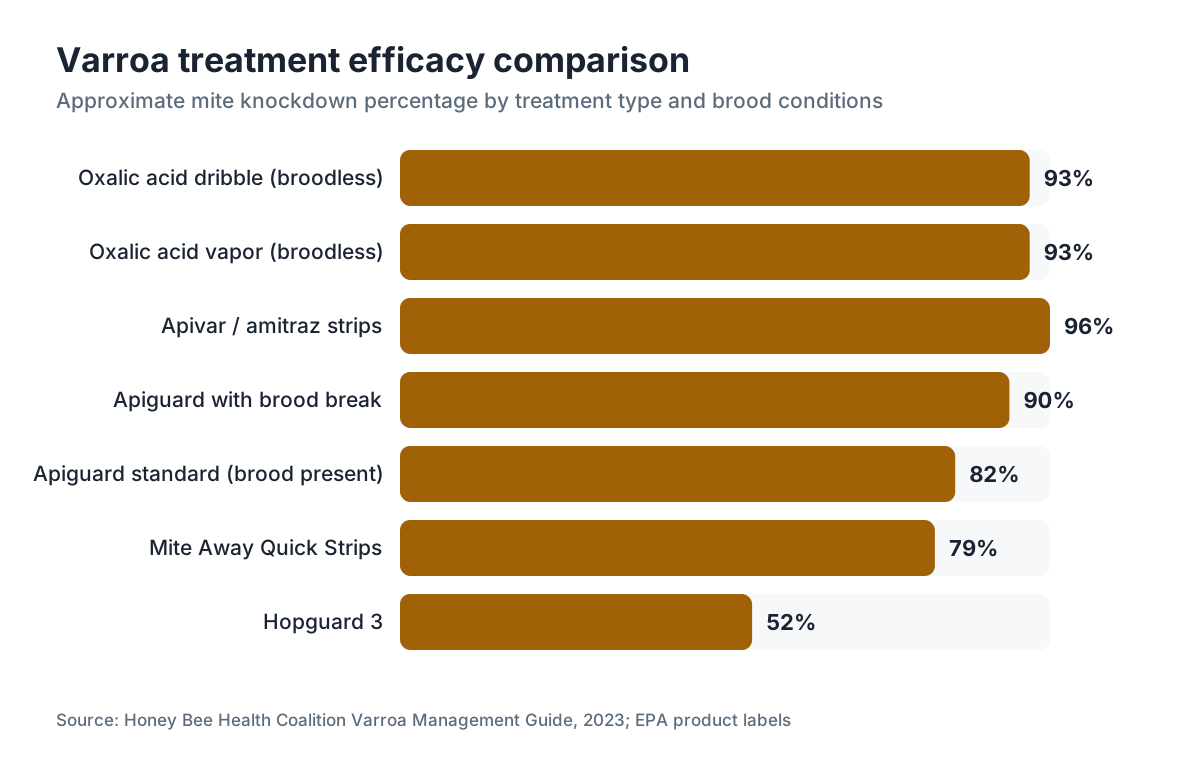
Here's the context that matters. Oxalic acid dribble under broodless conditions runs 90 to 97 percent, and amitraz strips (Apivar) in normal colonies run 93 to 99 percent [12]. Apiguard sits below both when brood is present and roughly ties oxalic acid when brood is minimal. That isn't a strike against Apiguard. It's a reason to match the tool to the situation.
Thymol resistance has turned up in some European varroa populations, though it looks less common and slower to develop than pyrethroid resistance [2]. Rotating chemistries year to year stays the safest play.
Can you use a brood break with Apiguard to improve results?
Yes, and it's one of the best ways to squeeze more out of this treatment. A brood break means caging or removing the queen so all capped brood emerges before you treat. Once the colony is broodless, every mite is phoretic on an adult bee and fully exposed to thymol vapor. That single change can push efficacy from the mid-70s toward 90 percent or better.
The mechanics are simple. Cage the queen in a queen clip or JZ BZ cage on a frame of capped honey for 24 to 25 days (the full worker brood cycle plus a buffer) before your planned treatment. When the last brood emerges, release the queen and start Apiguard that same day. You get the broodless window without a long gap in laying.
For how brood breaks fit the wider varroa calendar, see our coverage of varroa mite biology and seasonal timing.
Some beekeepers use natural cues instead of caging: the post-swarm broodless stretch, a split that stays queenless a few weeks, or a late-season requeen. Each can work as an informal brood break if the timing holds. The key is starting Apiguard within a couple of days of the colony going broodless, before new eggs hatch and cells start capping again.
One caution. Don't run a brood break unless you have time to watch the colony. Three to four weeks of queenlessness stresses bees and invites laying workers if reintroduction goes sideways. Plan the logistics before you cage the queen, not after.
When should you not use Apiguard?
Some situations make Apiguard the wrong call.
Honey supers on. Full stop. The label forbids it, and thymol soaks into wax and honey. Even after a long cure, supers that rode through treatment can carry off-flavors. Don't gamble a honey crop.
Cold fall weather. If nights sit below 45°F when you're ready to treat, switch to oxalic acid dribble or vapor. Those work in cooler air and suit the pre-winter broodless window better.
Weak colonies. A colony fighting a small cluster, a spotty brood pattern, or disease won't spread the gel. Bees have to physically work the tray. A tiny cluster may avoid it entirely, especially if it's parked far from the bees. Fewer than four or five frames of bees? Fix the strength problem first or pick a different delivery method.
Nuclei and mating nucs. Five-frame nucs are borderline. Vapor builds up fast in a tight space and can stress the colony more than the mites. Plenty of beekeepers run a half tray (about 12g) in a five-frame nuc and report decent results, but that's off-label.
Colonies already primed to abscond, say after a recent pesticide hit or a prior thymol treatment that caused trouble. Give those bees time to settle before you treat again.
How does Apiguard compare to other varroa treatments?
Here's a straight comparison of the main registered treatments. This isn't about crowning a winner. Every tool earns its spot depending on your season, climate, and hive.
| Treatment | Active ingredient | Efficacy (with brood) | Temperature window | Honey super restriction | Resistance risk |
|---|---|---|---|---|---|
| Apiguard | Thymol 25% gel | 74-93% | 59-105°F | Remove supers | Low-moderate |
| ApiLife Var | Thymol blend | 70-90% | 64-105°F | Remove supers | Low-moderate |
| Oxalic acid dribble | Oxalic acid | 90-97% (broodless only) | Above 40°F | Remove supers | Very low |
| Oxalic acid vapor | Oxalic acid | 90-97% (broodless only) | Above 40°F | Remove supers | Very low |
| Apivar strips | Amitraz | 93-99% | 50-105°F | Remove supers | Moderate-high |
| Mite Away Quick Strips | Formic acid | 68-90% | 50-85°F | Can leave supers | Low |
| Hopguard 3 | Hops beta acids | 40-65% | Any | Can leave supers | Very low |
Sources: Honey Bee Health Coalition Varroa Management Guide [3], University of Georgia Extension [12], EPA product labels [1].
Apiguard lands in the middle of the pack. It's a solid summer treatment when the weather cooperates, and it earns its keep if you're rotating away from amitraz to slow resistance. It's not the strongest and not the most convenient, but it's been in use since the late 1990s and has a well-understood safety record for bees and beekeepers.
Apiguard has one clear edge over Apivar: no amitraz residue building up in your wax. Amitraz and its breakdown products accumulate in beeswax over repeated treatments, and while the health picture is still being studied, plenty of beekeepers rotate to Apiguard specifically to keep from adding more amitraz to their comb [6].
Is Apiguard safe for bees, the beekeeper, and honey?
Thymol is a GRAS (Generally Recognized as Safe) food additive, and its residue profile in honey is well-documented. Studies show thymol residues in honey drop to background levels within weeks of treatment ending, as long as supers are off during treatment [7]. The European Food Safety Authority has reviewed thymol as a veterinary product for bees and found residues acceptable when the product is used to label.
For you, thymol is an irritant. Skip prolonged skin contact and don't handle trays bare-handed in a closed space. Nitrile gloves and fresh air when you open the hive are enough. There's no re-entry interval for the hive itself, since you're not standing inside it during the two-week exposure.
Bee safety tracks the dose. At labeled rates, most healthy colonies take Apiguard in stride. You'll see some bees moving fast at the entrance, some fanning, maybe a dip in foraging the first few days. That's normal. What you don't want is queen balling (a sign of severe stress), waves of bees bearding and not returning, or dead bees stacking up at the entrance. If any of that shows up, pull the tray and give the colony 48 hours to settle before you reassess.
Queen loss during treatment gets reported now and then, usually in hot weather with poor ventilation or in very small colonies. It's uncommon in well-run hives, but it happens. Check for eggs and young brood about 10 days after you place the first tray.
How do you time Apiguard treatment with your seasonal beekeeping calendar?
In the northern hemisphere, the sweet spot is late July through early September. That hits after the main flow in most regions, before temperatures fall below the treatment floor, and while varroa is climbing toward its fall peak.
A late-summer mite wash before you treat is non-negotiable. If your count clears 2 mites per 100 bees (2%), treat now [3]. At 1 percent or below in late June, you may have a few weeks before starting. At 3 percent or higher in August, skip the perfect brood break and start Apiguard now; chase the brood break on your next cycle instead.
Here's a rough calendar for a typical northern season:
- Late June to early July: first mite wash. Record the count.
- July 15 to August 1: if counts are rising, cage the queen for a 24-day brood break timed to an August Apiguard start.
- August 1 to September 10: Apiguard window (two trays, four to six weeks total).
- Early October: post-treatment wash. Still above 2%? Treat again before the winter cluster forms, likely switching to oxalic acid dribble or vapor for the broodless period.
- November onward: oxalic acid vapor for any lingering brood or a broodless winter treatment.
Want a structured way to track these calls? VarroaVault's free protocol tools let you log treatment dates, mite counts, and temperature windows across colonies without a spreadsheet.
Don't skip the post-treatment count. That number is the only proof the population actually dropped. Too many beekeepers treat and assume it worked. Some treatments don't, especially when temperatures were marginal, the colony was strong with heavy brood, or the queen laid straight through the whole treatment.
Where can you buy Apiguard and what does it cost?
Apiguard sells through most beekeeping supply retailers and online suppliers. For current pricing and stock, check our list of beekeeping supply companies that carry varroa treatments.
In the U.S., a two-tray 50g packet (one full treatment for one colony) usually runs $8 to $14 depending on the supplier. A ten-treatment bulk pack lands around $55 to $80 [8]. Prices move with supply and vendor, so check live listings instead of trusting these numbers forever.
Run more than five or six colonies and bulk buying pays off. Apiguard keeps for roughly two years from its manufacture date in a cool, dark spot. Don't stash it in a hot shed or the gel degrades before you get to it.
Hunting for suppliers with free shipping honey bee supply companies? Some fold Apiguard into their shipping-threshold deals, especially on larger orders. Compare total landed cost with shipping before you assume the cheapest unit price wins.
One sourcing note. Counterfeit or expired thymol gel shows up now and then in unregulated marketplaces. Buy from a named beekeeping retailer or straight from Vita Bee Health (the manufacturer) so you know it's within shelf life and at the right concentration.
What do you do if Apiguard doesn't reduce your mite count enough?
If your post-treatment wash still reads 2 percent or higher, you have options, and the right one depends on the calendar.
Still August or early September with warm weather? A second full Apiguard cycle is possible, but not back to back. Run a couple of weeks' break first, because consecutive thymol exposure raises the odds of queen loss and colony stress. A cleaner move is to switch chemistry: oxalic acid vapor if you can do several treatments over a few weeks, or Apivar strips if you want one reliable knock before winter.
October, with temperatures sliding? Oxalic acid dribble or vapor is the answer. The colony is probably heading into its broodless stretch anyway, which is exactly when oxalic acid earns its reputation. A colony entering winter at 2 percent or higher won't come through in good shape, so this is no place to play it safe.
Ask whether the failure was method or resistance. Method problems: temperatures too cool, brood too heavy, poor vapor spread. If you've leaned on thymol exclusively for several years in the same yard, rotate fully to amitraz or formic acid and see if results jump. Resistance doesn't show up overnight, but selection pressure builds it.
The Honey Bee Health Coalition's Varroa Management Guide has a treatment decision flowchart keyed to mite thresholds and season. Bookmark it for exactly these moments [3].
Are there any legal or regulatory restrictions on using Apiguard?
In the United States, Apiguard is an EPA-registered pesticide (EPA Reg. No. 73287-1), legal for any beekeeper to use without a prescription [1]. You have to follow the label, which is a legal document, not a suggestion. "The label is the law" is the standard phrase, and it holds here. Using Apiguard against the label (supers left on, off-label temperatures, or use in a state where the registration isn't active) puts you in violation of FIFRA, the Federal Insecticide, Fungicide, and Rodenticide Act.
State registrations vary. Most states keep Apiguard actively registered, but a few have lagged on renewals over the years. The National Pesticide Information Center or your state department of agriculture can confirm current status where you live [9].
In the European Union, thymol bee treatments are regulated as veterinary medicinal products under Regulation (EU) 2019/6. In the UK after Brexit, the Veterinary Medicines Directorate handles authorization. The practical upshot for most hobbyist EU and UK beekeepers: Apiguard is available over the counter at labeled concentrations without a vet prescription, but confirm current status with your national authority.
On organic certification: thymol is accepted in certified organic honey production under the USDA National Organic Program, as long as it's used to label and doesn't contaminate the honey [10]. Check with your certifier before treating, since individual certifiers read the rules with some latitude.
Frequently asked questions
How long does Apiguard take to work?
The full treatment runs four to six weeks: two 25g gel doses, each left in the hive 10 to 14 days. You won't see a dramatic mite drop in the first few days. The gel releases thymol slowly, and efficacy builds across the whole exposure. Run a mite wash two to three weeks after you place the second tray to measure the real knockdown.
Can I use Apiguard while honey supers are on the hive?
No. The Apiguard label requires removing honey supers before treatment. Thymol vapor absorbs into wax and honey, leaving an herbal off-flavor noticeable well above background thyme levels. Honey made during treatment or stored in supers exposed to thymol is not labeled safe for harvest. Take every super off before you place the first tray.
What temperature is too cold for Apiguard to work?
The labeled minimum is 59°F (15°C) ambient air. Below that, thymol volatilization slows hard and effective hive concentrations may never build, even over a full two-week tray. If your area dips below 59°F at night regularly during your treatment window, switch to oxalic acid, which works above 40°F and doesn't rely on warm volatilization.
Does Apiguard kill varroa mites in capped brood cells?
Only partly. Thymol reaches into capped cells a little, but it kills far fewer mites sealed in brood than phoretic mites on adult bees. That's why the two-dose, multi-week protocol exists, and why combining Apiguard with a brood break (caging the queen to stop new capping) lifts total knockdown. A broodless colony during treatment can push efficacy from 74% toward 90%+.
How many grams of Apiguard do I use per hive?
Two 25-gram trays per colony per cycle, placed two weeks apart. One standard retail pack holds 50 grams total, which is one complete treatment for one colony. For big multi-box colonies, some beekeepers run two trays at once (one per box), but that's off-label. Stick to the labeled protocol unless you have a specific reason and accept the off-label risk.
Can I use Apiguard with a queen excluder in place?
No label restriction covers excluders, but the common advice is to pull the excluder during treatment. Thymol vapor needs to move freely through the hive, and a crowded colony distributes the compound better with full access. If bees cluster away from the tray during a cool spell, an excluder can keep the queen from moving with them. Take it out for the treatment period.
Is Apiguard safe to use near honey that will be sold?
Yes, if you follow the label: no supers on during treatment, and they stay off for the full four-to-six-week cycle before going back. Studies show thymol residues in honey fall to background levels within weeks after treatment ends. Selling commercially and unsure about timing? Test a sample first. Your certifier or state department of agriculture can point you to a lab that does thymol residue testing.
Does Apiguard affect the queen?
Occasionally, yes. Beekeepers report queen loss during treatment, most often in hot weather, small colonies, or poor ventilation. It's uncommon in well-managed full-size hives. Check for eggs and young larvae about ten days after placing the first tray. If you find no eggs and the colony seems restless, inspect for the queen and order an emergency replacement before the colony makes a laying worker.
Can I use Apiguard on a nucleus colony?
With caution. The standard 25g dose is built for a full colony. In a five-frame nuc, vapor builds up fast and stresses the small cluster. Some beekeepers use half a tray (about 12g) in a standard five-frame nuc, but that's off-label. Oxalic acid dribble often fits nucs better: it works at all temperatures and the dose scales directly with the frames covered by bees.
How does brood break timing work with Apiguard treatment?
Cage the queen for 24 to 25 days before your planned Apiguard start. That covers the 21-day worker brood cycle plus a few buffer days. When the last brood emerges and the colony goes broodless, release the queen and place the first tray the same day. Every mite is now phoretic and exposed to the vapor, driving efficacy well above what a full brood nest allows.
What mite count means I should treat, and how do I check before using Apiguard?
The Honey Bee Health Coalition's threshold is 2 mites per 100 bees (2%) during the summer brood-rearing season. Use an alcohol wash or sugar roll on a 300-bee sample from the brood nest. At or above 2%, treat now regardless of your planned schedule. Don't wait for a better temperature window or a planned brood break if the count is already 3% or higher in August.
Can varroa mites become resistant to Apiguard over time?
Thymol resistance in varroa has been documented in some European populations after long-term exclusive use of thymol products. It develops slower than pyrethroid resistance (to fluvalinate or coumaphos), but the risk isn't zero. The practical advice: rotate chemistries. Use Apiguard or ApiLife Var one season, then amitraz or oxalic acid the next. Never rely on a single chemistry for all treatments in all seasons.
Does Apiguard work in all types of beehive construction?
It's built for standard Langstroth hives but works in any hive where the tray sits on or near the top of the brood frames and bees can reach it. In top-bar hives, place it near the brood cluster. Log hives and non-inspectable hives are a poor fit because you can't confirm placement or watch the colony's response. Ventilation matters in every hive type: a fully sealed cavity can concentrate vapor to damaging levels.
Sources
- EPA, Apiguard product label (EPA Reg. No. 73287-1), Vita Bee Health: Apiguard contains thymol at 25% w/w; application requires two 25g doses; honey supers must be removed; temperature window 59-105°F
- Rosenkranz P, Aumeier P, Ziegelmann B, Journal of Invertebrate Pathology, 'Biology and control of Varroa destructor': Thymol efficacy is lower against mites in capped brood than against phoretic mites; thymol resistance reported in some European varroa populations but slower to develop than pyrethroid resistance
- Honey Bee Health Coalition, Varroa Management Guide: 2% mite infestation threshold during brood-rearing season; soft chemical treatments including thymol can be highly effective with little or no capped brood; varroa populations peak in late summer
- University of Guelph, School of Environmental Sciences, apiculture research on thymol treatment efficacy: Colonies with lower brood levels at treatment start show higher thymol treatment efficacy
- Mullin CA et al., PLOS ONE, 2010, 'High levels of miticides and agrochemicals in North American apiaries': Amitraz and its breakdown products accumulate in beeswax over repeated treatments
- European Food Safety Authority (EFSA), scientific opinion on thymol residues in honey: Thymol residues in honey decline to background levels within weeks of treatment ending when supers are removed during treatment
- Mann Lake Ltd and Dadant & Sons, product listings for Apiguard: Apiguard 50g single-colony pack retails for $8-$14; bulk ten-treatment packs run $55-$80 depending on supplier
- National Pesticide Information Center, Oregon State University / EPA: State pesticide registrations can vary; NPIC confirms current state registration status for pesticides including Apiguard
- USDA National Organic Program, 7 CFR Part 205: Thymol is accepted for use in certified organic honey production when used consistent with label directions without contaminating honey
- Pennsylvania State University Extension, Apiary, Penn State Bee Lab: Late summer (August-September) is the recommended Apiguard treatment window for northern hemisphere beekeepers after honey flow
- Delaplane KS, University of Georgia Extension, Honey Bee Pests, Predators, and Diseases: Oxalic acid dribble achieves 90-97% knockdown under broodless conditions; amitraz strips achieve 93-99% in normal colony conditions
Last updated 2026-07-10