Caging the queen for varroa control: timing and method

TL;DR
- Cage your queen for 21 to 24 days and you create a broodless colony.
- Treat with oxalic acid on day 21 to 24, once all capped brood has emerged and every mite is riding an adult bee.
- Oxalic acid vaporization in a broodless hive hits 95 to 99% of mites.
- The technique works year-round, but its biggest payoff is late summer, right before winter bees are raised.
What is queen caging for varroa control and why does it work?
Queen caging means confining the queen in a small cage inside the hive so she stops laying. No eggs, no new capped brood. No capped brood, and varroa have nowhere to breed. After 21 to 24 days, every cell that was capped when you caged her has emerged, and each mite in the colony is stuck on an adult bee where oxalic acid can actually reach it.
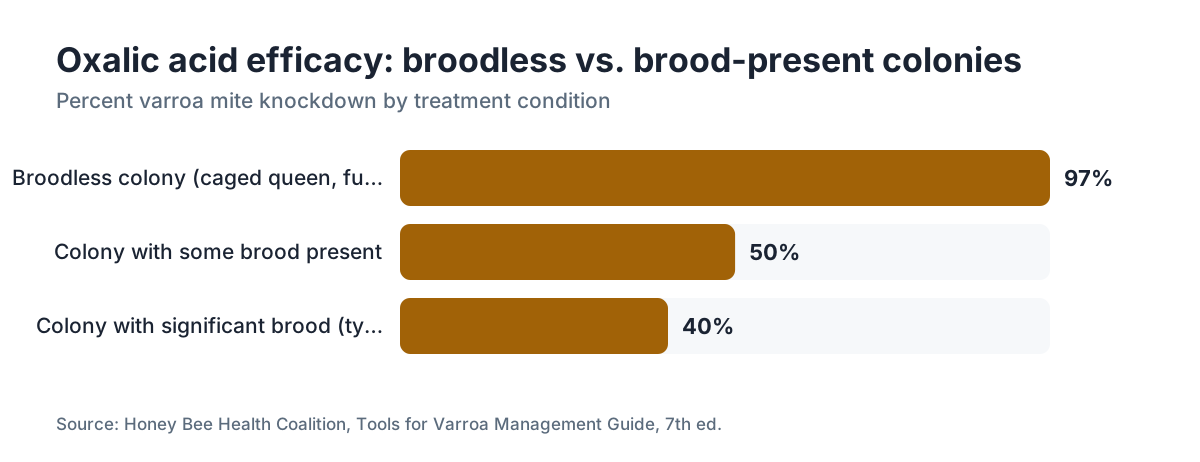
That's the whole logic. Varroa destructor reproduces only inside capped bee brood, and roughly 85 to 90% of the mite population is hiding in those capped cells at any moment in an active colony [1]. Oxalic acid, the most effective approved miticide for small operations, barely touches mites under cappings. Its efficacy in a colony with brood drops to about 40 to 60% [2]. In a broodless colony, the same treatment hits 95 to 99% [9].
Caging isn't the only path to broodlessness. Some beekeepers split a colony and let the queenless half raise a new queen, which takes 25 to 30 days. Others pull the queen entirely for a stretch. Caging is the most controlled version. You know the exact day the broodless window opens, you keep the genetic line you chose, and you skip the risk of a failed queen cell leaving you hopelessly queenless.
Name it plainly. Caging is not a treatment. It's a delivery mechanism that makes the miticide you already own far more effective.
When is the best time of year to cage the queen?
Late summer wins, roughly August through early September across most of North America. Here's the reason. The winter bees your colony raises in September and October carry the hive through to spring. Raise them under heavy varroa pressure and they emerge with shortened lifespans, weakened immune systems, and viruses like Deformed Wing Virus already loaded into their fat bodies [3]. A colony that goes into winter on damaged winter bees usually dies by February, even when November mite counts look fine.
Cage in late July or early August, treat around day 21 to 24, and you hand the colony a clean slate before those winter bees are made. It's the highest-payoff move on the whole seasonal calendar.
Spring is the second good window, March through April in temperate climates. Populations are still small, so the break feels shorter and the queen is back laying before the main flow. A spring break catches mites before they climb on all that expanding spring brood.
Midwinter works too, in regions where colonies go broodless on their own. If your bees quit rearing brood from December through January, the hive is already in the ideal treatment state and there's nothing to cage. Beekeepers in USDA hardiness zones 5 and colder often ride this natural broodless stretch for a simple oxalic dribble or vapor without ever touching the queen [4].
Summer splits and swarm-season handling open other chances. Any time you're deep in the colony anyway, ask whether caging the queen for 21 days before reintroduction fits your plan.
How long do you keep the queen caged?
The floor is 21 days. Worker brood has a capping period of about 12 days, and the full egg-to-emergence cycle runs 21 days [5]. Cage the queen on day zero, and the last brood capped before you caged her emerges by day 21. Treat on day 21 to 24.
Why the extra three days? A buffer covers slow cell development, cooler temperatures that drag out emergence, and the odd freshly capped cell you missed when the cage went in. Treating on day 24 costs you almost nothing and cuts the odds of a stray capped cell surviving your treatment.
Drone brood needs 24 days, not 21 [5]. If your colony had a lot of drone brood when you caged the queen, push treatment to day 25. Most sideliners just pick day 24 as their standard and stop thinking about it.
Don't hold the queen longer than you need to. Queens lose condition over weeks in a cage, and the colony gets edgy without open brood pheromone. Twenty-one to twenty-four days is the sweet spot. Release her, let laying restart, and check mite counts with an alcohol wash or sugar roll about two weeks after treatment to confirm it worked.
What types of cages work best for queen caging?
Three types show up regularly.
The JZ-BZ push-in cage is plastic and presses straight into comb over a few cells of honey and pollen. The queen sits in familiar comb with a small food supply, and workers outside the cage still touch her through the screen, which keeps the colony calmer. It's cheap and easy to find. This is where most hobbyists start.
The Benton mailing cage is the same one used to ship queens. Its candy plug lets workers chew through in two to five days. Fine for short confinements, wrong for 21-day caging, because the plug releases the queen on its own schedule and that defeats the point of controlling exactly when the broodless window ends.
Hair roller cages are the popular DIY pick. A standard metal or plastic curler roller has mesh gaps wide enough for workers to feed the queen but too tight for her to slip out. Wedge the open end against comb. Plenty of experienced beekeepers prefer these because they cost almost nothing, releasing the queen is just a matter of pulling the cage, and you skip the fuss of pressing her into a specific patch of comb.
For a full 21-day confinement, go with the JZ-BZ push-in or a hair roller. Make sure the queen has capped honey inside or right next to the cage. Workers will feed her through the mesh, but nearby stores cut her stress.
You can find cages and other gear at most beekeeping supply companies or through retailers that offer free shipping on honey bee supply orders.
How do you actually install a queen cage in the hive?
Start with a calm hive and a lit smoker. Find the queen. This is the hard part. If you can't spot her, find open eggs instead, move the frame with eggs into a separate nuc for 48 hours, and check the main hive for queen cells. If the main hive builds emergency cells, the queen is still in there and you keep hunting.
Once you have her, set her in the cage gently. With a push-in cage, pick a frame with capped honey close by and press the cage firmly into the comb so she can't squeeze out under the edge. With a hair roller, press one end against comb or plug it with a small piece of wood.
Mark the frame position with a pencil on the top bar. Write the date in your hive log. You'll come back in 21 to 24 days, and you want to grab the cage fast instead of pulling every frame.
Check the cage on day five to seven. Colonies sometimes build comb around a push-in cage and trap the queen or make removal a pain. Clear the burr comb. Confirm she's alive and workers are feeding her through the mesh. If she's dead, decide quickly: requeen, let the colony raise an emergency queen, or merge the colony.
On day 21 to 24, treat before you release the queen. This matters. You want the miticide working while the colony is still fully broodless. Release her right after treatment, or within a few hours.
Which miticide should you use during the broodless window?
Oxalic acid is the clear first pick for a broodless treatment. The EPA registers it for use in honey bee colonies [6], and nothing else matches its safety and efficacy in a broodless hive. The Honey Bee Health Coalition's Tools for Varroa Management guide describes oxalic acid as having "greater than 90% efficacy when used according to label directions in a broodless colony" [2].
Two delivery methods are approved: vaporization (also called sublimation) and dribble (also called trickle). Vaporization wins in a broodless colony because the vapor reaches bees on every frame, including ones a dribble solution never touches. The Api-Bioxal label, for the EPA-registered oxalic acid product, specifies 1 gram of oxalic acid dihydrate per brood box treated by vaporization [6]. Read the label. Dosage and timing are legally binding, not friendly advice.
Amitraz (Apivar) and thymol products (ApiLife Var, Apiguard) also get used during broodless windows. Amitraz strips work slower but have strong efficacy data. Thymol is temperature-sensitive, best between 59 and 69 degrees Fahrenheit (15 to 25 Celsius), which makes late-summer treatments tricky in hot regions [7].
Here's what I'd actually do. Vaporize with Api-Bioxal twice, three days apart, during the broodless window. A single vapor treatment works for some people, but two spaced a few days apart lower the odds that a handful of mites tucked into the cluster survive. The Coalition recommends confirming with a mite wash two weeks after treatment [2].
Don't reach for oxalic acid when brood is present and expect full efficacy. Killing brood-free is the entire point of this exercise.
How does queen caging compare to other brood break methods?
| Method | Broodless window achieved | Queen risk | Time investment | Cost |
|---|---|---|---|---|
| Queen caging (21-24 days) | Reliable, controlled | Low, queen stays in hive | 2 visits in 24 days | Cost of cage ($1-5) |
| Walkaway split | 25-30 days in queenless half | Medium (queen cell can fail) | 1 setup + monitoring | Cost of extra equipment |
| Queen removal (queenless) | 21-28 days until virgin emerges | High (laying workers possible) | 3-5 checks | Nothing |
| Natural winter broodless | 4-12 weeks (climate-dependent) | None | 1 treatment visit | Cost of miticide only |
| Nucleus split with caged queen | 21-24 days | Low | 2 visits, requires nuc box | Nuc box cost |
The walkaway split earns its keep if you want more colonies anyway. The natural winter broodless period is the easiest treatment window there is. Queen caging is your best move when you want a precisely timed broodless period without splitting the colony and without waiting on the weather.
Queen removal without caging, where you let the colony go queenless and raise a new queen, is riskier than it sounds. If the emergency cells fail or the virgin doesn't mate, you get a laying worker colony, and that's an ugly problem to unwind. Caging sidesteps it completely.
What mite levels should trigger a queen caging intervention?
The Honey Bee Health Coalition uses 2% or more by alcohol wash (about 2 mites per 100 bees) as the action threshold from spring through early summer [2]. In late summer, August especially, many extension specialists drop that threshold to 1 to 2% because of the winter bee timing above. You can't let mites ride upward heading into fall.
At 3% or above in August, a queen caging plus oxalic acid vapor is one of the strongest responses you have. At 5% and up you're looking at a colony on the way down, and you act now no matter which method you pick [3].
Managing more than a dozen colonies changes the math. Caging takes real labor, so the practical trigger climbs a bit. Some sideliners only cage queens on colonies at 3% or above and run a simpler knockdown, like Apivar strips, on hives below that line. That's a fair compromise.
Alcohol wash is the most accurate monitoring method [11]. The Coalition guide walks the method step by step [2]. The varroa mite identification and monitoring article on this site covers alcohol wash and sugar roll technique in detail if you need a refresher.
Can you cage the queen during a honey flow?
Technically yes, but it costs you. A colony with a caged queen tends to slow foraging over 14 to 21 days, because open brood pheromone drives much of the foraging impulse. Some hobbyists report barely any loss. Others watch nectar collection dip hard through the middle of the caging period.
My honest take: don't cage during a major flow if you have another decent window. The mite population isn't standing still, but it also isn't exploding if it started under 2% in early summer. Cage after the main flow ends.
If your mite load is already at 4% or above in June with a flow on, you're in triage. A collapsing colony brings in nothing anyway. Some beekeepers pull honey supers during caging and treatment, cage the queen, treat, then re-add supers after release. That's the safest route for both honey quality and colony health, and the Api-Bioxal label requires all honey supers intended for human consumption to be off the hive during oxalic acid treatment [6].
What can go wrong when you cage a queen, and how do you fix it?
The queen dies in the cage. It happens, mostly in heat or when she runs out of food. Check her on day five. If she's dead, your options are: requeen with a purchased queen, let the colony raise an emergency queen from whatever eggs or young larvae remain, or merge the colony with a healthy one. Act within 24 hours of finding her dead.
The colony builds emergency queen cells around the cage. Workers sometimes try to supersede a caged queen. Inspect on day five to seven and tear down any queen cells outside the cage. Leave them and an emerged virgin may find the cage and kill the caged queen through the mesh.
The colony turns aggressive. Broodlessness shifts temperament. Some colonies get noticeably defensive by day 10 to 14. Smoke them well during any inspection. It's normal and settles within a week of release.
You lose track of the queen during reintroduction. After 21 days confined, some queens move slower and catch brief aggression from workers who partly adjusted to being queenless. If you see balling (workers packing into a tight cluster around her), open the ball with a puff of smoke and a brush. Don't pull bees off by hand.
Mite counts stay high after treatment. Confirm with an alcohol wash two weeks post-release. If counts are still above 2%, you probably had stragglers in brood you didn't account for, or the treatment was underdosed. Follow with a second treatment; Apivar strips fit here for a longer knockdown.
How do you track progress and confirm the treatment worked?
Before caging, run a baseline alcohol wash. Write it down: date, mite count, bees sampled. A hundred-bee sample is standard [2].
On treatment day (day 21 to 24), drop a sticky board if you want a rough read on how many mites fall during treatment. It's optional. Watching hundreds of mites land on a board after an oxalic vapor treatment is genuinely satisfying proof there was a real load to kill.
Two weeks after you release the queen, run another alcohol wash. That gives brood time to recycle and lets any mites from very late-stage capped cells emerge and become countable. A win brings mite levels well under 1%, often to 0 or 1 mite per 100 bees.
If the post-treatment wash is still at 2% or above, something slipped: the cage didn't fully stop brood, the oxalic dose was off, or a supersedure queen laid during the treatment window. Retreat with Apivar strips and monitor every 30 days until counts sit below threshold.
VarroaVault has free protocol worksheets and a mite wash calculator to standardize this routine across multiple colonies if you're running more than a handful of hives.
The Honey Bee Health Coalition's Tools for Varroa Management, free to download, is the best single reference for all of this [2]. Keep a copy on hand.
Is queen caging safe for the queen and the colony's long-term health?
A 21 to 24 day caging sits well within what queens handle. Mailing cages routinely hold queens three to seven days in transit; a 21-day push-in confinement runs longer but isn't unusual in managed breeding programs. The main risks are starvation (easy to avoid by confirming food access on day five) and overheating if the cage lands in direct sun inside the hive, which shouldn't happen in normal placement.
Colony health after caging is usually excellent. Broodlessness plus an effective miticide resets the mite-bee balance. Colonies treated this way tend to build strong fall populations because the winter bees grow up without much mite parasitism.
One longer-term worry is worth naming honestly. Colonies run through frequent artificial broodless periods may show some drop in annual honey compared to colonies whose laying never gets interrupted. Nobody has great controlled data on how big that effect is in hobbyist conditions. The closest work compares brood interruption methods in European commercial operations, and the production differences look modest against the colony survival gains [8].
For most hobbyist and sideliner beekeepers, giving up some honey from a colony that lives beats losing the colony.
Frequently asked questions
How long does the queen need to be caged to create a fully broodless hive?
Worker brood takes 21 days from egg to emergence. Cage the queen for 21 to 24 days so all brood present before caging has fully emerged. Add a day or two if significant drone brood was present when you caged her, since drone brood takes 24 days. Most beekeepers use day 24 as a standard endpoint.
Can I use oxalic acid while there is still some brood in the hive?
Yes, but efficacy drops hard. The Honey Bee Health Coalition reports roughly 40 to 60% mite kill with brood present, versus 95 to 99% in a fully broodless colony. Treating with brood present works as a partial knockdown, but if you need high efficacy, waiting for or creating a broodless condition is worth the effort.
What is the best queen cage type for a 21-day brood break?
Push-in cages like the JZ-BZ and hair roller cages are the most practical for 21-day confinements. Both let workers feed and touch the queen through the mesh. Skip Benton mailing cages for this because the candy plug releases the queen automatically, which strips away your control over when the broodless window ends.
Will the colony try to supersede or replace the caged queen?
Sometimes. Workers can read a caged queen as unavailable and build emergency queen cells around day seven to ten. Check the hive on day five to seven and destroy any queen cells outside the cage. If an emergency queen hatches and stays, she may kill your caged queen through the mesh or split the colony's loyalty, causing trouble after release.
How many oxalic acid vapor treatments should I do during the broodless window?
Most label-compliant protocols allow multiple treatments. Many beekeepers and extension specialists suggest two vaporization treatments three to five days apart during the broodless window rather than one, to improve the odds of reaching every mite in the cluster. The Api-Bioxal label specifies dosing; always follow label directions, which are legally binding.
Can I cage the queen as a varroa strategy in spring?
Yes. Spring caging, usually March through April, catches the mite population while the colony is still small and before mites climb on expanding spring brood. A spring brood break followed by oxalic acid can push back the point where you need a second summer intervention. Watch the timing so the broodless period doesn't overlap your main nectar flow.
Do I need to remove honey supers before treating with oxalic acid?
Yes. The EPA-registered Api-Bioxal label requires honey supers intended for human consumption to be removed before treatment and left off until the treatment period ends. This applies to both dribble and vaporization. Treating with supers in place is an off-label use and can leave oxalic acid residue in honey.
What mite count level makes queen caging worthwhile?
The Honey Bee Health Coalition recommends treating at or above 2% (2 mites per 100 bees by alcohol wash) through most of the season. In late summer (August onward), many extension specialists recommend treating at 1 to 2% because of winter bee health. Above 3%, queen caging plus oxalic acid vapor is one of the highest-efficacy interventions available.
How do I find the queen quickly enough to cage her?
Look for her movement pattern, not her color. She moves more steadily than workers, and surrounding bees tend to face toward her. Check the warmest frames in the brood nest. If you can't find her in 10 to 15 minutes, look for fresh eggs in open cells (C-shaped, standing upright at the cell base). Marking queens with a paint pen during an earlier inspection saves real time.
Can I cage the queen in a nucleus colony instead of the full hive?
Yes, and it's a handy technique. Pull the queen and two frames of brood into a nuc, cage her there, and treat both the queenless main colony and the nuc separately 21 to 24 days later. The main colony goes broodless on its own once existing brood emerges. You get a split and a brood break at the same time.
Does queen caging affect the colony's honey production for that season?
It can trim production modestly. A queenless or brood-interruption period usually reduces foraging drive over two to three weeks. The impact rides heavily on timing: a late-summer caging after the main flow barely dents honey yield, while caging during peak flow costs more. Most beekeepers accept the tradeoff for the survival benefit of a strong mite knockdown.
How soon after releasing the queen should I check mite counts?
Wait two weeks after release before a post-treatment alcohol wash. That lets the queen restart laying, gives capped brood time to emerge, and lets any mites that survived in very late-stage cells move onto adult bees where you can count them. Under 1% means a successful treatment. Above 2% means you retreat and investigate what went wrong.
Is queen caging better than just doing a late-summer split for mite control?
Both create broodless conditions, but they chase different goals. A split makes increase; caging keeps your colony whole and at full strength into winter. Need more colonies? Split. Need top winter bee quality in your existing colony? Cage. Caging is also lower-risk, since you keep your proven queen instead of betting on a new virgin mating successfully.
Sources
- Honey Bee Health Coalition, Tools for Varroa Management Guide (7th edition): Roughly 85 to 90% of the mite population is inside capped brood cells in an active colony at any given time
- Honey Bee Health Coalition, Tools for Varroa Management Guide (7th edition): Oxalic acid has greater than 90% efficacy in a broodless colony; drops to 40 to 60% with brood present; 2% alcohol wash threshold triggers treatment
- USDA Agricultural Research Service, Varroa destructor and honey bee colony health: Winter bees raised under high varroa pressure show shortened lifespan and viral loading including Deformed Wing Virus
- Penn State Extension, Oxalic Acid Treatment for Varroa Mites: Natural winter broodless period in cold climates is an ideal oxalic acid treatment window without requiring artificial brood interruption
- University of Florida IFAS Extension, Honey Bee Biology and Beekeeping: Worker brood takes 21 days egg to emergence; drone brood takes 24 days
- EPA, Api-Bioxal Oxalic Acid Pesticide Label (Reg. No. 84304-2): Api-Bioxal is EPA-registered for honey bee varroa treatment; requires honey supers off during treatment; 1 gram oxalic acid dihydrate per brood box by vaporization
- UC ANR (University of California Agriculture and Natural Resources), Varroa Mite Management: Thymol-based miticides have an effective temperature window of 59 to 69 degrees Fahrenheit (15 to 25 Celsius)
- Journal of Apicultural Research, Brood interruption methods and colony productivity (Gregorc et al.): Honey production differences between brood-interrupted and non-interrupted colonies are generally modest compared to the colony survival benefits of mite knockdown
- North Carolina State University Extension, Varroa Mite Treatment Efficacy: Oxalic acid vaporization in broodless colonies achieves 95 to 99% varroa mite knockdown
- Virginia Cooperative Extension, Varroa Mite Management in Virginia: Late summer (August) varroa intervention timing is critical because winter bees are produced in September and October
- Cornell University, Department of Entomology, Honey Bee Program: Alcohol wash is the most accurate available method for estimating colony-level varroa infestation rates
Last updated 2026-07-09