Varroa mite control: every method that actually works

TL;DR
- Varroa mites are the leading cause of managed honey bee colony loss worldwide.
- Good control pairs regular monitoring (alcohol wash beats sugar roll and sticky boards) with timed treatments: oxalic acid for broodless periods, formic acid or thymol in season, and amitraz (Apivar) as a fallback.
- No single method works forever.
- Rotate chemistries, keep mite loads below 2%, and treat before the population crashes.
Why does varroa mite control matter so much?
Varroa destructor is more than a parasite. It's the primary driver of colony collapse in the temperate world. A healthy colony heading into summer can go from a manageable 1% infestation rate to a death spiral by fall if nothing is done. The mite reproduces inside capped brood cells, feeds on the fat bodies of developing bees, and transmits at least five damaging viruses, including deformed wing virus (DWV) and sacbrood. The resulting bees emerge smaller, shorter-lived, and with compromised immune systems [1].
The Honey Bee Health Coalition's Tools for Varroa Management Guide puts the stakes plainly: untreated colonies in most of North America are expected to die within one to three years of establishment [2]. That's not a worst-case scenario. It's the baseline.
For hobbyists and sideliners, this lands in a specific way. You don't have dozens of colonies to absorb losses. You have two, or ten, or twenty. Every death is a real financial and emotional hit, and every untreated colony is a mite bomb that drifts into your neighbors' hives. Getting control of varroa isn't optional. It's the job.
What is a dangerous varroa mite infestation level?
A 2% infestation rate is the treatment threshold during brood-rearing season, and most university extension programs plus the Honey Bee Health Coalition agree on it [2][3]. That means 2 mites per 100 adult bees. Some sources set the bar as low as 1% going into winter, because mite populations keep climbing even as bee numbers shrink in fall.
Here's what 2% looks like in the yard. Take a half-cup sample of nurse bees (roughly 300 bees) from a frame near the brood nest. If an alcohol wash returns 6 or more mites, you're at or above threshold. Six mites sounds trivial. It isn't. Each female mite in a capped cell produces 1-2 reproductive daughters per brood cycle, and colonies raise brood continuously for most of the year. The population roughly doubles every 3-4 weeks under good conditions [1].
The University of Minnesota Bee Lab recommends treating when alcohol wash counts hit 2 mites per 100 bees in the summer brood season, and 1 mite per 100 bees going into fall [3]. Treat at those numbers instead of waiting until you see deformed-winged bees crawling at the entrance, and you'll save a lot more colonies.
For a closer look at what varroa mites are and how they reproduce, see our varroa mite overview.
How do you monitor varroa mite levels accurately?
Monitoring is where most backyard beekeepers fail. They either skip it or lean on sticky board counts, the least accurate method available. Three practical options are worth your time.
Alcohol wash (most accurate). Collect roughly 300 nurse bees (half a cup) directly from a brood frame into a jar with 70% isopropyl alcohol. Shake for 60 seconds, strain, count the mites. Divide mites by bees, multiply by 100 for the percentage. It kills the sample bees, which bothers some keepers, but it's the gold standard. Studies comparing methods consistently find alcohol wash catches more mites than sugar roll and far more than sticky boards [3].
Sugar roll (less accurate, no bee deaths). Same sample size, same collection method, but you shake in powdered sugar and roll the bees to dislodge mites, which fall through mesh onto a white board. The problem: sugar roll undercounts by 20-40% compared to alcohol wash. You'll make treatment decisions on artificially low numbers.
Sticky board. Place a board under a screened bottom for 24-72 hours and count the mite fall. It's useful for tracking trends over time, but it doesn't give you the actual infestation rate without a conversion factor that shifts with colony size, season, and how much brood is present. The Honey Bee Health Coalition advises against using sticky boards as your primary monitoring tool for threshold-based decisions [2].
Monitor at least once a month during the active season, and more often in late summer when mite populations peak and bee populations start dropping. If you're treating, monitor again 3-4 weeks later to confirm it worked.
What are the best varroa mite control treatments available?
Treatments split into two camps: organic acids and essential oils (soft chemicals), and synthetic acaricides (hard chemicals). Every legal varroa treatment in the United States is a registered pesticide regulated by the EPA and must be used strictly according to its label. The label is the law [4].
| Treatment | Active ingredient | Brood-present use | Temperature window | Resistance documented? |
|---|---|---|---|---|
| Oxalic acid (Api-Bioxal) | Oxalic acid | No (dribble/vaporization) | Below 50°F ideal for vapor | No |
| Formic acid (Mite Away Quick Strips) | Formic acid | Yes | 50-85°F | Rare |
| Thymol (Apilife VAR, Apiguard) | Thymol | Yes | 59-105°F | Rare |
| Amitraz (Apivar) | Amitraz | Yes | Above 50°F | Yes, in some regions |
| Coumaphos (Checkmite+) | Coumaphos | Yes | Above 60°F | Yes, widespread |
| Hop beta acids (Hopguard 3) | Beta acids | Yes (limited) | No strict limit | No |
Sources: EPA product registrations [4], Honey Bee Health Coalition Tools for Varroa Management [2], Penn State Extension [5].
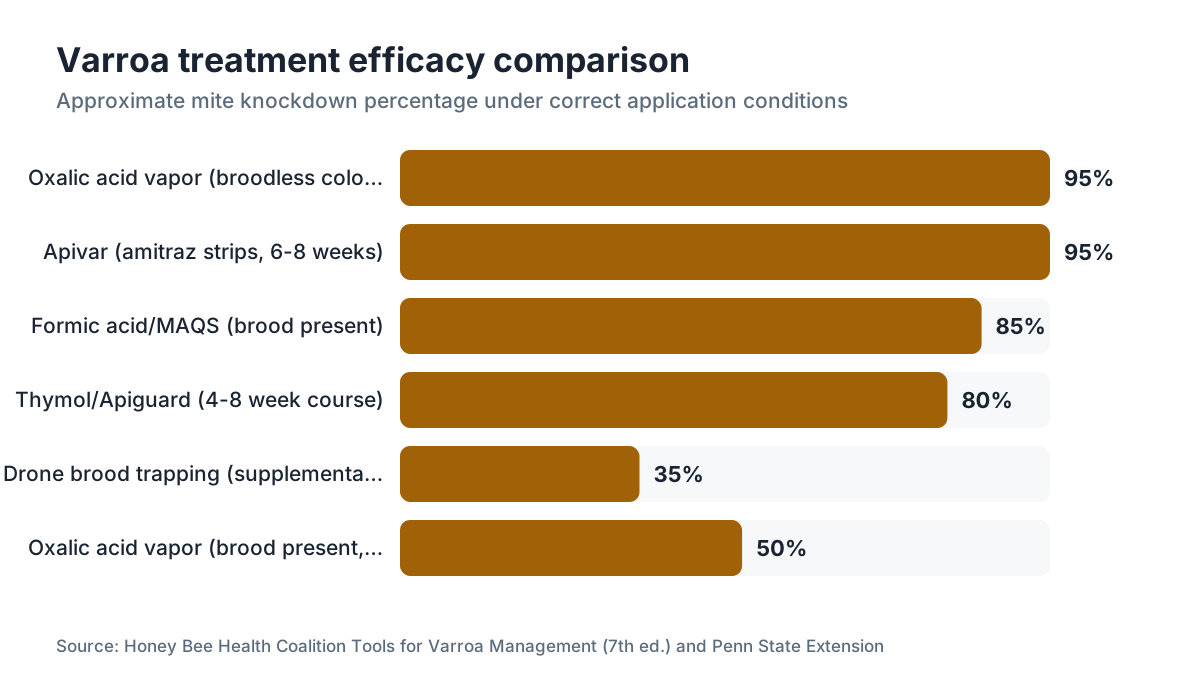
Oxalic acid (Api-Bioxal) is the top pick for winter treatment when colonies are broodless, because it kills phoretic mites (those riding adult bees) with very high efficacy, around 90-97% in broodless colonies [2]. Vaporization (a wand that sublimates oxalic acid crystals) is faster and reaches more of the colony than dribble. Extended-release oxalic acid strips are now registered for use with brood present, which opens up in-season options.
Formic acid (Mite Away Quick Strips, MAQS) penetrates capped brood cells and kills mites in the reproductive stage. That's rare and valuable. It works from 50-85°F [5]. The drawbacks are real: it's hard on queens in some conditions, causes short-term bee mortality at high temperatures, and reeks. Experienced beekeepers tend to respect it more than beginners do.
Thymol (Apilife VAR, Apiguard) works by vapor action and needs temperatures above 59°F to volatilize properly. It's gentler than formic acid but slower, usually a 4-8 week course. It leaves no wax residue above detectable limits in most studies.
Amitraz (Apivar) is the most effective synthetic option in most North American apiaries, with efficacy routinely above 95% when used correctly [5]. The catch: resistance is documented and spreading, especially where it's been used heavily for years. Rotate away from Apivar at least every other treatment cycle.
Coumaphos (Checkmite+) carries widespread resistance and heavy residue accumulation in beeswax. Most experienced beekeepers treat it as a last resort.
For sourcing treatments and equipment, the beekeeping supply companies page has vetted vendor options.
How do you control varroa mites naturally, without synthetic chemicals?
"Natural" control is genuinely possible, but it means accepting trade-offs and doing more work. The methods that actually pull their weight:
Oxalic acid vaporization. Oxalic acid occurs naturally in many plants (rhubarb, spinach) and leaves no problematic honey residues. The EPA-registered Api-Bioxal is the only legal oxalic acid treatment in the US [4]. Many beekeepers reasonably treat it as the closest thing to a natural treatment with hard efficacy data behind it. For broodless colonies, a single vapor treatment achieves 90%+ knockdown [2].
Brood breaks. One of the most effective all-natural approaches. You create a stretch with no capped brood, either by caging the queen for 24 days (one full brood cycle) or splitting the colony and letting a queenless gap run before a new queen mates. During a brood break, every mite is phoretic and fully exposed to oxalic acid. Pairing a brood break with an oxalic acid treatment is one of the highest-efficacy natural protocols going. Penn State Extension recommends this combination and reports efficacy above 90% in properly executed brood breaks [5].
Small cell comb. The theory says smaller cell diameter slows mite reproduction. The research doesn't back it as a standalone control method. Multiple studies found no meaningful difference in mite levels between standard and small-cell comb. Skip it as a primary strategy.
Drone brood removal. Varroa reproduces in drone brood at a ratio of about 8:1 over worker brood, because drone brood stays capped longer. Install drone comb frames, let the drones get capped, then remove and freeze the frames before emergence. That pulls mites out of the population. Studies suggest a 30-40% reduction in mite loads as a supplemental method [1]. The catch: you have to do it every 24-26 days through the drone-rearing season. Most beekeepers find it hard to sustain.
Thymol-based treatments. Thymol is an essential oil component from thyme. Apiguard and Apilife VAR are the registered products. They're "soft" treatments with no evidence of resistance, no concerning wax residue, and they work with capped brood present. They're slow and don't penetrate capped cells the way formic acid does, but they're a legitimate anchor for a natural rotation.
Hygienic behavior and Varroa Sensitive Hygiene (VSH) genetics. Buying or breeding queens from lines selected for hygienic behavior, and VSH in particular, gets more practical every year. VSH bees detect and remove mite-infested pupae from capped cells at higher rates than unselected stock. It won't erase the need for treatment, but documented VSH colonies carry lower mite reproduction rates and tolerate higher infestation loads before crashing [6]. The USDA Baton Rouge lab and several commercial breeders keep VSH stock going. This is where the field is heading long-term.
Here's the honest natural protocol for a full season: VSH or hygienic stock, plus drone brood removal in spring, plus oxalic acid with a brood break in late summer, plus oxalic acid vapor in midwinter. No single method carries the load alone.
What does a year-round varroa control protocol look like?
Timing matters as much as the product you pick. Varroa populations follow a predictable curve: low in early spring, building through summer, peaking in late summer and early fall just as the bee population is falling off. The winter bees that need to live six months or more are raised in August and September. Raise those bees under high mite pressure and the whole colony is compromised before the first frost.
Here's a practical seasonal framework for a typical northern US apiary.
Early spring (March-April). Monitor with an alcohol wash as soon as the colony is actively raising brood. If loads top 1%, treat with formic acid or thymol. Apivar fits here too, since there's no honey super on and temperatures are climbing.
Late spring/early summer (May-June). Monitor monthly. Honey supers go on, which restricts your options. Formic acid (MAQS) is labeled for use with supers on. Some oxalic acid extended-release strips are labeled during honey production. Check your product label for honey super restrictions before treating [4].
Late summer (July-August). The critical window. The Honey Bee Health Coalition names late summer treatment the single most important intervention of the year [2]. Mite populations are peaking, and the winter bees are about to be raised. Treat hard if counts are at or above threshold. Formic acid, thymol, or Apivar all work here, depending on your rotation and the temperature.
Fall (September-October). Supers are off after harvest, so this is your last chance before winter. Apivar works well. If the colony goes broodless early, pivot to oxalic acid dribble or vapor.
Winter (November-February). When the colony is broodless (heft and listen; don't crack the hive open in the cold without reason), a single oxalic acid vapor treatment knocks down phoretic mites very effectively. Even if you treated in fall, mite levels can rebound if that treatment missed reproductive mites in capped cells.
VarroaVault's free protocol tools track this calendar across multiple colonies and send treatment reminders based on your location and inspection data.
Stock the right beekeeping supplies before each treatment window too, since some products ship slowly or sell out in peak season.
How do you avoid varroa treatment resistance?
Resistance is real and getting worse in some regions. Coumaphos resistance in varroa runs widespread across North America and Europe. Amitraz resistance is documented in the southeastern United States and several European countries, though it isn't universal yet [7].
The mechanism is simple. Apply the same active ingredient over and over, and you select for mites carrying whatever genetic trait cuts their susceptibility. Their offspring take over. Within a few mite generations, you've built a resistant population the treatment can no longer touch.
Rotation is the counter. Alternate active ingredient classes, not brand names. Apivar and Amitraz Strip are both amitraz. Switching between them is not rotation. Switching from amitraz to oxalic acid to formic acid across successive cycles is rotation.
The Honey Bee Health Coalition recommends rotating between chemical classes every one to two treatment cycles and monitoring post-treatment efficacy to catch resistance early [2]. A simple check: if your alcohol wash shows mite loads that haven't dropped much 6-8 weeks after a full-course treatment, resistance may be the culprit. Rule out application errors first (temperature, timing, dose), but if those look right, switch chemistries.
Follow label directions exactly. Underdosing from shortened treatment durations or sloppy application is one of the fastest ways to speed up resistance [4].
Does varroa control work differently for small-scale vs. sideliner operations?
The biology is identical. The logistics are different.
A hobbyist with two hives can monitor every colony every 3-4 weeks, make individual decisions, and use whichever product fits each hive's situation. That's an advantage. You can be precise in a way a sideliner running 80 hives across rotating locations cannot.
The challenge for small operations is equipment cost. A good oxalic acid vaporizer runs $70-$200 depending on the model [8]. Treat two hives twice a year and that's a steep per-treatment cost next to a dribble applicator that costs $15. The math improves with scale, which is why sideline and commercial operations lean hard on vaporization.
For sideline operations (say, 15-150 colonies), standardizing treatment protocols across the yard becomes necessary for efficiency. Most experienced sideliners pick one or two products that fit their seasonal calendar, buy in bulk, and treat all colonies on the same schedule, using monitoring to confirm efficacy rather than to make individual calls. The downside: you'll sometimes treat colonies that didn't need it. The upside: you won't miss the ones that do.
Resistance management is easier at sideliner scale than at commercial scale, because you have fewer apiaries, shorter supply chains, and more room to switch products between seasons. Use that room.
Can varroa mites spread between colonies and apiaries?
Yes, and many hobbyists underrate it. Varroa spreads through three main routes: robbing behavior, bee drift, and swarms.
When a colony collapses under mite pressure, foragers from nearby colonies rob the honey stores. Those foragers pick up hitchhiking mites and carry them home. A single robbing event can transfer hundreds of mites into a previously clean colony. That's why treating a mite-collapsed neighbor's hive, or sealing it off, matters to your own bees.
Drift, where bees return to the wrong hive, happens constantly, especially when hives sit in a row with similar entrance orientations. Drifting bees carry mites with them. Colonies at the ends of rows consistently show higher mite loads because they take in more drifted bees than they send out [11].
Swarms carry mites in proportion to their mother colony. Catch swarms or install packages from high-mite operations and you're starting with a mite load, not from zero. Monitor any new colony within 30 days of installation.
This also matters if you keep africanized honey bees or colonies with africanized genetics, which swarm more readily, potentially increasing mite dispersal in mixed-genetics apiaries.
What mistakes do beekeepers most commonly make with varroa management?
Read enough extension literature and colony mortality research and a few patterns keep surfacing.
Treating without monitoring first. You can't tell if the treatment worked if you never knew where you started. Pre- and post-treatment monitoring separates a beekeeper who's managing varroa from one going through the motions.
Treating too late. The late-summer window (July-August in most of North America) saves or loses colonies going into winter. Many keepers miss it because harvest has their attention. By the time deformed-wing bees show up at the entrance in October, the winter bees are already compromised and survival odds have dropped hard.
Skipping treatment because the colony looks healthy. Colonies can look strong at 2-3% infestation. The crash comes later, often after brood production has already turned out thousands of mite-damaged bees. "Looks fine" is not a data point.
Using the same treatment year after year. Resistance. See above.
Misapplying organic acid treatments. Oxalic acid efficacy drops sharply with capped brood present (for dribble and vapor, not extended-release). Formic acid efficacy drops above 85°F. Thymol doesn't volatilize below 59°F. Read the label and respect the conditions [4].
Buying packages or nucs without asking about mite levels. This gets more common as demand for bees outpaces good practice among some suppliers. Ask. Monitor on arrival. Treat if needed before mites build in your new colony.
Are there any varroa-resistant honey bee stocks worth using?
This is one of the more interesting corners of applied bee research right now, and the answer is a qualified yes.
Varroa Sensitive Hygiene (VSH) came out of USDA research in Baton Rouge. VSH bees interrupt mite reproduction by detecting and removing mite-infested pupae. In controlled trials, VSH colonies held mite levels below economic thresholds with far less chemical intervention than unselected stock [6]. The USDA Agricultural Research Service keeps breeder stock and licenses it to commercial producers.
Russian honey bees, bred from stock originally collected in the Primorsky region of Russia where they co-evolved with varroa for decades before the mite moved west, also show measurable resistance traits. The Russian Honey Bee Breeders Association runs the selection programs. Russian bees aren't treatment-free silver bullets, but they tend to carry lower mite loads than Italian or Carniolan stock under similar conditions.
Brokeoff Mountain-type bees and various local survivor stock programs draw attention too, mostly in the natural beekeeping community. The data on these programs is thinner and harder to replicate, but the principle (selecting locally adapted bees that tolerate or suppress mite reproduction) is sound and backed by evolutionary biology.
The honest summary: resistant genetics help, they don't erase the need for monitoring and occasional treatment, and they work best combined with the protocols above. The Honey Bee Health Coalition's guide says as much directly: "genetic resistance is a tool to be used in combination with other management practices, not a replacement for them" [2].
Frequently asked questions
How often should I check my hives for varroa mites?
Monitor at least once a month during the active brood-rearing season (roughly April through October in most of North America), plus once in midwinter for a baseline heading into spring. Bump frequency to every 2-3 weeks in late summer (July-August), when mite populations grow fastest relative to bee populations. The University of Minnesota Bee Lab recommends monthly minimum monitoring as standard practice.
Can varroa mites kill a bee colony?
Yes. Untreated colonies in North America typically die within one to three years of establishment, according to the Honey Bee Health Coalition. Varroa doesn't just weaken bees directly; it transmits viruses like deformed wing virus that shorten lifespans and wreck the ability to forage, thermoregulate, and raise brood. A colony that looks strong in July can crash by October if mite loads went unmanaged through summer.
What is the alcohol wash method for varroa and how accurate is it?
Collect roughly 300 nurse bees (half a cup) from a brood frame into a jar with 70% isopropyl alcohol. Shake for 60 seconds, strain through mesh, count the mites in the liquid. Divide mite count by bee count and multiply by 100 for a percentage. Alcohol wash is the most accurate field method available, consistently catching more mites than sugar roll and far more than sticky boards. The sample bees do not survive.
Is oxalic acid safe to use near honey?
Api-Bioxal (the EPA-registered oxalic acid product) is approved for use in hives with honey supers removed. Oxalic acid occurs naturally in honey at low levels. Studies have not found significant increases in honey oxalic acid content after treatment per label directions. Some extended-release strip formulations are labeled for use during honey production; check the specific label, since restrictions vary by formulation.
How do I know if my varroa treatment worked?
Monitor with an alcohol wash 3-4 weeks after finishing the treatment course. If mite levels dropped well below pre-treatment counts and sit under the 2% threshold, it worked. If loads stay high despite proper application, question whether temperatures were right, whether the treatment duration was complete, and whether resistance is in play. Resistance is more likely if you've used the same chemistry several consecutive cycles.
Can I treat for varroa mites when honey supers are on?
Options are limited but real. Mite Away Quick Strips (formic acid) and Hopguard 3 are labeled for use with supers on in the US. Most other treatments, including Apivar (amitraz), Apiguard (thymol), and oxalic acid dribble or vapor, require supers to be off. Always read the specific product label for honey super restrictions before applying; using a restricted product with supers on is a label violation and could contaminate your honey.
What is the treatment threshold for varroa mites before winter?
Most extension programs, including the University of Minnesota Bee Lab, recommend treating if alcohol wash counts reach 1 mite per 100 bees going into fall, lower than the 2% used during the summer brood season. Winter bees live 4-6 months versus 6 weeks for summer bees, so any hit from mite-transmitted viruses during their development compounds across the whole overwintering period.
Do drone brood trapping frames really reduce varroa?
They can cut mite loads by roughly 30-40% as a supplemental method, per research cited in the Honey Bee Health Coalition's management guide. Varroa reproduces in drone brood at about 8 times the rate it does in worker brood. Removing capped drone frames before emergence pulls reproductive mites out of the population. The catch is consistency: frames need to come out and go back every 24-26 days through drone season, which is labor-intensive to keep up.
How does varroa spread from hive to hive?
Varroa spreads mainly through bee drift (bees entering the wrong hive), robbing when a collapsing colony's stores get raided by neighbors, and swarms carrying mites from a mother colony. Colonies at the ends of hive rows consistently pick up higher mite loads from drifting bees. Catching or buying swarms and packages introduces mites too; monitor any new colony within 30 days of installation and treat if counts hit threshold.
Are Russian or VSH honey bees actually resistant to varroa?
They show meaningful resistance traits, not immunity. VSH bees (developed by USDA researchers) detect and remove mite-infested pupae at higher rates, cutting mite reproduction. Russian bees from the Primorsky region co-evolved with varroa and carry behavioral and biological traits that suppress mite populations. Both need less chemical treatment than unselected Italian or Carniolan stock, but the Honey Bee Health Coalition still classifies resistant genetics as a management tool to combine with other methods, not a standalone fix.
What is the safest varroa treatment for a new beekeeper?
Oxalic acid dribble or vaporization during a broodless period (midwinter or after a deliberate brood break) is widely recommended as the starting point for new beekeepers. It's effective (90%+ knockdown in broodless colonies), leaves no harmful residues, and has no documented resistance. The dribble method needs no special gear beyond a syringe. Vaporization needs a wand but goes faster for multiple hives. Both use the same EPA-registered Api-Bioxal product.
How do I control varroa mites without any chemicals at all?
Fully chemical-free control is hard to sustain without heavy colony losses, but the closest practical approach combines Varroa Sensitive Hygiene (VSH) or hygienic genetics, queen-caging brood breaks paired with oxalic acid vapor (oxalic acid counts as organic/natural by most standards), drone brood removal, and rigorous monthly monitoring. No study has shown sustained colony survival using only mechanical methods with zero acid treatment in high-mite environments.
Can I use essential oils to control varroa mites?
Thymol, an essential oil component from thyme, is the only essential oil with EPA-registered varroa treatment products (Apilife VAR and Apiguard). Both need temperatures above 59°F to volatilize. Other essential oils like wintergreen or tea tree have no rigorous efficacy data and aren't labeled for varroa control in the US. Using unlabeled treatments is a legal violation and puts your colonies at risk if the treatment fails while mite loads stay high without your knowing.
What happens if I do nothing about varroa?
Most untreated colonies in North America collapse within one to three years, per the Honey Bee Health Coalition's assessment. Sooner than that, high mite loads damage winter bees during their late-summer development, all but guaranteeing poor spring buildup even if the colony technically survives. Untreated colonies also become mite sources for neighboring apiaries through drifting bees and robbing, which makes varroa management a community responsibility as much as an individual one.
Sources
- USDA Agricultural Research Service, Bee Research Laboratory: Varroa destructor biology and impact: Varroa preferentially reproduces in drone brood approximately 8:1 over worker brood; mite populations can roughly double every 3-4 weeks under favorable conditions; mites transmit deformed wing virus and other pathogens
- Honey Bee Health Coalition, Tools for Varroa Management Guide (7th edition): Treatment threshold of 2% infestation rate during brood-rearing season; untreated colonies expected to die within 1-3 years; late summer treatment identified as the single most important intervention; sticky boards not recommended as primary monitoring tool; resistant genetics are a tool to combine with other practices, not a replacement
- University of Minnesota Bee Lab, Varroa monitoring and management: Alcohol wash is most accurate field monitoring method; treatment threshold of 2 mites per 100 bees in summer and 1 mite per 100 bees going into fall
- US EPA, Pesticide registration: Api-Bioxal and varroa miticide labels: All varroa treatments in the US are registered pesticides; the label is the law; Api-Bioxal is the only EPA-registered oxalic acid product; honey super restrictions vary by product formulation
- Penn State Extension, Varroa mite management and treatment options: Formic acid works in the 50-85°F range; Apivar efficacy routinely above 95% when used correctly; brood break plus oxalic acid exceeds 90% efficacy
- USDA Agricultural Research Service, Honey Bee Breeding, Genetics and Physiology Research (Baton Rouge): VSH bees detect and remove mite-infested pupae at higher rates; VSH colonies hold mite levels below economic thresholds with reduced chemical intervention
- Pettis, J.S. et al., Varroa destructor resistance to acaricides, American Bee Journal: Amitraz resistance documented in southeastern United States and several European countries; coumaphos resistance widespread across North America and Europe
- Mann Lake Ltd., Oxalic acid vaporizer product pricing: Oxalic acid vaporizers range approximately $70-$200 depending on model
- Cornell University Department of Entomology, Honey Bee Disease and Pest Management: Colonies at ends of hive rows consistently show higher mite loads due to greater bee drift from neighboring colonies
Last updated 2026-07-09