Active ingredients in varroa mite treatments: what each one does
TL;DR
- Six active ingredients treat varroa in the US: oxalic acid, amitraz, tau-fluvalinate, flumethrin, thymol, and formic acid.
- Each kills mites a different way, works in a different temperature window, and carries a different resistance risk.
- Knowing which chemical does what lets you rotate correctly and hold mite counts below the 2 to 3 percent treatment threshold.
Why does the active ingredient matter more than the brand name?
Brand names are marketing. The active ingredient is the chemistry that kills the mite. Mite-Away Quick Strips, Api-Bioxal, Apivar, and Apiguard all look different on the shelf, but each carries exactly one active ingredient doing the actual work. The brand tells you the manufacturer. The active ingredient tells you the mechanism, the resistance history, and how warm your garage needs to be before you open the package.
That distinction saves colonies. Take Apistan and Apivar. They look like unrelated products, but both attack the mite's nervous system. One uses a pyrethroid, the other a formamidine, and they hit overlapping pathways. Rotate between those two and you get far less protection than rotating to formic acid or oxalic acid. Real rotation means rotating active ingredients, not labels on a box.
The EPA registers every one of these products under FIFRA (Federal Insecticide, Fungicide, and Rodenticide Act), and the label is a legal document [1]. Using a registered miticide in any way the label does not describe is a federal violation. It also throws out any efficacy or safety data you were counting on. Read the label every time you open a new lot. Manufacturers revise them.
What are the six active ingredients registered for varroa treatment in the US?
Here is a plain comparison of what hobby and sideliner beekeepers can buy in the United States as of mid-2025 [2][3][4]:
| Active ingredient | Chemical class | Example product(s) | Mode of action | Temperature window |
|---|---|---|---|---|
| Oxalic acid (OA) | Organic acid | Api-Bioxal | Contact toxicant, disrupts mite cuticle | 35°F to 85°F for trickle; sublimation any temp above freezing |
| Formic acid | Organic acid | Mite-Away Quick Strips, MAQS | Fumigant, penetrates capped brood | 50°F to 85°F (MAQS); 59°F to 79°F (FormicPro one-strip) |
| Thymol | Essential oil / terpenoid | Apiguard, ApiLifeVar | Fumigant, disrupts mite neurological function | 60°F to 105°F ambient |
| Amitraz | Formamidine | Apivar | Octopamine receptor agonist | Above 50°F; best at 59°F to 86°F |
| Tau-fluvalinate | Pyrethroid | Apistan | Sodium channel disruptor | No tight temperature window; residue persists in wax |
| Flumethrin | Pyrethroid | Bayvarol (not widely sold in US) | Sodium channel disruptor | Similar to fluvalinate |
Two of these, oxalic acid and formic acid, are organic acids. Used at label rates, they break down without leaving meaningful residue in honey or wax. The two pyrethroids do the opposite: they build up in beeswax and can sit there for years [5]. Amitraz clears faster than pyrethroids but still leaves detectable residue. Thymol degrades well in warm weather and leaves very little behind.
Run a certified organic operation? Only oxalic acid, formic acid, and thymol carry NOP-compatible status [12]. Check your certifier's current approved materials list before you treat, because the details shift.
How does oxalic acid kill varroa mites?
Oxalic acid kills on contact. A mite that walks through the solution or the vapor takes cuticle damage the acid causes, and its cells break down. What it cannot do is reach mites under cappings. That single limitation drives every decision you make about when to use it.
Because it never touches mites sealed inside brood cells, oxalic acid earns its keep during broodless periods: a winter cluster, a colony where you have caged or removed the queen, a split made deliberately broodless. USDA extended-release research showed that repeated OA exposure over several weeks, through slow-release cellulose strips used under a specific EPA or state exemption, can lower mite loads even with brood present. Efficacy still runs below a single broodless-period treatment [6].
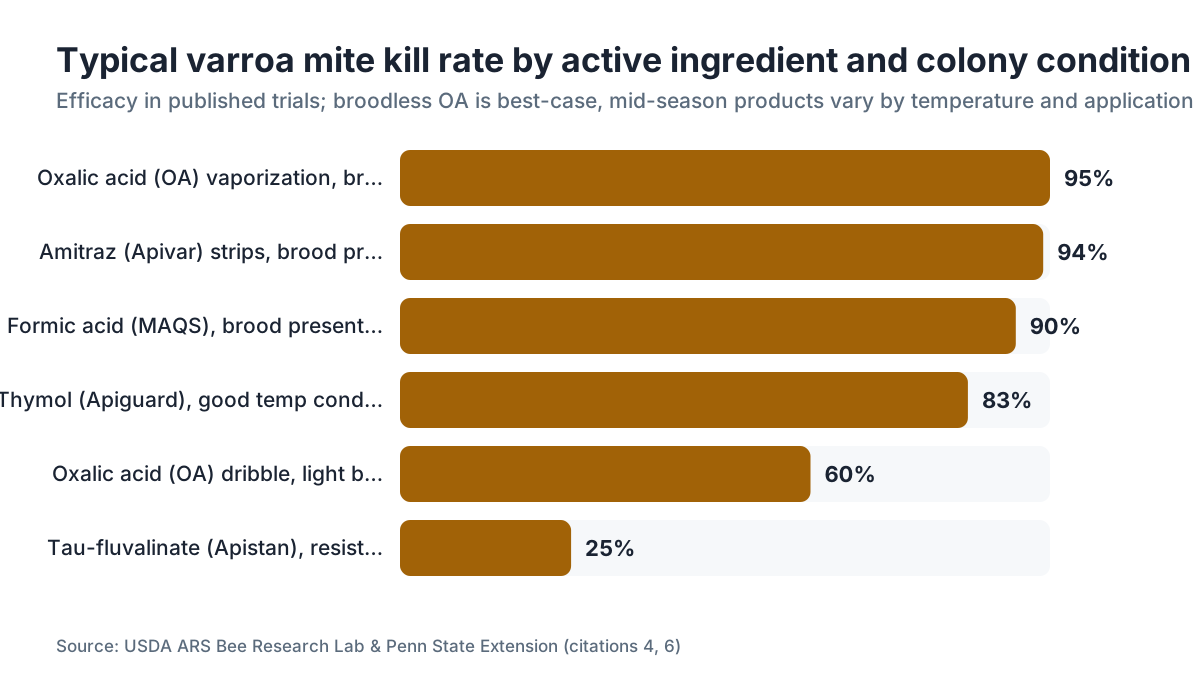
Api-Bioxal is the only fully EPA-registered OA product in the US. Its label allows three methods: vaporization (sublimation), dribble, and spraying package bees. The dribble calls for a 3.5 percent OA solution in sugar syrup, 5 mL per seam of bees. Vaporization uses 1 gram of crystalline Api-Bioxal per brood box. "A single oxalic acid vaporization treatment on a broodless colony achieves roughly 90 to 97 percent mite kill in published USDA trials" [6]. That is the number to remember.
OA is safe for bees at label rates and corrosive to you. Wear nitrile gloves, eye protection, and a half-face respirator rated for acid vapors (P100 with OV cartridges) any time you vaporize.
How does formic acid work, and why does it treat under cappings?
Formic acid is a fumigant. It turns to vapor at room temperature, and that vapor pushes through the wax cappings of brood cells. It is one of the only treatments that reaches mites feeding on developing pupae inside sealed cells [2]. That sets it apart from oxalic acid in a real way. When your colony carries a full brood nest, formic acid has an edge nothing else on the shelf matches.
Mite-Away Quick Strips (MAQS) is the dominant formic acid product in the US. Each strip releases acid over about seven days. The label calls for two strips applied at once for a single seven-day treatment. One-strip extended-release protocols exist with FormicPro, but check your state registration, because some states lag on approvals.
The catch is temperature. MAQS needs ambient temperatures between 50°F and 85°F, and it can kill brood or a queen, especially near the top of that range. University of Guelph trials found queen loss in MAQS-treated colonies ran roughly 3 to 10 percent depending on conditions [3]. That is real. Account for it, particularly with older queens or unpredictable weather. Treat in the early morning when temps sit on the low end of the window.
One more thing for small yards. The formic acid smell is strong, and neighbors notice. It clears quickly, but treat on calm days.
What does thymol do, and when should you choose it?
Thymol is a monoterpenoid that occurs naturally in thyme essential oil. As a varroa treatment it works as a fumigant: the vapor interferes with mite neurological function at concentrations the bees tolerate reasonably well [4]. Apiguard, the gel thymol product with the widest US distribution, releases thymol slowly from its gel matrix over about four weeks.
Temperature is not negotiable here. Below about 60°F, thymol does not volatilize enough to work. Above 105°F, the release rate climbs so fast it can hurt the bees. The sweet spot runs roughly 65°F to 95°F, which across much of North America means late summer and early fall, not spring.
Apiguard's label calls for two 50-gram doses of gel on top of the frames, the second placed two weeks after the first. Penn State extension trials put typical thymol efficacy in the 74 to 93 percent range under good temperature conditions [4]. Solid, but lower on average than OA on a broodless colony.
Thymol can taint honey flavor if supers are on. Pull the supers before you treat. For organic operations thymol is usually approvable, but confirm with your certifier [12].
How does amitraz work in Apivar, and what is the resistance risk?
Amitraz belongs to a class called formamidines. It acts as an agonist at octopamine receptors, a receptor type invertebrates have and vertebrates mostly lack, which is part of why it stays relatively selective at label rates [8]. In mites it triggers hyperexcitation, loss of coordination, and death. Apivar strips release amitraz slowly over six to ten weeks as bees walk across them [2].
Apivar strips stay in a minimum of six weeks and a maximum of ten [9]. In colonies with brood and no resistance in play, trials report 90 to 99 percent efficacy. That number is why so many beekeepers reach for Apivar year after year. The trouble is that tau-fluvalinate resistance in varroa is now everywhere, and amitraz resistance has turned up in US and European populations too, though not yet as widespread as pyrethroid resistance [5][8].
The Honey Bee Health Coalition puts the mechanism plainly: "Relying on a single mode of action over multiple treatment cycles is the primary driver of acaricide resistance development in varroa mite populations" [11]. Amitraz and fluvalinate are both synthetic acaricides. Lean on only those two and you sit one resistance event away from losing both tools. Rotating to an organic acid every other cycle is the practical way to slow that clock.
Amitraz breaks down in the hive, but some residue builds up in wax. Do not run Apivar with honey supers on; the label prohibits it [8]. Amitraz is also toxic to dogs at low doses, so keep packaging away from pets [10].
Are tau-fluvalinate and flumethrin still worth using?
Honest answer: tau-fluvalinate (Apistan) is rarely my first choice anymore, and most extension apiarists say the same. Pyrethroid resistance in varroa runs wide across the US and Europe. A 1999 survey found resistant varroa in 45 US states, and that was twenty-five years ago [5]. The mechanism, specific point mutations in the varroa sodium channel gene, is well characterized and heritable. A colony you bought may already carry a resistant mite population from before it was yours.
Want to know if your mites still respond to pyrethroids before spending on Apistan? Do an alcohol wash before treatment and again after. If the count barely moves, you have your answer.
Flumethrin sells as Bayvarol in Europe and shows up in Seresto flea collars for pets in the US. It carries the same resistance problems and is not widely available in a labeled miticide form for US beekeepers right now.
That said, a colony with no prior pyrethroid exposure and a need for a long-duration strip can still get real work out of Apistan where resistance has not developed. The strips stay in six to eight weeks. But test. Do not assume.
For most hobbyists running hives with any chemical history at all, OA or formic acid plus a rotation plan beats defaulting to pyrethroids.
Which active ingredient has the fewest wax and honey residue concerns?
Oxalic acid and formic acid break down to compounds already present in honey at low levels: oxalate ions, and formate plus CO2. Treated at label rates, colonies have not produced honey with OA or formic acid residues above naturally occurring background in peer-reviewed studies [6]. Neither has a pre-harvest interval beyond removing the strips or stopping treatment.
Thymol does leave detectable residue in honey, enough to affect flavor above certain thresholds, which is why Apiguard's label requires pulling supers first. At normal doses, its wax contamination is not the lingering problem pyrethroids are.
Amitraz and its metabolite DMPF (2,4-dimethylformanilide) build up in beeswax at levels detected in commercial wax worldwide [5][8]. What wax-based amitraz residue means for bee health is still under study, but the accumulation itself is documented.
Pyrethroids are the worst offender. Tau-fluvalinate in beeswax can reach concentrations well above the lethal dose for other insects, and it has turned up in wax from hives that had no pyrethroid treatment for several years [5]. This matters if you make candles or sell wax: foundation pressed from heavily contaminated wax can affect the colonies drawing it out.
The cleanest long-term wax strategy runs OA and formic acid as the backbone and saves amitraz for the years when brood-present efficacy has to come first.
What treatment threshold should trigger the use of these active ingredients?
Most extension apiculture programs land on a 2 percent mite infestation rate as the action threshold during brood-rearing season [2][4]. That is 2 mites per 100 adult bees on an alcohol wash. Some programs use 3 percent in spring and summer, then drop to 1 to 2 percent in August and September when the winter bees are being raised. Those late-summer bees carry the colony through winter, so protecting them counts for more than the calendar suggests.
The Honey Bee Health Coalition's Varroa Management Guide states it directly: "A treatment threshold of 2 mites per 100 bees (2%) is commonly used, though some beekeepers use 1-3% depending on the time of year" [2]. That range is honest. Nobody owns a single universal number, but 2 percent is a defensible default through most of the season.
For a broodless winter cluster with OA, many beekeepers treat regardless of count once daily lows stay below about 45°F and the cluster is tight. The treatment is that low-risk and that efficient in the window. Treating at 0.5 percent in winter is not a waste. It is strategy.
Test before you treat. Alcohol wash is the gold standard. Sugar roll is gentler but less accurate. Sticky boards give you a rough estimate, not a rate. Use the alcohol wash to make a real call on which active ingredient and what timing you actually need.
VarroaVault (varroavault.com) has free treatment scheduling tools that map your monitoring data to treatment windows based on your chosen active ingredient and local climate.
Can you combine active ingredients or use them at the same time?
As a rule, do not run products from different chemical classes at the same time unless the label spells out that combination. No registered US protocol calls for two active ingredients in a colony simultaneously.
The practical reason to keep treatments separate is stress. Stacking chemicals can raise bee mortality and queen loss, and there is no good data showing simultaneous combinations beat sequential treatments planned correctly.
What works is sequential rotation. Finish one course completely, monitor mite counts, then apply a different active ingredient the next cycle or next season. The Honey Bee Health Coalition recommends rotating modes of action across cycles specifically to slow resistance [2].
A two-year rotation looks like this. Year one spring: amitraz (Apivar) strips. Year one fall: formic acid (MAQS) if temps allow, or OA vaporization in a broodless December cluster. Year two spring: OA extended release or formic acid. Year two fall: amitraz again. Each chemical class gets a long rest between exposures. That is what resistance management looks like in practice.
Starting out? Beekeeping supply companies often sell starter kits that include a single active ingredient. Plan for rotation from day one instead of running with whatever came in the box.
What does the EPA label actually require you to know before treating?
The EPA product label is enforceable law under FIFRA. Every label for a registered varroa miticide covers several things you are legally bound to follow [1].
First, the restricted-entry interval (REI) and any personal protective equipment (PPE) requirements. OA vaporization requires respiratory and eye protection, and nobody else opens that hive until the vapor clears. Amitraz strips require gloves during application.
Second, the timing rules relative to honey supers. Apivar (amitraz), Apiguard (thymol), and Apistan (fluvalinate) all require pulling supers before treatment. Api-Bioxal (OA) and MAQS (formic acid) have more permissive rules, but read the current label, not what a forum told you.
Third, colony strength and queen status. Some labels set a minimum adult bee population. Apiguard's label notes reduced efficacy in weak colonies.
Fourth, treatment duration. Pulling strips early is off-label use, and it cuts efficacy while still breeding resistance. Yank Apivar before the six-week minimum and you have done nothing for the mite population and plenty of harm to the product's long-term usefulness [9].
The EPA Pesticide Product Label System (PPLS) keeps every current label online [1]. Print yours and keep it with your treatment supplies. If your lot differs from the printout, follow whichever is newer.
For the biology behind these windows, our page on varroa mites walks through the lifecycle. Understanding when mites hide under cappings makes the treatment timing click.
Is there an active ingredient better suited for specific colony situations?
Yes. Matching the tool to the situation is where you actually save colonies.
Broodless winter cluster: oxalic acid vaporization is the clear first pick. High efficacy, low cost, no hard temperature minimum (it just needs to be warm enough for you to work), and no residue worry. A single Api-Bioxal vaporization can drop mite infestation from 10 percent to under 1 percent on a broodless colony.
Active brood nest in summer: formic acid (MAQS) is the only registered product that penetrates capped brood. High mite load mid-summer with a full brood nest? MAQS is the logical choice if temps cooperate. Amitraz (Apivar) over six-plus weeks also reaches brood-associated mites as new bees emerge and contact the strips, but it takes longer.
Fall, before winter bees are raised: both amitraz and formic acid earn their place. The goal is knocking mite load down before the shift to long-lived winter bees, so speed and depth matter. Formic acid works faster (7 days for MAQS) but has a narrower temp window in September and October depending on your latitude. Amitraz is slower and more forgiving of temperature swings.
Nucs and splits: OA dribble or vaporization fits splits that are temporarily broodless or carry little brood. Small colony size makes MAQS dosing awkward, since the label still calls for a full dose even on a small colony, which can be rough on them.
Colonies with suspected pyrethroid resistance: skip Apistan entirely. Use OA, formic acid, thymol, or amitraz, then check the response with a post-treatment alcohol wash three to five days after the course ends.
Running beekeeping supplies across several hives? Stock at least two different active ingredient classes so you are never boxed in when timing or temperatures refuse to cooperate.
How do you track which active ingredient you used and plan the next rotation?
Most hobbyists track this poorly, and that is the most common reason resistance sneaks up on a yard. At a minimum you want a simple per-hive log: date of mite wash, mite count, active ingredient used, application start and end dates, and the post-treatment wash result.
Post-treatment monitoring is not optional if you care whether the treatment worked. Do an alcohol wash three to five days after finishing an OA or formic acid course, or after pulling amitraz strips. Counts still above 2 percent are telling you something. Either the treatment failed (resistance, poor application, bad temperatures) or reinfestation from neighboring colonies is already underway.
VarroaVault offers a free protocol builder that logs active ingredients and sets reminders for post-treatment washes based on each product's timeline. It is free and needs no subscription.
Manage more than five colonies? A plain spreadsheet with hive ID, treatment date, active ingredient, and mite-per-wash counts before and after does the job. The point is that the data exists and you actually read it before choosing next season's product.
Frequently asked questions
What is the active ingredient in Apivar?
Apivar contains amitraz, a formamidine-class acaricide. It binds octopamine receptors in varroa, causing paralysis and death. Strips stay in the colony six to ten weeks. Amitraz resistance has turned up in some US and European varroa populations, so rotate to an organic acid periodically and run a post-treatment alcohol wash to confirm the treatment worked.
What is the active ingredient in Api-Bioxal?
Api-Bioxal is oxalic acid dihydrate at 5.7 percent concentration. It is the only EPA-registered oxalic acid product for varroa in the US. It kills phoretic mites by contact and does not penetrate capped brood, so it works best during broodless periods. The label allows vaporization, dribble, and package-bee spray application.
What is the active ingredient in Apistan?
Apistan contains tau-fluvalinate, a type II pyrethroid that disrupts sodium channels in the varroa nervous system. Pyrethroid resistance has been documented across most US states since at least 1999, so do not assume Apistan works without pre- and post-treatment mite counts. It accumulates in beeswax and can persist for years at levels affecting other insects.
What is the active ingredient in Mite-Away Quick Strips?
Mite-Away Quick Strips (MAQS) contain formic acid. Each strip is a slow-release matrix that volatilizes formic acid vapor over about seven days. The vapor penetrates capped brood cells and kills mites on developing pupae, which most other treatments cannot do. Ambient temperature must stay between 50°F and 85°F. Queen loss of roughly 3 to 10 percent has been reported.
What is the active ingredient in Apiguard?
Apiguard contains thymol, a naturally occurring monoterpenoid from thyme, at 25 percent concentration in a gel matrix. The gel releases thymol vapor slowly over about four weeks, disrupting mite neurological function. It needs ambient temperatures of 60°F to 105°F to volatilize well. Remove honey supers before use. It is usually compatible with certified organic production when your certifier approves it.
Can varroa mites become resistant to oxalic acid?
No confirmed cases of varroa resistance to oxalic acid have been documented as of mid-2025. Because OA works by physical damage to the mite's cuticle rather than binding a specific receptor, genetic resistance is considered less likely than with synthetic acaricides. That makes OA a dependable anchor in any rotation, especially for broodless-period treatments where its contact-only limitation does not matter.
Which varroa treatment active ingredient is safe to use with honey supers on?
MAQS (formic acid) and Api-Bioxal (oxalic acid) have the most permissive super rules among registered products. Both organic acids break down without persistent residue in honey at label rates. Apivar (amitraz), Apistan (fluvalinate), and Apiguard (thymol) all require removing supers before treatment per their current EPA labels. Always read the current label for your specific lot, since labels get revised.
How long do varroa treatment active ingredients stay in beeswax?
Pyrethroids like tau-fluvalinate can persist in beeswax for years after treatment and have been detected in wax from colonies with no recent pyrethroid exposure. Amitraz metabolites accumulate too, though with lower persistence. Oxalic acid and formic acid break down to natural compounds with no meaningful wax accumulation. Thymol leaves low residue that dissipates over time, especially in warm weather.
What temperature does each varroa treatment active ingredient need to work?
Oxalic acid vaporization works at any temperature above freezing since it sublimates. Formic acid (MAQS) requires 50°F to 85°F. Thymol (Apiguard) needs 60°F to 105°F to volatilize adequately. Amitraz (Apivar) works best above 59°F, and the strips can stay in below that with reduced efficacy. Pyrethroids (Apistan) tolerate the widest temperature range, but resistance makes the point moot in many yards.
How do I know if varroa mites in my hive are resistant to a treatment?
Do an alcohol wash before treatment and again three to five days after finishing the full course. If the post-treatment count has not dropped by at least 90 percent from the pre-treatment level, resistance or treatment failure is the likely cause. Repeat with a different active ingredient class and monitor again. No in-field genetic test exists for hobbyists; mite counting is the practical method.
Is formic acid or oxalic acid better for treating varroa?
They solve different problems. Oxalic acid on a broodless colony is exceptionally effective, 90 to 97 percent in published trials, but does nothing to mites under cappings. Formic acid (MAQS) reaches mites in capped brood cells, making it the better tool mid-season with a full brood nest. Most experienced beekeepers use both across the year: formic acid when brood is present, OA during the broodless winter window.
Can I use essential oils instead of registered treatments to control varroa?
Unregistered essential oil treatments, including home-mixed thymol, are not legal as pesticides on managed honey bee colonies under FIFRA. Apiguard and ApiLifeVar are registered thymol products with EPA approval and defined protocols. Using unregistered preparations means relying on products with no validated efficacy or safety data, which risks harming your colony with no guarantee of mite control.
How often should I rotate varroa treatment active ingredients?
The Honey Bee Health Coalition recommends rotating modes of action across treatment cycles, more than brand names. A practical schedule uses organic acids (OA or formic acid) for at least one of your two annual treatments and reserves synthetic acaricides (amitraz or pyrethroids) for the other. Treat twice a year and that means at least one organic acid treatment annually. Always confirm efficacy with post-treatment mite counts.
What is the active ingredient in flumethrin products like Bayvarol?
Bayvarol contains flumethrin, a pyrethroid that disrupts sodium channels in the mite nervous system, the same mechanism as tau-fluvalinate. It is sold widely in Europe but is not available in a labeled miticide form for US beekeepers as of mid-2025. It carries the same resistance concerns as fluvalinate, so pyrethroid-resistant mites will resist flumethrin too.
Sources
- EPA Pesticide Product Label System (PPLS) and Pesticide Registration: EPA registers varroa miticides under FIFRA; the product label is a legally enforceable document and using a product in a manner inconsistent with the label is a federal violation.
- Honey Bee Health Coalition, Varroa Management Guide (2023 edition): Treatment threshold of 2 mites per 100 bees is commonly used; rotating modes of action across treatment cycles is the primary recommendation to slow acaricide resistance in varroa.
- University of Guelph, School of Environmental Sciences, Honey Bee Research Centre: MAQS (formic acid) trials found queen loss rates ranging from approximately 3% to 10% depending on temperature conditions during treatment.
- Penn State Extension, Apiculture Program, Varroa Mite Management: Thymol (Apiguard) efficacy in Penn State trials ranged from approximately 74% to 93% under appropriate temperature conditions; 2% infestation rate is the commonly cited action threshold during brood-rearing season.
- Elzen PJ et al., Resistance to the acaricide fluvalinate in North American Varroa, Apidologie, 1999: Pyrethroid (tau-fluvalinate) resistant varroa populations had been detected in 45 US states by 1999; pyrethroids accumulate in beeswax and can persist for years at concentrations detectable above treatment periods.
- USDA Agricultural Research Service, Bee Research Laboratory: A single oxalic acid vaporization treatment on a broodless colony achieves roughly 90-97% mite kill in published USDA trials; OA and formic acid at label rates do not produce honey residues above naturally occurring background levels.
- EPA Pesticide Registration (Api-Bioxal, Reg. No. 91422-4): Api-Bioxal (oxalic acid dihydrate 5.7%) is the only EPA-registered oxalic acid miticide for varroa in the US; label allows vaporization, dribble, and package bee spray application methods.
- Oregon State University Extension Service: Amitraz resistance in varroa has been documented in US and European populations; amitraz acts as an octopamine receptor agonist and breaks down faster than pyrethroids but leaves detectable wax residue.
- University of Minnesota Extension: Apivar (amitraz) strips should remain in the colony for a minimum of six weeks and maximum of ten weeks per label; removing strips early reduces efficacy while still applying selection pressure for resistance.
- National Pesticide Information Center (NPIC), Amitraz Technical Fact Sheet: Amitraz is toxic to dogs at relatively low doses; pet exposure to amitraz packaging or strips is a documented veterinary concern.
- Honey Bee Health Coalition, Tools for Varroa Management: Relying on a single mode of action over multiple treatment cycles is the primary driver of acaricide resistance development in varroa mite populations.
- USDA Agricultural Marketing Service, National Organic Program: Oxalic acid, formic acid, and thymol are generally compatible with NOP certified organic production; amitraz and synthetic pyrethroids are not permitted in certified organic operations.
Last updated 2026-07-10