Varroa destructor treatments approved for honey bees in Hawaii
TL;DR
- Hawaii beekeepers can use oxalic acid (vapor, dribble, extended-release), formic acid (Mite-Away Quick Strips, Formic Pro), thymol (ApiLife VAR, Apiguard), and amitraz (Apivar).
- Each carries temperature windows, brood-stage limits, and honey super rules.
- Hawaii's warm year-round climate means broodless periods almost never happen on their own, which changes which treatments actually work here.
Why varroa treatment in Hawaii is different from the mainland
Hawaii colonies raise brood year-round in most locations. That single fact reshapes every treatment decision you make. On the mainland, beekeepers time oxalic acid dribble and vapor to the broodless window in late fall or early winter, when mites have nowhere to hide except on adult bees. Hawaii rarely hands you that window, so the treatments that lean on it lose most of their punch.
Varroa destructor reached Hawaii in 2007 and spread through the islands within a few years [1]. Before that, Hawaii was one of the last mite-free bee populations on Earth. That door is shut. Mite pressure is real and constant across all the main islands.
The warm climate also pushes temperature limits the wrong direction. Formic acid has an upper ceiling near 85 degrees F, and coastal Hawaii blows past it for weeks at a time in summer. Thymol has its own narrow sweet spot that's hard to hit at sea level. You have more options than you'd guess. You just have to match the tool to your actual elevation and season instead of copying whatever your mainland beekeeping buddy swears by.
Hawaii also runs some of the tightest bee biosecurity in the country. The state keeps active import restrictions on bees and used equipment to protect its remaining disease-free zones and feral populations [1]. That's the backdrop for why local extension and the Hawaii Department of Agriculture treat varroa as a serious matter, and why treatment records carry more weight here than in most states.
Want the biology behind the pest before you pick a protocol? The varroa mite coverage walks through how the mite reproduces inside capped brood, which is the thing that makes every treatment choice hinge on brood status.
What varroa treatments are actually registered and legal in Hawaii?
Every varroa product sold in the United States, Hawaii included, has to be registered by the EPA under FIFRA (the Federal Insecticide, Fungicide, and Rodenticide Act). Using an unregistered product, or applying a registered one against its label, is a federal violation. The label is the law. Read it before you open the box.
As of 2025, these EPA-registered categories are available to Hawaii beekeepers [2][3]:
| Treatment | Active ingredient | Brand names | Brood penetration | Honey super restriction |
|---|---|---|---|---|
| Oxalic acid dribble | Oxalic acid dihydrate | Api-Bioxal | Bees only (no kill inside capped brood) | No supers during treatment |
| Oxalic acid vapor | Oxalic acid dihydrate | Api-Bioxal | Bees only | No supers during treatment |
| Oxalic acid extended-release | Oxalic acid dihydrate | Api-Bioxal (glycerin-soaked towels per supplemental label) | Bees plus limited brood reach over time | No supers during treatment |
| Formic acid | Formic acid | Mite-Away Quick Strips (MAQS), Formic Pro | Reaches into capped brood | MAQS: supers allowed with restrictions; Formic Pro: no supers |
| Thymol | Thymol | ApiLife VAR, Apiguard | Bees only | No supers during treatment |
| Amitraz | Amitraz | Apivar | Bees only | No supers during treatment |
That's six treatment approaches from four chemical classes. Rotating between those classes is the main way to slow resistance, and amitraz resistance is already documented in some U.S. mite populations [4]. Rotation isn't a clever tactic. It's basic stewardship.
Does oxalic acid work in Hawaii's year-round brood cycle?
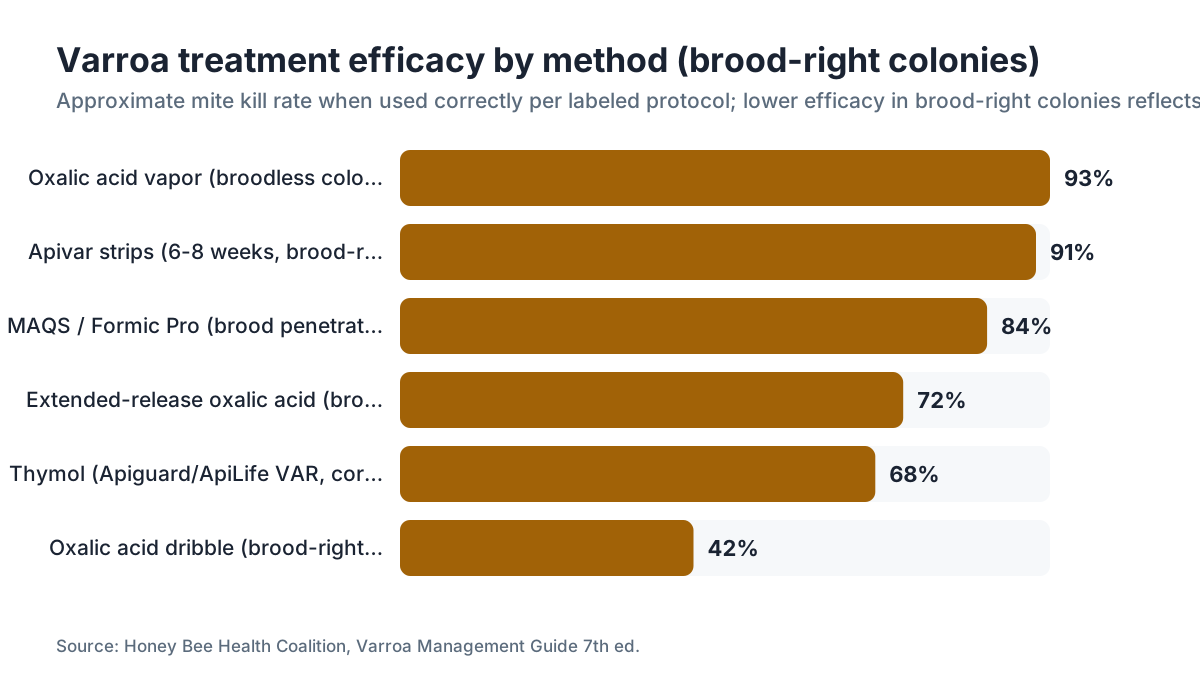
Oxalic acid is the best tool you have when a colony is broodless. It kills phoretic mites riding on adult bees at roughly 90 to 95 percent in that window [3]. The catch in Hawaii is blunt: that broodless window rarely shows up on its own.
The Honey Bee Health Coalition's Varroa Management Guide states plainly that "oxalic acid is not effective against mites in capped brood" [3]. That's the whole problem for Hawaii beekeepers. If your colony has brood in every stage, a single oxalic acid hit knocks down the mites on adult bees and leaves the capped-brood mites untouched. They emerge with the next batch of bees and your count rebounds within a week or two.
You have two honest paths. First, create the broodless window yourself. Cage or pull the queen for about 24 days, long enough for all capped brood to emerge, then treat. It works. It's also labor and carries real risk to colony buildup and queen acceptance. Some Hawaii beekeepers run this once a year as a combined swarm-prevention and mite-reset move.
Second, use extended-release oxalic acid with the glycerin-soaked towel method authorized under the Api-Bioxal supplemental label [2]. This keeps oxalic acid in the hive for 28 days or more, catching mites as they crawl out of cells onto adult bees. Efficacy in a brood-right colony is lower than a broodless dribble or vapor treatment, but it beats a single application by a wide margin. University of Florida IFAS extension has studied and published protocols for this method in warm climates that never reach broodlessness [5].
Vapor (sublimation) with an Api-Bioxal vaporizer is the third route. Several treatments spaced 5 to 7 days apart, timed around your queen management, can hit successive waves of emerging mites. It takes equipment (a decent vaporizer runs $150 to $250), a proper respirator, and patience. Never vaporize without PPE. Oxalic acid vapor is a serious respiratory irritant [2].
Can you use formic acid treatments in Hawaii's heat?
Formic acid is the only registered varroa treatment that penetrates capped brood, which makes it tempting anywhere colonies never stop rearing brood. Hawaii qualifies. The problem is heat.
Mite-Away Quick Strips (MAQS) require ambient temperatures between 50 and 85 degrees F for the full treatment [6]. Formic Pro runs a similar window: 50 to 92 degrees F for the single-strip dose, 50 to 85 degrees F for the two-strip protocol. Coastal lowland Hawaii sits above 85 degrees F for long summer stretches. Applying formic acid over those limits spikes queen mortality risk and can cause heavy brood kill.
That doesn't scratch formic acid off the list for Hawaii. Higher elevations (Kula on Maui, parts of the Big Island above 2,000 feet, upland Oahu) can hold the acceptable window year-round or at least through cooler seasons. At lower elevations you can often find a window in the cooler months, roughly November through February in many spots, when daytime highs behave. Check the 10-day forecast before you start a MAQS or Formic Pro treatment. You can't easily pull the strips once they're in.
One detail worth knowing: MAQS carries a label provision allowing treatment with honey supers on the hive. No other registered varroa treatment does that [6]. That matters if you don't want to pull supers and stall a flow. Read the current label word for word, because the conditions for that super exemption are specific and you have to follow them exactly.
Do thymol treatments (Apiguard and ApiLife VAR) work in Hawaii?
Thymol comes from thyme oil, and both Apiguard and ApiLife VAR are EPA-registered for varroa. Both work by slow evaporation, dosing the colony with thymol vapor across a multi-week treatment. They're naturally derived and leave no synthetic residue in wax, which appeals to some beekeepers.
The workable temperature range is narrow. Apiguard's label sets a minimum of 59 degrees F and recommends staying below 105 degrees F. ApiLife VAR calls for 59 to 95 degrees F [3]. The real trouble in Hawaii is that thymol evaporates too fast in high heat. The dose hits hard and early, then burns off before the full treatment period finishes. That can stress bees and queens without ever completing the mite knockdown.
In cooler Hawaiian microclimates, thymol is a viable option. In hot coastal areas through summer, it's genuinely problematic. Thymol also does little against mites sealed inside capped brood, same limitation as oxalic acid, so the year-round brood challenge applies here too.
Neither Apiguard nor ApiLife VAR can be used with honey supers on the hive.
How does Apivar (amitraz) fit into a Hawaii treatment program?
Apivar strips carry amitraz, a synthetic miticide that works by contact as bees walk across the strips and spread the compound through normal hive traffic. Strips stay in for a full 6 to 8 weeks, and efficacy in brood-right colonies is usually high, often above 90 percent in mite-susceptible populations, because the long exposure catches mites as they emerge from cells [3][9].
That makes Apivar one of the more practical tools for Hawaii's year-round brood. No broodless period required. You set two strips in the brood area, leave them the full run, then pull them completely at the end. The label is blunt about removal: strips come out, they don't stay in. Amitraz breaks down in wax over time, and chronic low-level exposure from forgotten strips is one of the documented paths to resistance [4].
Resistance is the real hazard with amitraz. USDA ARS research has identified amitraz-resistant mite populations in parts of the U.S. [4]. Hawaii's isolation has probably slowed resistance compared to the mainland, but that's a head start, not a shield, and bee movement keeps rising. Rotating Apivar with oxalic acid and occasional formic acid or thymol is the sensible long game.
Apivar can't be used with honey supers present. Put supers on only after strips are out and you've waited the label interval. The current label controls storage and disposal, and those rules aren't suggestions.
What does Hawaii state law say about varroa treatments and bee imports?
Hawaii runs some of the strictest bee biosecurity laws in the country. The Hawaii Department of Agriculture administers Chapter 150A of the Hawaii Revised Statutes, which governs importing bees, used beekeeping equipment, and related materials [1]. Bringing in live bees, queens, or used gear requires permits and health inspections, and some items are banned outright.
For the treatments themselves, federal EPA registration governs. In practice, the major products here (Api-Bioxal, MAQS, Formic Pro, Apiguard, ApiLife VAR, Apivar) are commercially available and legal to use in Hawaii under their federal registrations. Verify the current label anyway, because registrations get updated.
Hawaii also takes part in the USDA National Honey Bee Survey, which monitors for exotic pests including varroa, small hive beetle, and Tropilaelaps mites. Tropilaelaps hasn't established in Hawaii, but it's a live biosecurity concern given the state's proximity to the Asia-Pacific region [1].
Keep treatment records. Not only for your own management, but because Hawaii's biosecurity framework leans harder on traceability every year. The Hawaii Department of Agriculture Plant Industry Division is your primary contact for bee regulations and permits [1]. University of Hawaii at Manoa CTAHR cooperative extension is the place for local integrated pest management guidance tuned to the tropics [11].
When should you treat, and how do you know mite levels are high enough?
The threshold question matters as much as the product question. Treating for no reason wastes money and adds chemical load to the hive. Waiting too long costs you colonies. So you monitor, and you treat on the number.
The Honey Bee Health Coalition recommends an action threshold of 2 percent infestation, 2 mites per 100 bees on an alcohol wash or sugar roll, during the brood-rearing season [3]. Some researchers argue for 1 to 1.5 percent in late summer on the mainland, when the bees being raised will overwinter. Hawaii's version of that concern is the buildup before a major nectar flow. Those are the bees that have to be healthy and long-lived to work the flow.
Alcohol wash is the most accurate method. Sugar rolls spare your sample bees but read a bit lower. Sticky boards give a relative number without a percentage, so they track trends rather than pin a threshold.
Monitor every 4 to 6 weeks at minimum during active brood season, which in Hawaii means basically all year. Track the numbers. A colony reading 0.5 percent in February and 1.8 percent in April is on a curve that hits crisis by June. Treat before you cross the line, not after.
For logging counts and setting treatment reminders, VarroaVault's free protocol tools are worth bookmarking. The monitoring calendar lets you record washes and flag treatment windows against your location and colony history.
What does each treatment cost, and where do you buy it in Hawaii?
Hawaii's isolation adds shipping cost to everything, and some suppliers charge extra for Hawaiian addresses or won't ship there at all. Here are realistic 2025 price ranges, though prices move.
| Product | Approx. cost per treatment | Treats how many colonies | Notes |
|---|---|---|---|
| Api-Bioxal 35g | $25-$35 | Up to 20 (dribble) or 10-15 (vapor, dose dependent) | Vapor method needs a vaporizer ($150-$250 one-time) |
| Mite-Away Quick Strips (MAQS) | $20-$28 per 2-strip pack | 1 colony | Widely available; single-use |
| Formic Pro | $35-$50 per pack | 2 colonies | Longer treatment window than MAQS |
| Apiguard 400g tray (2-pack) | $10-$18 | 1 colony (two-tray treatment) | Cheap; temperature-limited |
| ApiLife VAR (10 tablets) | $15-$22 | 2-3 colonies | Temperature-limited |
| Apivar (10 strips) | $20-$30 | 5 colonies | Per-colony cost is low at scale |
Your most practical sourcing options are mainland suppliers that ship to Hawaii (confirm their shipping policy before ordering), local farm supply stores on Oahu and Maui that stock basic beekeeping gear, and the Hawaii Beekeepers Association, which sometimes runs group orders. The beekeeping supply companies page lists more suppliers to compare. Coordinating a group order with other local beekeepers can cut per-unit shipping a lot. Order early. Shipping to Hawaii takes longer than you expect.
How do you choose the right treatment for your specific situation?
There's no single right answer for every Hawaii beekeeper. Your elevation, the season, your mite count, whether supers are on, and whether you can induce broodlessness all steer the decision.
Here's how I'd think it through. If your mites are at or above threshold and you can pull the queen or make a split to induce broodlessness for 3 to 4 weeks, oxalic acid vapor during that window is the most effective and least chemically heavy option you have. It's hard to beat 90-plus percent efficacy from a product that leaves no synthetic residue.
If inducing broodlessness isn't realistic, your two best Hawaii options are extended-release oxalic acid (the glycerin towel method) or Apivar strips. Extended-release OA is organic-compliant and residue-friendly but demands strict no-super discipline for the full run. Apivar is convenient and effective in brood-right colonies but builds resistance risk if you overuse it.
At higher elevation with temperatures in range, MAQS or Formic Pro give you brood penetration, a genuine edge in year-round-brood situations. At sea level in summer, formic acid is risky. Skip it.
Rotation across chemical classes isn't optional. The Honey Bee Health Coalition's Varroa Management Guide recommends alternating oxalic acid, formic acid, thymol, and amitraz to reduce selection pressure [3]. A reasonable Hawaii rotation: Apivar one round, extended-release oxalic acid the next, MAQS slotted in when temperatures allow and the colony is building for a flow.
VarroaVault's free mite management OS can map a rotation calendar to your location, colony count, and treatment history. Structured tracking is what separates beekeepers who stay ahead of mites from those who bury colonies every couple of years.
What mistakes do Hawaii beekeepers commonly make with varroa treatment?
The biggest mistake is assuming Hawaii's warm, gentle-seeming conditions mean lower mite pressure. They don't. Mites in warm climates hit economic threshold faster, because colonies rarely pause brood production and mites get uninterrupted reproductive cycles.
Second mistake: riding one chemistry year after year. Beekeepers who reach for Apivar every single round are training resistant mites. Rotate.
Third: ignoring the temperature limits on formic acid and thymol. Running MAQS through a stretch of 90-degree days and losing queens is an expensive, avoidable lesson. Check the 10-day forecast. If it looks like a heat spike is coming, wait.
Fourth: treating without monitoring. If you don't know your baseline count, you can't tell whether the treatment worked. Do an alcohol wash or sugar roll before treatment and again 3 to 4 days after the treatment window closes to confirm efficacy. Anything under 90 percent kill in a correctly applied treatment is a warning flag for resistance.
Fifth: leaving Apivar strips past the label's 6-to-8-week maximum. Strips forgotten for months feed resistance and leave amitraz in wax. Set a calendar reminder the day you put them in.
Sixth, and this one hurts: buying from unreliable sources or using expired product. Miticide efficacy fades over time. Api-Bioxal, MAQS, and Apivar all carry expiration dates. Expired product can run the full window without adequate kill, and you won't find out until you recheck counts.
Frequently asked questions
Is oxalic acid legal to use in Hawaii?
Yes. Api-Bioxal, the EPA-registered oxalic acid product, is legal and available in Hawaii. All three methods, dribble, vapor, and the extended-release glycerin towel, are authorized under the Api-Bioxal label and its supplemental label. Follow the label exactly, including the ban on use with honey supers present. The vapor method requires a vaporizer and proper respiratory protection.
Can I use Apivar in Hawaii without a prescription or license?
Yes. Apivar is an over-the-counter product in the United States, no veterinary prescription needed. Any beekeeper can buy and apply it. Follow the label: two strips per brood box, left in for 6 to 8 weeks, then removed completely at the end of treatment. Never use it with honey supers in place.
Does Hawaii have its own varroa treatment regulations beyond federal EPA rules?
Hawaii's added layer is its strict bee import law under Hawaii Revised Statutes Chapter 150A, administered by the Hawaii Department of Agriculture. For the treatments themselves, federal EPA registration governs. Hawaii does not currently require state-level registration separate from EPA registration for the major varroa miticides. Contact the HDOA Plant Industry Division to confirm current requirements before buying or importing any new product.
What is the best varroa treatment for Hawaii beekeepers who keep bees near a nectar flow?
Mite-Away Quick Strips (MAQS) is the only registered varroa treatment with a label provision allowing use while honey supers are on, subject to specific conditions. That makes it the most useful option during a flow. Temperature limits still apply: 50 to 85 degrees F. At higher Hawaii elevations in cooler months, MAQS during a flow is workable. At sea level in summer, the heat risk is real.
How often should Hawaii beekeepers monitor for varroa mites?
Every 4 to 6 weeks at minimum, year-round, because Hawaii's warm climate means colonies almost never stop producing brood and mite counts can climb fast. The Honey Bee Health Coalition recommends treating at 2 mites per 100 bees (2 percent) on an alcohol wash. Monitoring every 3 to 4 weeks during high colony growth or before a major nectar flow gives you earlier warning.
Can Hawaii beekeepers induce a broodless period to use oxalic acid effectively?
Yes, and many experienced Hawaii beekeepers do exactly this. Caging or temporarily removing the queen creates a broodless window in roughly 24 days, the time all capped brood needs to emerge. An oxalic acid vapor or dribble treatment during that window reaches 90 to 95 percent efficacy because nearly all mites are on adult bees, not sealed in cells. The main tradeoff is reduced colony productivity during the break.
What temperature range is safe for formic acid treatment in Hawaii?
Mite-Away Quick Strips (MAQS) requires ambient temperatures between 50 and 85 degrees F for the full treatment. Formic Pro allows up to 92 degrees F for the single-strip protocol and up to 85 degrees F for the two-strip protocol. Hawaii's coastal lowlands often exceed these limits in summer. Higher elevations, generally above 2,000 feet on the Big Island and Maui, frequently hold the safe window year-round.
Will varroa mites in Hawaii develop resistance to treatments?
Resistance is a real risk in any mite population hit with the same chemistry repeatedly. Amitraz-resistant varroa populations are already confirmed in parts of the continental U.S. Hawaii's isolation may slow the process, but it isn't immunity. The practical defense is rotating the four chemical classes: oxalic acid, formic acid, thymol, and amitraz. A post-treatment mite wash is your early warning system for emerging resistance.
Are there any organic or chemical-free varroa treatment options in Hawaii?
Oxalic acid is organic-compliant and approved for certified organic operations under the USDA National Organic Program when used as directed. Thymol (Apiguard, ApiLife VAR) is naturally derived. Formic acid is treated as organic-compatible in some programs. None leave synthetic residues in wax or honey when used correctly. Check your specific organic certification program's current list before applying any treatment in an organic operation.
How do I dispose of used Apivar strips in Hawaii?
The Apivar label directs you to wrap used strips in several layers of newspaper and dispose of them in household trash. Do not burn or compost them. Hawaii's waste disposal rules follow standard federal pesticide disposal guidelines. Never reuse strips between colonies; once out of the hive, strips get discarded. For large quantities of expired or unused product, contact your local hazardous waste disposal facility.
Where can I buy varroa treatments if I live on a neighbor island in Hawaii?
Options are thinner on neighbor islands than on Oahu. Your most reliable route is ordering from mainland suppliers that explicitly ship to Hawaii, then budgeting for added cost and time. The Hawaii Beekeepers Association periodically organizes group orders that cut per-unit shipping. Some agricultural supply stores on Maui and the Big Island stock Apivar and occasionally Api-Bioxal, but availability is inconsistent. Order before you need it.
What is the Honey Bee Health Coalition's recommended varroa treatment threshold?
The Honey Bee Health Coalition's Varroa Management Guide recommends treating when an alcohol wash shows 2 mites per 100 bees (2 percent infestation) during the brood-rearing season. Some researchers suggest a lower threshold of 1 to 1.5 percent before a critical buildup period. The Coalition's guide is free online and is the most widely referenced practical standard for U.S. beekeepers.
Can I treat for varroa while using honey supers in Hawaii?
Generally no, with one exception. Apivar, Api-Bioxal, Apiguard, ApiLife VAR, and Formic Pro all prohibit use with honey supers in place. Mite-Away Quick Strips (MAQS) has a specific label provision allowing use with supers on under defined conditions, including a temperature ceiling of 85 degrees F. That MAQS provision is the only registered pathway to treat during a flow in Hawaii, and even then the temperature limits stand.
Sources
- Hawaii Department of Agriculture, Plant Industry Division, Apiary Program: Varroa destructor arrived in Hawaii in 2007; Hawaii Chapter 150A governs bee import restrictions and apiary biosecurity
- EPA, Pesticide Registration (Api-Bioxal Section 3 Registration and Supplemental Label): Api-Bioxal is the EPA-registered oxalic acid product; the supplemental label authorizes the extended-release glycerin towel method; vapor method requires PPE due to respiratory hazard
- Honey Bee Health Coalition, Varroa Management Guide (7th ed.): Oxalic acid is not effective against mites in capped brood; 2% infestation is the recommended action threshold; efficacy comparisons across treatment classes; rotation across chemical classes recommended
- USDA ARS, Bee Research Laboratory (amitraz resistance documentation): Amitraz-resistant varroa populations have been identified in some U.S. honey bee populations; chronic low-level amitraz exposure is a documented resistance pathway
- University of Florida IFAS Extension, Entomology and Nematology Department: University of Florida IFAS has published protocols for extended-release oxalic acid use in warm climates without a natural broodless period
- Mite-Away Quick Strips and Formic Pro product labels, NOD Apiary Products: MAQS requires 50-85 degrees F; Formic Pro allows up to 92 degrees F single-strip and 85 degrees F two-strip; MAQS label permits use with honey supers present under defined conditions
- Apivar (amitraz) product label, Veto-Pharma: Apivar strips must remain in the hive 6-8 weeks and be fully removed at end of treatment; no use with honey supers present; over-the-counter product, no prescription required
- USDA Agricultural Marketing Service, National Organic Program: Oxalic acid is approved under the USDA National Organic Program for certified organic beekeeping operations when used as directed
- University of Hawaii at Manoa, College of Tropical Agriculture and Human Resources (CTAHR): Hawaii CTAHR cooperative extension provides local guidance on integrated pest management and beekeeping in Hawaii's tropical climate conditions
Last updated 2026-07-09