Buckfast bees and varroa mite susceptibility: what the research shows
TL;DR
- Buckfast bees show moderate varroa tolerance compared to unselected stock, largely due to hygienic behavior and some grooming activity, but they are not as mite-resistant as purpose-bred VSH or Minnesota Hygienic lines.
- Their varroa performance varies widely by breeder.
- Treatment-free keeping on Buckfast alone is a gamble most colonies lose.
What are Buckfast bees and where do they come from?
Buckfast bees are a hybrid honey bee developed by Brother Adam (Karl Kehrle) at Buckfast Abbey in Devon, England, starting in the early twentieth century and continuing until his death in 1996. After a tracheal mite epidemic wiped out most British colonies in the 1920s, Brother Adam set out to breed a bee that combined disease resistance, productivity, and gentle temperament by crossing Apis mellifera lines from across Europe and the Mediterranean. The resulting bee is not a single subspecies but a continually refined blend, incorporating genetics from Italian (ligustica), Carniolan (carnica), Greek (cecropia), Anatolian (anatoliaca), and other regional strains. [1]
The key thing to understand about Buckfast bees is that "Buckfast" does not describe one fixed genotype. It describes a breeding philosophy and an ongoing selection program. Queens sold as Buckfast by different breeders can be meaningfully different from one another, sometimes dramatically so. A queen from a breeder actively selecting for varroa resistance traits will produce a very different colony than one from a breeder focused primarily on honey yield or temperament. This matters enormously when you try to interpret varroa research on Buckfast bees, because the literature rarely specifies which Buckfast line was tested.
For context on honey bee diversity and how subspecies differ in disease response, see our overview of beekeeping species.
Are Buckfast bees more resistant to varroa mites than other breeds?
The honest answer is: somewhat, compared to unselected commercial Italian stock, but not dramatically, and the margin depends heavily on which Buckfast line you are talking about. Buckfast bees were never specifically bred to resist Varroa destructor, because varroa did not reach Western Europe until the 1970s and 1980s, long after the core Buckfast hybrid was established. Brother Adam's varroa work in his later years was real but cut short by age and death before a varroa-resistant Buckfast line was fully stabilized. [1]
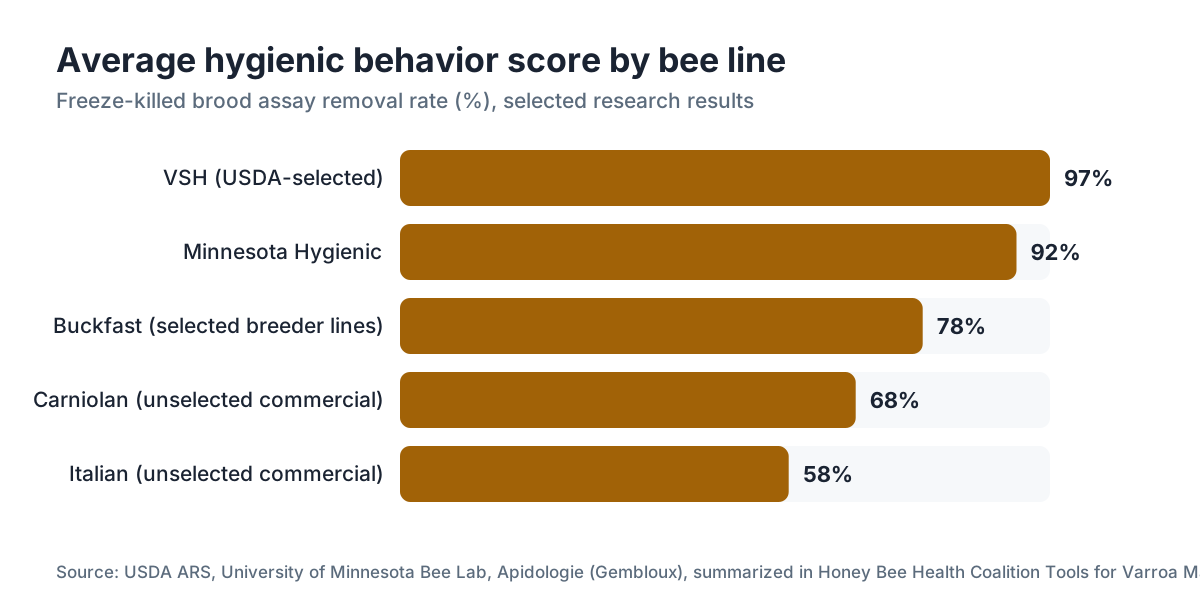
What Buckfast bees do tend to have, in lines maintained by serious breeders, is above-average hygienic behavior. Hygienic behavior is the tendency of workers to detect, uncap, and remove diseased or mite-infested brood before the mite can complete its reproductive cycle. This trait measurably reduces mite population growth rates. Studies at Gembloux Agro-Bio Tech in Belgium found that hygienic behavior scores among tested Buckfast colonies averaged around 70 to 85 percent removal in the freeze-killed brood assay, which qualifies as good but falls short of the 95 percent threshold used to certify VSH (Varroa Sensitive Hygiene) breeder queens. [2]
Grooming behavior, where bees physically remove mites from each other, also varies within Buckfast populations. Some Buckfast colonies show meaningful grooming activity. Others barely do it. Nobody has good population-wide data on Buckfast grooming rates specifically. The closest consistent finding is that Buckfast colonies tend to build up mite loads more slowly than unselected Italian colonies under similar conditions, but still require intervention by the second or third season in most temperate climates. [3]
Buckfast bees buy you time. They do not buy you a treatment-free life unless you are also selecting hard for varroa traits yourself or sourcing from a breeder who is.
How do Buckfast bees compare to VSH, Carniolan, and Italian bees on varroa?
Here is how the main commercially available lines stack up on the traits that matter for varroa management. These figures come from USDA ARS research and university extension summaries. [3][4]
| Bee line | Hygienic behavior (avg) | Varroa growth rate vs. Italian | Treatment-free potential |
|---|---|---|---|
| VSH (USDA-selected) | ~95%+ | 60-80% lower | High, with proper selection |
| Minnesota Hygienic | ~90%+ | 40-60% lower | Moderate to high |
| Buckfast (selected breeder) | ~70-85% | 20-40% lower | Low to moderate |
| Carniolan (unselected) | ~60-75% | 10-25% lower | Low |
| Italian (commercial, unselected) | ~50-65% | Baseline | Essentially none |
A few things jump out of that table. VSH bees outperform Buckfast considerably on the traits that directly suppress varroa reproduction. The USDA Baton Rouge lab developed VSH specifically by selecting for a trait where workers detect and remove mite-infested pupae with extremely high precision, and that focused selection pressure shows. [4] Buckfast bees in their best commercial form are meaningfully better than standard commercial Italian stock, which explains why many European beekeepers have used them as a baseline for resistance breeding programs. And Carniolan and Buckfast overlap more than many beekeepers expect.
For more on what varroa mites are, how they reproduce, and why colony collapse follows predictable infestation curves, see our detailed explainer on the varroa mite.
The practical implication is that if you are choosing a bee line primarily for varroa management, purpose-selected VSH or Minnesota Hygienic queens give you more built-in resistance. Buckfast bees may be the better choice if you also heavily weight temperament, honey production, and overwintering, and you are willing to manage varroa actively. That is a legitimate trade-off, not a failure of reasoning.
What specific varroa resistance traits do Buckfast bees actually carry?
Buckfast bees have three documented traits that contribute to varroa management, to varying degrees.
Hygienic behavior is the most consistently reported. As mentioned, selected Buckfast lines show solid but not exceptional hygienic scores. A 2017 study published in Apidologie examining Belgian Buckfast colonies found highly variable hygienic scores between colonies even within the same apiary, with a coefficient of variation above 30 percent. [2] That spread matters. You cannot assume every Buckfast colony in your yard performs the same way.
Brood cycle length is a secondary factor. Buckfast bees tend toward a brood cycle roughly similar to Italian bees, around 21 days for workers. This is longer than the Carniolan cycle in some studies. A longer capped brood period gives reproducing varroa more time per cycle, which is mildly disadvantageous compared to bees with naturally shorter brood periods. This is one reason that Carniolan-Buckfast crosses are sometimes bred in European programs: combining Carniolan's shorter brood cycle with Buckfast's other traits.
Suppressed mite reproduction (SMR), a heritable trait where mites in a colony fail to reproduce successfully even when physically present, has been identified in some Buckfast lines in European selection programs. [2] This is distinct from hygienic behavior. SMR bees do not necessarily remove mites faster. Instead, the mites in capped cells simply fail to lay viable eggs or lay fewer of them. The trait exists in Buckfast-derived stock in some Dutch and Belgian programs, but it is not uniform across all breeders. If you are specifically hunting for SMR in Buckfast queens, you need to ask your breeder directly whether they select for it and how they measure it.
Can you keep Buckfast bees treatment-free because of varroa resistance?
Almost certainly not, unless you are running a deliberate selection program with aggressive culling of high-mite colonies and regular monitoring. Treatment-free beekeeping gets its best results with either purpose-selected VSH stock, feral survivor populations that have been through multiple generations of natural selection, or Africanized bees (whose varroa tolerance is significant but comes with well-documented behavioral trade-offs, described in our article on africanized honey bee).
Buckfast bees slow the mite curve. They do not flatten it. In a typical temperate climate, a Buckfast colony starting spring with a low mite load, say 1 percent infestation, will usually hit the 3 percent economic threshold sometime in mid-to-late summer without intervention, often a few weeks later than an unselected Italian colony would. That extra time is genuinely useful. But "a few weeks later" is not the same as "never gets there."
The Honey Bee Health Coalition's "Tools for Varroa Management" guide, one of the most used practical references in North American beekeeping, does not categorize any current Buckfast line as reliably treatment-free. It lists Buckfast under moderately tolerant stock and explicitly recommends ongoing monitoring and treatment as needed regardless of bee genetics. [5]
If you read forum posts or YouTube channels claiming Buckfast bees are essentially treatment-free, look carefully at the location and scale. Some beekeepers in isolated mountain valleys or islands in Europe have had success with locally adapted Buckfast populations, but that success depends on the isolation preventing re-mating with non-selected drones, which is simply not achievable in most beekeeping settings. Open-mated Buckfast queens in a normal landscape produce workers of highly mixed genetics, diluting any resistance traits the queen herself carries.
How fast do varroa mite populations grow in Buckfast colonies?
Mite population growth in any colony follows a roughly exponential curve during the main brood-rearing season because varroa reproduce inside capped brood and the only limiting factors are the colony's hygienic response, the availability of brood, and how many mites are present to begin with. The doubling time for a varroa population in a standard commercial Italian colony with no hygienic behavior is roughly 4 to 6 weeks during peak brood season. [3]
In Buckfast colonies with good hygienic behavior, the effective doubling time stretches to somewhere around 7 to 10 weeks based on field data from European selection programs. That is a meaningful improvement. If your colony starts May 1 with 50 mites (roughly 1 percent infestation on 5,000 adult bees), standard Italian bees might hit 3,200 mites by mid-August. A hygienic Buckfast colony might hit that same number in late September. That difference could mean one fewer oxalic acid treatment per year, and it almost certainly means less brood damage over the summer.
But the 3 percent threshold, widely used as the action point by extension services and the Honey Bee Health Coalition [5], does not move just because your bees are Buckfast. Mites above that level start causing measurable wing deformity in emerging bees, immunosuppression, and viral load increases, regardless of bee genetics. Buckfast bees are not immune to DWV (Deformed Wing Virus) or the other varroa-vectored viruses. They just tend to carry lower mite loads for longer.
Monitoring is still mandatory. The alcohol wash or sugar roll method, done monthly during brood season, works the same way on Buckfast colonies as on any other. Do not let the genetics make you complacent about the calendar.
What varroa treatments work best with Buckfast bees?
All EPA-registered varroa treatments work on Buckfast bees. Mite biology does not change based on host bee genetics. The practical question is which treatments fit the management style and seasonal schedule that Buckfast beekeepers tend to use.
Oxalic acid (OA) is the treatment most compatible with genetics-based management strategies. Because hygienic Buckfast colonies often maintain lower mite loads longer, there is more opportunity to use OA during broodless periods (winter, or an induced broodless period via queen caging), when OA vaporization or dribble methods are most effective. OA kills phoretic mites on adult bees but does not penetrate capped brood, so a broodless colony is ideal. [6]
Formic acid products (Mite-Away Quick Strips, Formic Pro) kill mites under cappings and are effective when brood is present. These work well for a mid-summer knockdown in Buckfast colonies that are building mite loads heading into August. The temperature constraints on formic acid (label specifies roughly 50 to 85 degrees Fahrenheit for MAQS) are the same regardless of bee line. [7]
Amitraz (Apivar strips) is highly effective and works in colonies with brood present. Some beekeepers who rely on Buckfast genetics for partial resistance use Apivar as a once-a-year fall treatment rather than the twice-yearly schedule often needed for unselected stock. That is a reasonable approach if monitoring confirms low summer loads, but do not skip the monitoring and assume the genetics are covering you.
Thymol-based products (Apiguard, ApiLife VAR) work well in moderate temperatures and suit beekeepers who prefer organic acids and essential oil treatments. Same temperature range restrictions apply.
For tracking your treatment schedule, thresholds, and mite counts across all your hives, the free protocol tools at VarroaVault can help you build a season-long plan that accounts for how your specific Buckfast colonies are performing.
One thing to avoid: skipping fall treatment because your Buckfast colony had a low summer count. Mite loads in fall can accelerate as the bee population contracts and brood becomes scarce, concentrating mites on fewer adult bees. A 2 percent wash result in August can be a 5 or 6 percent result by October in a colony that looked fine in late summer.
How do you monitor varroa mites in Buckfast colonies?
Monitoring is the same for Buckfast as for any colony, with one caveat: because Buckfast colonies tend to trend lower on mite counts, there is sometimes a temptation to test less frequently. Resist that. The only way to know whether your Buckfast genetics are actually suppressing mites or you are just getting lucky is to have data over multiple seasons.
The alcohol wash is the most accurate readily available field method. USDA ARS research confirms it as roughly 95 percent accurate in detecting mites compared to dissection counts. [8] Take a sample of about 300 bees (roughly half a cup) from the brood nest, not the entrance, add 70 percent isopropyl alcohol, shake for 30 to 60 seconds, and count mites in the liquid. Divide mites by bees and multiply by 100 for a percentage.
The Honey Bee Health Coalition recommends sampling every four to six weeks during the brood season and setting 2 percent as a conservative treatment threshold in late summer and fall, when winter bees are being raised and mite damage to those bees has longer-lasting consequences. [5]
Sugar rolls work but are less accurate. Sticky boards give you relative trend data but not a true infestation percentage. Neither is a replacement for the alcohol wash in a serious monitoring program.
Keep written records of your mite counts per colony per date. After two or three seasons, you will have real data on how your specific Buckfast colonies perform, which is far more useful than any general statement about the breed.
Does the Buckfast bee's origin affect how European and North American beekeepers use them?
Yes, meaningfully. In Western Europe, particularly the Netherlands, Belgium, Germany, and Scandinavia, Buckfast bees have been developed through organized selection programs with controlled mating stations on islands or in mountain valleys. These programs can maintain genetic integrity over generations and select consistently for measurable varroa resistance traits. The European Buckfast breeder networks (BEEBREED is the largest coordinated database) actually publish estimated breeding values for hygienic behavior, allowing breeders to make selection decisions based on documented performance rather than anecdote. [9]
In North America, genuine Buckfast breeding with that level of rigor is rare. Most queens sold as Buckfast in the US are F1 or F2 hybrids from imported Buckfast genetics open-mated in normal apiary conditions. Open mating with local drones means the genetics in the worker population are partly Buckfast and partly whatever the neighborhood drones carry. This is not necessarily bad, but it does mean North American Buckfast queens produce colonies that drift further from the original breed with every generation. For the varroa resistance discussion, this matters: you are less likely to see the upper end of Buckfast hygienic behavior in a typical North American operation than in a coordinated European selection program.
That said, some serious North American breeders do select for hygienic behavior within their Buckfast lines and publish their test scores. If a breeder cannot tell you their average hygienic behavior score or their method for measuring it, that is a useful data point about how seriously they are selecting for it.
What should you ask a Buckfast breeder about varroa resistance before buying queens?
This is where the rubber meets the road. Breed claims are marketing. Actual selection data is evidence.
Ask the breeder: Do you test your colonies for hygienic behavior? What method do you use (freeze-killed brood assay, pin test, FGIS-certified lab)? What percentage of your tested colonies score above 80 percent removal? Do you cull colonies that score below your threshold? Do you select for SMR or VSH traits specifically, or primarily for hygienic behavior?
Also ask: Where are your queens mated? Open mating in a mixed-breed area produces less consistent results than instrumental insemination or mating stations in isolated areas. Open mating is not disqualifying, but it is a factor.
Ask about winter survivorship data. A breeder who tracks overwintering rates across multiple years and shares that data (even if it is just their own farm records) is taking their work more seriously than one who relies on testimonials.
The honest reality is that most small-scale Buckfast breeders in North America do not run formal hygienic behavior testing. Many produce good bees with reasonable varroa tolerance through informal selection. But you are essentially trusting their eye and experience rather than their data, which is a different level of certainty. For most hobbyist beekeepers with two to twenty hives, a well-regarded local Buckfast breeder with good reviews and honest communication is a reasonable choice even without certified test scores. Just pair it with your own monitoring program.
Are there other bee breeds or stocks that outperform Buckfast on varroa?
For varroa resistance specifically, yes. VSH bees from the USDA ARS program are the gold standard for heritable resistance. The VSH trait suppresses mite reproduction at the source, meaning mites physically present in a VSH colony fail to produce viable offspring at rates that can keep mite populations near zero without treatment in controlled conditions. [4] The USDA Honey Bee Breeding, Genetics and Physiology Lab in Baton Rouge states that VSH colonies in their trials maintained mite levels below economic thresholds without treatment in research apiaries.
Minnesota Hygienic bees, developed by Marla Spivak's lab at the University of Minnesota, consistently score 90 percent and above on hygienic behavior tests and show strong field performance. [10] Spivak's work on these bees is among the most rigorous in North American apiculture research, and the University of Minnesota's Bee Lab maintains a certification program for hygienic breeders.
Feral survivor populations in areas with long varroa exposure (parts of Europe, isolated US populations) show high natural resistance, but sourcing bees from feral populations introduces unpredictability in temperament and management traits.
African-derived bees, including Africanized honey bees, show the highest natural varroa tolerance of any Apis mellifera population, largely due to shorter brood cycles, smaller cell size, and strong grooming behavior. But the behavioral challenges of Africanized colonies make them impractical in most North American beekeeping contexts, as detailed in the africanized honey bee overview.
Buckfast bees sit in a practical middle ground: better varroa performance than standard commercial Italian stock, reasonably gentle, good honey producers, but requiring active management and not a replacement for a real monitoring and treatment program. For many hobbyist and sideliner beekeepers, that trade-off is the right one. VarroaVault's free management tools can help you track whether your specific Buckfast colonies are performing as expected and flag when it is time to treat.
Frequently asked questions
Do Buckfast bees require varroa treatment?
Yes. Buckfast bees with good hygienic behavior build mite loads more slowly than unselected stock, but they do not prevent infestation. Most Buckfast colonies in temperate climates need at least one targeted varroa treatment per year, usually in late summer or early fall. The Honey Bee Health Coalition recommends monitoring every four to six weeks and treating at or before a 2 to 3 percent infestation threshold regardless of bee genetics.
How does hygienic behavior reduce varroa mite infestation?
Hygienic bees detect mite-infested or diseased brood through chemical cues, uncap the cells, and remove the contents before the mite inside completes its reproductive cycle. This interrupts mite breeding and reduces how many new mites enter the phoretic phase. Colonies scoring above 80 to 85 percent on freeze-killed brood assays show noticeably slower mite population growth, though they still require monitoring and eventual treatment.
What is the difference between VSH bees and Buckfast bees for varroa?
VSH (Varroa Sensitive Hygiene) bees were specifically selected by USDA ARS researchers for one trait: detecting and removing mite-infested pupae at a rate above 95 percent. Buckfast bees were selected for many traits including temperament, productivity, and disease resistance, with varroa tolerance as a secondary consideration. In direct comparison, VSH bees suppress mite populations more effectively, often without treatment in research settings. Buckfast bees require active management.
Are Buckfast bees good for beginner beekeepers?
They are a reasonable beginner choice for temperament and manageability. Buckfast bees are typically gentle and productive. The varroa resistance angle is a benefit but should not lead beginners to skip monitoring. New beekeepers who choose Buckfast should still plan for at least one varroa treatment per year and learn the alcohol wash method for accurate mite counts. The genetics help, but they do not replace a management program.
What mite count threshold should I treat Buckfast colonies at?
The standard threshold applies to Buckfast colonies the same as any other: 2 percent in late summer and fall (when winter bees are being raised), and 2 to 3 percent in spring and early summer. This is the threshold recommended by the Honey Bee Health Coalition based on research showing measurable brood damage and viral load increases above these levels. Some beekeepers treat Buckfast colonies at slightly higher thresholds, but that is a risk tolerance choice, not a breed-specific recommendation.
Where can I buy genuine Buckfast queen bees in the US?
Genuine Buckfast queens with documented selection history are sold by a small number of specialized breeders in the US, often with a waiting list. Look for breeders who can tell you their hygienic behavior testing protocol and scores. The American Buckfast Breeders Association and various state bee breeder associations maintain lists of member breeders. Queens advertised as Buckfast without any selection data attached should be treated as commercial hybrid queens with Buckfast ancestry, which may still be good bees.
Can Buckfast bees' varroa resistance be passed to offspring?
Hygienic behavior is heritable, but it is polygenic (controlled by multiple genes) and diluted by open mating with non-selected drones. A hygienic Buckfast queen open-mated in a normal landscape produces workers of variable genetics, so colony performance will be less consistent than from instrumentally inseminated queens. Breeders selecting for hygienic behavior over multiple generations in controlled mating situations can maintain and strengthen the trait. Single-queen open-mated replacements see the trait diluted within one generation.
How do I test my Buckfast colony's hygienic behavior at home?
The freeze-killed brood assay is the standard method. Use a liquid nitrogen-filled coring tool or dry ice to kill a 4 to 5 square inch patch of capped brood, mark the area, and return 24 hours later to count how many cells have been uncapped and emptied. Divide cleaned cells by total cells and multiply by 100 for a percentage. Above 80 percent is considered acceptable. Above 90 percent is excellent. Repeat across multiple colonies to compare your Buckfast stock's performance.
Do Buckfast bees groom varroa mites off each other?
Some Buckfast colonies show meaningful grooming behavior, where workers remove mites from nestmates and sometimes damage or kill them. The trait exists in the breed but is not uniform. Research in European Buckfast populations has documented grooming activity in a subset of colonies, but population-wide data specifically on Buckfast grooming rates is limited. Grooming is generally considered a secondary resistance mechanism in Buckfast compared to hygienic behavior.
How often should I replace Buckfast queens to maintain varroa resistance?
Annual or every-other-year queen replacement is a common practice for maintaining colony health generally. For varroa resistance specifically, replacing queens from colonies with chronically high mite counts makes sense, regardless of breed. If a particular Buckfast queen's colony consistently requires more treatment than others in your apiary, that is useful genetic information. Source replacement queens from breeders selecting for hygienic behavior rather than defaulting to the cheapest available option.
Is oxalic acid safe to use with Buckfast bees?
Yes. Oxalic acid is registered by the EPA for use in all honey bee colonies and is not selective by breed. Buckfast bees tolerate OA vaporization and dribble methods the same as other bee lines. Because hygienic Buckfast colonies may maintain longer broodless periods through natural cluster behavior or queen caging, OA can sometimes be applied more effectively in Buckfast colonies with good timing. Follow label rates and ventilation guidelines regardless of bee line.
Did Brother Adam specifically select Buckfast bees for varroa resistance?
Only partially and late in his life. Brother Adam's original selection work starting in the 1920s targeted tracheal mite resistance and overall vigor. Varroa destructor did not reach Western Europe until the 1970s, by which time Brother Adam was in his 70s. He did begin evaluating Buckfast bees' response to varroa in his final decades and documented some promising colonies, but he died in 1996 before completing a dedicated varroa resistance line. Subsequent Buckfast breeders have continued this work with varying rigor.
What percentage of varroa mites in a Buckfast colony fail to reproduce?
In Buckfast colonies selected for SMR (Suppressed Mite Reproduction), non-reproducing mite rates of 30 to 50 percent have been reported in some European selection program data, compared to roughly 15 to 25 percent in unselected colonies. However, SMR is not a universal Buckfast trait and varies dramatically between lines and breeders. Standard commercial Buckfast queens in North America likely do not carry meaningful SMR, making this a breeder-selection question rather than a breed-wide characteristic.
Sources
- Brother Adam, 'Beekeeping at Buckfast Abbey' (1975); summarized in Buckfast Abbey historical record: Brother Adam developed the Buckfast bee through crosses of multiple Apis mellifera subspecies starting after the 1920s tracheal mite epidemic
- Apidologie journal, Gembloux Agro-Bio Tech, Belgium, Buckfast hygienic behavior studies: Belgian Buckfast colonies averaged 70-85% in freeze-killed brood hygienic behavior assays with a coefficient of variation above 30% between colonies
- USDA ARS Honey Bee Research, varroa population dynamics summary: Varroa mite doubling time in unselected commercial Italian colonies is roughly 4-6 weeks during peak brood season; hygienic colonies extend this meaningfully
- USDA ARS Honey Bee Breeding, Genetics and Physiology Laboratory, Baton Rouge, VSH research: USDA-selected VSH bees detect and remove mite-infested pupae at rates above 95%, keeping mite populations near economic thresholds without treatment in research apiaries
- Honey Bee Health Coalition, Tools for Varroa Management Guide: HBHC recommends 2-3% infestation as action threshold and ongoing monitoring regardless of bee genetics; does not classify current Buckfast lines as reliably treatment-free
- EPA, Oxalic acid registration for Varroa destructor in honey bee colonies: Oxalic acid is registered by the EPA for varroa treatment; most effective during broodless periods as it does not penetrate capped brood
- Formic Pro / Mite-Away Quick Strips EPA label, temperature use guidelines: Formic acid products specify a temperature range of approximately 50-85 degrees Fahrenheit for label-compliant application
- USDA ARS, alcohol wash accuracy compared to dissection for varroa sampling: Alcohol wash is approximately 95% accurate for detecting varroa mites compared to full dissection counts
- BEEBREED international honey bee breeding evaluation database, European Buckfast programs: BEEBREED publishes estimated breeding values for hygienic behavior in Buckfast and other lines, enabling data-driven selection across European breeding programs
- University of Minnesota Bee Lab, Marla Spivak, Minnesota Hygienic bee development: Minnesota Hygienic bees consistently score 90%+ on hygienic behavior tests; the U of M Bee Lab maintains a certification program for hygienic breeders
- Penn State Extension, Varroa mite management, monitoring thresholds: Penn State Extension recommends 2% threshold in late summer and fall when winter bees are being raised, citing increased brood damage and viral load above this level
Last updated 2026-07-09