Grooming behavior in bees: how colonies remove varroa mites
TL;DR
- Honey bees groom mites off their bodies and chew the ones that fall to the hive floor.
- Well-selected colonies remove a measurable share of their mite load this way.
- Grooming alone rarely holds varroa below treatment thresholds, but it slows mite buildup, especially in colonies carrying Varroa Sensitive Hygiene (VSH) or grooming-selected genetics.
What is grooming behavior in honey bees and how does it work against varroa?
Grooming is a bee using her legs and mouthparts to strip parasites or debris off her own body (autogrooming) or off a nestmate (allogrooming). Against varroa the goal is blunt. Knock a mite off an adult bee, then bite or injure it before it climbs onto another bee or slips into a brood cell.
A mite riding an adult bee is not reproducing. It sits in what researchers call the phoretic phase, feeding on fat body tissue and waiting for a chance to enter a cell with a larva [1]. That phoretic window is the only time grooming can touch a mite. Once she is inside a capped cell, no amount of grooming reaches her.
The mechanics run like this. A bee senses the mite, usually by contact or vibration. She reaches back with a hind leg, rakes the mite off, and bites it with her mandibles. A mite that gets groomed off often lands on the bottom board injured or dead. Researchers count these "mutilated" mites on sticky boards under colonies to gauge how hard a colony grooms [2].
The behavior is real and you can measure it. The open question is how much it moves mite populations, and the honest answer is that it hinges almost entirely on the colony's genetics.
How much do bees actually reduce varroa through grooming?
Not enough on its own in most managed colonies. More than plenty of beekeepers assume.
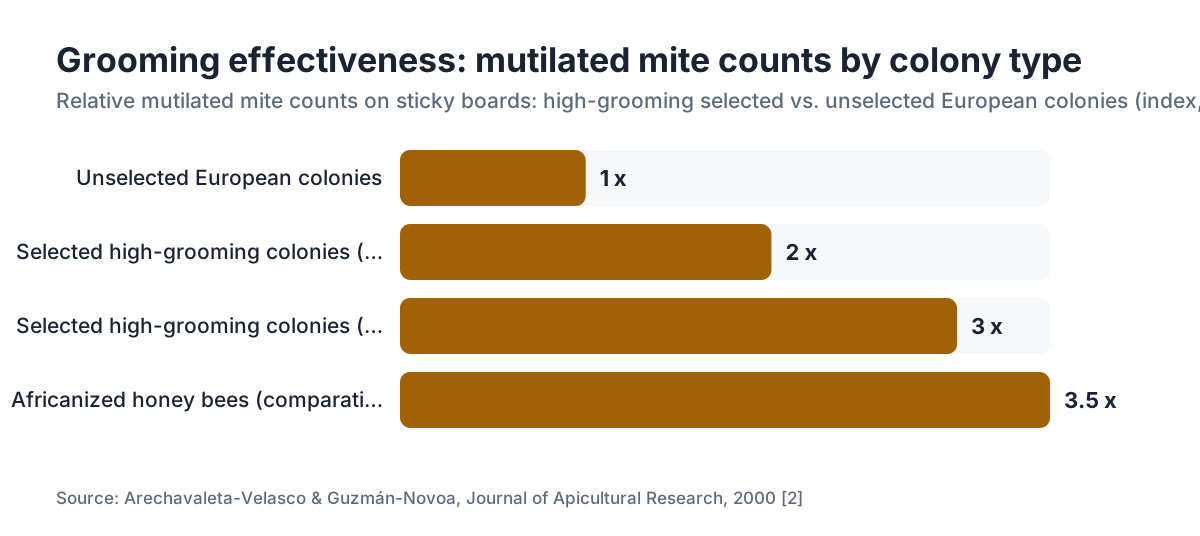
Arechavaleta-Velasco and Guzman-Novoa (2000) found colonies selected for high grooming removed mites at roughly two to three times the rate of unselected colonies, with mutilated mite counts on sticky boards making the gap obvious [2]. Strong groomers held phoretic mite loads measurably lower over the same stretch of time.
Still, even hard-grooming colonies in standard temperate conditions rarely hold mites under the 2 percent infestation threshold (2 mites per 100 adult bees) that most extension guidelines use to trigger treatment [3]. The reason is arithmetic. Varroa breeds inside capped brood, out of grooming's reach. A mite that enters a cell and produces 1.3 to 1.5 daughters per cycle can outrun what even a busy grooming colony scrapes off adult bees.
Grooming shows its real muscle in combination with other traits, especially Varroa Sensitive Hygiene (VSH), the tendency of bees to detect and uncap cells holding reproducing mites. Grooming clears phoretic mites, VSH interrupts reproduction in the brood, and together they can build colonies that genuinely suppress varroa without chemicals. USDA's Baton Rouge Bee Lab has documented VSH colonies keeping mite loads low across multiple seasons [4].
For a hobbyist buying queens from a commercial supplier, the realistic read is this. Your bees do some grooming, it slows the mite curve a little, and you still need to monitor and probably treat. The colonies people call "treatment-free" that survive on behavior alone are almost always running VSH plus grooming plus hygienic behavior at once, selected over many generations.
What is the difference between grooming behavior and VSH (Varroa Sensitive Hygiene)?
Grooming and VSH are not the same trait, and beekeepers mix them up constantly. Grooming targets mites on adult bees, the phoretic phase. VSH targets reproducing mites inside capped brood. Different life stages, different mechanics.
General hygienic behavior, first described by Walter Rothenbuhler in the 1960s and later quantified by Marla Spivak at the University of Minnesota, is bees uncapping and hauling out diseased or dead larvae. It overlaps with VSH but covers more ground [5].
The distinction matters because the two traits hit varroa at different moments. Grooming can remove a phoretic mite before she enters a cell. VSH can wreck the reproduction of a mite that already slipped past grooming. A colony needs both to knock the mite population down through behavior alone.
USDA's VSH work pinned down a specific genetic component: high-VSH bees detect and uncap cells where mites are reproducing even when the brood looks healthy. The trait is partly heritable and has been bred into commercial VSH queens and the "Pol-line" bees from the Baton Rouge lab [4]. Grooming intensity is heritable too, but its genetics are messier and less fully mapped.
Breeders chasing varroa resistance try to stack all three traits. The Honey Bee Health Coalition says no single behavioral trait gives complete protection, and colonies combining high hygienic behavior, VSH, and grooming show substantially better mite outcomes [6].
How do you test whether your colony has good grooming behavior?
Two methods work without a lab. The first is a sticky board count with a mutilation check. Slide a sticky board under a screened bottom board for 24 to 72 hours. Then do more than count the total drop. Count the mites missing legs, showing mandible damage, or otherwise crushed and deformed. A grooming colony leaves a signature you can see: chewed mites, not intact ones. Arechavaleta-Velasco and Guzman-Novoa found high-grooming colonies produced a statistically higher share of mutilated mites than low-grooming ones [2].
The second is the freeze-killed brood test. It was built to measure hygienic behavior rather than grooming specifically, but it tells you about a colony's overall behavioral responsiveness. You freeze a patch of capped brood with liquid nitrogen, put it back, and time how fast the bees clear it. A colony that removes 95 percent of freeze-killed brood within 48 hours scores as highly hygienic [5]. These colonies tend to groom better too, though the link is loose.
Want to go further? Marla Spivak's lab at the University of Minnesota has published protocols for both tests, and some state apiarists run trainings on them. The University of Minnesota Bee Lab site describes the freeze test in plain language [5].
Here is the caveat nobody likes. Neither test tells you the mite trajectory. You still need a regular alcohol wash or sugar roll to know your actual infestation rate. Behavior tests tell you what the bees are capable of. Mite washes tell you what is actually happening. You need both.
Do africanized honey bees groom better than European bees?
Yes, by a real margin. It is one of the documented reasons Africanized honey bees across South and Central America live alongside varroa at lower infestation levels than European-derived colonies in the same regions, with no chemical treatment.
Study after study finds Africanized bees groom more often and mutilate more mites than European bees kept under identical conditions. Moretto et al. (1991) and the work that followed showed Africanized colonies in Brazil held phoretic mite loads much lower through behavior alone [7]. The grooming response looks faster and more frequent, and a bigger share of dislodged mites end up dead or injured rather than just knocked loose.
The catch is obvious. Africanized bees are intensely defensive, and managing them safely takes experience and specialized gear. They are not a workable answer for most hobbyists in the continental United States, where their range is limited to the Southwest and populations are regulated. There is more on their biology and range at africanized honey bee.
The useful part is that the grooming trait has been partly bred into gentler stock. Some of the improved grooming in VSH lines and selected European bees traces straight back to research comparing Africanized and European colonies. You are not going to keep a yard of Africanized bees for mite control, but the research on them shaped what breeders now select for in commercial queens.
Can you breed or buy bees with stronger grooming behavior?
You can do both. The options differ in cost, reliability, and how much labor you sign up for.
On the buying side, queens sold as VSH, Pol-line, varroa-resistant, or Hygenic (spellings vary by supplier) differ wildly in how rigorously the trait was actually selected and tested. The best come from programs that run the freeze-killed brood test and publish removal rates. The USDA Baton Rouge lab built the Pol-line to stack VSH with decent honey production and gentleness, and commercial suppliers have licensed those genetics [4]. The Honey Bee Health Coalition's varroa guide recommends buying from queen producers who score their colonies with validated hygienic tests before selling [6].
Tested queens cost more. As of 2024, standard untested mated queens from most suppliers run $30 to $50. Tested hygienic or VSH queens often run $50 to $80 or higher, and supply is tight. Whether the premium pays off depends on your mite management costs and how many colony losses you can stomach.
On the breeding side, hobbyists can select for grooming using the mutilated mite count above, raising queens from colonies that show consistently high mutilation combined with low infestation. That is real selection pressure. The problem is open mating: your queens breed with drones from nearby colonies, which dilutes your work. Holding a trait across generations takes a reasonably isolated mating yard or a coordinated local breeding program.
For most hobbyists in a typical suburban or rural setting, buying tested queens and monitoring carefully beats breeding your own.
Does grooming behavior change with the season or colony size?
Yes, and it changes how you should read your mite monitoring. Grooming runs highest when adult bee populations are large relative to brood area, because more adults are in contact and more bees are around to allogroom. In peak summer, with 60,000 to 80,000 adult bees, allogrooming events are simply more common than in a thin spring buildup or a shrinking fall colony.
Winter broodlessness (or near-broodlessness) is the one stretch when every mite is phoretic on an adult bee. In theory that makes grooming more useful, since no brood cells exist for mites to hide in. Some researchers have proposed that good-grooming colonies suppress mites better through a broodless winter, though the data are shakier than you would like. Cold also cuts bee activity, which probably cuts grooming.
Stress from other sources drags behavioral defenses down. Nosema, American Foulbrood, a nutritional gap: any of these appears to reduce grooming and other behaviors. A colony fighting on several fronts loses to varroa on two counts, the direct mite load and the weakened ability to defend itself. This is one reason the Honey Bee Health Coalition treats varroa as part of broader colony health rather than a standalone problem [6].
The practical takeaway. Do not assume a low mite count in a big summer colony means it will coast. Mite populations can double every four to six weeks under good conditions [3]. Grooming may bend that curve. It rarely flattens it.
What does the research actually show about grooming reducing mite populations over time?
Grooming measurably cuts phoretic mite loads in selected colonies. But controlled trials showing behavior-only colonies staying under treatment thresholds across multiple seasons are mostly limited to colonies carrying stacked traits (VSH plus grooming plus hygienic behavior) under specific conditions. That is the honest summary of the literature.
A 1999 review by Boecking and Spivak weighed the evidence on multiple behavioral mechanisms and concluded that "removal of Varroa mites from adult bees by grooming does significantly reduce the number of phoretic mites but is not sufficient alone to prevent population growth" [8]. That still reads as a fair take. Most work since has focused on combining behavioral traits rather than isolating grooming.
The strongest long-term evidence for behavior-based control comes from feral and isolated populations. The Gotland study in Sweden followed a population left untreated on an island starting in 1999. Colonies filtered by natural mortality over years did develop lower mite reproductive rates and stronger behavioral defenses [9]. But those populations crashed hard before a resistant remnant survived. That is not a management plan. It is natural selection paid for with most of your colonies.
So here is what it means for you. Select for grooming and hygienic traits where you can, support colony health broadly, and treat behavioral traits as a layer in your mite management, not a swap for monitoring and treatment. The VarroaVault protocol library has mite count trackers and treatment timing guides to help you build that stack.
Want the primary evidence yourself? The USDA Agricultural Research Service apiculture page and the Honey Bee Health Coalition's varroa guide (free PDF) are the best places to start [4][6].
Does screened bottom board design affect how well grooming works?
A screened bottom board does not make bees groom harder. It does stop groomed mites from climbing back onto bees. On a solid board, a mite knocked off an adult can crawl the hive floor, find another bee, and reattach. On a screened board, dislodged mites drop through the mesh and cannot easily return. Each grooming event becomes more likely to end in permanent removal.
The evidence that screened boards lower overall mite loads is modest. Sammataro et al. reviewed bottom board studies and found phoretic mite reductions of roughly 10 to 15 percent versus solid boards, real but not dramatic [1]. The bigger payoff from a screened board is probably diagnostic (sticky boards let you count natural drop) rather than therapeutic.
If you want to squeeze more out of grooming, keeping a clean screened bottom board is a low-effort win. Mites that fall through stay out. The cost is small. You can find screened bottom boards at most beekeeping supply companies.
One note for cold climates. Screened boards can push winter clusters to burn more energy holding temperature. Plenty of northern beekeepers close or partly block the screen in winter. The mite-control loss over winter is minimal anyway, since bees are less active and grooming drops off.
How does grooming behavior fit into a complete varroa management plan?
Grooming is one layer, not the plan. Treat it as a standalone strategy and you bury colonies.
Here is a framework that works. Monitor first. Alcohol wash or sugar roll every four to six weeks through the active season, or at minimum before and after your mite buildup windows (late summer is usually the highest-risk period in temperate North America). A threshold of 2 to 3 mites per 100 bees is the widely cited treatment trigger, though some state extension programs set slightly different numbers [3].
Select for behavioral traits where you can. If you are requeening anyway, spend the extra money on a tested VSH or hygienic queen from a reputable breeder. That one decision improves more than grooming; it lifts the whole behavioral defense suite.
Use approved treatments when monitoring says you need them. Oxalic acid (EPA-approved in the United States for both dribble and vaporization), formic acid, and thymol-based products all carry strong efficacy data and approved labels [10]. The Honey Bee Health Coalition's varroa guide has treatment timing tables, efficacy comparisons, and temperature windows for each [6]. Grooming genetics do not retire these tools during high-mite periods. They cut how often and how hard you reach for them.
Time your work around the brood cycle. Broodless or low-brood periods, natural or induced, sharply raise the effectiveness of treatments like oxalic acid, because most mites are phoretic instead of sealed in cells. A brood break also hands grooming bees a stretch where they are working the entire mite population rather than a fraction of it.
To build this kind of plan without relying on memory, VarroaVault's free protocol tools let you log mite counts, track treatment timing, and flag when you are closing on a threshold. The point is never to replace your judgment. It is to keep you honest when the season gets loud.
More on the mite itself, its life cycle, and why timing matters is at varroa mite.
Frequently asked questions
Can bees remove varroa mites on their own without treatment?
Most managed colonies cannot. Even strong groomers rarely hold mite populations below treatment thresholds through behavior alone, because varroa reproduces inside capped brood where grooming cannot reach. Colonies combining VSH, grooming, and hygienic behavior come closest, but they still need careful monitoring and occasional treatment. Relying on grooming alone leads to colony loss in most temperate beekeeping situations.
What percentage of mites do bees remove through grooming?
Studies on selected colonies show grooming removes or injures a meaningful fraction of phoretic mites, but exact percentages swing widely by genetics and season. Arechavaleta-Velasco and Guzman-Novoa (2000) found high-grooming colonies had two to three times more mutilated mites on sticky boards than unselected ones. No peer-reviewed study has shown grooming alone eliminating more than a minority of total mite load in a brood-rearing colony.
How do I know if my bees are grooming varroa mites?
Check your sticky board or screened bottom board for mutilated mites. A mite with missing legs, bite damage, or a deformed body was almost certainly groomed off an adult. A high ratio of damaged to intact mites is a good sign of active grooming. Pair this with regular alcohol washes to see whether that grooming is actually keeping your infestation rate low.
Are there specific bee breeds or races that groom more than others?
Yes. Africanized honey bees show much higher grooming rates and mite mutilation than European-derived bees, one reason they coexist with varroa more easily in South America. Among European stock, VSH-selected bees, Pol-line bees from the USDA program, and colonies tested for hygienic behavior groom better than average. Carniolans and some Russian strains have a reputation for above-average behavioral defenses too, though colony-to-colony variation is large.
Does a screened bottom board help bees control varroa through grooming?
A screened bottom board stops mites knocked off during grooming from climbing back onto bees, so each grooming event is more likely to end in permanent removal. Studies suggest screened boards cut phoretic mite counts by roughly 10 to 15 percent versus solid boards. That is real but modest. The bigger value is enabling sticky board monitoring to estimate your natural mite drop.
What is the difference between hygienic behavior and grooming in bees?
Grooming targets mites on adult bees (the phoretic phase). Hygienic behavior is bees detecting and removing diseased or dead larvae from capped cells. VSH (Varroa Sensitive Hygiene) is a subset of hygienic behavior aimed at cells with reproducing mites. The three traits hit varroa at different life stages and work best together. A colony strong in all three suppresses mites measurably better than one with a single trait.
How does brood break affect grooming effectiveness against varroa?
A brood break pushes every mite into the phoretic phase on adult bees, where grooming can reach them. During normal brood-rearing, most mites are sealed inside capped cells. A break of 24 days (the capped brood period) plus a few days exposes nearly all mites to grooming and to treatments like oxalic acid. Pairing a brood break with good grooming genetics and oxalic acid is one of the strongest short-term mite suppression moves available.
Is treatment-free beekeeping possible if you select for grooming?
For a small share of carefully selected, intensively monitored colonies in specific settings, treatment-free management is documented. For most hobbyists, treatment-free beekeeping that leans on behavioral traits alone produces colony losses. The Honey Bee Health Coalition recommends monitoring and treating when thresholds are exceeded, regardless of stock. Selecting for grooming and VSH cuts your treatment frequency and dose, but dropping monitoring is a path to high losses.
What is the Pol-line bee and why does it groom varroa better?
Pol-line bees came out of the USDA Baton Rouge Bee Lab through intensive selection for VSH, the ability to detect and remove reproducing mites from capped brood. They also groom phoretic mites above average. Many generations of selection under controlled conditions produced colonies that hold lower mite loads than unselected stock. Commercial producers have licensed Pol-line genetics, so hobbyists can buy them, though availability and quality vary by supplier.
Can I test my own bees for grooming behavior at home?
Yes. Slide a sticky board under a screened bottom board for 48 to 72 hours, then count the total drop and specifically the damaged mites (missing legs, bite marks). A high ratio of damaged to intact mites points to active grooming. The freeze-killed brood test measures hygienic behavior, a related trait: freeze a patch of sealed brood with liquid nitrogen and measure removal within 48 hours. Above 95 percent removal means a highly hygienic colony.
How often should I monitor mite levels even if my bees groom well?
Monitor every four to six weeks during the active brood season, whatever the genetics. Mite populations can double every four to six weeks in favorable conditions, and grooming genetics do not guarantee you stay below thresholds. At minimum, monitor in late spring before buildup, in late summer when mite pressure peaks, and before winter cluster formation. The 2-to-3-mites-per-100-bees threshold most extension programs use is your action point, not your signal to stop watching.
Does pollen availability affect grooming behavior?
Nutrition shapes bee behavior across the board, and colonies with adequate protein from pollen tend to have healthier, more active adults. Undernourished colonies show weaker immune function and dulled behavioral responses. Direct studies isolating pollen availability and grooming rate specifically are thin, but supporting nutrition through diverse forage or pollen supplements is generally recommended as part of the overall colony health that carries behavioral defenses against varroa.
Are there any downsides to selecting only for grooming behavior?
The main risk is that single-trait selection can accidentally select against other useful traits like honey production, gentleness, or overwintering ability. Good breeders select for a trait package, not one behavior. Grooming chosen in isolation from VSH and hygienic behavior also gives incomplete protection, since it only touches phoretic mites. Work with breeders who test for multiple traits at once and publish their selection criteria.
Sources
- Sammataro D, Gerson U, Needham G. "Parasitic mites of honey bees: life history, implications, and impact." Annual Review of Entomology, 2000.: Screened bottom boards reduce phoretic mite counts by roughly 10-15% compared to solid boards; phoretic phase mites ride adult bees feeding on fat body tissue
- Arechavaleta-Velasco ME, Guzmán-Novoa E. "Relative effect of four characteristics of honey bee colonies on their resistance to Varroa." Journal of Apicultural Research, 2000.: High-grooming colonies produced two to three times more mutilated mites on sticky boards than unselected colonies
- University of Minnesota Bee Lab, Hygienic behavior testing protocol (Spivak lab): Colonies that clear 95 percent of freeze-killed brood within 48 hours score as highly hygienic; hygienic behavior trait described by Spivak and Downey
- Honey Bee Health Coalition, Tools for Varroa Management guide: No single behavioral trait provides complete varroa protection; colonies combining hygienic behavior, VSH, and grooming show substantially better mite management outcomes; coalition recommends monitoring and treating when thresholds are exceeded
- Moretto G, Gonçalves LS, De Jong D. "Africanized and European honey bee worker populations as evaluated by removal of Varroa jacobsoni." Journal of Apicultural Research, 1991.: Africanized honey bees in Brazil kept phoretic mite loads substantially lower through behavioral means including higher grooming frequency and mite mutilation rates
- Boecking O, Spivak M. "Behavioral defenses of honey bees against Varroa jacobsoni Oud." Apidologie, 1999.: "Removal of Varroa mites from adult bees by grooming does significantly reduce the number of phoretic mites but is not sufficient alone to prevent population growth"
- Fries I, Imdorf A, Rosenkranz P. "Survival of mite infested (Varroa destructor) honey bee (Apis mellifera) colonies in a Nordic climate." Apidologie, 2006.: Isolated island population (Gotland study) left without treatment developed lower mite reproductive rates and stronger behavioral defenses after severe initial colony losses through natural selection
- US EPA, Pollinator Protection and pesticide registration for varroa treatments (oxalic acid, formic acid): Oxalic acid approved by EPA for use in the United States including dribble method and vaporization for varroa control
- USDA Agricultural Research Service, Bee Research Laboratory (varroa infestation thresholds and population growth): 2 percent infestation (2 mites per 100 adult bees) commonly cited treatment threshold; mite populations can double every four to six weeks under favorable conditions; varroa produce 1.3 to 1.5 daughters per reproductive cycle
- USDA Agricultural Research Service, Honey Bee Breeding, Genetics and Physiology Research (Baton Rouge), VSH and Pol-line: USDA Baton Rouge lab developed VSH and Pol-line bees; documented colonies maintaining low mite loads across multiple seasons
Last updated 2026-07-09