Selecting for grooming behavior in backyard bees
TL;DR
- Grooming behavior (also called allogrooming or mite-biting) is a heritable trait where worker bees physically remove and damage varroa mites.
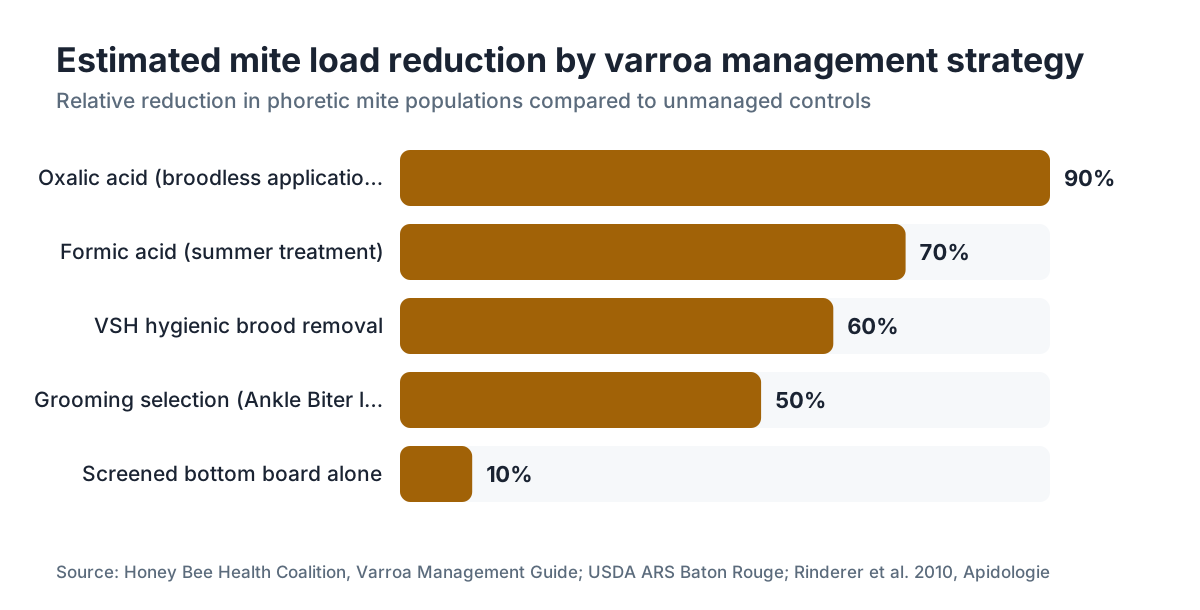
- Colonies scoring high for grooming carry 30 to 50% lower mite loads than unselected stock.
- Backyard beekeepers select for it with a mite wash, a sticky-board count, and a mutilated-mite assay over two to three seasons.
What is grooming behavior in honey bees and why does it matter for varroa?
Grooming behavior means worker bees using their mandibles and forelegs to pull varroa mites off nestmates, bite them, and sometimes eject them from the hive. It targets adult mites riding on adult bees, the phoretic stage. That's different from hygienic behavior, which targets mites inside sealed brood. The distinction matters because phoretic mites are the ones that ride between colonies and reinfest brood.
A colony that grooms well knocks down phoretic mite loads. Research from Louisiana State University, confirmed by later work at the USDA Baton Rouge lab, found that selected grooming lines carried 30 to 50% fewer phoretic mites than unselected control colonies under similar reinfestation pressure [1]. That's not a cure. It does not end your need to treat. In a balanced varroa program it works like a slow bleed on the mite population, tilting the numbers your way.
The genetic basis is partly understood. Grooming has a heritability estimate in the range of 0.3 to 0.5 in some studies, which means your selection pressure can move the trait over just a few generations [2]. Honey bee queens mate with 10 to 20 drones, and you can't control open mating in most backyard yards, so progress is slower than in a closed breeding program. Real, though. Worth doing.
How is grooming behavior different from hygienic behavior?
The two get confused constantly. Hygienic behavior is well-defined: workers detect, uncap, and remove diseased or mite-infested sealed brood before the mites finish reproducing [3]. It's tested with the freeze-killed brood assay or the liquid nitrogen pin test. Grooming targets mites on adult bees, specifically the phoretic phase, and it's tested by looking for leg damage on fallen mites.
A colony can be strongly hygienic and a poor groomer, or the reverse. Some people use "Varroa Sensitive Hygiene" (VSH) as an umbrella term that lumps both together, which muddies the conversation. The USDA Honey Bee Breeding, Genetics, and Physiology Lab defines VSH strictly as the ability to detect and remove mite-infested capped brood, separate from general grooming [4]. If you're shopping for queens sold as VSH, ask the breeder point blank whether they test for allogrooming. Many don't.
Both traits are worth chasing. They need different tests. Grooming is scored by counting damaged mites on a sticky board, the mutilated-mite assay. Hygienic behavior is scored by how fast bees clean out a patch of freeze-killed brood. Colonies strong in both are the ones you want.
Is grooming behavior actually heritable, and how fast can selection work?
Yes, it's heritable, though estimates swing by population and environment. The most-cited heritability figures for grooming in Apis mellifera run from about 0.28 to 0.54 depending on the study and the stock used [2]. In plain terms: if you breed only from your best-grooming colonies and stop breeding from your worst, roughly 30 to 50% of the variation you see comes from genetics rather than environment. That's enough to make headway.
The catch is polyandry. A queen mates with somewhere between 10 and 25 drones on her flights, so the workers in any colony are a genetic mix of many patrilines [5]. That diversity helps the colony but complicates your breeding math. When you graft from a good queen, her daughters carry half her genetics, then mate with whatever drones are flying in your area. In a suburb full of other beekeepers, that's a lot of genetic noise from unselected drones.
Set your expectations. In a small apiary with open mating, you can expect measurable improvement in grooming scores over 3 to 5 generations of steady selection. That's 3 to 5 years if you requeen annually. Beekeepers with geographic isolation or drone flooding get there faster. Nobody should expect VSH-level mite suppression from backyard selection alone in year one.
What does the mutilated-mite assay actually involve?
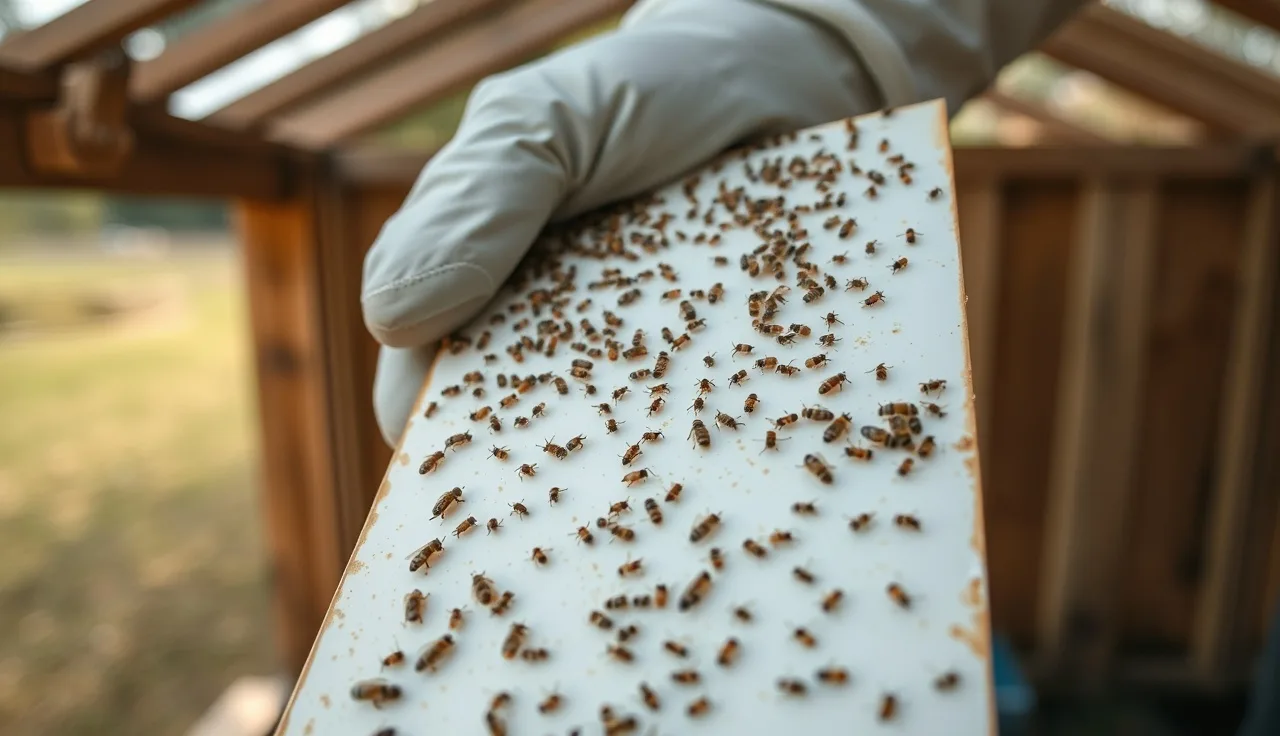
The mutilated-mite assay is the practical heart of grooming evaluation. The logic is simple. If bees are biting mites, the mites on the sticky board show damage: missing legs, punctured bodies, deformed cuticles. You compare the share of damaged mites to total mites on the board and call that your grooming index.
The protocol most university extension programs use runs like this [6]:
- Slide a clean sticky board (petroleum jelly or Tangle-Trap on cardboard) under a screened bottom board for exactly 24 hours.
- Pull the board and count every mite under magnification (a 10x hand lens works, a dissecting microscope is better).
- For each mite, record whether it has at least one missing or clearly damaged leg, or visible body damage.
- Calculate the grooming index: mutilated mites divided by total mites, as a percentage.
High-grooming colonies typically score 30 to 45% or higher. Scores below 15% fit low-grooming stock. Some researchers use a cutoff of 25% mutilated mites to split high from low groomers, though that line isn't universal [6].
Run at least three separate 24-hour collections before you rank a colony. Day-to-day variation is real. Temperature, season, and colony population all change how many mites fall and how many show damage. Spring and fall, when phoretic loads are shifting, give the clearest signal.
How do you rank colonies and decide which ones to breed from?
Ranking starts with your mite wash. A standard alcohol wash or CO2 wash on 300 adult bees gives a reliable mite count per 100 bees [7]. Colonies with lower loads in similar forage and reinfestation conditions are already self-selecting for some mix of varroa-suppressing traits: grooming, hygienic behavior, maybe reduced mite reproduction.
Then layer in the mutilated-mite assay. A colony with a low mite wash AND a high mutilated-mite percentage is your breeding candidate. A colony with a low wash but a low mutilated-mite score might be suppressing mites some other way, such as hygienic brood removal, which is useful but tells you something different.
Here's a ranking matrix you can copy into a field notebook:
| Colony | Mite wash (mites/100 bees) | Mutilated mite % | Breed from? |
|--------|--------------------------|------------------|-------------|
| A | 1.2 | 38% | Yes |
| B | 3.4 | 41% | Maybe (grooms but load is high) |
| C | 0.9 | 12% | Investigate hygiene instead |
| D | 4.1 | 11% | No |
Colony A is your clearest target. Colony B grooms hard but still carries too many mites, maybe from heavy reinfestation, so check the context before you write it off. Colony C might be a strong hygienic colony worth freezing brood from. Colony D is out.
Some beekeepers fold in winter survival and spring buildup as soft criteria. A colony that grooms, overwinters without treatment, and explodes in spring is a strong candidate no matter what one day's numbers say.
What practical methods can backyard beekeepers use to select and propagate grooming traits?
You don't need a lab. The simplest approach is rearing queens from your best-scoring colonies and deliberately requeening your worst. That second part is what most hobbyists skip. Selection only works if you cut the bottom, more than clone the top.
Grafting is the most reliable way to propagate queen genetics. If you're not comfortable grafting yet, split your best colony into a walk-away split and let the bees raise emergency queens from your selected stock. Those queens won't match grafted queens for consistency, but you capture most of the maternal genetics. Walk-away splits also force the new queen to mate locally, which is exactly where the uncontrolled-drone problem lives.
Drone flooding is the strongest technique available to backyard beekeepers who can't do instrumental insemination. You raise large numbers of drones from your best colonies in the weeks before queen cells mature, saturating the local drone pool with your selected genetics. Drones from one productive colony can outnumber drones from neighbors inside roughly a 1-mile radius if you time it right. It isn't perfect and it fails in dense urban settings, but in rural and suburban yards it raises the odds that your virgins mate with related, selected drones [5].
Sideliners and club members get more from coordinating selection with two or three nearby beekeepers, because it compounds the genetic pressure. Tools for tracking colony data across seasons, like the free protocol tools at VarroaVault, make it easier to log mite washes, mutilated-mite scores, and breeding decisions year over year without losing the thread.
Buying queens from breeders who publish their VSH or grooming test data is a fair shortcut, especially in the first years while you build your own selected stock. Ask for the actual assay data, not the marketing language. Reputable breeders hand it over.
What mite load thresholds should you track alongside grooming scores?
The Honey Bee Health Coalition's Varroa management guide sets action thresholds of 2% infestation (2 mites per 100 bees) during the brood-rearing season and 1% or lower heading into winter [8]. For colonies you plan to breed from, these aren't optional benchmarks. They're the floor. You should not graft from a colony sitting at 4% mites just because its mutilated-mite score looks decent.
Here's why. A high-grooming colony running above threshold still needs treatment. Grooming slows mite population growth; it doesn't stop it. The Honey Bee Health Coalition states directly that "even colonies with high levels of VSH or grooming behavior require monitoring and may require treatment depending on local reinfestation rates" [8]. Treat when you need to. Then evaluate grooming on the treated colony after loads stabilize, because the assay reads cleaner when total mite counts are low and each damaged mite is easier to spot.
For selection, the most useful colonies to evaluate sit in the 1 to 3% mite range. That's enough varroa pressure that grooming is actively expressed and measurable, but not so much that the signal drowns in noise.
How does Africanized bee genetics relate to grooming behavior?
Africanized honey bees get cited often as carriers of varroa-resistant traits, including more active grooming, compared to European subspecies. That's partly true, and worth understanding carefully before you chase it for breeding.
African-derived bees (Apis mellifera scutellata and its hybrids, what we call Africanized bees in the Americas) do show higher rates of both grooming and hygienic behavior in some studies. They also have shorter brood cycles, which disrupts varroa reproduction mechanically. Several researchers credit their resistance more to that brood-cycle effect than to grooming specifically.
The problem for U.S. backyard beekeepers is defensiveness. Africanized bees sting in far higher numbers, chase threats much farther, and demand very different management from European bees. In states where they're established (Texas, Arizona, California, Florida, and others), hybridization with local feral populations is already underway, and selecting toward that genetics without accepting the defensive behavior isn't something you can reliably do in a backyard. You can read more about the range and biology of Africanized honey bees separately.
The better path for most hobbyists is selecting within European stock already bred for grooming: the Purdue Ankle Biter line, Varroa Sensitive Hygiene stock from USDA-selected lines, or locally adapted survivor stock with documented low mite loads.
What is the Purdue Ankle Biter line and how was it developed?
The Purdue Ankle Biter bee is the best-known example of deliberate grooming selection in North America. Greg Hunt and colleagues at Purdue University started it in the early 2000s, selecting specifically for the mutilated-mite trait. The name comes from the bees' habit of biting at mite legs, which is the damage you see most on sticky boards.
The methodology was exactly what any beekeeper can do at small scale: score colonies with the mutilated-mite assay, graft from the high scorers, requeen the low scorers. Over several generations of steady selection, the Purdue team built a line with much higher grooming rates than the commercial stock they started with [9].
Published research from Purdue found that Ankle Biter colonies held mite populations at about half the level of control colonies under identical conditions, mostly through reduced mite survival on adult bees rather than hygienic brood removal [9]. That's a meaningful effect, not an enormous one. Those colonies still needed monitoring and occasional treatment in high-pressure years.
Ankle Biter genetics are now sold by several U.S. queen breeders. Generations of open mating in commercial apiaries have diluted the line, so quality varies a lot by source. Same rule as any queen purchase: ask for documented assay data.
Does selecting for grooming reduce the need for varroa treatments?
Honestly, no. Not for most backyard beekeepers in most years, at least not early in a breeding program. This is the expectation problem that makes people quit on genetic selection.
Here's what the research shows. In a 2010 Purdue study, mite populations in Ankle Biter colonies ran roughly 50% lower than controls by late summer [9]. Real difference. But those selected colonies were still piling up mites, just slower. In a high-reinfestation environment (which is what you have anytime you're within a couple miles of other colonies), a colony that accumulates mites at half speed still crosses the 2% action threshold, just later in the season.
The practical payoff is that you may cut your treatment frequency from two per year to one, or shift timing so you treat late in fall and skip a midsummer round. That's genuinely worth something. Better for the bees, cheaper, and it eases resistance pressure on the mite population.
The Honey Bee Health Coalition's guidance treats genetic resistance as a long-term management layer, not a replacement for monitoring and treatment decisions [8]. Use the mite wash, track your numbers, treat when you need to. The genetic work pays out over years, not seasons.
For tracking treatment timing, thresholds, and colony performance across years, a structured protocol earns its keep. The free tools at VarroaVault help you build that record without starting from scratch.
What are realistic limitations of backyard grooming selection?
Open mating is the big one. You can't control which drones your virgins mate with unless you're doing instrumental insemination (a specialized skill needing equipment that costs hundreds of dollars and a lot of practice) or you have a very isolated apiary with no other colonies within a few miles. So queen daughters from your best colony mate with mixed-genetics drones, and the resulting colony is a blend. Some of that blend keeps the mother's grooming traits. Some doesn't.
Generation time is another hard limit. Honey bee queen production means you select once a year in most hobbyist yards. At that pace, real genetic change takes years. Professional line selection with many colonies and instrumental insemination moves faster.
Sample size bites too. If you run five colonies and two are good groomers, you're working with thin data. Colony-to-colony variation in the mutilated-mite assay can hit 20-plus percentage points on a single day, driven by temperature, forage, and mite pressure, not genetics. Three or more assay dates per colony across the season give you far steadier rankings.
Reinfestation is the last one. A study from Penn State found that a large share of varroa mites in monitored colonies arrived from outside via drifting and robbing [10]. A high-grooming colony in a dense beekeeping area is fighting a headwind. The genetics help. They can't beat unlimited external mite immigration.
How do you document and track your selection progress season to season?
Consistency beats everything. The beekeeper who records the same three numbers at the same times each year (mite wash percentage, mutilated-mite index from the sticky board, and winter survival yes or no) has far more actionable data after four years than the one who ran elaborate tests once and stopped.
A paper field notebook works. A spreadsheet works better because you can sort rankings. For each colony, track: colony ID, queen lineage (if known), date of each mite wash, wash result, sticky board collection dates, total mites on the board, mutilated mites on the board, mutilated-mite percentage, treatment dates and products, and winter survival.
After two seasons of data, you start seeing which queen lines reliably throw lower mite loads and higher grooming scores. That's when selection turns into something informative instead of guesswork.
Photograph your sticky boards before counting. Damaged mites read easier from a photo on a backlit screen or under a loupe than in the field, and the photo gives you a record to review later or share with an extension apiarist for a second opinion. Most state extension services offer free or low-cost help on assay interpretation [11].
Keep records on dead colonies too. A colony that died of varroa in November is data. It shows you the low end of your genetic pool and reinforces the requeen-the-worst discipline that makes selection work.
Frequently asked questions
Can I test grooming behavior without a microscope?
Yes. A 10x hand lens is enough to spot mites with missing legs or clear body damage on a sticky board. A dissecting microscope gives better accuracy but isn't required for hobbyist-scale selection. What you need is good lighting and the patience to examine each mite one at a time. Count at least 50 mites per sample before you calculate a percentage.
How long does a sticky board need to be under the hive before I collect it?
Most grooming assay protocols use a 24-hour collection window. Shorter periods cut total counts and make the sample harder to read. Longer periods invite weathering and ants that disturb where mites sit. Sticking to 24 hours lets you compare results across colonies and seasons. Run at least three separate 24-hour collections before you rank a colony.
What percentage of mutilated mites indicates a good grooming colony?
Scores above 25 to 30% generally point to elevated grooming, and scores above 40% are high-grooming range. Scores below 15% suggest poor grooming. These thresholds aren't universal across research protocols, so they're most useful for ranking colonies within your own apiary rather than comparing against benchmarks from other operations.
Do all worker bees in a colony groom, or is it a specialist behavior?
All workers can groom, but individual tendency varies a lot even within one colony. Because a colony holds multiple patrilines (daughters of different drones), some subfamilies in the same hive groom harder than others. Selecting for a high-grooming queen raises the proportion of workers from high-grooming patrilines, which shifts the colony average upward.
Is Varroa Sensitive Hygiene (VSH) the same as grooming behavior?
No. The USDA defines VSH specifically as workers detecting and removing varroa-infested capped brood. Grooming targets adult phoretic mites. A colony can be strong in one and weak in the other. The mutilated-mite assay tests grooming. The freeze-killed brood assay tests hygienic behavior. Both are worth selecting for, but they need different tests.
How many generations of selection does it take to see a real difference?
In open-mating backyard settings, expect 3 to 5 seasons of steady selection before a population-level shift shows up in grooming scores. In closed breeding programs with instrumental insemination, researchers have seen strong shifts in 3 to 5 generations under controlled conditions. Heritability of 0.3 to 0.5 means the trait responds to selection, but open mating slows the pace considerably.
Can I just buy VSH or grooming-selected queens instead of doing my own selection?
Yes, and it's a reasonable start. Buying queens from breeders who publish real assay scores gives you a faster genetic boost than years of backyard selection. The catch is that after one generation of open mating, your daughters are half the purchased queen's genetics and half unknown local drones. Ongoing selection from the best of those daughters is still needed to hold the gains.
Do I need to stop treating for varroa to select for grooming behavior?
No, and this trips people up. Stopping treatment to see which colonies survive is natural selection, not genetic selection. It kills bees. Keep treating colonies at threshold while you run a breeding program. Evaluate grooming through the mutilated-mite assay and mite wash data, breed from the best, requeen the worst. Treat every colony that needs it, regardless of its genetics.
Does the season or temperature affect mutilated-mite assay accuracy?
Yes, meaningfully. Grooming activity runs higher when colonies are populous and brood production is strong, typically late spring through early fall. Cold temperatures cut bee activity and can lower apparent grooming scores. Avoid assaying right after treatments, during dearth, or in colonies with very low populations. Spring and fall, when phoretic loads are naturally shifting, give the most stable readings.
What's the difference between grooming behavior and bees just running mites off accidentally?
The mutilated-mite assay tells them apart. Mites that fall off through normal bee movement land on the board intact with all eight legs. Mites that were bitten show leg loss, puncture damage, or cuticle deformation. Counting the share of visibly damaged mites measures active biting, not passive dislodgment. That's what makes the assay informative instead of just a mite count.
Can I use drone flooding to improve grooming genetics if I only have a few hives?
Drone flooding works better at three or more hives than at one or two, because you need enough drone production to shift the local drone pool. With two hives and one high-groomer, suppress drone production in the low-groomer by removing drone comb and prioritize drone rearing in the selected colony. Coordinating with nearby beekeepers multiplies the effect.
How do I handle a high-grooming colony that has defensive behavior?
Defensiveness and grooming are genetically independent, so a hot colony isn't automatically a better groomer or worse one. If a colony is both a high groomer and overly defensive, you can still use it as a breeding source while working to reduce defensiveness next generation by grafting only from the calmest, most productive frames. Requeen the colony itself with a gentler queen if the defensiveness is unmanageable.
Where can I find extension resources on honey bee grooming selection protocols?
The Honey Bee Health Coalition's Varroa management guide covers genetic traits and monitoring. University extension programs at Purdue, Penn State, and UC Davis publish free grooming and hygienic behavior testing protocols. Your state apiarist's office (often inside the department of agriculture) can point you to local resources and sometimes runs free colony evaluation workshops.
Sources
- USDA Agricultural Research Service, Honey Bee Breeding, Genetics, and Physiology Research Unit, Baton Rouge: Selected grooming lines carried 30 to 50% fewer phoretic mites than unselected control colonies under similar reinfestation pressure
- Arechavaleta-Velasco, M.E. & Hunt, G.J. (2003). Genotypic variation in the grooming behavior of the honey bee. Apidologie, 34(4), 339-347: Heritability of grooming behavior in Apis mellifera estimated at 0.28-0.54 depending on population
- Spivak, M. & Reuter, G.S. (2001). Resistance to American foulbrood disease by honey bee colonies Apis mellifera bred for hygienic behavior. Apidologie: Hygienic behavior is defined as detection, uncapping, and removal of diseased or mite-infested sealed brood
- USDA Agricultural Research Service, Honey Bee Breeding, Genetics, and Physiology Research Unit (VSH definition): USDA defines Varroa Sensitive Hygiene as the ability to detect and remove mite-infested capped brood, separate from general grooming
- Palmer, K.A. & Oldroyd, B.P. (2000). Evolution of multiple mating in the genus Apis. Apidologie, 31(2), 235-248: Honey bee queens mate with 10-25 drones on mating flights, creating multi-patriline worker populations
- Purdue University Extension, honey bee mite-biting and grooming assay protocol: Standard 24-hour sticky board mutilated-mite assay protocol; high groomers score 30 to 45% or higher, low below 15%, with a common 25% cutoff
- Honey Bee Health Coalition, Tools for Varroa Management Guide: Alcohol wash or CO2 wash on 300 adult bees provides reliable mite count per 100 bees
- Honey Bee Health Coalition, Tools for Varroa Management Guide (7th edition): Action thresholds of 2% mite infestation during brood-rearing season and 1% heading into winter; colonies with high VSH or grooming behavior may still require treatment depending on local reinfestation rates
- Rinderer, T.E., Harris, J.W., Hunt, G.J., & de Guzman, L.I. (2010). Breeding for resistance to Varroa destructor in North America. Apidologie, 41(3), 409-424: Purdue Ankle Biter colonies maintained mite populations approximately 50% lower than control colonies; resistance attributed primarily to reduced mite survival on adult bees via grooming
- Penn State Extension, Center for Pollinator Research, varroa mite reinfestation and drifting: A significant portion of varroa mites in monitored colonies arrived from outside via drifting and robbing
- National Association of State Departments of Agriculture (NASDA), State Apiarist Directory: State extension services offer free or low-cost consultation on colony health and assay interpretation
- Hunt, G.J., Guzman-Novoa, E., Fondrk, M.K., & Page Jr., R.E. (1998). Quantitative trait loci for honey bee stinging behavior and body size. Genetics, 148(3), 1203-1213: Honey bee behavioral traits including defensiveness are genetically independent from grooming behavior, and can be selected separately
Last updated 2026-07-10