Buying formic acid for bees on Amazon: what actually works
TL;DR
- You can buy EPA-registered formic acid treatments for honey bees on Amazon, but the only legal options are registered products like Formic Pro or Mite Away Quick Strips.
- Raw formic acid is not a registered pesticide for bees, and using it violates FIFRA.
- Registered products cost roughly $28 to $45 for a two-pack that treats two hives.
What formic acid products for honey bees can you actually buy on Amazon?
You can find EPA-registered formic acid treatments on Amazon. What shows up in your search results is a mess, though. Type in 'formic acid honey bees' and you'll see legit products like Formic Pro sitting right next to raw 85% industrial formic acid, random international imports, and the occasional mislabeled item. Only one category is legal to use in a managed honey bee colony in the United States.
EPA-registered miticides are the only formic acid options for honey bees that are lawful under the Federal Insecticide, Fungicide, and Rodenticide Act (FIFRA). Two products own the US market: Formic Pro (made by NOD Apiary Products) and Mite Away Quick Strips (MAQS, same company, slightly different formulation and label). Both are slow-release formic acid pads you set on the bottom bars of the brood frames [1]. Both are registered with the EPA, and the label they carry is the law. You follow that label.
Raw industrial formic acid also turns up on Amazon, listed for leather tanning, dyeing, or lab use. It is not a registered pesticide for bees. Applying it without an EPA-registered label is a federal violation, full stop. Some old-timers have experimented with it. I won't pretend the practice doesn't exist, and I won't walk you through it either. The bee kill risk from a bad concentration, the liability, and the legal exposure are not worth the twenty bucks you'd save.
Amazon sometimes undercuts dedicated beekeeping supply companies by a few dollars. You lose the expert customer service, and sometimes the freshness guarantee on a product with a real shelf life. More on the cost math below.
Is buying formic acid treatments on Amazon legal and safe?
Buying Formic Pro or MAQS on Amazon is legal. Retailers can sell EPA-registered pesticides to end users without a special license. You don't need a license to buy them either, because both products sit in the 'general use' category, not 'restricted use' [11].
Safety is the trickier part. Formic acid vapor is caustic. It irritates the eyes, skin, and respiratory tract at concentrations well below what it takes to kill mites. The ambient concentration drifting off a Formic Pro pad inside a hive won't drop you where you stand, but wear nitrile gloves and keep your face out of the vapor stream when you open a hive with pads installed. The Formic Pro label tells you to 'avoid breathing vapors or mist' and to wear chemical-resistant gloves [1].
Check two things before you order. First, confirm the seller ships from within the US and the product description matches the registered label language. You can pull the actual EPA label from the National Pesticide Information Center or the EPA's pesticide registration search. Second, find the expiration date in the listing or the Q&A section. Formic Pro loses efficacy as the pads dry out with age [3].
Some third-party listings describe these products as 'for agricultural use' or give instructions that contradict the label. Ignore the listing. The label is the law, and if the two disagree, the label wins every time.
How does formic acid actually kill varroa mites in a bee hive?
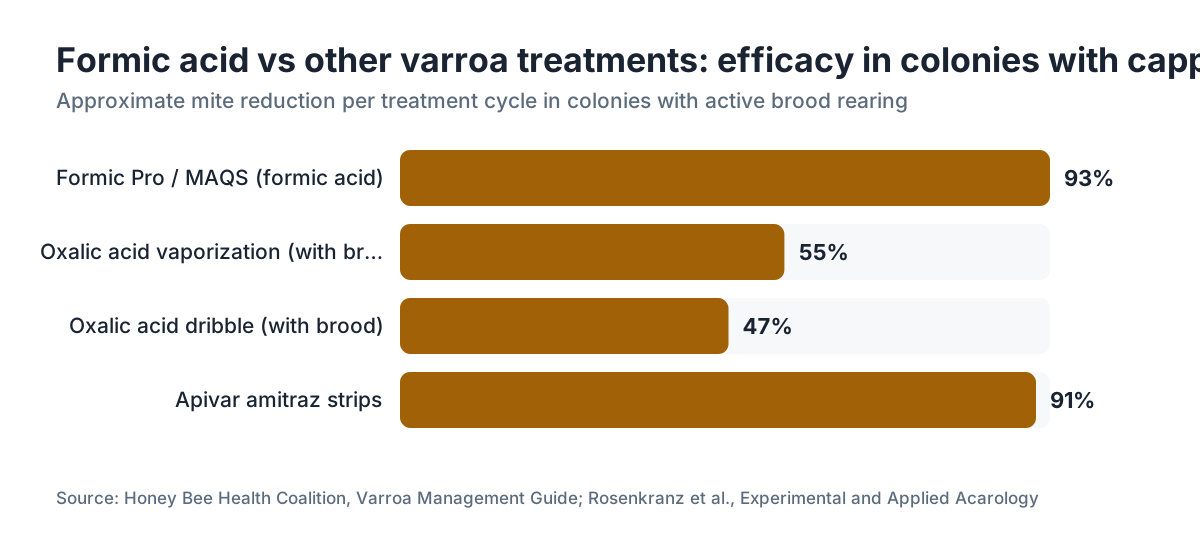
Formic acid works as a fumigant. It turns to vapor at hive temperatures, and that vapor moves through the wax cappings into capped brood cells [4]. That last part is why beekeepers care about it so much. Most other miticides don't cross the cappings. Amitraz and oxalic acid mostly hit phoretic mites riding on adult bees. Varroa reproduce inside capped cells, so any treatment that skips the brood leaves the breeding population alive.
Formic acid vapor diffuses through the cappings and reaches mites in the reproductive stage. That's the whole game. A 2010 review in the journal Experimental and Applied Acarology reports that formic acid formulations reach roughly 90 to 97% varroa reduction per treatment cycle when applied to label [4]. Oxalic acid dribble in colonies with brood typically manages only 40 to 60% because it can't touch the mites under the cappings [5].
The acid enters the mite through its breathing system and wrecks its metabolism. It also kills foundress mites inside cells before or shortly after they lay eggs. Honey bees tolerate the vapor at the doses registered pads produce, as long as hive temperatures stay below 29.5 C (85 F). Treat above that and you'll see queen loss climb [1].
There's a small side benefit. The vapor has some activity against small hive beetle larvae in the lower boxes. It's not enough to build a management plan around, so don't.
Formic Pro vs MAQS: which product should you buy?
Both come from NOD Apiary Products and both use formic acid as the active ingredient. The real differences are application length and how the release curve behaves in heat.
MAQS runs two pads at once for a 7-day treatment. Formic Pro gives you two paths: a 14-day single-pad treatment, or a 20-day extended release with two pads applied in sequence. NOD built Formic Pro's slower release to cut the queen loss MAQS caused in warm weather [3].
Here's the side by side:
| Feature | MAQS | Formic Pro |
|---|---|---|
| Active ingredient | Formic acid 68.2% | Formic acid 46.1% |
| Treatment duration | 7 days | 14 or 20 days |
| Max temp at application | 29.5°C (85°F) | 29.5°C (85°F) |
| Minimum temp | 10°C (50°F) | 10°C (50°F) |
| Honey super allowed | Yes (remove before treating) | Yes (remove before treating) |
| Queen risk | Moderate (5-15% reported loss) | Lower than MAQS |
| Typical Amazon price per 2-pack | $28-38 | $30-45 |
Those prices are approximate, pulled from Amazon listings in mid-2025, and they move around. Run 1 to 5 hives with hot summers? Formic Pro's slower curve earns the extra few dollars. Run a sideliner operation that needs a fast fall knockdown before winter bees are raised? MAQS's 7-day window fits a tight schedule better.
For most hobbyists, I'd buy Formic Pro. The queen loss reduction matters a lot more when you have three hives than when you have thirty.
What temperature limits apply to formic acid treatments?
Temperature is the constraint that trips people up. Both MAQS and Formic Pro need ambient temps between 10 C (50 F) and 29.5 C (85 F) across the entire treatment window [1][3]. There's no splitting the difference. Install pads on a 75 F day, then watch a heat wave push you to 92 F on day three, and you pull the pads.
Why so strict? In heat, formic acid volatilizes faster than the pad was engineered to release it. Vapor concentration inside the hive spikes, bees start dying, and queen loss gets much more likely. Below 10 C, volatilization crawls, almost no active compound reaches the hive, and efficacy falls off a cliff.
Here's what that means for timing. Across most of the US, the usable window lands in spring (roughly late April through May, before summer heat arrives) and again in late summer to early fall (late August through September). That fall window lines up with the late-summer mite treatment point the Honey Bee Health Coalition flags as one of the most important in the varroa calendar [6].
Deep South and desert Southwest beekeepers often can't use formic acid in summer at all. If you're managing hives through August in Arizona or Florida, oxalic acid vapor or amitraz strips may be your only workable tools for that stretch. Your regional varroa mite calendar decides this, not a national average.
Can you use formic acid treatments while honey supers are on?
This is one of formic acid's real advantages over synthetic acaricides. The EPA label for both Formic Pro and MAQS allows use on hives that carry honey supers meant for human consumption, with one hard catch: you must remove the supers before you apply the pads, and you can't put them back until the treatment is done and the pads are out [1].
Formic acid does move into honey and beeswax. So does the formic acid bees make on their own as part of their metabolism. Honey always carries some naturally. The Honey Bee Health Coalition describes formic acid as a naturally occurring compound in honey, and residue from registered treatments stays inside the range you'd find in untreated hives [5]. That's why regulators in the US and EU have set no maximum residue limit (MRL) for formic acid in honey.
In practice, you can't leave supers on while pads are active anyway. The vapor condenses in the cooler upper boxes and the smell gets noticeable. Pull the super, run the treatment, then set the super back once the pads are out and the hive has aired for 24 hours. During a midsummer flow that's an annoyance, not a dealbreaker, over a 7 to 14 day window.
Compare that to Apivar (amitraz strips), which you remove before adding supers and can't reapply to honey-producing colonies within a set pre-harvest interval [10]. Formic acid carries no such interval, which is a big reason honey producers lean on it.
How do you actually apply Formic Pro, step by step?
Follow the full label instructions, not forum posts. That said, here's the procedure most beekeepers actually run.
Check your mite load first. You need a reason to open a new package: an alcohol wash or sugar roll should show 2 or more mites per 100 bees before you treat [6][7]. Treating below threshold wastes money and adds resistance pressure over time for no gain.
For a 14-day single-strip Formic Pro treatment on a single or double-story hive: gloves on before you handle the package. Open the outer cardboard, remove one strip. The strip is a cellulose pad saturated with formic acid. Lay it flat on top of the bottom brood box's top bars, roughly centered, gel side down toward the bees. Close the hive. Mark your calendar 14 days out.
Running a two-box hive? You may need to split the strip lengthwise and set one half in each brood box so vapor reaches both brood nests, per the Formic Pro label for multi-story hives [3].
Come back at 14 days. Remove the strip. It's usually mostly consumed but can still be partly intact. The spent strip goes in the household trash; used pads aren't classified as hazardous waste. Do an alcohol wash 3 to 5 days after the treatment ends to check that it worked. Still above 2 per 100? Plan a follow-up with a different chemistry to hold down resistance risk.
VarroaVault's free tools include a mite calculation worksheet and a seasonal planner that maps formic acid windows against your local climate data. Bookmark it next to your label.
What are the risks of formic acid to bees, queens, and brood?
Formic acid is not harmless to bees. Say that out loud before you treat. At the doses registered pads produce, you'll see bee mortality above the normal background rate during treatment, worst in the first 24 to 48 hours when vapor peaks.
Queen loss gets the most airtime. Field reports and studies on MAQS put queen loss in the 5 to 15% range under good conditions, higher in heat or in big colonies with heavy forager traffic [4]. Formic Pro's extended release brought that number down, though not to zero. University of Guelph work on the Formic Pro formulation showed queen loss under 5% in most trials when the temperature rules were followed [9].
Some brood die near the pad in the first few days. Bees clean it up. In a strong colony the hit to overall brood development is minor. In a weak colony (fewer than 5 frames of bees) formic acid can be brutal, so weigh whether the colony can take it before you start. The Formic Pro label sets a minimum of 5 frames of bees covered [3].
One risk most people forget: don't treat a package or a fresh nuc that has a virgin or newly mated queen. Wait until she's established and laying and the colony hits minimum frame strength. Losing a new queen to formic acid fumes is a real and frustrating way to waste a $50 queen.
For how bees behave under treatment stress, see do honey bees sting.
How much does formic acid treatment cost, and how does it compare to other varroa treatments?
Cost per hive starts to bite once you run five or more colonies. Here's where formic acid lands against the main alternatives.
Formic Pro on Amazon runs roughly $30 to $45 for a two-strip pack, enough for two hives at 14 days each. That's about $15 to $22.50 per hive per treatment. Apivar (amitraz strips) runs roughly $28 to $40 for a 10-pack that treats five hives, so about $6 to $8 per hive. Oxalic acid dribble costs almost nothing per treatment if you buy Api-Bioxal in bulk, but it needs broodless conditions for full efficacy [10].
Price isn't the whole story. Formic acid's brood penetration means one treatment cycle can do what would take two separate oxalic acid rounds (one during brood, one broodless). Framed that way, $20 a hive for a product that hits a big share of the mite population, capped brood included, is fair.
| Treatment | Cost per hive | Brood penetration | Honey super safe | Resistance reported |
|---|---|---|---|---|
| Formic Pro | $15-23 | Yes | Yes (remove during tx) | No |
| MAQS | $14-19 | Yes | Yes (remove during tx) | No |
| Apivar (amitraz) | $6-8 | No | No | Yes (some regions) |
| Api-Bioxal OA dribble | $1-3 | No | No | No |
| Api-Bioxal OA vaporization | $2-5 | Limited | No | No |
Run 3 to 5 hives and want a mid-season treatment that doesn't require broodless timing? Formic acid is probably your best value despite the higher per-treatment price. Hunting for free shipping and cross-supplier pricing? See our rundown of free shipping honey bee supply companies.
Buying beekeeping supplies in bulk through specialist retailers often beats Amazon once you count shipping. Our beekeeping supplies guide covers the broader picture.
Does Amazon sell raw formic acid and is it safe to use on bees?
Amazon does sell raw industrial formic acid, usually at 85 to 90% concentration, listed for leather tanning, textile dyeing, and lab work. Some beekeepers search for it hoping to rig up a cheaper DIY treatment. Don't.
Here's the honest picture. Raw 85% formic acid is dangerous to handle. It causes severe chemical burns on skin contact, and the vapor can cause pulmonary edema with serious inhalation exposure. Registered products like Formic Pro use a lower concentration (46.1%) locked into a controlled-release matrix engineered to deliver a steady, survivable dose over 14 days. There's no kitchen-table equivalent to that engineering.
Beyond the safety problem, using raw formic acid on a colony without an EPA-registered label violates FIFRA, which prohibits using a pesticide in a manner inconsistent with its labeling [11]. The raw product's label reads 'industrial use' or 'laboratory use', not 'apply to managed honey bee colonies'. That mismatch is the violation.
Nobody has clean peer-reviewed data on the lethal versus sublethal vapor curve for bees using homemade formic acid preps. The closest studies used the laboratory-controlled release of registered products, which you can't reproduce with a bottle and a sponge. The odds of gassing your hive or burning yourself aren't theoretical.
Buy a registered product. The $20 you'd save isn't worth a dead colony or a trip to the ER.
When should formic acid fit into your annual varroa management calendar?
Timing formic acid right matters more than almost any other variable. Its brood penetration pays off most when mite populations in capped brood peak, which is usually late summer, right before the colony raises the winter bees that carry it through to spring.
The Honey Bee Health Coalition's Varroa Management Guide recommends treating before the winter bee-rearing period begins, which across most of the contiguous US means finishing treatment by mid-August to early September [6]. If mites are still breeding in brood cells while the long-lived winter bees develop (roughly 4 to 8 weeks before your first hard frost), those winter bees emerge parasitized with shortened lifespans. A colony that enters October with high mite loads almost always collapses by February.
A yearly schedule built around formic acid might run like this. Spring (April to May): check mite loads once colonies hit full strength; if counts top 2 per 100, treat before summer heat shuts the window. Late summer (mid-August to early September): treat again regardless of earlier treatment, because mite populations roughly double every 4 to 6 weeks during peak brood production [8]. A formic acid treatment here gives you brood penetration before the winter bee window opens. Winter (December to February, during a broodless stretch): consider oxalic acid dribble or vaporization for the mites left on adult bees.
None of this is one-size-fits-all. Your bloom dates, your race of bee, and your overwintering climate all shift the windows. A Georgia beekeeper and a Minnesota beekeeper face completely different formic acid temperature windows. The late-summer treatment is the one I'd never skip.
VarroaVault's protocol tools map these windows against your zip code's historical temperature data. Free, and worth ten minutes.
How do you know if formic acid treatment actually worked?
A mite count after treatment isn't optional if you care whether the colony survives. Too many beekeepers treat and assume. Mite loads swing hard between hives in the same yard, and efficacy drops if the window ran too hot, the colony was weak, or the pads were old.
The standard check is an alcohol wash. Take a half-cup sample (about 300 bees) from the brood nest frames 3 to 7 days after you pull the pads. Shake in 70% isopropyl alcohol, strain, and count the mites [7]. Divide by the bee count for a percentage. Below 2% (2 mites per 100 bees) is generally acceptable through summer. Some researchers argue below 1% is the right target heading into winter bee production.
A sticky board count during treatment tells you something's happening too. Pull the board 48 hours into a Formic Pro application and find hundreds of mite carcasses, and the treatment is working. Find almost nothing on a colony you suspected was loaded, and either the pads were compromised or the temperatures didn't cooperate.
Still above 2 per 100 after treatment? Don't reach straight for another round of formic acid. Rotating chemistries holds down resistance pressure. Switch to amitraz or oxalic acid for the next treatment, then come back to formic acid in a later cycle [6][11].
Frequently asked questions
Can I buy Formic Pro on Amazon and ship it to any US state?
Formic Pro is an EPA-registered general-use pesticide, so no federal rule stops Amazon from shipping it across state lines. A handful of states add their own pesticide registration requirements, so check your state department of agriculture's pesticide registry to confirm. California, for one, runs its own pesticide registration database and has historically required separate state registration even for EPA-cleared products.
Is formic acid the same thing as oxalic acid for bees?
No. Both are organic acids used against varroa, but they work differently and have different windows. Formic acid vapor penetrates capped brood cells and can treat colonies during active brood rearing. Oxalic acid (dribble or vaporization) works best in broodless or low-brood conditions because it mainly contacts phoretic mites on adult bees. Many beekeepers rotate both across the season.
How many hives does one pack of Formic Pro treat?
One retail pack of Formic Pro holds two strips. Each strip treats one hive for 14 days on the single-strip protocol, or both strips can run one double-deep hive over 20 days. So a standard pack treats two single-story hives, or one hive on the extended protocol. Check the label for multi-story configurations, which may require splitting a strip.
Will formic acid treatment kill my queen?
It can. With Formic Pro applied per label below 85 F, queen loss runs under 5% in university trials. Risk climbs in hot weather, in newly established colonies, or if you use MAQS instead of Formic Pro. Never treat a package or nuc carrying a newly mated or virgin queen. Wait until she's laid for at least two weeks and the colony covers at least five frames of bees.
Can you use formic acid with a honey super on?
You must remove honey supers before applying formic acid pads and can't put them back until the treatment is out. Unlike amitraz products, formic acid carries no pre-harvest interval that blocks treating honey-producing colonies. Formic acid occurs naturally in honey, and registered-product residue falls inside the natural range. That makes it a popular choice for beekeepers treating during or near a nectar flow.
What temperature is too hot to use formic acid on bees?
Both Formic Pro and MAQS labels set a maximum of 29.5 C (85 F) across the full treatment period. If the forecast tops that on any day of the 7 to 14 day window, pull the pads or don't start. Above that threshold, formic acid volatilizes too fast, producing toxic concentrations inside the hive that kill bees and drive queen loss up sharply.
How long does Formic Pro take to work, and when will I see mites dying?
You'll usually see elevated mite drop on a sticky board within 24 to 48 hours of applying Formic Pro. Peak kill often lands in the first few days when vapor is highest. The 14-day release keeps killing mites as they leave brood cells across the window. Do an alcohol wash 3 to 7 days after you remove the strips to confirm your post-treatment count.
Does formic acid work against varroa mites inside capped brood?
Yes, and that's its defining edge over most other varroa treatments. The vapor diffuses through beeswax cappings at hive temperatures and reaches mites in the reproductive stage inside cells. A 2010 Experimental and Applied Acarology review reports formic acid formulations reach roughly 90 to 97% varroa reduction per cycle, against 40 to 60% for oxalic acid dribble in colonies with capped brood.
Is it cheaper to buy formic acid treatments at a bee supply store vs Amazon?
It varies. Amazon sometimes undercuts specialty retailers by a few dollars a pack, but you lose freshness guarantees and expert advice. Dedicated bee suppliers often offer bulk pricing and free shipping thresholds that close the gap fast once you buy for more than two or three hives. Compare total landed cost including shipping before defaulting to Amazon, especially for temperature-sensitive products that need careful handling.
Can I use formic acid in the winter to treat varroa?
Generally no. The minimum application temperature for Formic Pro and MAQS is 10 C (50 F), and you need it held across the full 7 to 14 day window. Across most of North America, winter temps sit well below that consistently. Winter varroa treatment is better handled with oxalic acid dribble or vaporization, which works in broodless colonies at lower temperatures.
How do I store Formic Pro or MAQS that I bought on Amazon?
Store unopened packs somewhere cool and out of direct sunlight, ideally between 5 C and 25 C (41 to 77 F). The active ingredient volatilizes slowly even in sealed packaging, so don't stockpile more than a season's supply. Check the expiration date before you buy on Amazon. Outdated or heat-exposed pads deliver less active compound and show reduced efficacy in your post-treatment counts.
What should I do if formic acid gets on my skin during application?
Remove contaminated clothing and rinse the affected skin right away with plenty of water for at least 15 to 20 minutes. Formic acid causes chemical burns, so don't shrug off a small spill. If irritation lasts or the area is large, contact Poison Control (1-800-222-1222 in the US) or seek medical care. This is exactly why the label requires chemical-resistant nitrile gloves during handling.
Does using formic acid repeatedly cause varroa mite resistance?
No confirmed varroa resistance to formic acid has been documented as of 2025, which makes it one of the most durable tools you have. That's a sharp contrast to amitraz, where resistance is documented in some US and European populations. Rotating formic acid with other chemistries is still good practice as general resistance management, but there's no evidence-based reason to avoid it on resistance grounds alone.
Sources
- EPA, Formic Pro pesticide label (EPA Reg. No. 84922-4): Formic Pro label requires avoiding breathing vapors, wearing chemical-resistant gloves, and sets temperature limits of 10-29.5°C during treatment; honey supers must be removed before application
- NOD Apiary Products, Formic Pro product information and label: Formic Pro contains 46.1% formic acid, offers 14- or 20-day protocols, requires minimum 5 frames of bees, and was designed to reduce queen loss compared to MAQS
- Rosenkranz P. et al., Experimental and Applied Acarology, 2010 (varroa biology and treatment efficacy review): Formic acid vapor penetrates capped brood cells and achieves roughly 90-97% varroa reduction per treatment cycle in registered product trials
- Honey Bee Health Coalition, Varroa Management Guide (3rd edition): Oxalic acid dribble achieves only 40-60% efficacy in colonies with capped brood; formic acid is noted as a naturally occurring substance in honey with no MRL set
- Honey Bee Health Coalition, Varroa Management Guide: HBHC recommends treating before the winter bee-rearing period begins and identifies late summer as the most critical treatment window; 2 mites per 100 bees is the general action threshold
- Honey Bee Health Coalition, Tools for Varroa Management (alcohol wash sampling): Standard alcohol wash uses a half-cup sample of about 300 bees from brood nest frames; count mites and divide by bee count for a percentage
- Delaplane K.S., University of Georgia Extension, Varroa destructor biology: Varroa mite populations double approximately every 4-6 weeks during peak brood production in summer
- University of Guelph, Honey Bee Research Centre, Formic Pro efficacy trials: Formic Pro showed queen loss rates under 5% in most trials when temperature guidelines were followed, improving on MAQS performance
- EPA, Oxalic acid (Api-Bioxal) pesticide registration: Api-Bioxal (oxalic acid) requires broodless or low-brood conditions for full efficacy and cannot be used with honey supers; no pre-harvest interval restriction applies to formic acid
- Penn State Extension, Varroa Mite Management for Honey Bees: Rotating varroa treatment chemistries reduces resistance pressure; amitraz resistance has been documented in some US varroa populations; using a pesticide inconsistent with its label violates FIFRA
Last updated 2026-07-09