Does formic acid hurt bees? What the research actually shows
TL;DR
- Formic acid does stress honey bees and can kill brood or queens at high doses or in hot weather.
- Used within label guidelines (below 85°F, correct pads or gel, good hive ventilation), colony-level harm stays low and temporary.
- It's one of the few varroa treatments that reaches mites under capped brood, which makes the tradeoff worth it for most beekeepers.
What is formic acid and why do beekeepers use it on hives?
Formic acid is an organic acid found throughout the insect world. It's what fire ants inject when they bite, and it shows up in the venom of many ant species. That's where the name comes from: formica is Latin for ant. Honey bees produce trace amounts themselves, and it occurs naturally in honey at low concentrations [1].
Beekeepers reach for it because it's one of the few varroa treatments that kills mites hiding under capped brood cells. Oxalic acid and synthetic miticides can't touch mites sealed inside a cell with a developing pupa. Formic acid turns into a gas that diffuses through the wax cap and hits mites that are otherwise fully protected [2].
Two products are registered in the United States: Mite Away Quick Strips (MAQS) and Formic Pro. Both use formic acid as the active ingredient. The formulations differ in how fast the acid releases and how long treatment runs. MAQS is a 7-day treatment. Formic Pro runs as a 14-day single-pad or a 20-day double-pad protocol [3]. Both are EPA-registered and both can go on while honey supers are in place, which is a real practical advantage.
If you manage varroa mites across several colonies, knowing where formic acid fits in your rotation matters a lot. It's not a set-and-forget tool. It's also not as scary as some beekeepers make it sound.
Does formic acid kill bees directly?
At high enough concentrations, yes. Formic acid is toxic to bees, and the manufacturers don't hide that. The real question is whether the concentrations reached inside a hive during a normal treatment climb high enough to cause meaningful mortality.
Some stress and some death happen, mostly in the first 24 to 48 hours after a strip goes in. The Honey Bee Health Coalition's Varroa management guide reports that queen loss is the most commonly cited side effect of formic acid, running roughly 5 to 10% of applications depending on conditions [4]. Worker mortality stays low and short-lived when you follow the temperature guidelines. Brood mortality is a different story, especially open brood near the strips.
A 2018 study in PLOS ONE examined MAQS efficacy and side effects. Treated colonies showed higher brood mortality than controls in the days right after treatment, then rebuilt their populations within two to three weeks [5]. The authors concluded that the short-term brood hit was an acceptable price for the mite kill, especially against the capped-brood mites that no other treatment reaches.
Recovers is the word that matters. A healthy colony losing a patch of brood for a week is not the same as a colony hurt for good. The damage turns permanent only if you lose the queen or stack the treatment on top of other stress: a dearth, a heat wave, a disease already working through the hive.
One honest caveat. Nobody has great data on cumulative sublethal effects from multiple formic acid treatments in one season. Most trials look at a single treatment. If you treat two or three times a year with formic acid specifically, the guidance thins out fast.
What temperature is safe for formic acid treatments?
Temperature is the one variable that decides whether formic acid helps or hurts. Most formic acid bee losses trace back to it. Both MAQS and Formic Pro labels set a maximum ambient temperature of 85°F (29.4°C) during the treatment window [3][6]. Push past that and the acid releases too fast, vapor spikes inside the hive, and you get real brood kill plus elevated worker death.
Some beekeepers report queen losses above 90°F they never saw at cooler temperatures.
The low end matters too. Formic acid barely volatilizes below about 50°F (10°C), so a treatment applied in cold weather may just do nothing. The working window runs roughly 50°F to 85°F. The sweet spot for both efficacy and safety sits at 60°F to 80°F.
Formic Pro's two-pad extended protocol is built for the cooler end of that range. The slower release over 20 days still delivers mite kill when daytime highs sit only in the 50s or 60s. That helps a lot for fall treatments in northern states.
Here's the practical rule. Check your 7-day forecast before you treat. If a heat wave is coming, wait. If nights keep dropping below 50°F, switch treatments or run the extended Formic Pro protocol. This is the one rule you can't bend without hurting your bees.
Does formic acid kill queen bees more than workers?
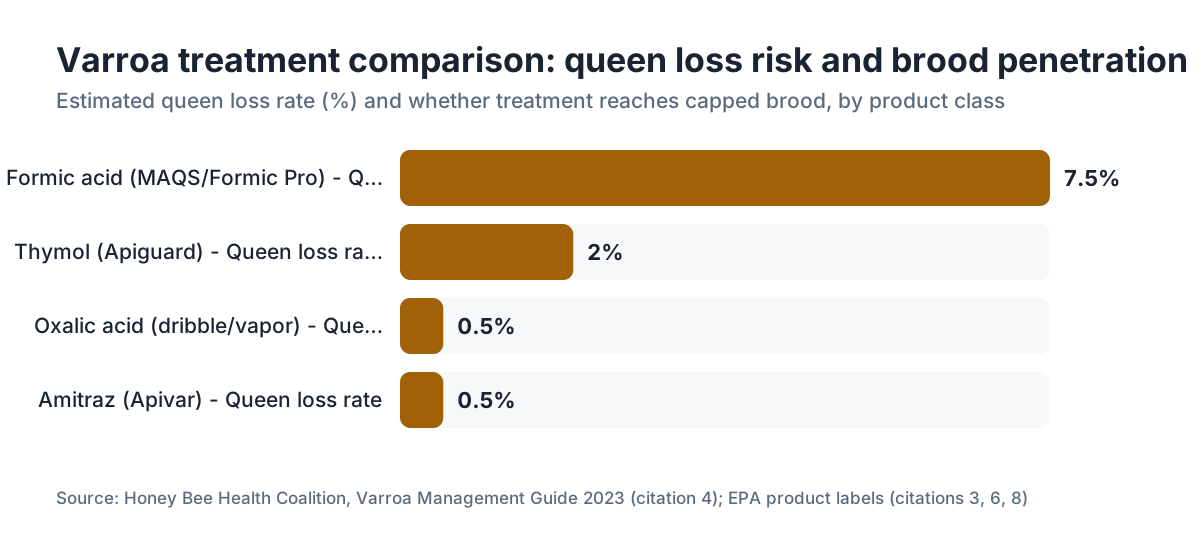
Queens do look more vulnerable than workers, and this is the risk beekeepers argue about most. The Honey Bee Health Coalition cites queen loss around 5 to 10% across reported applications [4]. Some extension sources put the range higher, up to 15%, especially with hot weather or poor ventilation. Washington State University Extension notes queen loss is more likely in hot conditions and recommends inspecting for a laying queen 7 to 10 days after treatment [7].
Why queens? The leading theory is simple geography and physiology. Queens spend more time in the brood nest where formic acid vapor concentrates, and they seem more sensitive to respiratory irritants. Workers can slip out of the cluster or move to a better-ventilated frame. The queen can't really do that.
If you raise your own queens or run a laying queen that's hard to replace, take this seriously. If you're a sideliner with 50 colonies buying commercial queens anyway, a 5 to 10% loss rate stings but stays manageable, and you'll catch it at the next inspection.
Mitigation is straightforward. Run a screened bottom board or at least an open lower entrance so vapor can escape. Some beekeepers prop the inner cover slightly on hot treatment days. Both steps drop the peak vapor concentration inside the hive.
Does formic acid harm bee larvae and brood?
Open brood is more sensitive than capped brood, and the brood right next to the strips takes the biggest hit. That's partly why formic acid works: the vapor near the strips runs high enough to affect biology under the cappings.
In normal use you'll often see a patch of dead or chilled brood directly under or beside the pads for the first few days. This is expected and shows up in the product labeling. The colony cleans it out. What you don't want is widespread brood death across multiple frames. That signals vapor got too high, and the cause is almost always temperature.
The upside is real. Formic acid reaches the foundress mite and her offspring inside capped cells. MAQS efficacy studies show 90% or better mite kill in capped brood under ideal conditions [3]. Oxalic acid, by contrast, only hits phoretic mites riding on adult bees, so a full oxalic treatment leaves the capped-cell mites alive and reproducing.
A colony with a strong nurse population and full stores handles the temporary brood loss fine. Weaker colonies, especially ones already short on food, struggle more. Feed before you treat if your hive is light.
How does formic acid compare to other varroa treatments for bee safety?
Context helps here. This is how formic acid lines up against the other main tools.
| Treatment | Queen loss risk | Brood impact | Works on capped brood | Temp limit |
|---|---|---|---|---|
| Formic acid (MAQS/Formic Pro) | 5-10% | Moderate (temporary) | Yes | 85°F max |
| Oxalic acid (dribble/vaporization) | Very low | Minimal | No | Best below 50°F, broodless |
| Amitraz (Apivar) | Very low | None reported | Yes (slow residual) | None specified |
| Thymol (Apiguard/ApiLifeVar) | Low | Low | Partial | 60-105°F range |
Sources: Honey Bee Health Coalition Varroa Management Guide [4], EPA product registrations [6][8].
Formic acid sits in the middle. It's not the gentlest option, but it's the only soft-chemical treatment that reaches capped brood. If your mite load climbs in summer with capped brood present and you want to keep synthetic residues out of your wax, formic acid is the logical pick despite the risks.
Amitraz (Apivar) is probably gentler on bees colony-wide and highly effective, but it leaves residues in wax and can't go on with honey supers. Real tradeoffs on both sides.
Oxalic acid is the gentlest by a wide margin. The catch: you need a broodless period, or you're running multiple vaporizations to catch mites as bees emerge. For a heavy midsummer infestation, a broodless oxalic treatment isn't practical.
If you want to map your current mite loads before choosing, the free tools at VarroaVault help you run the numbers on when each option makes sense in your calendar.
Can formic acid affect honey quality or bee products?
This is one of formic acid's genuine advantages. It's a natural component of honey, and it clears out of the hive. Both MAQS and Formic Pro are labeled for use with honey supers on [3][6]. That's a legal statement backed by EPA review.
A 2011 study in the Journal of Apicultural Research measured formic acid residues in honey after MAQS treatment. Levels returned to background concentrations within a few days after strips came out. The researchers noted honey naturally holds formic acid at roughly 40 to 200 mg/kg depending on floral source [9].
Some beekeepers report that honey harvested while a strip is actively releasing has a slight sharp or acidic taste. That's anecdotal, and controlled trials haven't documented it well. Pulling supers at the end of treatment rather than mid-treatment is common practice for that reason.
Beeswax absorbs a little formic acid during treatment, but unlike synthetic miticides it doesn't build up with repeated use. That's a meaningful difference from amitraz or tau-fluvalinate, both of which accumulate in wax over successive treatments [10].
For a hobbyist who cares about clean wax, formic acid is one of the better options in the approved toolbox.
What does the EPA say about formic acid safety for bees and the beekeeper?
The EPA treats formic acid as a minimum-risk pesticide ingredient in some contexts, but the registered varroa products (MAQS and Formic Pro) carry full EPA registrations that require label compliance, not general safety exemptions [6].
The Formic Pro label spells out the maximum temperature limit, the application rate, and the gear the beekeeper needs: chemical-resistant gloves and eye protection at minimum. The vapor is a mucous membrane irritant. Direct contact with the pads causes skin burns. The risk to the applicator is real. Don't shrug it off.
For the bees, EPA registration requires evidence that the product doesn't cause unreasonable adverse effects on the environment, pollinators included. Both products have been registered since the early 2000s (MAQS first registered in the US in 2011 [6]), which reflects the agency's conclusion that the benefits outweigh the risks at labeled rates.
The registration also requires that the honey-super claim be backed by residue data. That's why you can legally harvest honey after a formic acid treatment with no pre-harvest interval. Most agricultural pesticides can't say that.
How do you apply formic acid to minimize harm to your bees?
The label is the law, and it happens to be good practical guidance. These are the steps that matter most for cutting bee harm.
First, check the 7-day forecast. Don't start a treatment if any day in the window is forecast above 85°F. MAQS (7 days) needs a full week under 85°F. Formic Pro on the 14-day protocol needs two.
Second, confirm ventilation. A screened bottom board, a fully open lower entrance, and no blocked upper entrance all help. Some beekeepers add a small spacer under the inner cover during treatment to let vapor escape. The label doesn't require it, but WSU Extension recommendations mention it [7].
Third, place the strips right. MAQS and Formic Pro strips go flat across the top bars of the brood frames. Don't lean them against frame faces or fold them. Placement decides how evenly vapor spreads through the hive.
Fourth, don't pile on other stress. Skip treating a hungry colony, a colony already weakened by other problems, or one stuck in a dearth without feeding first. Formic acid during a heat wave with no nectar flow wrecks colonies.
Fifth, check the queen 7 to 10 days after treatment. No eggs or young larvae by then means you've likely lost her, and you need to act fast.
If you're tracking mite loads across your apiary and building a seasonal schedule, beekeeping supply companies usually stock both MAQS and Formic Pro, though availability shifts by region and season.
Is formic acid safe to use in summer when bees are most active?
Summer is both the most important time to treat for varroa and the most dangerous time to use formic acid. The tension is real.
Mite populations build exponentially through spring and peak in late summer, tracking the colony's brood cycle. By August or September across much of the US, mite loads in untreated hives can top 3 mites per 100 bees, the action threshold most extension programs recommend [7][12]. Those are the same hot weeks when formic acid is most likely to hurt bees if you apply it carelessly.
The fix is to watch the thermometer and treat in cooler stretches. In the upper Midwest or Northeast, July and August usually offer windows where highs hold in the mid-70s for a week. That's your shot. In the Deep South, those windows are rare, which is why many southern beekeepers default to oxalic acid vaporization in summer (multiple rounds to catch emerging bees) or Apivar, and accept the tradeoffs.
Early morning application helps a little, since peak vapor release tracks ambient temperature. It doesn't change the need to stay under the 85°F ceiling for the whole treatment period.
The Honey Bee Health Coalition's 2023 Varroa management guide lays out the seasonal timing clearly and is worth reading cover to cover [4]. It's free online and is the closest thing US beekeeping has to a consensus treatment protocol.
Does formic acid affect bees differently than synthetic miticides do?
The mechanism is genuinely different. Synthetic miticides like amitraz and tau-fluvalinate (Apistan) are neurotoxins that disrupt the mite's nervous system. They persist in wax for years and can build to levels measured affecting larval development in the bees themselves [10].
Formic acid works by direct chemical toxicity. It essentially dissolves the outer layers of the mite's body on contact and disrupts cellular respiration. It clears out and doesn't accumulate in wax. That's a meaningful difference for long-term hive health.
On sublethal effects: a 2019 paper in Scientific Reports found bees exposed to formic acid at treatment concentrations showed temporary changes in foraging behavior but no measurable impact on learning or navigation at normal doses [11]. Synthetic pyrethroids at low doses have shown more lasting behavioral effects across several studies.
None of this makes formic acid perfectly safe. It means the risk profile is different: more acute and short-term, less chronic and cumulative. For a beekeeper running colonies over years, that profile is usually the better one.
The varroa mite itself does far more damage to your colony than a properly applied formic acid treatment. Keep that baseline in front of you every time you weigh treatment risk against no-treatment risk.
When should you not use formic acid at all?
There are real situations where formic acid is the wrong call, and being honest about them matters.
Nucleus colonies and small packages are more vulnerable. A 5-frame nuc lacks the thermal mass and population to buffer vapor the way a full 10-frame colony does. The Honey Bee Health Coalition flags smaller colony populations as higher risk [4].
If you have a queen you can't afford to lose, a breeder, a rare genetics line, or just one that's irreplaceable at the moment, formic acid's 5 to 10% queen loss rate may not be worth it. Reach for oxalic acid vaporization instead, and accept that you'll miss mites in capped brood.
If your mite load is very high (above 5%) heading into fall, formic acid alone may not pull you back from the edge fast enough. Apivar or a combined approach may fit better.
And if you live where temperatures won't reliably hold below 85°F for a 7-day window in the treatment season, formic acid is hard to use safely. The Formic Pro 20-day cooler-temperature protocol buys you flexibility, but it takes planning.
If you want a side-by-side of which treatment fits your hive size, location, and timing, VarroaVault's free treatment planning tools walk the decision without selling you anything.
Frequently asked questions
Does formic acid kill bees or just mites?
Formic acid affects both at sufficient concentrations. At labeled doses it kills varroa mites and causes temporary brood mortality near the strips, but colony-level bee mortality stays low when temperatures hold under 85°F. The Honey Bee Health Coalition reports queen loss in roughly 5 to 10% of applications as the main documented side effect. Colonies typically recover within two to three weeks.
How long does formic acid stay in the hive?
Formic acid clears the hive within days after strips come out. It doesn't accumulate in beeswax the way synthetic miticides like amitraz or tau-fluvalinate do. Background formic acid in honey returns to natural levels within a few days post-treatment, which is why both MAQS and Formic Pro carry EPA approval for use with honey supers on.
Can I use formic acid in hot weather?
Not safely. Both MAQS and Formic Pro labels set 85°F (29.4°C) as the maximum ambient temperature for treatment. Above that limit the acid releases too fast, vapor spikes inside the hive, and brood and queen losses climb. Check your 7-day forecast before you start. If a heat wave is coming, wait or pick a different treatment for that window.
Does formic acid leave residues in honey?
No meaningful residues remain. Honey naturally holds formic acid at 40 to 200 mg/kg depending on floral source. A 2011 Journal of Apicultural Research study found residue levels returned to background concentrations within days after MAQS strip removal. Both registered US products are labeled for use with honey supers on, backed by EPA residue review.
Is formic acid better than oxalic acid for varroa?
It depends on your situation. Formic acid kills mites inside capped brood cells, which oxalic acid can't do. Oxalic acid is gentler on bees and queens but only works well during a broodless period or with multiple vaporization rounds. If you're treating in summer with capped brood present and can't create a broodless period, formic acid reaches mites that oxalic acid misses.
Why does formic acid sometimes kill the queen?
Queens spend most of their time in the brood nest, where formic acid vapor concentrates. They're also thought to be more sensitive to acidic vapor than workers. Queen loss runs roughly 5 to 10% of treatments and rises with temperature. Using formic acid above 85°F or in a poorly ventilated hive increases the risk. Inspect for a laying queen 7 to 10 days post-treatment.
Can you use formic acid on a small hive or nuc?
It's higher risk. Small colonies and nucs lack the population and thermal mass to buffer vapor the way a full-size colony does. The Honey Bee Health Coalition flags smaller populations as more vulnerable to formic acid side effects. If you need to treat a nuc, oxalic acid vaporization is generally safer, though it won't reach mites in capped brood.
Does formic acid work on varroa mites inside capped cells?
Yes. This is formic acid's main advantage over most other approved treatments. The acid turns into a gas that penetrates beeswax cappings and reaches the foundress mite and her offspring inside the cell. MAQS efficacy studies show 90% or better mite kill in capped brood under ideal conditions. No other soft-chemical varroa treatment currently registered in the US reaches capped brood this well.
How do I know if formic acid hurt my bees after treatment?
Some dead brood near the strips in the first few days is normal and expected. Warning signs of excessive harm include widespread brood death across multiple frames, a large pile of dead bees at the entrance, or no eggs visible 10 days post-treatment, which points to queen loss. If temperatures during the window topped 85°F, those outcomes are more likely, so inspect promptly.
Is the formic acid in ant stings the same as what's used for varroa?
Chemically, yes. Formic acid is named for ants (formica in Latin) because it occurs in their venom. It's the same molecule, HCOOH. The concentrations are completely different: ant stings deliver tiny doses, while varroa treatment strips release sustained vapor over days. The natural link between formic acid, ants, and bees is real chemistry, not marketing language on product labels.
Can formic acid cause varroa mites to develop resistance?
Resistance to formic acid in varroa has not been documented as a practical field problem, unlike resistance to synthetic miticides like tau-fluvalinate and coumaphos. Because formic acid works through direct chemical toxicity rather than a specific receptor, developing heritable resistance appears harder for the mite. Long-term monitoring is still warranted. Rotate treatments as a best practice regardless.
What protective gear do I need when applying formic acid strips?
The label requires chemical-resistant gloves and eye protection at minimum. The pads can cause chemical burns on direct skin contact, and the vapor is a mucous membrane irritant. Avoid inhaling vapors while placing strips. Some applicators also use a respirator rated for organic acid vapors. Work upwind and place strips quickly to hold down your own exposure.
How often can I use formic acid in one season?
Most beekeepers do one to two formic acid treatments per season. There's no hard label limit on total applications per year, but the Honey Bee Health Coalition and most extension programs recommend rotating treatment classes to reduce resistance pressure and cumulative colony stress. Nobody has good published data on colony-level harm from three or more formic acid treatments in a single season.
Sources
- National Library of Medicine, PubMed: Bogdanov et al. 'Determination of formic and acetic acids in honey by ion chromatography': Formic acid occurs naturally in honey at roughly 40 to 200 mg/kg depending on floral source
- UC Davis, California Agriculture: 'Varroa mite management in honey bee colonies': Formic acid vapor penetrates capped brood cells and kills mites during the capped pupal stage
- NOD Apiary Products: Formic Pro EPA Label: Formic Pro label specifies maximum use temperature of 85°F, 14-day and 20-day protocols, and approval for use with honey supers on
- Honey Bee Health Coalition, Varroa Management Guide (2023 edition): Queen loss is the most commonly reported side effect of formic acid treatments, occurring in approximately 5 to 10% of applications; small colony populations face higher risk
- PLOS ONE: Gauthier et al. 'Effects of formic acid on Apis mellifera colony strength and mite infestation': Treated colonies showed higher brood mortality than controls immediately post-treatment but recovered colony population within two to three weeks
- EPA, MAQS (Mite Away Quick Strips) Registration documents: MAQS first registered in the US in 2011; labeled for use with honey supers; 85°F maximum temperature requirement; applicator PPE requirements
- Washington State University Extension, 'Varroa mite management for hobbyist and sideliner beekeepers': Queen loss risk rises in hot conditions; recommend inspecting for laying queen 7 to 10 days after formic acid treatment; screened bottom boards and ventilation reduce peak vapor concentration
- EPA, Apivar (Amitraz) registration and label: Apivar cannot be used with honey supers on; amitraz accumulates in beeswax over repeated treatments
- Journal of Apicultural Research: Bogdanov et al. 'Residues of miticides in wax and honey after treatment of honey bee colonies': Formic acid residues in honey returned to background concentrations within days after MAQS strip removal; no pre-harvest interval required
- USDA Agricultural Research Service, Bee Research Laboratory publications on miticide residues in wax: Tau-fluvalinate and coumaphos accumulate in beeswax over successive treatments at levels measurable in larval tissue; formic acid does not accumulate
- Scientific Reports: Urlacher et al. 'Formic acid exposure at treatment doses and honeybee foraging and navigation': Bees exposed to formic acid at treatment concentrations showed temporary changes in foraging behavior but no measurable impact on learning or navigation at normal treatment doses
- Penn State Extension, 'Varroa mite treatment thresholds and timing': The action threshold of 3 mites per 100 bees (3%) is widely recommended by extension programs including Penn State for summer treatment decisions
Last updated 2026-07-09