At what concentration does oxalic acid harm adult bees?
TL;DR
- Oxalic acid turns toxic to adult honey bees above roughly 2.8% w/v in dribble syrup and above about 1 gram per cubic meter in vapor.
- EPA-registered products like Api-Bioxal stay under those thresholds by controlling dose per bee.
- Brood contact drops the safe ceiling hard, which is why labels ban dribble on capped-brood colonies.
What exactly is oxalic acid and why do beekeepers use it?
Oxalic acid is a dicarboxylic acid that shows up in rhubarb, spinach, and honey. Bees make trace amounts themselves, and untreated honey carries somewhere between 8 and 243 mg/kg depending on the floral source [1]. That natural baseline is part of why regulators warmed to it: the treatment barely moves honey residue numbers.
Beekeepers reach for it against Varroa destructor, the mite that has wrecked managed colonies worldwide. The mite is far more sensitive to OA than the bee is. That gap is the whole pharmacological opening. But the window is not infinite. Push concentration or exposure time high enough and you start killing bees faster than mites.
The EPA registered the first OA product for U.S. beekeepers, Api-Bioxal, in 2015 [2]. Before that, hobbyists mixed their own solutions with no label to guide concentration, and results scattered all over the place. Knowing where bee-safe ends and bee-toxic starts is the entire point of the label.
For a broader look at the pest itself, see the varroa mite overview.
At what concentration does oxalic acid start harming adult bees?
Honest answer: it depends on delivery method. Dribble and vapor hit bees in completely different ways.
For dribble (syrup) applications, the toxicity work most often cited in the apiculture literature puts the lethal threshold for adult bees above roughly 2.8% oxalic acid dihydrate by weight in a 1:1 sugar syrup [3]. Here is the wrinkle. Api-Bioxal dribble mixes at 35 g OA dihydrate per liter of 1:1 syrup, which lands near 3.5% w/v. That sits above the 2.8% figure, and sharp-eyed beekeepers have flagged it. What saves the bees is the tiny label dose per seam (5 mL, which hits each bee with a microdose rather than a soaking), keeping per-bee exposure under the LD50. Concentration in the carrier and actual dose per insect are two different things, and the difference matters a lot here.
For vapor (vaporization) applications, Gregorc and Ellis (2011) found that concentrations at or above 1 g OA per m³ of hive airspace caused measurable adult mortality in caged-bee trials [4]. The Api-Bioxal protocol deposits about 1 gram per brood box. But a hive is not a sealed lab chamber, so real vapor disperses fast. Your safety margin in a ventilated hive runs much wider than in a caged-bee experiment.
Short version: above 2.8% w/v in dribble, or above about 1 g/m³ of sustained vapor, you are in toxic territory for adults. Registered products thread the needle by controlling dose, not concentration.
How does brood presence change the toxicity picture?
Brood changes everything. OA is highly toxic to developing larvae, and that is no side note. It is the reason every registered label in the U.S. bans dribble treatment (and most vaporization protocols) when capped brood is present [2].
When bees contact OA while tending brood, they pass the compound to larvae through feeding. A 2000 study by Higes et al. found that OA applied to colonies with heavy sealed brood caused substantially higher adult mortality than in broodless colonies at the same concentration, likely because nurse bees ingested more while feeding or cleaning affected cells [5]. The larvae themselves die at concentrations well below the adult LD50.
That is also why extended-release methods being studied in some university trials are built for colonies with brood: they aim for a low, sustained release instead of one concentrated hit. Results are still trickling in. Nobody has good consensus data yet on exactly what sustained-release concentration is safe across every brood stage.
Practical takeaway: if you have capped brood, vaporization is your label-compliant option in most U.S. states, and you follow the dose precisely instead of assuming more is better. Dribble on a colony with capped brood is off-label, and it risks heavy brood kill plus higher adult mortality.
What does the EPA-registered label actually specify?
Api-Bioxal is the only oxalic acid product currently registered by the EPA for varroa control in the U.S. [2]. The label spells out two delivery methods.
Dribble: 35 g OA dihydrate dissolved in 1 liter of 1:1 (w/w) sugar syrup. Apply 5 mL per occupied seam, up to 10 seams, so 50 mL per colony maximum per treatment. Once per year. Broodless colonies only.
Vaporization: 1 g of Api-Bioxal (0.855 g pure OA dihydrate per gram of product) per brood box, up to 3 treatments per year, no more than one every 5 days. Legal with brood present, which is why it is the go-to warm-season option.
The label language itself reads: "Do not treat more than once per year" for dribble, and "Do not treat colonies more than 3 times per 12 month period" for vaporization [2]. The EPA set these limits through a residue and safety review more than through efficacy data. Exceeding label dose is a federal violation under FIFRA (the Federal Insecticide, Fungicide, and Rodenticide Act). More to the point for your bees, it is the fastest way to shove ambient concentration into the harmful range.
Several state extension services, including the University of Florida IFAS and Penn State Extension, host plain-language label summaries for beekeepers who would rather not wade through the full regulatory document [6][7].
How toxic is oxalic acid to bees compared to common alternatives?
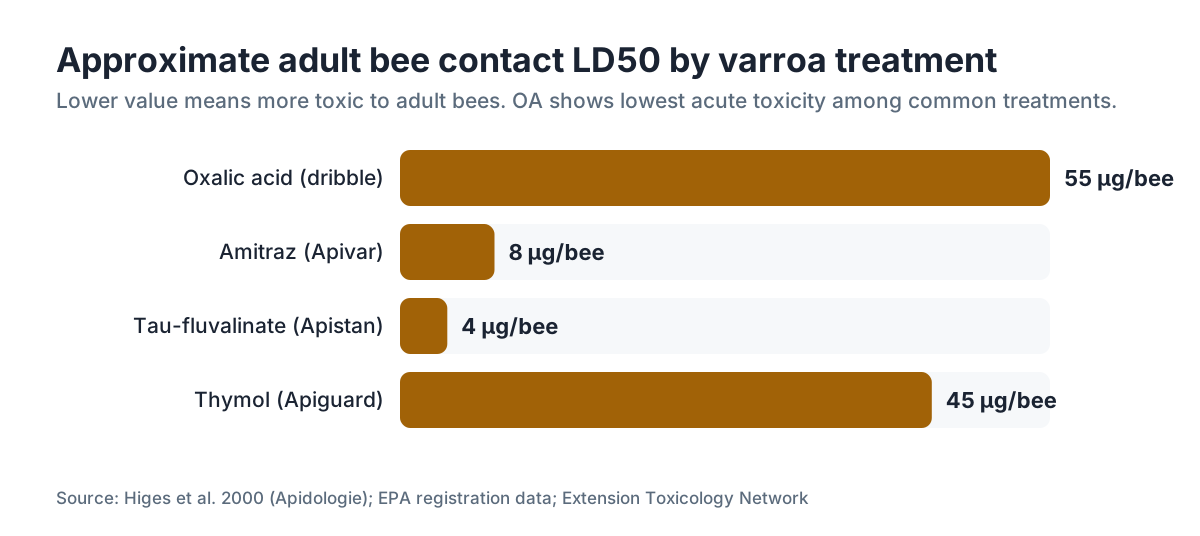
Put OA next to the treatments beekeepers actually run and it looks gentle on adults. The table below lists contact LD50 values for adult honey bees from peer-reviewed and extension sources. Lower LD50 means more toxic.
| Treatment | Adult bee contact LD50 (approx.) | Source |
|---|---|---|
| Oxalic acid dihydrate (dribble) | ~50 to 60 µg/bee (in syrup) | Higes et al. 2000 [5] |
| Amitraz (Apivar) | ~8 µg/bee | Extension Toxicology Network |
| Tau-fluvalinate (Apistan) | ~3 to 5 µg/bee | EPA Registration |
| Formic acid (Mite-Away Quick Strips) | Causes dose-dependent brood/adult mortality at label dose in hot weather | CAPA guidelines |
| Thymol (Apiguard) | Low adult toxicity at label concentrations | EFSA assessment |
OA comes out easy on adults next to the synthetic miticides. The comparison is not clean, though, because the delivery mechanisms differ. Amitraz and fluvalinate act as contact poisons even at trace levels. OA at dribble concentrations is consumed as a liquid and works partly through ingestion. The takeaway holds anyway: OA is not uniquely dangerous to adult bees among varroa treatments, as long as you stay inside label parameters.
The Honey Bee Health Coalition's Tools for Varroa Management guide calls OA "one of the safest treatments available for adult bees when used as directed," and the LD50 data backs that up [8].
Does oxalic acid accumulate in bees or honey to dangerous levels?
Residue worries come up constantly, and the data here reassures. A 2015 analysis cited in the EPA registration process found OA residues in honey after Api-Bioxal treatment were not significantly different from pre-treatment levels or from untreated control hives, because background OA in honey is already variable and the treatment does not push residues past natural ranges [2][9].
OA does not build up in bee tissue the way some synthetic chemicals do. Bees metabolize and excrete it, and the compound breaks down fairly fast in the hive. That is one reason OA carries a zero-day pre-harvest interval for honey supers in many countries. The U.S. Api-Bioxal label still requires pulling supers before dribble treatment, though supers can stay on for vaporization under the current label, a detail that catches some beekeepers off guard.
Bottom line: follow the label and you are not creating a residue problem. The risk to bees from OA is acute exposure during treatment, not slow accumulation.
What signs tell you that oxalic acid harmed your bees?
Reading OA harm correctly matters, because mistaking it for disease or a failing queen sends you down the wrong path.
Acute overdose in adults looks like this: dead or dying bees in front of the hive within 24 to 48 hours, crawling bees that cannot fly, and in dribble overdose cases, bees with wet or sticky bodies who cannot groom the solution off. You may see cluster size drop sharply and briefly.
Brood damage from OA contact shows as a spotty pattern, sunken or discolored cappings, and larvae that look brown or twisted in their cells. That is far more likely if you dribbled with brood present, against the label.
Sublethal effects hide better. Rademacher and Harz (2006) documented that bees treated with OA at above-label concentrations showed impaired learning and memory in controlled settings, though whether that translates to colony-level harm at realistic field doses is not firmly established [10].
See heavy bee mortality after a treatment? Check three things first: whether you exceeded the label dose, whether the colony held significant capped brood at dribble time, and whether the vaporizer was calibrated right. Most post-treatment mortality beekeepers blame on OA is actually varroa-driven bee loss that was already underway, becoming visible as mite-damaged bees finally die once the colony gets disturbed.
Does temperature or season affect how toxic oxalic acid is to bees?
Temperature matters, mostly for vaporization. Cold slows sublimation, so vapor concentration builds gradually and disperses before it peaks. In high heat (above roughly 40°C / 104°F), vaporizers can put out uneven amounts, and hive temperature can shift how bees process the compound.
Most extension guidance says vaporize when ambient temperature sits between 0°C and 20°C (32 to 68°F) for best mite kill and lowest bee stress [6]. Treating in extreme heat is not banned by the label, but it is generally discouraged. The mite-killing mechanism relies on OA contacting mites in the hive, not on volatility itself, and agitated bees at high temperatures cluster poorly and may pick up more OA than intended.
For dribble, temperature drives syrup viscosity and clustering behavior. Dribble works best when bees pack tight, usually below 10°C (50°F). Warmer than that, bees spread across frames, and the 5 mL per seam dose lands on fewer bees per unit area. That can concentrate the solution on individual bees rather than spreading it, which could push per-bee dose above what you planned.
Season ties to the brood cycle more than to temperature. The classic OA dribble window is late fall or early winter in broodless colonies. That timing exists to maximize efficacy (mites have nowhere to hide), not because winter chemistry is different.
How do you calculate if your homemade OA solution is in the safe range?
Plenty of beekeepers still mix their own, especially in countries where Api-Bioxal is not registered. For dribble, the target is 35 g OA dihydrate per liter of 1:1 syrup, which lands around 3.2 to 3.5% w/v depending on how you count the water already in the syrup.
To check your math: weigh your OA dihydrate on a kitchen scale accurate to 1 g, dissolve it in warm syrup, and confirm total volume. Do not eyeball oxalic acid. The gap between an effective dose and a harmful one is narrow, and OA powder is corrosive to mucous membranes, so accurate measurement protects you and your bees.
The arithmetic: 35 g OA in 1,000 mL solution = 3.5 g per 100 mL = 3.5% w/v. Go above 4% w/v in dribble and the peer-reviewed literature starts showing consistent adult bee mortality at normal application volumes [3][5]. Go below 2% w/v and you lose efficacy without cutting bee risk proportionally, because concentration and mite kill do not track in a straight line.
Sourcing OA powder and building a treatment kit? Look at what reputable beekeeping supply companies stock alongside vaporizers and PPE. Buying pharmacy-grade OA on its own takes more attention to purity: you want food or pharmaceutical grade, not industrial grade laced with metal contaminants.
VarroaVault's free protocol tools include a dose calculator that runs these numbers for any colony count, handy when you are treating multiple hives from one mixed batch.
What do researchers still not know about oxalic acid bee safety?
Honest answer: there are real gaps, and any source claiming total certainty is overselling the evidence.
Sublethal neurological effects at label-compliant doses are not fully worked out in field conditions. The Rademacher and Harz (2006) findings on learning impairment came from caged bees at fixed concentrations, which does not map cleanly onto a live hive where exposure is brief and variable [10]. Field studies tracking forager behavior and colony output after OA treatment are thin.
Extended-release OA methods (slow-release boards, cellulose strips) are under evaluation in USDA AMS and university trials as of the mid-2020s, but concentration-response data for adult bees under slow release is still being collected. What chronic low-dose exposure does to worker longevity over a full brood cycle remains unanswered.
The interaction between OA and other in-hive chemicals, pesticide residues in wax for example, is understudied too. If a colony already carries sublethal neonicotinoid levels from forage, does OA treatment tip it over a toxicological edge? Nobody has published a solid answer.
These gaps do not make OA unsafe. They mean the science is still maturing, and beekeepers should follow label guidance rather than improvise, partly because the label rests on the best available data and partly because freelancing on dose risks bees you care about.
What are the practical rules for keeping oxalic acid safe for your bees?
Here is what the evidence actually supports as action.
For dribble: mix 35 g OA dihydrate per liter of 1:1 syrup. Apply exactly 5 mL per occupied seam, 50 mL per colony maximum. Broodless colonies only. Once per year. Weigh the OA. Do not estimate.
For vaporization: 1 g Api-Bioxal per brood box. Do not stack treatments chasing mites. Three per year maximum, spaced at least 5 days apart, is the label ceiling, and it is a ceiling to stay under, not a routine to hit. Seal the hive during vaporization and keep it sealed at least 10 minutes so vapor distributes before bees fan it out.
For your own safety: OA vapor is corrosive to lungs and eyes. The EPA label requires a NIOSH-approved respirator (N95 minimum, though a P100 or a half-face respirator with OV/P100 cartridges is better), chemical splash goggles, and gloves. Plenty of beekeepers skip the respirator because OA feels natural. That is a mistake. Natural does not mean harmless to human tissue.
For record-keeping: log the date, colony ID, method, dose, and any bee mortality within 48 hours. That is how you catch a vaporizer calibration problem before it costs you more colonies. Track it alongside your mite counts in any monitoring log. VarroaVault's free varroa management tools include a treatment log template if you want a ready-made format.
Stocking up on equipment and OA? See what beekeeping supply companies carry for full treatment kits. It is also worth browsing general beekeeping supplies so the PPE is sorted before the OA shows up.
Frequently asked questions
Can you overdose a hive with oxalic acid vaporization?
Yes. More than 1 g Api-Bioxal per brood box, or treating more often than once every 5 days, pushes vapor concentrations into ranges that cause measurable adult bee mortality. The 3-treatment-per-year ceiling on the EPA label exists for that reason. More OA does not mean more mite kill past a certain point. It means more dead bees.
Is oxalic acid safe for bees when honey supers are on?
For vaporization, the Api-Bioxal label does not require super removal, and OA residues in honey after vaporization have tested within natural background ranges. For dribble, the label requires supers off. Dribbling with supers on is off-label and creates a potential residue concern that the vaporization route avoids.
How long after oxalic acid treatment do dead bees appear?
If OA causes acute adult mortality, you usually see dead or dying bees in front of the hive within 24 to 48 hours. A small number of dead bees after treatment is normal and often reflects mite-damaged bees that were already dying. A large pile, or bees that cannot fly and are crawling, points to overdose or off-label brood contact.
Does oxalic acid kill bee larvae?
Yes. OA is much more toxic to developing larvae than to adult bees. That is why the dribble label bans treating colonies with capped brood. Even at concentrations adults tolerate, larvae exposed directly or through nurse bee feeding show significant mortality. Vaporization is the labeled option when brood is present.
What concentration of oxalic acid is in Api-Bioxal?
Api-Bioxal contains 97.2% oxalic acid dihydrate. Mixed per label for dribble (35 g per liter of 1:1 syrup), the solution comes out near 3.5% w/v oxalic acid dihydrate in the carrier. For vaporization, the product is used as a dry solid, 1 gram per brood box.
Why does oxalic acid kill varroa mites but not bees at the same concentration?
Varroa mites have a very different integument and respiratory system from honey bees. OA appears to disrupt the mite's cuticle and possibly interfere with feeding. Honey bees carry stronger detoxification pathways and a thicker cuticle relative to body size. The selectivity is real but not absolute, which is why concentration control still matters.
Can I use oxalic acid more than once in the same season?
For vaporization: yes, up to 3 times per year, no more than once every 5 days. For dribble: no. The Api-Bioxal label allows dribble only once per year. Repeated dribble is off-label and risks cumulative OA exposure pushing individual bee doses into toxic territory, especially late season when colonies are smaller.
Does temperature affect how much oxalic acid bees absorb?
Yes, indirectly. In cold, bees cluster tight, making dribble more effective and holding per-bee exposure to a known dose. In warmth, bees spread out and may contact uneven amounts of solution. For vaporization, high ambient temperatures raise hive ventilation, which can cut the time vapor stays in the hive at effective concentrations.
Is homemade oxalic acid solution as safe as Api-Bioxal for bees?
Mixed correctly at 35 g OA dihydrate per liter of 1:1 syrup using food-grade OA, the pharmacology is identical. The risk with homemade solutions is measurement error and impurity in the source. Industrial-grade OA can carry heavy metal contaminants. In the U.S., using non-registered OA products on bees also violates FIFRA, whatever the concentration.
What PPE do I need to apply oxalic acid safely as a beekeeper?
The Api-Bioxal label requires a NIOSH-approved respirator, chemical splash goggles, chemical-resistant gloves, and protective clothing covering arms and legs. For vaporization especially, OA vapor is corrosive to lung tissue and eyes. An N95 is the minimum. A half-face respirator with P100/OV cartridges is better for repeated use or treating multiple hives in one session.
How does the Honey Bee Health Coalition recommend using oxalic acid?
The Honey Bee Health Coalition's Tools for Varroa Management guide recommends OA as a first-line organic option, particularly for winter broodless dribble and warm-season vaporization. The guide stresses confirming brood status before choosing a method, and it insists that mite monitoring before and after treatment is the only way to know if a treatment worked.
Can oxalic acid affect a queen bee?
Queens are adult bees and face the same acute toxicity thresholds as workers. There are anecdotal reports of queen loss after OA treatment, but peer-reviewed evidence does not show elevated queen mortality at label doses in broodless colonies. The risk appears higher when treating with brood present, possibly because queen behavior and nurse bee activity shift OA exposure.
How do I know if my oxalic acid treatment worked without harming bees?
Run an alcohol wash or sugar roll mite count 48 to 72 hours after treatment and compare to your pre-treatment count. A clean OA treatment in a broodless colony should cut mite counts by 90% or more. Low bee mortality (under a few hundred bees total) plus a sharp mite drop means it worked. High bee mortality with weak mite reduction points to a concentration or application problem.
Sources
- Bogdanov et al., 2002. Honey containing naturally occurring oxalic acid. Apidologie.: Untreated honey naturally contains between 8 and 243 mg/kg of oxalic acid depending on floral source.
- EPA, Api-Bioxal Registration and Label, EPA Reg. No. 87243-1: Api-Bioxal is the EPA-registered oxalic acid product for U.S. varroa control; label specifies dribble dose of 35 g per liter, once per year broodless; vaporization up to 3 times per year.
- Mutinelli et al., 1997. Efficacy of oxalic acid in varroa treatment. Apidologie.: Dribble concentrations above approximately 2.8% w/v OA dihydrate in syrup produce significant adult bee mortality.
- Gregorc & Ellis, 2011. Cage laboratory studies on oxalic acid toxicity to honey bees. Pesticide Biochemistry and Physiology.: Vapor concentrations at or above 1 g OA per m³ of hive airspace caused measurable adult bee mortality in caged-bee trials.
- Higes et al., 2000. Toxic effects of oxalic acid on Apis mellifera. Apidologie.: OA applied to colonies with capped brood caused substantially higher adult mortality than in broodless colonies; adult bee contact LD50 approximately 50 to 60 µg per bee in syrup.
- University of Florida IFAS Extension, Honey Bee Varroa Mite Treatment: Extension guidance recommends vaporizing OA when ambient temperature is between 0°C and 20°C for best efficacy and lowest bee stress.
- Penn State Extension, Varroa Mite Management for Honey Bees: Penn State summarizes Api-Bioxal label requirements including brood status restrictions for dribble applications.
- Honey Bee Health Coalition, Tools for Varroa Management Guide, 2022 edition: HBHC calls OA 'one of the safest treatments available for adult bees when used as directed' and recommends it as a first-line organic option.
- EPA Registration Review: Oxalic Acid Proposed Interim Decision, Docket EPA-HQ-OPP-2012-0329: OA residues in honey after Api-Bioxal treatment were not significantly different from pre-treatment levels or untreated control hives.
- Rademacher & Harz, 2006. Oxalic acid for the control of Varroa destructor in honey bee colonies. Apidologie.: Caged bees treated with above-label OA concentrations showed impaired learning and memory; sublethal neurological effects at label-compliant field doses remain less certain.
- USDA AMS National Organic Program, Oxalic Acid Handling and Use: USDA recognizes oxalic acid as an approved substance for use in organic beekeeping under NOP regulations.
- Cornell University College of Agriculture and Life Sciences, Honey Bee Disease and Pest Management: Cornell apiculture extension resources describe OA application methods and colony preparation for safe treatment.
Last updated 2026-07-09