Does oxalic acid hurt bees? What the research actually shows
TL;DR
- At label doses, oxalic acid does not meaningfully hurt adult bees or brood when you use it correctly.
- EPA-registered Api-Bioxal (3.5 g active ingredient per application) shows low adult bee toxicity and no significant brood damage in broodless colonies.
- Wrong concentration, method, or timing raises the risk.
- Follow the label and bee mortality stays near background levels.
What is oxalic acid and why do beekeepers use it?
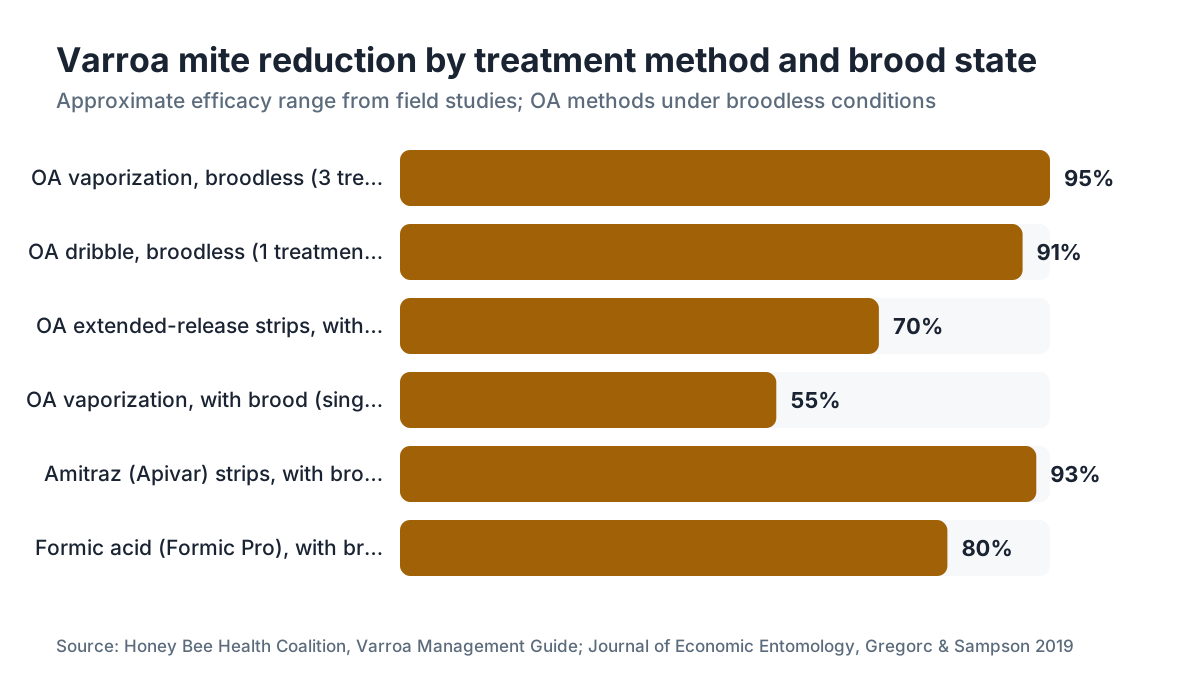
Oxalic acid (OA) is a dicarboxylic acid that shows up naturally in rhubarb, spinach, and, at low levels, in honey itself. Beekeepers reach for it because it kills Varroa destructor mites without leaving harmful residues in wax or honey at label doses. It is one of the few treatments that actually works on phoretic mites, the ones riding on adult bees. In a broodless colony, a single application can knock mite loads down by 90 percent or more.
The EPA registered the product Api-Bioxal (oxalic acid dihydrate) in the United States in 2015. The label covers three delivery methods: dribble, sublimation (vaporization), and an extended-release glycerin-soaked strip application approved in 2023. Each method has a different bee-safety profile, and that is where most of the confusion about whether OA hurts bees starts. [1]
For context on the mite problem these treatments solve, see our guide to the varroa mite.
Does oxalic acid kill or injure honey bees?
Not at label rates, applied correctly. That is the honest short answer. Studies keep showing that Api-Bioxal at 3.5 g active ingredient per colony produces bee mortality you cannot tell apart from untreated control colonies when you follow the label. The Honey Bee Health Coalition's Varroa management guide describes oxalic acid treatments as having "low toxicity to adult bees" with no significant brood damage during broodless periods. [2]
Bees get hurt when the product gets misused. Overdosing, treating in heat (above 50°F ambient is fine, but high hive temperatures during vaporization can stress bees), or dribbling onto a colony that still has open brood are the documented causes of excess losses. The brood piece matters most, and it gets its own section below.
At the cellular level, oxalic acid is thought to hurt Varroa by damaging the mite's cuticle and wrecking its metabolism. Bees have a different cuticle and some capacity to break down oxalic acid, so they tolerate what kills the mite. That tolerance is real. It is not unlimited.
How does oxalic acid affect bee brood?
Here is where OA loses its reputation as harmless. Direct contact with open (unsealed) brood causes brood damage, full stop. The dribble method applies an aqueous solution right over bees clustered in the frames, and it reaches open larvae when brood is present. Field studies have shown elevated larval mortality when OA solution touches open brood at treatment concentrations.
The Api-Bioxal label addresses this directly: the dribble and spray methods are approved only for broodless colonies or colonies with sealed brood. Vaporization has a slightly different profile because the vapor phase does not contact brood cells as directly, but the label still steers you toward broodless conditions for the best efficacy and the lowest risk. [1]
Sealed brood tolerates OA vapor reasonably well. Research from the mid-2010s found no statistically significant rise in sealed brood mortality from vaporization at label rates. [11] Do not read "sealed brood is okay" as permission to vaporize over and over through a full brood cycle and expect zero effect. The extended-release strip method delivers OA slowly over several weeks and is built to work through brood cycles. The 2023 label approval rested on data showing acceptable brood safety at that slow delivery rate. [1]
Treat in winter or during a broodless split whenever you can. The safety margin is much wider.
What does the EPA oxalic acid label actually say about bee safety?
The Api-Bioxal label is the legal document that controls what is permitted in the US, and you should read it directly instead of trusting summaries. A few specifics matter for bee safety.
The label sets the maximum single application at 3.5 g OA dihydrate per colony for dribble, and permits no more than one dribble or spray treatment per year. For vaporization, the label allows up to three treatments per broodless period, spaced at least five days apart. The extended-release strips (approved 2023) allow one application per colony per year. [1]
Residue data submitted to the EPA showed that background oxalic acid in honey, naturally around 7 to 10 mg/kg, was not meaningfully raised by Api-Bioxal treatments at label rates. [3][4]
The EPA's pesticide registration for OA runs under the Federal Insecticide, Fungicide, and Rodenticide Act (FIFRA), and the registration dossier is public through the EPA's pesticide registration portal. [3] Understanding EPA oxalic acid guidance for bees means going to the actual label, not a forum thread. The agency's registration review concluded that oxalic acid dihydrate used per label directions poses no unreasonable risk to pollinators. [3]
Does the application method change how much oxalic acid hurts bees?
It changes a lot. The three methods carry meaningfully different bee-safety profiles.
| Method | Brood contact risk | Approved colony state | Max applications/year | Bee mortality risk at label rate |
|---|---|---|---|---|
| Dribble (aqueous) | High if brood present | Broodless only | 1 | Low if broodless, elevated with open brood |
| Vaporization (sublimation) | Low to moderate | Broodless recommended | 3 per broodless period | Low |
| Extended-release strips (2023) | Low | Brood present acceptable | 1 | Low |
Dribble is the cheapest method to set up because it needs only a syringe or measuring device, but it carries the highest bee contact. You pour a roughly 3.5% w/v solution (35 g OA per liter of 1:1 sugar syrup) directly over the cluster, about 5 mL per occupied seam. Do this in January in a tight winter cluster with no brood and it is safe and effective. Do it in October with a full brood nest and you will damage larvae.
Vaporization uses a heated pan or electric sublimator to turn OA crystals into vapor inside the sealed hive. Bees walk through the vapor and it coats them and their phoretic mites. The main concern here is operator safety, not bee safety at label rates. The bigger risks to the bees are overheating the hive (especially in summer) and treating too often.
Extended-release strips soak in a glycerin-OA mixture and sit between frames, releasing OA slowly enough that it never overwhelms the colony's tolerance. The method is newer and its long-term resistance risk is debated, but the acute bee-safety data look good. [1][2]
How much oxalic acid is toxic to bees (what is the LD50)?
The acute contact LD50 for oxalic acid in honey bees is about 56 micrograms per bee, based on laboratory bioassay data submitted during the Api-Bioxal registration. [3] The dribble method delivers roughly 3.5 g of OA across a colony of tens of thousands of bees, so the per-bee dose lands well under the LD50 once it spreads across the cluster.
Vaporization deposits even less OA per bee. The action against Varroa at these doses looks like physical contact toxicity to the mite, not a pharmacological poisoning of the bee.
The oral LD50 is harder to pin down from public sources, but the oral route matters little for vaporization and dribble. The contact number is what drives risk assessment, and it gives the label dose a wide safety margin. Do not treat that margin as license to double the dose. It exists to cover variability in colony size, temperature, and how precisely you actually measure.
Does oxalic acid leave residues in honey?
The answer is reassuring, within limits. Oxalic acid occurs naturally in honey at roughly 7 to 10 mg/kg. [4] Multiple studies, including research cited in the Api-Bioxal registration data, found that treatment at label rates did not significantly raise honey OA above that natural background.
The EU-based studies the EPA drew on showed that honey from treated colonies was statistically indistinguishable from honey from untreated colonies for OA content, as long as treatments happened after the honey super came off or during honey-free periods. [4]
The Api-Bioxal label therefore requires that honey supers come off before dribble and vaporization treatments. If you use the extended-release strips and worry about residues, keep them out of the hive within 42 days of the honey flow. That buffer is conservative. The underlying data suggest the real residue increase is tiny, but the label requirement is what binds you legally. [1]
For anyone selling honey, this matters. Treat after harvest, follow the label timing, and the residue question stops being a question.
Can you overdose a colony with oxalic acid and what happens?
You can, and the signs are hard to miss. Overdosing with the dribble method, usually by pouring too much solution per seam or hitting a small cluster with a large brood area, shows up as dead larvae at the entrance, higher adult mortality for several days after treatment, and in bad cases a visibly distressed or absconding cluster.
Vaporization overdose is less common because the vapor disperses and dilutes, but rapid repeat treatments or dosing a tiny nucleus colony can push intra-hive OA high enough to cause noticeable adult losses.
The University of Florida IFAS extension puts it plainly: follow the label rate, because more is not better with oxalic acid. [5] Mite mortality does not climb much once you pass the effective threshold, but bee mortality does. You get worse returns on mite kill and better returns on bee damage. There is no reason to exceed the label.
To track whether treatments work instead of guessing, use a mite wash before and after. VarroaVault's free protocol tools walk you through the math on when to treat and how to verify efficacy.
Is oxalic acid safe for bees compared to other varroa treatments?
Among the registered options, OA has one of the better acute bee-safety profiles. Formic acid (MAQS, Formic Pro) causes measurable queen loss and brood damage at elevated temperatures, which is why its labels carry explicit temperature limits. Amitraz (Apivar strips) has low acute bee toxicity, but there are legitimate concerns about long-term exposure and resistance. Synthetic pyrethroids (tau-fluvalinate in Apistan) have documented resistance problems and some evidence of sublethal effects on bee learning and navigation at high residue levels. [2]
OA, by contrast, has no known resistance mechanism in Varroa yet (nobody should get comfortable about that), leaves negligible residues at label rates, and does not build up in wax. The Honey Bee Health Coalition's Varroa management guide ranks it among the preferred soft treatments for these reasons. [2]
The honest caveat is that OA cannot penetrate capped cells. That means it needs either broodless conditions or the extended-release delivery to be fully effective. That is a timing and management constraint, not a toxicity problem, but it explains why beekeepers sometimes see disappointing kill rates when they treat at the wrong time.
For a full look at treatment options and supplies, the beekeeping supply companies roundup covers where to source Api-Bioxal and other registered treatments.
Does oxalic acid affect queen bees specifically?
The evidence here is mixed, so the honest answer needs some hedging. Adult queens tolerate OA at label rates the same general way workers do, and controlled studies do not show strong evidence that one properly applied dribble or vaporization treatment causes queen loss above background rates.
Still, beekeeper reports of queen loss after OA vaporization come up often enough to take seriously. The proposed mechanism is not direct OA poisoning of the queen but disruption of retinue behavior and the brood pheromone environment in the hours and days after treatment. Some beekeepers report queens pausing egg-laying briefly. Most resume within a week.
The highest risk shows up in very small colonies, nucs, and packages, where the retinue around the queen is thin and the combined disturbance can tip a marginal queen toward failure. Treating a large, well-established colony with a known-mated queen carries much lower practical risk.
The brood question circles back here too. If a queen is mid-way through a strong laying cycle and you dribble OA through the brood nest, you risk damaging larvae and disrupting the colony's developmental rhythm in ways that indirectly stress her. Broodless application removes that mechanism entirely.
What are the real risks of oxalic acid to the beekeeper, not the bees?
OA is far more hazardous to the person applying it than to the bees, and that deserves plain talk. Vaporization produces an airborne acid that causes severe respiratory damage at occupational exposure levels. The NIOSH recommended exposure limit for OA dust and vapor is 1 mg/m³ as a time-weighted average. [6]
The Api-Bioxal label requires anyone using a vaporizer to wear a NIOSH-approved respirator rated for acid vapors, goggles, and appropriate gloves. Most extension programs strongly recommend an OV/P100 combination cartridge respirator rather than a bare N95. [1] This is not safety theater. Oxalic acid fumes cause irreversible lung damage with repeated unprotected exposure.
Dribble application is lower risk because there is no airborne vapor, but you should still keep the concentrated solution off your skin (3.5% OA irritates) and wear eye protection.
Anyone upgrading their beekeeping supplies for OA treatment should budget for a proper half-face respirator with acid-rated cartridges. The sublimator is often the cheapest part of the setup. The PPE should not be.
How should you time oxalic acid treatment to minimize harm to the colony?
Timing is the single biggest factor in whether OA treatment goes well or badly for the colony. The best window for dribble and vaporization is a natural or induced broodless period, usually one of three:
- Midwinter cluster (December through January across most of North America), when queens naturally stop laying.
- After a split, or after caging the queen for at least 24 days so all capped brood emerges.
- During a swarm, before the new queen starts laying.
Midwinter is the classic timing and it works for most temperate climates. A single dribble or a three-vaporization sequence during a broodless winter period can drop mite loads by 90 to 97 percent in documented trials. [2][11]
The extended-release strip method exists precisely because many beekeepers cannot or will not wait for a broodless window. Strips placed in the brood area during late summer, before mite populations peak, release OA slowly over four to eight weeks and contact phoretic mites across multiple mite generations. Reach for this if you missed the window or run enough colonies that inducing broodlessness is not practical. [10]
A useful rule from the University of Minnesota extension: do an alcohol wash in August. If you are above 2 mites per 100 bees, treat immediately, brood state be damned. High August mite loads kill colonies long before you ever reach the ideal winter window. [7]
Where can you find reliable oxalic acid guidance beyond the label?
The label is your legal floor. Several resources go deeper on practical application.
The Honey Bee Health Coalition publishes a free, regularly updated Varroa management guide covering every registered treatment, threshold, and integrated pest management strategy. It is probably the most useful single reference for hobbyist and sideliner beekeepers in the US. [2]
Extension programs at the University of Minnesota, University of Florida IFAS, Penn State, and Oregon State all keep free online guides with state-specific timing and dosing. [5][7][8][10] Bookmark them, because they update when new label amendments land (as happened with the 2023 strip approval).
The EPA's pesticide registration portal holds the full Api-Bioxal label and registration support documents, including the bee toxicology data, as public PDFs. [3]
For tracking mite levels and figuring out treatment timing against your local climate and colony state, VarroaVault's free protocol tools give you a decision framework so you are not guessing when the broodless window actually opens in your region. Pair that with the HBHC threshold (3 mites per 100 bees as a treatment trigger during brood-rearing season) and you get a defensible decision point instead of calendar-based guessing. [2]
Frequently asked questions
Can I use oxalic acid when there is brood in the hive?
For dribble and vaporization, the Api-Bioxal label recommends broodless conditions, since direct contact with open brood causes larval damage. The extended-release glycerin strip method, approved in 2023, is designed for use when brood is present and delivers OA slowly enough to avoid significant brood harm. If you must treat with brood and only have a vaporizer, efficacy drops but acute brood damage stays lower than with the dribble method.
How long does oxalic acid stay in the hive after treatment?
Oxalic acid is water-soluble and does not build up in wax the way synthetic acaricides do. Studies measuring OA residues in comb wax after treatment found levels returning to background within one to two months. Residues in honey from treated colonies were not significantly above the natural background of 7 to 10 mg/kg when the label's timing requirements, mainly removing honey supers before treatment, were followed.
Does vaporizing oxalic acid hurt the queen bee?
Controlled studies have not found a statistically significant queen loss rate tied to OA vaporization at label rates in established colonies. Beekeeper reports of post-treatment queen issues do exist, and the risk looks highest in very small colonies and nucs where the retinue around the queen is thin. Treating large, established colonies during a natural broodless period carries the lowest practical risk to the queen.
How many oxalic acid vaporization treatments can I do per year?
The Api-Bioxal label allows up to three vaporization treatments per broodless period, with at least five days between applications. There is no explicit total annual limit on vaporization beyond that per-period restriction, but the label's intent is that you treat once per broodless window. The extended-release strip method is limited to one application per colony per year.
Is oxalic acid treatment organic or certified for organic beekeeping?
Yes. The USDA's National Organic Program allows oxalic acid for varroa control in certified organic operations, provided you use the EPA-registered product (Api-Bioxal) at label rates. Using unlabeled or non-registered OA sources, even the identical chemical, does not satisfy organic certification and violates FIFRA.
What PPE do I need when applying oxalic acid to my hives?
For vaporization, the Api-Bioxal label requires a NIOSH-approved respirator for acid vapors (an OV/P100 half-face respirator is the practical choice), chemical splash goggles, and nitrile gloves. Do not treat enclosed spaces without ventilation. For the dribble method, airborne exposure is much lower, but eye protection and gloves are still required by the label. Respiratory exposure to OA vapor causes irreversible lung damage.
Why does oxalic acid kill mites but not bees?
Varroa mites are arachnids with a thin, permeable cuticle that OA penetrates easily, disrupting their metabolism and water balance. Honey bees have a thicker, waxy cuticle with different chemistry and some capacity to metabolize OA. The contact LD50 for bees is about 56 micrograms per bee, and the label dose spreads well below that threshold across the colony. Mites have no comparable tolerance mechanism.
Can I use oxalic acid on packages and nucs?
Packages are a strong use case for the dribble method because they are almost always broodless. A single application to a freshly hived package is highly effective and low risk. Nucs vary more. If a nuc has open brood and you dribble, expect some larval damage. Vaporization is safer than dribbling for nucs with brood, though efficacy drops compared to a broodless application.
Does oxalic acid harm bumblebees or other pollinators near the hive?
OA treatment stays inside the managed hive. Sublimation vapor is contained by sealing hive entrances during treatment and waiting 10 to 15 minutes before reopening. Residue drift to nearby forage plants or other pollinators has not been documented as a meaningful exposure pathway at the scale of a single hive treatment. The EPA's registration found no unreasonable risk to non-target insects from label-compliant use.
How effective is oxalic acid compared to synthetic varroa treatments?
In broodless colonies, a single dribble or three-vaporization sequence achieves 90 to 97 percent mite reduction in documented trials, comparable to or better than Apivar strips in the same timeframe. The catch is that OA does not penetrate capped cells, so efficacy in colonies with brood drops to 40 to 70 percent for one treatment. Synthetic acaricides like amitraz work through brood cycles and can be more practical when broodless timing is not feasible.
What concentration of oxalic acid solution do you mix for the dribble method?
The Api-Bioxal label calls for 35 g OA dihydrate dissolved in 1 liter of 1:1 sugar-to-water syrup by weight, yielding about a 3.5% w/v OA solution. Apply 5 mL per occupied bee seam, not per frame, with a maximum of 50 mL per colony. A stronger solution does not improve mite kill and raises the risk of bee mortality.
When is the best time of year to treat with oxalic acid?
Midwinter (December through January in temperate North America) is the classic timing because colonies are naturally broodless or nearly so. A secondary window is after a late-summer split where the queen has been caged or removed for at least 24 days. The Honey Bee Health Coalition recommends checking mite loads in August and treating immediately if counts exceed 2 to 3 mites per 100 bees, regardless of brood state, using the method best suited to conditions.
Is homemade or raw oxalic acid the same as Api-Bioxal?
Chemically, oxalic acid dihydrate is the same compound. But using any product other than EPA-registered Api-Bioxal on managed honey bee colonies is illegal in the US under FIFRA. That includes lab-grade or food-grade OA bought elsewhere. The registration process verified purity, formulation, and efficacy data that generic sources have not gone through. Organic certification also requires the registered product specifically.
Sources
- EPA, Api-Bioxal (Oxalic Acid) Pesticide Label: Api-Bioxal approved at 3.5 g active ingredient per colony; three delivery methods; extended-release strip approved 2023; honey supers must be removed before dribble and vaporization treatments
- Honey Bee Health Coalition, Varroa Management Guide: OA treatments have low toxicity to adult bees and no significant brood damage in broodless colonies; 3 mites per 100 bees is the treatment threshold during brood season
- EPA, Oxalic Acid Biopesticide Registration (EPA Reg. No. 80569-1): EPA found oxalic acid dihydrate at label rates poses no unreasonable risk to pollinators; contact LD50 approximately 56 micrograms per bee; honey residue data showed no significant increase above natural background
- Journal of Apicultural Research, Bogdanov et al. 2002 - OA residues in honey: Natural oxalic acid concentration in honey is approximately 7 to 10 mg/kg; OA treatment at label rates did not significantly raise honey OA above natural background
- University of Florida IFAS Extension, Varroa Mite Management: Following the label rate is non-negotiable for OA; increased dose does not significantly improve mite kill but does increase bee mortality
- NIOSH, Oxalic Acid Occupational Exposure Limit: NIOSH recommended exposure limit for oxalic acid dust and vapor is 1 mg/m3 as a time-weighted average; respiratory damage occurs with repeated unprotected vapor exposure
- University of Minnesota Extension, Varroa Mite Management for Beekeepers: August alcohol wash threshold of 2 mites per 100 bees triggers immediate treatment regardless of brood state; high August mite loads kill colonies before ideal winter treatment window
- Penn State Extension, Controlling Varroa Mites in Honey Bee Colonies: Vaporization efficacy data and broodless period timing recommendations for OA in temperate North American climates
- USDA Agricultural Marketing Service, National Organic Program Allowed and Prohibited Substances: Oxalic acid is an approved substance under the USDA National Organic Program for varroa control in certified organic operations when using EPA-registered products
- Oregon State University Extension, Honey Bee Health and Varroa Treatment: Extended-release OA strip efficacy and application timing guidance for colonies with brood present
- Journal of Economic Entomology, Gregorc & Sampson 2019 - OA efficacy and bee safety comparison: Single broodless-period OA vaporization sequences achieve 90 to 97 percent mite reduction; sealed brood mortality not statistically significant compared to untreated controls
Last updated 2026-07-10