Apiary Layout and Varroa: How Hive Arrangement Affects Drift and Reinfestation
Most beekeepers think about varroa as a per-colony problem. The mites are in your hives, you treat, the mites go down. But varroa is really an apiary-level problem. Mites move between colonies constantly through drifting bees, robbing, and swarms. If your apiary layout encourages high drift rates, you're fighting reinfestation every single season regardless of how well you treat.
Arranging hives in a non-linear pattern with varied entrances reduces average drift from 30% to 8% per colony. That's a substantial difference. It means lower baseline reinfestation pressure and better treatment outcomes because you're not immediately reloading with mites from neighboring hives.
TL;DR
- Treatment decisions should always be triggered by a mite count result, not a fixed calendar date
- Different treatments have different temperature requirements, PHI restrictions, and brood penetration capabilities
- Always run a post-treatment count 2-4 weeks after treatment ends to calculate efficacy
- Efficacy below 80% warrants investigation -- possible resistance, application error, or reinfestation
- Rotate treatment chemistry to prevent resistance buildup across successive cycles
- VarroaVault logs treatment events, calculates efficacy, and flags when rotation is recommended
How Drifting Spreads Varroa
Forager and drone bees drift regularly. In a standard row layout with identical hive bodies facing the same direction at uniform spacing, bees returning from forage frequently enter the wrong hive. Studies measuring drift in row apiaries consistently find that 25-35% of bees enter a hive other than their own at least some of the time.
Drifting bees carry phoretic mites. When a bee from a high-mite colony drifts into your low-mite colony, she brings mites with her. In an apiary where you've treated some colonies and not others, drifting actively undermines your treatment program. It's not just a theoretical concern. It's happening every flying day.
Layout Principles That Reduce Drift
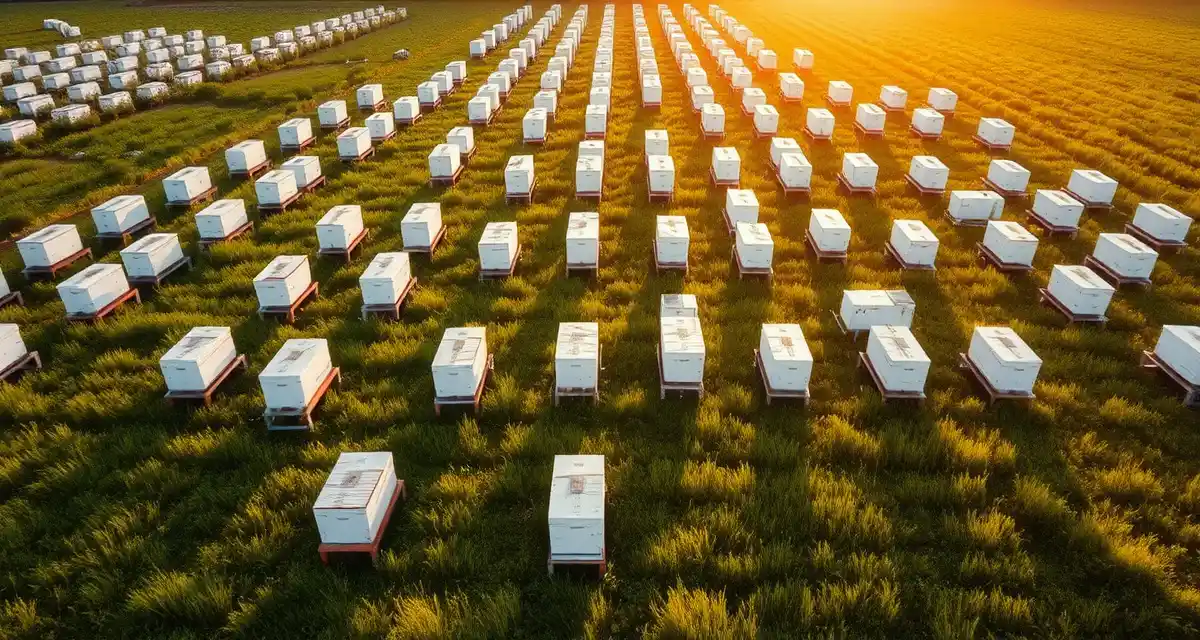
Avoid straight rows. In a straight row with all hives facing the same direction, returning bees use adjacent hives as landmarks and frequently enter the wrong one. A slight curve, an angled arrangement, or staggered rows all help bees identify their own hive.
Vary entrance orientation. When entrances face different compass directions, each hive has a distinct flight path. This is one of the single most effective drift reduction techniques available. Entrances facing north, south, east, and west create four distinct navigation environments.
Use visual landmarks at each hive. Paint hive bodies different colors, use different landing board shapes, or place a distinctive object near each entrance. Bees recognize visual patterns and use them for navigation. Varied landmarks significantly reduce entrance confusion.
Increase spacing where possible. The closer hives are, the more drift occurs. Ideal spacing is three to four feet between adjacent hive bodies. This isn't always possible in a small yard, but even an extra foot of separation helps.
Arrange hives in clusters rather than lines. Small groups of three to five hives arranged in a rough circle or chevron pattern drift less than hives arranged in a single long row, even at the same total density.
Special Considerations for Robbing Season
Drift and robbing are related but distinct problems. Robbing, which peaks during dearth periods in late summer, involves bees from strong colonies actively raiding weak ones. A collapsing high-mite colony is a particularly attractive robbing target because weakened colonies defend poorly.
When strong colonies rob a collapsing hive, they carry mites back with them. Reducing robbing during late summer is a direct varroa management tool. Entrance reducers on weak colonies, avoiding feeding that attracts attention, and not opening hives during dearth periods all help.
Your apiary layout affects robbing risk too. Hives placed too close together, especially in a row where robbers can move from hive to hive easily, experience higher robbing pressure than scattered hives with more physical separation.
Using VarroaVault's GPS Mapping for Layout Planning
The apiary layout tool in VarroaVault's GPS mapping module allows you to visualize hive orientation and spacing for drift reduction. You can place hive icons on a satellite map of your apiary, assign entrance directions, and see at a glance which hives are positioned close together or facing the same direction.
This is useful at initial setup, but it's also valuable for troubleshooting. If you notice that one corner of your apiary consistently has higher mite counts than the rest, the GPS map may reveal a layout problem, such as several hives facing the same direction or clustering near a flight path bottleneck. Pair this tool with GPS hive mapping to document your apiary's physical configuration.
Drift Reduction in Practice: What to Expect
Changing your apiary layout won't eliminate reinfestation. External mite pressure from feral colonies and neighboring apiaries will still affect you regardless of your internal layout. But reducing internal drift reduces the reinfestation rate from treated hives and untreated hives within your own operation.
In practical terms, this means your post-treatment counts stay lower for longer. It means that treating one weak colony doesn't immediately get undone by a drifting bee from the untreated strong colony next door. It means your treatment program is working against a smaller moving target.
Review your layout alongside our detailed guide on varroa mite drifting to understand the full scope of how mites move between colonies and what you can do at the apiary level to slow it down.
When to Rearrange
If you're already established with an existing layout, rearranging isn't always practical. Making small adjustments, reorienting a few entrances, adding visual landmarks, and separating hives that are particularly close together, can improve things without a full redesign.
If you're starting fresh or building out a new apiary site, this is the time to get the layout right. Five minutes of planning before you set up can reduce your varroa management workload for every subsequent season.
Frequently Asked Questions
How should I arrange my hives to reduce varroa reinfestation?
Avoid straight rows of uniformly-oriented hives. Instead, arrange hives in staggered clusters with entrances facing different compass directions. Use visual landmarks near each entrance to help bees identify their own hive. Maintain at least three to four feet of spacing between adjacent hive bodies where possible. These steps reduce drifting, which is the primary mechanism for mite transfer within an apiary. A non-linear layout with varied orientations can reduce drift rates from 30% to roughly 8% on average.
Does hive spacing affect mite transmission?
Yes, directly. Bees drift more frequently between closely-spaced hives because they use neighboring hive bodies as navigation landmarks. When bees drift from a high-mite colony to a low-mite one, they carry phoretic mites with them, effectively transferring varroa between colonies. Wider spacing and varied entrance orientations reduce drift rates, which in turn reduces the rate at which mites move from high-infestation colonies to treated or low-infestation ones.
Does VarroaVault's GPS mapping tool support apiary layout planning?
Yes. The GPS mapping module in VarroaVault lets you place hive icons on a satellite map of your apiary location, assign entrance directions, and visualize the overall layout. You can use this to identify drift risk factors like closely-spaced hives facing the same direction. It's also useful for troubleshooting persistent high-count areas within an apiary, since physical layout problems often explain count patterns that aren't easily explained by colony-level management alone.
How do I know if my varroa treatment is working?
Run a mite count 2-4 weeks after the treatment ends and compare it to your pre-treatment count. The efficacy formula is: ((pre-count - post-count) / pre-count) x 100. A result above 90% indicates effective treatment. Results below 80% should trigger investigation for possible resistance, application error, or reinfestation. Log both counts in VarroaVault to track efficacy trends across treatment cycles.
How often should I check mite levels in my hives?
At minimum, once per month (every 3-4 weeks) during the active season. Increase to every 2 weeks when counts are near threshold or after a treatment to verify it worked. In fall, monitoring frequency matters most because the window to treat before winter bees are raised is narrow. VarroaVault's monitoring reminders can be set to your preferred interval for each apiary.
What records should I keep for varroa management?
Each record should include: date of count or treatment, hive identifier, monitoring method used, number of bees sampled, mites counted, infestation percentage, treatment product name and EPA registration number, dose applied, treatment start and end dates, and PHI end date. State apiarists typically expect this level of detail during inspections. VarroaVault captures all of these fields in a single log entry.
What is Apiary Layout and Varroa: How Hive Arrangement Affects Drift and Reinfestation?
This article explains how the physical arrangement of hives in your apiary directly influences varroa mite levels across all your colonies. Rather than treating varroa as a per-hive issue, it frames reinfestation as an apiary-wide problem driven by bee drift and robbing behavior. It covers how switching from linear to varied hive layouts can reduce drift rates from roughly 30% down to 8%, significantly lowering the mite pressure your colonies face between treatment cycles.
How much does Apiary Layout and Varroa: How Hive Arrangement Affects Drift and Reinfestation cost?
The article and VarroaVault's core guidance are free to read. VarroaVault offers tools that log treatment events, track mite counts, calculate treatment efficacy, and flag when chemistry rotation is needed. Pricing for those tracking features depends on the current VarroaVault plan tiers — check the VarroaVault pricing page for up-to-date subscription details.
How does Apiary Layout and Varroa: How Hive Arrangement Affects Drift and Reinfestation work?
Bee drift — where foragers return to the wrong hive — transfers varroa mites between colonies continuously. Linear hive rows with identical entrances dramatically increase drift rates. By staggering hive positions, varying entrance orientations, and using landmarks or color coding, bees navigate more accurately. Fewer drifting bees means fewer mites crossing colony boundaries, so your treatments hold longer and your post-treatment mite counts stay low rather than rebounding quickly from neighboring hives.
What are the benefits of Apiary Layout and Varroa: How Hive Arrangement Affects Drift and Reinfestation?
Optimizing apiary layout reduces baseline reinfestation pressure, meaning your varroa treatments achieve better real-world efficacy. You spend less on repeated treatment rounds, your colonies stay healthier between cycles, and you get cleaner data when calculating treatment efficacy. It also reduces the risk of resistance developing by lowering how hard you need to lean on any single treatment chemistry to compensate for constant mite reintroduction from adjacent hives.
Who needs Apiary Layout and Varroa: How Hive Arrangement Affects Drift and Reinfestation?
Any beekeeper managing more than one hive benefits from understanding apiary layout and drift. It is especially critical for those who treat consistently but still see mite counts rebound quickly after treatment — a classic sign of reinfestation rather than treatment failure. Hobbyists running backyard apiaries, sideliners with multiple yards, and commercial operations alike can reduce mite pressure significantly by rethinking how hives are positioned relative to each other.
Related Articles
- Varroa Management for Isolated Apiaries: Low Reinfestation Risk Strategies
- Varroa Treatment for Small-Scale Commercial Operations: 50-200 Hive Logistics
Sources
- American Beekeeping Federation (ABF)
- USDA ARS Bee Research Laboratory
- Honey Bee Health Coalition
- Penn State Extension Apiculture Program
- Project Apis m.
Get Started with VarroaVault
The information in this guide is most useful when you have your own mite count data to apply it to. VarroaVault stores every count, flags threshold crossings automatically, and builds the treatment history you need for state inspections and effective management decisions. See pricing and free tools at varroavault.com.