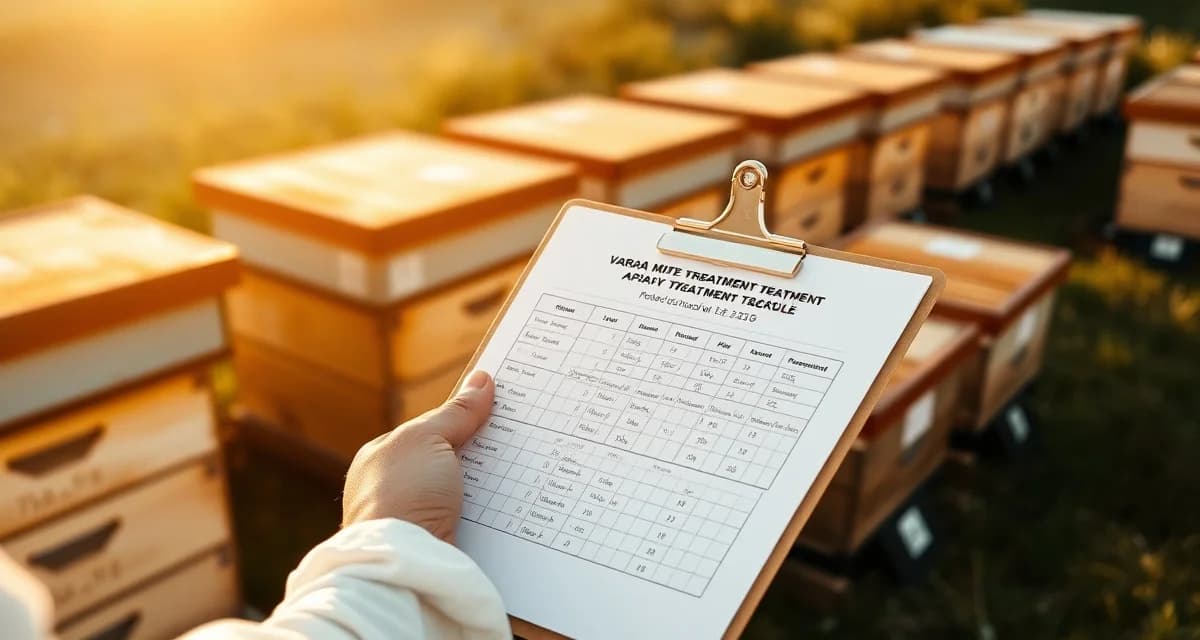
Varroa Treatment Strategy for Split Apiaries: Different Locations, Different Programs
Beekeepers with 3 or more apiaries who use a single treatment schedule for all locations miss location-specific windows in 60% of cases. That number is striking because it suggests that the default approach -- treating all your locations the same way on the same schedule -- is systematically failing more than half the time at sites where conditions differ from the average.
If you keep bees at multiple locations, each of those locations has its own microclimate, its own honey flow timing, its own reinfestation risk, and potentially its own pest pressure history. A unified treatment program that ignores these differences is a program that's wrong for at least some of your locations all the time.
TL;DR
- Treatment decisions should always be triggered by a mite count result, not a fixed calendar date
- Different treatments have different temperature requirements, PHI restrictions, and brood penetration capabilities
- Always run a post-treatment count 2-4 weeks after treatment ends to calculate efficacy
- Efficacy below 80% warrants investigation -- possible resistance, application error, or reinfestation
- Rotate treatment chemistry to prevent resistance buildup across successive cycles
- VarroaVault logs treatment events, calculates efficacy, and flags when rotation is recommended
Why Location Differences Matter So Much
Different nectar flows. A mountain apiary and a valley apiary 30 miles apart can have spring flows that differ by 3-4 weeks. When honey supers are on at one location but not another, your PHI calculations and treatment product choices diverge. Treating your mountain apiary with Apivar in June (no supers) while your valley apiary has full supers on is the right call for both -- but it requires managing them separately.
Different mite pressure. An isolated rural apiary with no other managed bees within 3 miles has a fundamentally different reinfestation risk than a suburban apiary surrounded by unmanaged feral colonies and neighbors who keep bees. The isolated apiary can extend its post-treatment monitoring intervals; the high-density location may need more frequent checks.
Different climate microclimates. Elevation differences create temperature variation that affects treatment timing. A valley apiary at 500 feet elevation may have formic acid conditions available 3 weeks before a mountain apiary at 3,000 feet. The broodless period may arrive 2-3 weeks earlier at the mountain site.
Different honey flow status. If one apiary is being used for honey production and another is in a pollination placement, PHI rules and timing constraints are completely different. Managing them with the same schedule creates compliance risk at the pollination site.
Building Per-Location Programs
The location-specific program builder in VarroaVault generates a separate treatment calendar for each apiary based on its GPS coordinates. Each apiary's calendar reflects its own USDA hardiness zone, regional bloom timing, and frost dates -- not a national average.
Here's how to build your per-location program:
Step 1: Register each apiary separately in VarroaVault. Every apiary should have its own location record with GPS coordinates or at minimum a ZIP code. This is the foundation that allows the system to generate location-specific calendars.
Step 2: Set the honey production status for each apiary. Mark apiaries that are in active honey production versus those in pollination placement, queen rearing, or other non-honey uses. The treatment planner restricts product selections based on your stated super status.
Step 3: Log your local flow events. When you observe nectar flow starting at a specific apiary, log it. When supers go on, log it. These events update the treatment recommendation calendar for that specific location.
Step 4: Set your monitoring frequency per location. High-reinfestation-risk locations need monthly monitoring. Isolated locations with low reinfestation risk can extend to 6-week intervals between counts. The varroa mite monitoring every apiary guide covers frequency recommendations by isolation level.
The PHI Calculation Problem in Multi-Apiary Operations
PHI tracking becomes genuinely complicated when you have multiple apiaries with different honey super timelines. Missing a PHI calculation at one location while correctly managing the others exposes you to compliance risk on that site's honey.
Consider a three-apiary operation:
- Apiary A: Spring flow, supers on April 15, planned removal September 15
- Apiary B: No current flow, supers not on, expected installation July 1
- Apiary C: Pollination placement, no supers allowed until post-placement PHI clearance
Each of these apiaries has completely different treatment eligibility right now. At Apiary A with supers on, you're limited to treatments that allow super-on application (Api-Bioxal, MAQS, Formic Pro, HopGuard) and must plan removal timing for Apivar if you plan to use it in fall. At Apiary B, you have full treatment flexibility until July. At Apiary C, your treatment timing is constrained by the pollination contract.
The multi-apiary management software section of VarroaVault Professional manages this complexity automatically. Every treatment entry is evaluated against the honey super status logged for that specific apiary, and any treatment selection that would violate PHI for that location triggers a compliance warning before you submit the record.
Coordinating Treatment Days Across Locations
Treating multiple apiaries on separate days requires planning. Each location needs its own treatment day on the calendar, its own supply allocation, and its own post-treatment count date.
For a 3-apiary operation doing a fall Apivar treatment:
- Order supplies: 2 strips per colony across all three apiaries combined
- Schedule treatment Day 1 for Apiary A (closest, largest)
- Schedule treatment Day 2 for Apiaries B and C (schedule together if possible to reduce driving)
- Log each apiary's treatment separately in VarroaVault
- Set post-treatment count reminders at the right time per apiary based on each one's treatment date (not a single unified date)
This may seem like extra work, but it's the difference between managing your apiaries deliberately and managing them generically -- and generic management is what creates the 60% window-miss rate cited at the top of this guide.
Reinfestation Risk by Location
Not all apiaries need the same monitoring frequency or the same level of post-treatment vigilance. A mountain apiary 4 miles from the nearest other hives has low reinfestation risk and can space post-treatment monitoring to 6-week intervals. A suburban apiary with three other beekeepers within a half-mile radius needs post-treatment monitoring at 3-4 weeks because reinfestation can rebuild counts quickly.
Log each apiary's isolation status in VarroaVault. The system adjusts recommended monitoring frequencies and post-treatment count timing based on your recorded isolation level.
Frequently Asked Questions
How do I build different varroa programs for different apiaries?
Start by registering each apiary as a separate location in VarroaVault with its own GPS coordinates or ZIP code. Then set each apiary's honey production status, honey super timeline, and isolation level. The location-specific program builder generates a separate treatment calendar for each apiary reflecting its own flow timing, frost dates, and hardiness zone. When you log a treatment or count, assign it to the specific apiary so your records are separated by location rather than combined into a single undifferentiated log.
Should my mountain apiary have a different schedule than my valley apiary?
Almost certainly, yes -- at least for treatment product choices and timing. Temperature differences that affect formic acid application windows, different nectar flow timing that changes when supers go on, and possibly different first frost dates that shift the fall treatment window all contribute to location-specific optimal schedules. A mountain apiary at 3,000 feet may need fall treatment 2-3 weeks earlier than a valley apiary, and the broodless period for OA dribble may arrive 3-4 weeks earlier at the higher elevation.
Does VarroaVault support per-apiary treatment programs?
Yes. VarroaVault Professional includes a location-specific program builder that generates a separate treatment calendar for each apiary in your account. Each calendar is based on the GPS coordinates and honey super status you've logged for that location. PHI tracking is per-apiary rather than account-wide, so treatment eligibility is evaluated independently for each site. Treatment day scheduling, post-treatment count reminders, and efficacy tracking all operate at the apiary level.
How do I know if my varroa treatment is working?
Run a mite count 2-4 weeks after the treatment ends and compare it to your pre-treatment count. The efficacy formula is: ((pre-count - post-count) / pre-count) x 100. A result above 90% indicates effective treatment. Results below 80% should trigger investigation for possible resistance, application error, or reinfestation. Log both counts in VarroaVault to track efficacy trends across treatment cycles.
How often should I check mite levels in my hives?
At minimum, once per month (every 3-4 weeks) during the active season. Increase to every 2 weeks when counts are near threshold or after a treatment to verify it worked. In fall, monitoring frequency matters most because the window to treat before winter bees are raised is narrow. VarroaVault's monitoring reminders can be set to your preferred interval for each apiary.
What records should I keep for varroa management?
Each record should include: date of count or treatment, hive identifier, monitoring method used, number of bees sampled, mites counted, infestation percentage, treatment product name and EPA registration number, dose applied, treatment start and end dates, and PHI end date. State apiarists typically expect this level of detail during inspections. VarroaVault captures all of these fields in a single log entry.
What is Varroa Treatment Strategy for Split Apiaries: Different Locations, Different Programs?
A varroa treatment strategy for split apiaries means managing mite control differently across each of your apiary locations rather than applying one unified schedule. Because each site has its own microclimate, honey flow timing, and reinfestation risk, a single calendar-based program fails to hit optimal treatment windows at more than 60% of locations. This approach uses mite count data to trigger location-specific decisions, selects treatments based on temperature and brood conditions at each site, and tracks efficacy independently per apiary.
How much does Varroa Treatment Strategy for Split Apiaries: Different Locations, Different Programs cost?
Varroa treatment strategy for split apiaries is not a product with a price—it is a management methodology. The cost depends on the treatments you select (oxalic acid, formic acid, amitraz strips, etc.) and how many hives you manage across locations. What changes is not your spend on treatments but how you schedule and track them. Using a tool like VarroaVault to log counts and calculate efficacy per site adds structure without significant added cost.
How does Varroa Treatment Strategy for Split Apiaries: Different Locations, Different Programs work?
The approach works by replacing fixed calendar dates with mite-count triggers. You monitor each apiary independently, treat when thresholds are exceeded, and then run a post-treatment count 2–4 weeks after the treatment period ends to calculate efficacy. Treatment selection accounts for local temperature ranges, honey super presence, and PHI restrictions. Chemistry is rotated across cycles to limit resistance development. Each location is essentially managed as its own program that shares a framework but responds to site-specific data.
What are the benefits of Varroa Treatment Strategy for Split Apiaries: Different Locations, Different Programs?
The primary benefit is precision: treatments hit when and where they are actually needed rather than when a shared schedule says so. This reduces mite load more effectively, lowers unnecessary chemical exposure, and helps identify underperforming treatments early through efficacy tracking. Rotating chemistry across locations also slows resistance development. Beekeepers managing three or more sites gain the biggest advantage, as location-specific programs catch the timing gaps that a unified schedule systematically misses at roughly 60% of sites.
Who needs Varroa Treatment Strategy for Split Apiaries: Different Locations, Different Programs?
Any beekeeper managing hives across two or more separate locations benefits from this approach, but it becomes critical at three or more apiaries. Hobbyists with a home yard and an out-yard, sideliners, and commercial operations all face the same problem: conditions differ between sites. Beekeepers who have seen inconsistent treatment results, unexpected colony losses, or declining efficacy over successive treatments are especially likely to benefit from switching to location-specific, count-triggered management rather than a one-size-fits-all calendar program.
Sources
- American Beekeeping Federation (ABF)
- USDA ARS Bee Research Laboratory
- Honey Bee Health Coalition
- Penn State Extension Apiculture Program
- Project Apis m.
Get Started with VarroaVault
The information in this guide is most useful when you have your own mite count data to apply it to. VarroaVault stores every count, flags threshold crossings automatically, and builds the treatment history you need for state inspections and effective management decisions. See pricing and free tools at varroavault.com.