Organic varroa treatment options for certified beekeepers

TL;DR
- Certified beekeepers have four legal organic varroa treatments: oxalic acid (Api-Bioxal), formic acid (Formic Pro, MAQS), thymol (Apiguard, ApiLife VAR), and hop beta acids (HopGuard 3).
- All four are EPA-registered and permitted under USDA organic rules.
- Efficacy runs from 93-97% for an oxalic acid dribble on broodless colonies down to 30-50% for a single HopGuard strip.
What counts as an 'organic' varroa treatment, and do they actually work?
An organic varroa treatment is one whose active ingredient comes from a naturally occurring compound and is registered by the EPA under FIFRA for use in honey bee colonies. Four ingredient groups matter: oxalic acid (found in rhubarb and other plants), formic acid (from ant venom and plant metabolism), thymol (from thyme oil), and hop beta acids (from hops). All four sit on the USDA National Organic Program's National List under 7 CFR 205.606, which is what makes them compatible with certified organic honey. [1]
Do they work? Yes, with real caveats. No organic treatment matches a well-timed synthetic on a heavily infested colony in July. These compounds need correct timing, the right temperature, and often a broodless or near-broodless window to hit numbers worth bragging about. Used wrong, you kill mites and lose colonies at the same time. Used right, you can hold mite loads under the 2-3% action threshold the Honey Bee Health Coalition recommends. [2]
The word 'organic' fools people. It doesn't mean harmless. Oxalic acid at the wrong dose burns brood. Formic acid past 90 degrees F can kill queens. Respect these the way you'd respect any miticide, because that's what they are.
What are the main organic varroa treatments available in the U.S.?
Four options cover almost every certified apiary. Here's how they stack up. All efficacy figures come from peer-reviewed or extension-published data, and real-world results swing lower.
| Treatment | Active ingredient | Approved form(s) | Typical efficacy | Temperature window | Brood requirement |
|---|---|---|---|---|---|
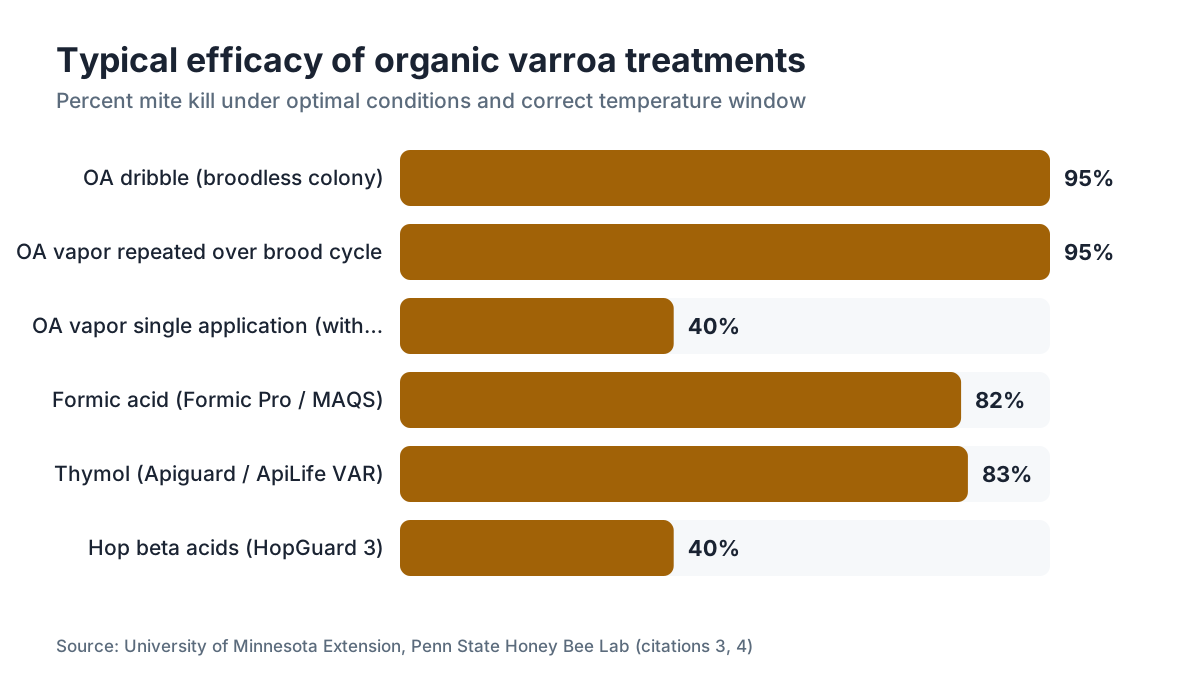
| Oxalic acid dribble | Oxalic acid dihydrate | Api-Bioxal | ~93-97% | Any (best below 50°F for winter cluster) | Broodless colonies only |
| Oxalic acid vaporization | Oxalic acid dihydrate | Api-Bioxal | ~90-99% repeated; ~40% single treatment with brood | Any above ~25°F | Works with brood present if repeated |
| Formic acid pads | Formic acid | Formic Pro, MAQS | ~74-90% | 50-85°F (Formic Pro); 50-92°F (MAQS) | Works with brood sealed |
| Thymol gel/strips | Thymol | Apiguard, ApiLife VAR | ~74-93% | 59-105°F (optimal 65-85°F) | Works with brood |
| Hop beta acids | Hop beta acids | HopGuard 3 | ~30-50% single strip | 50-100°F | Works with brood |
Sources: University of Minnesota Extension [3], Pennsylvania State University Honey Bee Lab [4], EPA product labels [5].
A few things jump off that table. Repeated OA vapor is the strongest option, but it eats your time. HopGuard 3 is the weakest performer in most trials and earns its place in a rotation, not as a standalone. Formic acid is the only organic that reaches into capped brood cells and kills reproductive mites where they hide.
For the biology behind all this, the varroa mite article covers how the mite reproduces before you pick a strategy.
How do you use oxalic acid correctly, and when is it most effective?
Oxalic acid is the most widely used organic miticide in hobbyist apiaries, and the reasons are simple: it's cheap, fast, and has a near-zero resistance record so far. The only EPA-approved oxalic acid product for U.S. beekeepers is Api-Bioxal. The label is the law. Using any other OA source or a homemade mix breaks FIFRA and voids your organic certification. [5]
Three delivery methods exist. The dribble pours a 3.5% solution (mixed per the Api-Bioxal label) onto bees between the frames, about 5 mL per seam. It works beautifully on a broodless winter cluster because every mite is phoretic, riding on an adult bee and fully exposed. A single dribble on a truly broodless colony runs 93-97% mite kill. [3] The catch: it does nothing for mites inside capped brood, so any brood present tanks the number.
Vaporization heats OA crystals into a gas that coats every bee and surface. One pass on a colony with open brood drops the phoretic mites but leaves the reproductive ones safe under cappings. The power comes from repeating the treatment every 5 days across a brood cycle (roughly 24 days), catching mites as they emerge before they re-infest. Penn State's work found repeated vapor across a full brood cycle matches a dribble on a broodless colony. [4]
Extended-release products like Api-Bioxal gel pads keep OA active for several weeks. Early data looks promising. Long-term efficacy across brood cycles is still being tested in larger field trials.
Safety comes next, and it isn't optional. OA vapor is a respiratory irritant and a probable carcinogen at occupational exposure levels. The EPA label requires a NIOSH-approved respirator (N95 minimum, P100 better), goggles, and gloves. Don't skip it. [5]
When should you use formic acid, and which product is better: MAQS or Formic Pro?
Use formic acid when you have capped brood and can't wait for a broodless window. It's the only organic miticide that penetrates capped cells, which matters in summer when 70-80% of your mites sit safely inside sealed worker and drone brood. Both MAQS (Mite Away Quick Strips) and Formic Pro run formic acid at 65% concentration. The difference is the release rate.
MAQS dumps its formic acid faster over 7 days. That usually means higher efficacy and a higher risk of queen loss and brood damage in warm weather. Its label limits use to 50 to 92 degrees F, and the manufacturer warns that above 85 degrees, bee mortality and brood damage climb. Formic Pro uses a slower 14-day pad, so exposure is gentler and more sustained. Most beekeepers find Formic Pro more forgiving in summer heat, though solid head-to-head data comparing the two in identical conditions is thin. [6]
A practical warning: formic strips stink, and your bees will beard hard for a few days. That's normal. The colony is ventilating, not failing.
A properly applied summer formic treatment lands in the 74-90% range. [3] That's not as clean as a midwinter dribble, but it's the right tool when brood is capped.
Temperature runs the whole show. If a heat wave hits mid-treatment, you can pull the pads early, add ventilation, or accept some brood and queen loss. Install in the early morning and read the 10-day forecast before you commit.
How does thymol work, and what are Apiguard and ApiLife VAR?
Thymol is a phenolic compound distilled from thyme oil, and it kills mites by disrupting their cell membranes and behavior. Europe has used it against varroa since the 1980s with a long track record. It's less popular in North America, mostly because our temperature swings make it fussy.
Apiguard is a 25% thymol gel in foil trays. You set one tray on top of the frames, the bees strip the gel over 2 weeks, then you place a second tray for another 2 weeks. Full course is 4 weeks. ApiLife VAR is a vermiculite tablet holding thymol at roughly 74% with small amounts of eucalyptol, menthol, and camphor. Both need about 59 to 85 degrees F to vaporize thymol at the right rate. Below 59, too little evaporates and efficacy drops. Above 85 to 90, too much releases at once, which can drive bees out and sometimes cause queen loss. [7]
Efficacy across studies runs 74-93% for a full course inside the right temperature window. [3] That's respectable. The catch is timing: in much of the U.S., by the time summer heat drops enough to stay reliably below 85 degrees, you're racing fall mite explosions.
Thymol also suppresses brood rearing in some colonies for a spell. Most bounce back fine, but watch it if you're building population for winter.
One clear advantage: thymol is hands-off after you place it. Set the tray, come back in 2 weeks, swap it. No daily vaporizer sessions.
What is HopGuard 3, and is it worth using?
HopGuard 3 uses potassium salts of hop beta acids on cardboard strips you hang between frames. Its label allows use any time of year, including with honey supers on, an advantage no other organic treatment offers. [8]
The efficacy is the problem. Most independent trials put a single HopGuard 3 application at 30-50% mite kill, which isn't enough as a standalone when loads run high. The Honey Bee Health Coalition's Varroa Management Guide notes that hop beta acids fit best inside an integrated approach rather than as a primary knockdown. [2]
So where does it earn its keep? As a rotation component, for emergency use when nothing else is safe (mid-flow with supers on), or as mild suppression in low-infestation colonies. If your June mite wash comes back at 0.5% and you don't want to pull supers, a round of HopGuard buys time. If it comes back at 4%, skip it and reach for something stronger.
Cost is reasonable. HopGuard 3 strips run roughly $2-3 per colony per treatment at retail. Competitive, sure, but you're paying it for marginal knockdown.
Are these treatments legal if you're certified organic?
Yes. All four ingredient groups are permitted under USDA National Organic Program rules. Oxalic acid, formic acid, thymol, and hop beta acids appear on the National List (7 CFR Part 205) as allowed substances for livestock, and honey bees count as livestock under the NOP. [1]
The catch is that certified organic status covers your apiary practices and inputs, not automatically the honey in the jar. Your certifying agent may want documentation that you used only listed substances, followed every EPA label, and bought the registered version (Api-Bioxal, not some bulk OA powder of murky origin).
All four are also EPA-registered pesticides, so using them means following the federal label. That's a legal requirement under FIFRA, not advice. The label sets doses, application methods, minimum colony population, temperature limits, and required protective gear.
One thing snags new certified beekeepers: the MAQS and Formic Pro labels forbid use when honey supers meant for people are on the hive. HopGuard 3 is the only registered organic treatment with a super-on exemption. OA and thymol both prohibit treatment with supers in place.
What's the right treatment schedule, and how do you time organic treatments seasonally?
There's no universal schedule, because timing hangs on your local climate, your colony's brood cycle, and your monitoring data. Still, most beekeepers in temperate North America work the year in roughly the same four phases.
Winter (broodless period): This is the single most important treatment window of the year. A midwinter OA dribble or a short series of OA vapor treatments on broodless colonies gets you the highest efficacy possible. Mite loads going into winter predict spring strength and survival, and a well-timed winter treatment can cut overwintering mite loads by 95% or more. Treat 2-4 weeks before the cluster fully forms, or during the broodless stretch itself (typically November through February in USDA hardiness zones 5-7). [4]
Spring buildup: Monitor with an alcohol wash or sticky board every 2-4 weeks once brood rearing resumes. Hit 2% (2 mites per 100 bees) and treat. Formic acid or repeated OA vapor across a brood cycle both fit here.
Summer: The hardest window. Mite numbers can double every 3-4 weeks in a strong colony carrying lots of capped drone brood. Formic acid is your best organic option because it reaches capped brood. If you must treat mid-flow, HopGuard 3 is the only legal choice with supers on, but expect modest knockdown.
Fall (August through September): The second most important window. Bees raised in August and September become your winter bees, and mite-damaged winter bees don't survive to spring. Treat when the mite wash hits 2%, or by August 1 as a calendar backstop regardless of counts. Plenty of experienced beekeepers treat every August, no exceptions. Formic acid or thymol (if temperatures behave) works well, then follow with a late fall OA treatment once the colony goes broodless. [2] [10]
VarroaVault's free protocol builder can map treatments to your region and colony calendar if you want a structured starting point.
How do you monitor mite levels to know when to treat?
Guessing at treatment timing kills colonies. You need hard numbers from an alcohol wash or sugar roll, run every 2-4 weeks through the active season.
The alcohol wash is the most accurate method. Take a roughly 300-bee sample (about half a cup) from the brood nest, wash them in 70% isopropyl alcohol, and count the mites in the liquid. The math is (mites / bees) x 100. The Honey Bee Health Coalition recommends treating at 2% or above during summer brood rearing, and 1% heading into fall. [2]
Sticky boards are easier and less accurate. A 24-hour natural drop count swings wildly and ignores colony size. Use them for trends over time, not for precise treatment calls.
Sugar rolls work like alcohol washes but spare the bees. The tradeoff is about 10-15% lower accuracy, because sugar doesn't shake mites loose as reliably as alcohol. Some studies put the sugar roll's detection at roughly 60-70% of the true count. [3] If you roll sugar, treat at 1.5% rather than 2% to cover the undercount.
How often? Monthly during the main flow, every 2 weeks in late summer when populations climb fastest. Log every result. The trend across weeks tells you more than any single number.
Write this one down: an alcohol wash reading of 2 mites per 100 bees in summer is the point where the Honey Bee Health Coalition says to treat.
Can organic treatments cause bee or queen loss, and what are the risks?
Yes. Every organic treatment carries risk, and pretending otherwise is how you lose queens or crash colonies.
Oxalic acid dribble on a wintered cluster is the safest for colony impact. The main risks are over-application, wrong dilution, or dribbling onto brood (which kills uncapped larvae). Stick to 5 mL per occupied seam and never exceed 50 mL per colony.
OA vapor brings small but real bumps in adult bee mortality at high doses or high frequency. The bigger danger is to you. Respiratory exposure during vaporization is a serious health hazard, the EPA label is explicit about the gear, and there are documented cases of beekeepers developing breathing problems from chronic unprotected vaporizing. [5]
Formic acid is the highest-risk organic for colony impact. Queen loss in independent trials runs about 3-12% depending on temperature and product. [6] Bees show visible stress (bearding, less foraging) during treatment. Never apply formic acid to a colony that's queenless or holding a very recently mated queen.
Thymol can suppress brood rearing for a while and occasionally triggers supersedure, mostly at higher temperatures. The risk stays low inside the labeled window.
HopGuard 3 has the mildest side-effect profile of the group, which tracks with its modest efficacy.
All of this is manageable with clean technique, correct temperature, and good monitoring. The risk of doing nothing while mite loads climb is colony death. Weigh it that way.
How much do organic varroa treatments cost per colony?
Cost depends on the product, your hive count, and whether you buy retail or through a co-op. Here's a realistic per-colony breakdown at current retail pricing (prices move; check with your beekeeping supply companies for current figures).
| Treatment | Typical retail cost | Colonies per package | Approx. cost per colony/treatment |
|---|---|---|---|
| Api-Bioxal (35g) dribble | $25-30 | ~10 single treatments | $2.50-3.00 |
| Api-Bioxal vapor (35g) | $25-30 | ~35 single grams (multiple vaporizations) | $0.75-1.50 per vaporization |
| Formic Pro (10 pads) | $35-45 | 5 full treatments (2 pads each) | $7-9 |
| MAQS (10 strips) | $35-45 | 5 full treatments (2 strips each) | $7-9 |
| Apiguard (10 x 50g trays) | $30-40 | 5 full treatments (2 trays each) | $6-8 |
| ApiLife VAR (6 tablets) | $20-30 | 2-3 full treatments | $7-10 |
| HopGuard 3 (10 strips) | $22-28 | 5 treatments (2 strips each) | $4.50-5.50 |
For a hobbyist running 5-10 hives with a full annual OA winter treatment plus one summer formic round, total annual treatment cost usually lands between $50 and $150 for the whole operation. That's a fraction of what a single package or nuc costs to replace a dead colony.
Some beekeepers skip the $100-250 commercial vaporizer and build their own. That's legal as long as the device isn't marketed or sold, but it still has to deliver Api-Bioxal at labeled rates.
What does the Honey Bee Health Coalition recommend for organic treatment?
The Honey Bee Health Coalition (HBHC) publishes the most widely cited non-government varroa guidance in the U.S. Its Varroa Management Guide, last updated in 2022, is the document most extension agents and apiary inspectors hand beekeepers. [2]
HBHC frames organic treatments inside an IPM (integrated pest management) approach. The core steps: monitor first, treat when thresholds get crossed (2% in summer, 1% in late summer and fall), match the product to the season and brood state, then run a mite wash 1-2 weeks after treatment to confirm it worked.
The guide's line on oxalic acid is blunt: "Oxalic acid treatments are most effective when applied during a broodless period." [2] Take it seriously. A beekeeper who vaporizes OA once in August over heavy brood and calls it done did something, but not enough.
HBHC also pushes detailed records: treatment dates, products, pre- and post-treatment mite counts, and colony reactions. Good records make you sharper and protect you legally if a certification audit ever questions your product use.
If you'd rather not manage a spreadsheet full of formulas, VarroaVault's free monitoring and protocol tools are built around exactly this kind of record-keeping.
Does mite resistance to organic treatments exist, and should you rotate products?
This is one of the genuinely good news stories in varroa management, at least for now. Documented resistance to oxalic acid, formic acid, or thymol in varroa is rare, especially next to the well-established resistance to synthetic pyrethroids (fluvalinate) and organophosphates (coumaphos) that has wrecked those treatments across many U.S. apiaries. [9]
Some lab work shows varroa can build tolerance to thymol under selection pressure, but field-level resistance causing treatment failure hasn't been widely reported in the current literature. Nobody has good long-term field resistance data at scale in the U.S. for organic treatments. The closest work sits in European apiaries.
Should you rotate anyway? Many extension IPM programs say yes, on the logic that alternating modes of action slows resistance in general. Rotating OA (oxidative), formic acid (respiratory and cellular), and thymol (membrane-disrupting) is sound pest management. Your climate forces rotation anyway: you won't use thymol in winter or formic acid in a heat wave, so the seasons push you toward different products naturally.
The deeper threat isn't resistance. It's complacency. Using OA at the wrong time of year, skipping the winter treatment, or treating without a mite count first produces bad outcomes that look like treatment failure but are really protocol failure.
Frequently asked questions
Can I use oxalic acid when honey supers are on the hive?
No. The Api-Bioxal label explicitly prohibits use when honey supers intended for harvest are present. This applies to both dribble and vaporization methods. HopGuard 3 is currently the only EPA-registered organic varroa treatment with a label exemption that permits use with honey supers on the hive.
How many times can I treat with oxalic acid vapor in one season?
The Api-Bioxal label allows up to three applications per year for the dribble method and multiple applications via vaporization, though the label language on vaporization frequency has changed across registration amendments. Check the current EPA-registered label directly. Many extension programs recommend a series of 3-5 vaporizations every 5 days during a brood-suppressed period for maximum efficacy.
What temperature is too cold for formic acid treatment?
The Formic Pro label sets a minimum of 50°F (10°C) for application. Below this threshold, formic acid doesn't volatilize fast enough to achieve meaningful mite kill. The MAQS label uses the same lower bound. Both products also have upper limits: Formic Pro at 85°F and MAQS at 92°F, above which brood damage and queen loss risk climb significantly.
Is homemade oxalic acid solution legal to use on hives?
No. Under FIFRA, using any pesticide not registered with the EPA, or using a registered product in a way inconsistent with its label, is illegal. Api-Bioxal is the only EPA-registered oxalic acid product for varroa control in the U.S. Bulk OA sold for wood bleaching or other uses is not approved for beehive application, regardless of its purity.
How do I do an alcohol wash to check mite levels?
Shake about 300 bees (roughly half a cup) from a brood frame into a jar of 70% isopropyl alcohol. Shake hard for about 60 seconds. Pour the liquid through a mesh screen and count the mites. Divide mite count by bee count and multiply by 100 for your percentage. The Honey Bee Health Coalition recommends treating at 2% or above during summer.
Can I use multiple organic treatments at the same time?
Generally not recommended, and sometimes prohibited by individual product labels. Combining formic acid with oxalic acid or thymol at once increases stress on bees without evidence of additive mite kill. Sequential treatments after monitoring are safer and more effective. Always read each product's label before combining anything, and check with your state apiarist if you're uncertain.
Are organic varroa treatments safe around brood?
It depends on the product. Formic acid and thymol work with brood present and are labeled for the brood-rearing season. Oxalic acid dribble should not be used when brood is present because it kills uncapped larvae. OA vapor can be used with brood, but it needs multiple applications across a full brood cycle (24-plus days) to match the efficacy of a single treatment on a broodless colony.
How long after treatment can I add honey supers?
The waiting period depends on the product. For Apiguard, the label recommends removing trays and waiting at least two weeks before adding supers. For Formic Pro and MAQS, supers should be off during treatment and can typically go back on after the treatment period ends. Always follow the specific product label. When in doubt, wait longer to avoid formic acid or thymol residues in honey.
What's the best organic varroa treatment for a beginner beekeeper?
An oxalic acid dribble on a broodless winter cluster is the best starting point: simplest application, lowest cost, highest single-treatment efficacy, and most forgiving of small technique errors. Learn a clean winter dribble first. Add OA vaporization and formic acid to your toolkit as you get comfortable with monitoring and seasonal timing.
Do organic treatments affect honey quality or leave residues?
Oxalic acid, formic acid, and thymol all occur naturally in honey at trace levels. Research published in the Journal of Apicultural Research found that properly applied, label-following treatments do not raise residues above naturally occurring background levels in honey. This is part of why they're approved for organic production, though supers must still be removed during application for most products.
How do I know if my organic varroa treatment worked?
Run an alcohol wash 48-72 hours after treatment and again at 7-10 days post-treatment. A successful treatment should bring your mite load below 1% if you started near the 2% threshold. If counts haven't dropped much within two weeks, reassess your technique, check the temperature window, confirm brood state, and consider whether retreatment or a different product is needed.
Are there varroa treatments approved for certified organic operations that aren't organic themselves?
Under current USDA NOP rules, only substances on the National List are allowed. Synthetic miticides like Apivar (amitraz) and Apistan (fluvalinate) are not on the National List and cannot be used in certified organic operations. Some states have emergency exemptions for specific synthetic treatments in outbreak situations, but routine use disqualifies organic status.
Sources
- USDA Agricultural Marketing Service, National Organic Program, 7 CFR Part 205 National List: Oxalic acid, formic acid, thymol, and hop beta acids are listed on the USDA National Organic Program's National List of Allowed and Prohibited Substances, permitting their use in certified organic honey bee operations.
- Honey Bee Health Coalition, Varroa Management Guide (2022): The HBHC recommends treating when mite wash counts reach 2% during summer brood-rearing season, and states that oxalic acid treatments are most effective when applied during a broodless period.
- University of Minnesota Extension, Bee Lab, Varroa Mite Management: Typical efficacy ranges cited for major organic treatments: OA dribble on broodless colonies 93-97%, formic acid 74-90%, thymol products 74-93%, sugar roll detection accuracy approximately 60-70% of alcohol wash.
- Pennsylvania State University Honey Bee Lab, Varroa Mite Management Resources: Repeated OA vapor applications across a full brood cycle achieve efficacy comparable to a single dribble on a broodless colony; midwinter OA treatment can reduce overwintering mite loads by 95%+.
- U.S. EPA, Api-Bioxal (oxalic acid) pesticide registration label: Api-Bioxal is the only EPA-registered oxalic acid product for varroa control in U.S. apiaries; the label requires a NIOSH-approved respirator, goggles, and gloves for vaporization and prohibits use when honey supers are present.
- NOD Apiary Products, Formic Pro and Mite Away Quick Strips label and use instructions: Formic Pro and MAQS both use formic acid at 65% concentration; MAQS releases over 7 days with an upper temperature limit of 92°F, Formic Pro over 14 days with an upper limit of 85°F; queen loss in independent trials ranges roughly 3-12%.
- Vita (Europe) Ltd., Apiguard product label and efficacy data: Apiguard requires an ambient temperature of 59-105°F (optimal 65-85°F) to achieve correct thymol evaporation rate; above 85-90°F, excess thymol volatilization can drive bees from the hive and risk queen loss.
- U.S. EPA, HopGuard 3 pesticide registration label: HopGuard 3 is the only currently EPA-registered organic varroa treatment with a label exemption permitting use when honey supers are on the hive.
- USDA Agricultural Research Service, Bee Research Laboratory: Documented resistance to synthetic pyrethroids and organophosphates in varroa mites is well established in U.S. apiaries; resistance to oxalic acid, formic acid, or thymol remains extremely rare in field populations.
- University of California Cooperative Extension, Bee Health Program: Late summer (August-September) is the second-most critical varroa treatment window because bees raised during this period become the winter bee cohort; mite-damaged winter bees reduce colony survival probability.
- Journal of Apicultural Research, residue studies on organic treatments in honey: Properly applied oxalic acid, formic acid, and thymol treatments do not elevate residue levels in honey above naturally occurring background concentrations, supporting their approval for certified organic production.
Last updated 2026-07-10