Beehive in Minecraft: how to get, make, and use one
TL;DR
- You can't craft a beehive from scratch with raw materials; you make one at a crafting table using 3 honeycomb and 3 planks, but honeycomb only comes from an existing bee nest or beehive.
- Most players instead find naturally generating bee nests in the world, or move one with silk touch, then place their own crafted beehives near flowers to grow a bee farm.
What is a beehive in Minecraft, and how is it different from a bee nest?
A beehive is the player-crafted version of a bee home. A bee nest is the naturally generating version that spawns in the world.
They behave almost identically in survival gameplay (both hold up to three bees, both fill with honey over time, both can be harvested with a bottle or shears) but you cannot craft a bee nest, only a beehive. The distinction matters because a lot of players search "how to get a beehive in Minecraft" expecting a recipe that starts from nothing, and get confused when they realize the recipe requires honeycomb, which itself only comes from a nest or hive that already exists and already has bees in it. It's a bit of a chicken-and-egg design. Mojang's own Minecraft Wiki documents both blocks as functionally separate entries, and the bee nest is the one you'll actually encounter first in a fresh world [1].
Visually they're easy to tell apart. Bee nests are a duller, more weathered wood texture and generate hanging on the sides of trees, most commonly oak and birch trees in plains, sunflower plains, and forest biomes. Beehives look cleaner and more uniform because they're built from planks.
How do you make a beehive in Minecraft (the actual crafting recipe)?
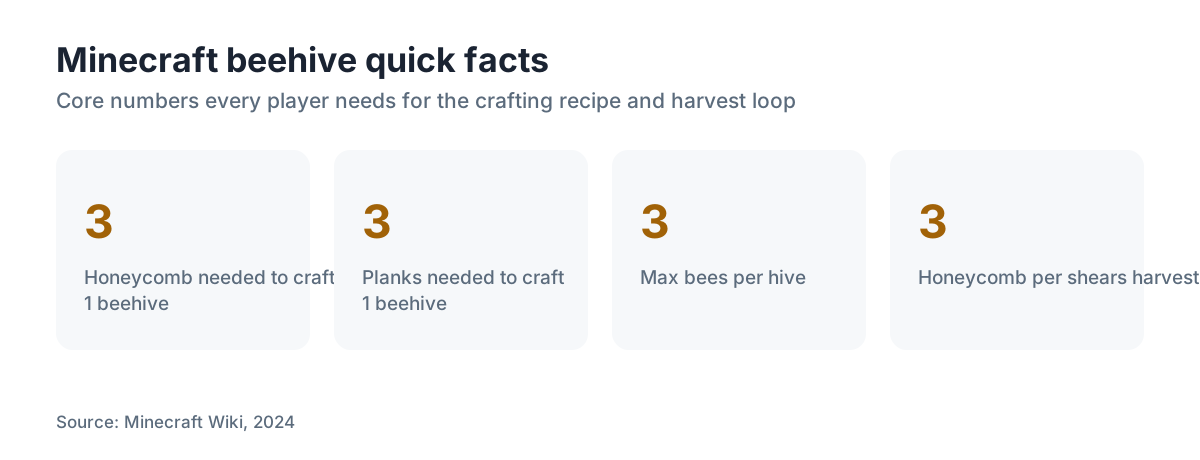
The beehive crafting recipe is 3 honeycomb plus 3 planks of any wood type, arranged in a crafting table to yield 1 beehive. That's the full recipe, confirmed on the Minecraft Wiki crafting page [1].
Here's the catch every beginner hits: honeycomb is not a raw resource you dig up or find in chests reliably (it's not in any common loot table). You get honeycomb almost exclusively by using shears on a bee nest or beehive that has reached the "full honey" stage, which shows as a visible dripping-honey texture on the block and five distinct particle and animation cues once honey level 5 is reached. So the realistic answer to "how to make a beehive in Minecraft" is: find a wild bee nest first, harvest honeycomb from it safely, then craft your own beehive to expand your farm.
One wood-type note: any planks work (oak, spruce, birch, jungle, acacia, dark oak, mangrove, cherry, bamboo, crimson, warped), so you're not locked into a specific tree just because that's what the wild nest was in.
How do you get a beehive (or bee nest) in Minecraft if you don't want to craft one?
The fastest route for most players is to just find a natural bee nest and use it directly, no crafting required. Bee nests generate in plains, sunflower plains, and (less commonly) forest biomes, attached to oak or birch trees, roughly at a rate that makes them somewhat rare but not hard to find if you fly or walk through a few plains biomes with trees.
If you want to physically relocate a bee nest to your base instead of building a new hive, you need a tool enchanted with Silk Touch. Mining a bee nest or beehive with any tool that lacks Silk Touch destroys it and drops nothing except the bees fly away angry (if it had bees in it and you didn't smoke it first, expect a few bee stings). With Silk Touch, the block breaks cleanly and keeps its current honey level and up to three bees stored inside it, and you can place it wherever you like [1].
A silk touch move is genuinely the best method if you found a nest in an inconvenient spot, like the middle of a ravine wall or a tree you want to chop down anyway. You get an instant, populated bee home for zero honeycomb cost.
How do you safely harvest honey and honeycomb without getting stung?
Bees in Minecraft only get aggressive if you take honey or honeycomb from a hive without pacifying them first, or if you attack them directly, or if you're just too close when they're already agitated from a previous harvest. The standard trick is to place a lit campfire directly beneath the beehive or bee nest before you harvest. Smoke from the campfire prevents bees from becoming hostile even while you're taking their honey [1].
Two harvesting tools give two different results:
- A glass bottle on a full hive gives you 1 honey bottle per use and resets the honey level to 0, without harming the block or angering bees (this one doesn't even require the campfire trick, per the wiki, though most players smoke it anyway out of habit).
- Shears on a full hive give you 3 honeycomb per use, also resets honey level to 0, but this one absolutely will anger bees without the campfire smoke protection.
If bees do get angry, they'll chase and sting, and a stinger sting deals a small amount of damage plus gives the bee itself a short countdown before it dies (bees die after stinging a player on Java Edition, similar to real honey bee biology where a barbed stinger kills the worker). So a swarm of five angry bees is a real threat to squishy early-game armor. Building a campfire first costs nothing and takes ten seconds; skipping it to save time is the single most common beginner mistake.
How long does it take a beehive to fill with honey?
A beehive or bee nest advances one honey level roughly every random game tick cycle tied to bees successfully pollinating flowers and returning home, and reaches its max level of 5 (full, ready to harvest) after enough successful pollination trips. In practice, on a hive with 3 bees and flowers nearby, most players report a full cycle takes somewhere in the neighborhood of a real-world hour or a bit more of continuous gameplay, though Mojang hasn't published an exact fixed timer because it's dependent on bee pathing and pollination success rather than a hard clock.
What you can control is the input side: more bees per hive (up to the 3-bee cap) and more nearby flowers within roughly a 22 to 30 block radius mean bees pollinate more often, which speeds up the honey level climbing. Bees also need a clear flight path outside during daylight and calm weather; rain and night keep them inside.
How do you get bees into a beehive if it's empty?
An empty beehive (one you crafted, or one you moved and lost the bees from) fills itself passively if wild bees are nearby and decide to move in, but you can also force it by breeding bees or physically walking bees toward it. Bees that are following flowers you're holding, or bees you've bred using two bees fed flowers, will look for the nearest valid hive with open capacity (fewer than 3 bees currently inside) as their new home.
The practical method most builders use: locate a wild nest, get 2 to 3 bees to spawn or gather near your new empty hive by planting flowers close to it, and let nature take its course over a Minecraft day or two. Breeding two bees by feeding them any flower produces a baby bee, and that baby (once grown) will also look for a home, which is a solid way to populate a second or third hive without needing to find more wild nests.
What's the best design for a Minecraft bee farm?
The most efficient designs cluster multiple beehives close together, surrounded by a dense flower field, with a permanent campfire (or a removable one you place only during harvest) positioned under each hive. Because bees can pollinate from up to roughly 22 to 30 blocks away in most versions, you don't need flowers directly touching the hive, just somewhere within range.
A common layout: a 2-wide row of 4 to 6 beehives mounted on a wall, one campfire block beneath each (or a retractable campfire on a piston if you don't want it lit all the time, since campfire smoke can also mess with nearby crop growth or item frames in tight builds), and a flower garden of at least a few dozen blocks within range. Sunflowers, poppies, and dandelions all count and are cheap to farm in bulk.
For honeycomb specifically (used for waxing copper blocks, crafting beehives, and making honeycomb blocks), shears are the tool. For honey bottles (used for food, or crafting sugar), bottles are the tool. Most farm builds run both, alternating harvest type based on what the player currently needs.
What can you actually use honey and honeycomb for in Minecraft?
Honey bottles restore hunger (a small amount) and can also be thrown or drunk in some versions; they're also a required ingredient for crafting sugar (which matters for cake, and for splash potions of a few types) as of newer recipe updates on the Minecraft Wiki's honey bottle entry [1].
Honeycomb has two big uses. First, it's the beehive crafting ingredient itself (3 honeycomb plus 3 planks). Second, and this is the one veteran players actually care about, honeycomb is used to "wax" copper blocks, which locks the copper's oxidation state so it stops weathering and changing color over time. This became a signature building technique after the 1.17 Caves & Cliffs update introduced oxidizing copper blocks, and waxing with honeycomb is the only in-game way to freeze that look permanently.
Honeycomb can also be crafted into honeycomb blocks (a decorative building block), useful for detailing builds with a warm yellow, waxy-looking texture.
Do Minecraft bees actually reflect real honey bee biology?
Loosely, yes, more than most Minecraft mob mechanics reflect real animal behavior. Real honey bees do forage from flowers, return to a central nest, and communicate location data to nest-mates (the famous waggle dance, first decoded by Karl von Frisch, whose work on bee communication won a share of the 1973 Nobel Prize in Physiology or Medicine [2]). Minecraft doesn't simulate the waggle dance, but the basic loop of "leave hive, visit flower, return to hive, repeat" is a simplified nod to that real foraging cycle.
Real worker honey bees also die after stinging a mammal, because the barbed stinger lodges in the skin and rips free from the bee's abdomen, a mechanic USDA and university extension resources describe when explaining why honey bees are generally reluctant to sting unless defending the colony [3]. Minecraft mirrors this: in Java Edition, a bee that stings a player has a chance to die shortly afterward, similar to the real insect's fatal, one-time defense.
Where the game diverges hardest from biology: real colonies have one queen and thousands of workers, actual honeycomb comes from wax the bees themselves secrete (not "found" as a loose item), and hive humidity, temperature regulation, and disease pressure (like varroa mites, a real and serious threat to real-world colonies) have zero equivalent in-game. Minecraft beehives never get sick, never swarm, and never need a beekeeper checking brood frames every ten days. Real colonies absolutely do.
If Minecraft beekeeping got you curious about real bees, what's actually involved?
If the in-game farm has you wondering what real beekeeping looks like, the honest answer is that it's a lot more maintenance than three bees and a campfire. Real colonies need regular inspection, feeding support during nectar dearths, swarm prevention, and active pest management, especially against the varroa mite (Varroa destructor), which the Honey Bee Health Coalition and USDA identify as a leading driver of U.S. colony losses today [4][5]. The Bee Informed Partnership's annual national survey has repeatedly found beekeepers losing somewhere around 40 to 50 percent of managed colonies annually in recent survey years, with varroa consistently cited as a top contributing factor [6].
Real beekeepers use sugar roll or alcohol wash mite counts, track thresholds (many extension programs recommend treatment around 2 to 3 mites per 100 bees in an alcohol wash, though thresholds shift by season), and rotate treatments (like formic acid, oxalic acid, or amitraz-based products approved on EPA labels) to avoid resistance buildup [7]. None of that exists in Minecraft, which is part of why the game is a nice, low-stress on-ramp for kids curious about bees, but a poor substitute for understanding what colony management actually demands.
If you're a hobbyist beekeeper in real life trying to get a handle on mite pressure, tools like VarroaVault's free protocol tracker exist specifically to help you log mite wash counts, pick a treatment window, and follow a season-by-season plan instead of guessing. It's a different hobby than crafting a wooden hive block, but the curiosity that gets a kid hooked on the game version is the same curiosity that makes a good real-world beekeeper.
For more general background on real bees and real hive equipment, see honey bee and beehive, and if you want to go further into the real hobby, beekeeper and beekeeping supplies cover the gear and role in plain terms.
What version of Minecraft added bees and beehives, and has anything changed since?
Bees, bee nests, beehives, honey bottles, and honeycomb all arrived together in the Java Edition 1.15 update, nicknamed "Buzzy Bees," released in December 2019, per Mojang's official update history [8].
It was a small, focused update almost entirely built around this one feature set. Since then, the core mechanics haven't changed much, but honeycomb's usefulness expanded a lot with the Caves & Cliffs update (1.17, released mid-2021), which added copper blocks and the waxing mechanic. That single addition turned honeycomb from a minor crafting curiosity into something builders actively farm in bulk for large copper structures. Bedrock Edition received the same feature set on a matching timeline, with minor behavior differences (Bedrock bees, for instance, have historically been slightly more forgiving about not dying after a single sting in certain versions, though this has shifted across updates, so check current patch notes if that specific detail matters to your build).
Frequently asked questions
How do you make a beehive in Minecraft?
Craft one at a crafting table using 3 honeycomb and 3 planks of any wood type. The catch is honeycomb only comes from shearing an existing bee nest or beehive that's full, so most players harvest honeycomb from a wild nest first, then craft additional beehives to expand their farm.
How do you get a beehive in Minecraft without crafting?
Find a naturally generating bee nest, most common in plains, sunflower plains, and forest biomes attached to oak or birch trees. Mine it with a Silk Touch tool to pick it up intact, bees and stored honey included, then place it anywhere you like.
What's the difference between a bee nest and a beehive?
A bee nest generates naturally in the world on trees and can't be crafted, only found or moved with Silk Touch. A beehive is player-crafted from honeycomb and planks. Functionally they behave the same: both hold up to three bees and fill with honey over time.
How do you get honey out of a beehive without making bees angry?
Place a lit campfire directly under the hive before harvesting. The smoke stops bees from turning hostile. Use a glass bottle for one honey bottle per harvest, or shears for three honeycomb per harvest; either resets the hive's honey level back to zero.
How many bees can live in one beehive?
Three bees maximum per beehive or bee nest. Once a hive holds three, additional bees will look elsewhere for a home, so a multi-hive wall design is the standard way to house a larger bee population.
What do you need honeycomb for in Minecraft?
Honeycomb crafts into beehives (3 honeycomb, 3 planks) and honeycomb blocks for building. Its biggest practical use is "waxing" copper blocks, which locks copper's oxidation state so it stops changing color over time, a mechanic added with the Caves & Cliffs update.
Can you move a beehive with bees still inside it?
Yes, if you mine it with a Silk Touch enchanted tool. The block drops as an item and keeps its current honey level and any bees stored inside, so placing it elsewhere gives you an instant working hive without needing to breed or attract new bees.
Do bees die after stinging you in Minecraft?
In Java Edition, a bee that stings a player has a chance to die shortly afterward, echoing real honey bee biology where a barbed stinger tears free and kills the worker bee. Bedrock Edition behavior has varied slightly across updates, so check current patch notes.
What biome do bees and bee nests spawn in?
Plains, sunflower plains, and forest biomes are the main spawn locations, with nests generating on oak or birch trees. If you're exploring for one, flying or fast-traveling through open, flower-dotted plains with scattered trees is the most efficient search method.
What update added beehives to Minecraft?
The Java Edition 1.15 "Buzzy Bees" update, released in December 2019, introduced bees, bee nests, beehives, honeycomb, and honey bottles all at once, per Mojang's official release notes. Bedrock Edition got the same feature set on a comparable timeline.
Are Minecraft bees realistic compared to real honey bees?
Loosely. The forage-and-return loop nods to real bee behavior, and the sting-then-die mechanic mirrors real worker bee anatomy. But Minecraft skips queen bees, wax-making, colony disease, and pests like varroa mites entirely, so it's a simplified, kid-friendly version rather than an accurate simulation.
How far can Minecraft bees travel to pollinate flowers?
Bees generally pollinate flowers within roughly 22 to 30 blocks of their hive, depending on version, then return home to raise the honey level. You don't need flowers touching the hive block itself, just planted somewhere inside that working radius.
Sources
- Minecraft Wiki, Beehive and Bee Nest entries: Beehive crafting recipe, bee nest generation, Silk Touch relocation, harvesting mechanics with bottles and shears, and campfire smoke pacifying bees
- The Nobel Prize, Physiology or Medicine 1973: Karl von Frisch shared the 1973 Nobel Prize for decoding the honey bee waggle dance communication system
- USDA Agricultural Research Service: Worker honey bees die after stinging mammals because the barbed stinger detaches from the bee's abdomen
- Honey Bee Health Coalition: Varroa destructor is identified as a leading driver of managed honey bee colony losses in the U.S.
- USDA Agricultural Research Service, bee research program: Varroa mites are a major factor in U.S. honey bee colony health decline
- Bee Informed Partnership, annual colony loss survey: National surveys have found managed colony loss rates around 40 to 50 percent in recent years, with varroa cited as a top contributor
- U.S. Environmental Protection Agency, pesticide product labels: Varroa mite treatment products such as formic acid, oxalic acid, and amitraz are regulated with EPA-approved labels
- Minecraft.net: Bees, bee nests, beehives, honeycomb, and honey bottles were introduced together in the Java Edition 1.15 Buzzy Bees update in December 2019
Last updated 2026-07-09