Deformed wing virus symptoms caused by varroa: what you're seeing and why
TL;DR
- Deformed wing virus (DWV) is a bee pathogen that varroa mites inject directly into pupae while feeding.
- Infected bees emerge with crumpled, stubby wings, swollen abdomens, and short lives.
- Colonies above 2-3% mite infestation are at high risk.
- DWV is the most damaging virus behind varroa-driven winter loss, and killing mites is the only real fix.
What is deformed wing virus and how does varroa spread it?
Deformed wing virus is an RNA virus in the Iflavirus family. It lives in honey bee populations at low, mostly harmless levels. The trouble starts with varroa. When a mite feeds on a developing bee pupa inside a capped cell, it injects DWV straight into the bee's hemolymph, skipping the gut defenses that would neutralize most viral particles picked up by mouth. That direct injection sends viral titers to levels millions of times higher than a bee would ever reach through oral contact. [1]
Researchers at Rothamsted Research, in work published in Science, described varroa as a vector that "transmits DWV directly into the bee body," and showed the mite selects for the most virulent DWV strains over time and drives those strains to dominance in managed populations worldwide. [1] So varroa does more than weaken bees by feeding on their fat body tissue. It rewires the virus community inside your hive in the worst possible direction.
Two main variants circulate: DWV-A and DWV-B (also called Varroa destructor virus-1). DWV-B seems to be spreading harder in North America and Europe, and some studies suggest it replicates to higher levels, though the field picture is still shifting. [2] At the hive, both strains cause the same visible symptoms.
What do deformed wing virus symptoms look like in adult bees?
The wings tell you first. An infected bee emerges from her cell with wings crumpled, stubby, and folded back so flight is impossible. They often look like crinkled tissue paper, shrunk to a fraction of normal size. These bees can't forage and can't thermoregulate. Most get ejected from the hive or die at the entrance within hours or days.
Beyond the wings, look for these signs in the same batch of newly emerged bees:
- Bloated, shortened abdomen. The bee looks rounded and stubby instead of the normal tapered shape.
- Discoloration. Affected bees often look darker or show mottled yellow-brown coloring instead of clean banding.
- Neurological signs. Some infected bees walk in circles, tremble, or can't right themselves. Easy to miss unless you're watching the bottom board closely.
- Reduced size. DWV-infected bees measure smaller than healthy nestmates.
Here's the part that catches beekeepers off guard: not every infected bee shows symptoms. At low varroa loads, most infected bees emerge looking normal but live shorter lives, roughly 50% shorter by some estimates. [3] You only see the dramatic deformities when infestation is high enough that multiple mites reproduce per cell, or when DWV titers spike. By the time deformed bees are crawling at the entrance, your mite load is almost certainly out of control.
A practical rule. If you spot more than a handful of deformed-wing bees per day at the entrance, treat your mite count as an emergency. Do an alcohol wash or sugar roll that day. Don't wait for a scheduled inspection.
How does DWV affect brood, and what does infected brood look like?
The damage happens inside the capped cell, so brood usually looks fine to the eye. You won't see the sunken or discolored cappings you get with American foulbrood. The capping looks intact. The disaster stays hidden until the bee tries to emerge.
Heavy DWV pressure paired with high varroa can still show up as spotty, irregular brood. The mites cause some pupal death on their own, and the combination leaves a brood frame that looks like a checkerboard. Spotty brood is not a DWV diagnosis by itself. It's a signal that something is wrong with the varroa situation, and it's worth a mite count.
One check is genuinely useful. Pull a few capped worker cells at the purple-eyed or pink-eyed pupal stage (roughly day 14 to 15 of development) and look for mites on the pupa and in the cell. A pupa sharing its cell with two or more mites has a much higher chance of emerging with DWV symptoms than a pupa with one mite. [4] That fits the dose-response pattern from lab studies, where higher viral titers track with worse deformity.
At what varroa mite level does DWV become a real colony threat?
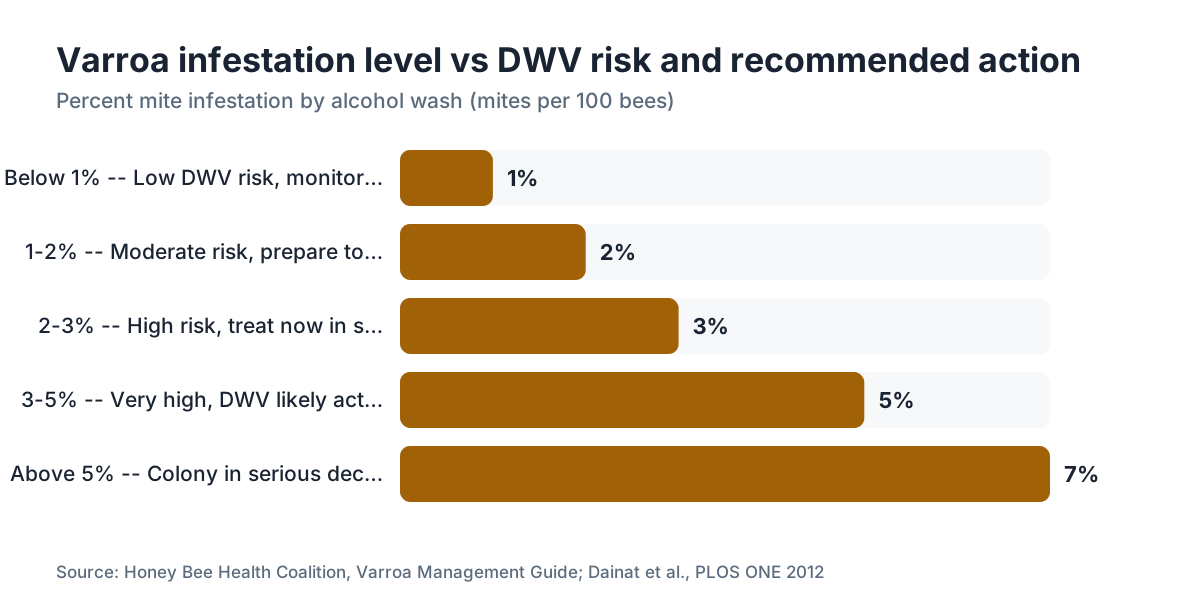
The Honey Bee Health Coalition's Varroa Management Guide recommends treating when infestation hits 2% (2 mites per 100 bees) during summer brood-rearing, and 1-2% or lower going into fall when the colony raises its long-lived winter bees. [5] Those thresholds exist partly because of DWV. Winter bees carry the colony through the cold, and they need intact fat bodies for nutrition and immune function. Infect them with high DWV loads during pupal development, and they die early, so the cluster falls apart before spring.
The link between mite load and DWV isn't perfectly linear, but the pattern holds across studies: colonies at 5% or higher infestation show DWV prevalence near 100% and much higher average titers than colonies kept under 2%. [3] Some colonies tolerate moderate mite loads without symptoms for a season, which fools beekeepers into thinking all is well. Then winter hits.
Here is a rough way to read your risk:
| Mite infestation (% by alcohol wash) | DWV risk level | Typical action |
|---|---|---|
| Below 1% | Low | Monitor monthly |
| 1-2% | Moderate | Treat or prepare to treat based on season |
| 2-3% | High, treat now in summer | Treat immediately |
| Above 3% | Very high, DWV likely active | Emergency treatment, assess colony strength |
| Above 5% | Colony in serious decline | Treat urgently, expect brood and adult losses |
These thresholds come from HBHC guidance [5] and match Penn State Extension recommendations. [4]
Can a colony survive and recover from DWV?
Yes, but only if you remove the vector. There is no antiviral treatment for DWV in bees. No medication, no supplement, no feed additive clears an active DWV infection. Recovery runs one road: bring the varroa population down fast and hard, then give the colony time to raise a fresh cohort of clean or barely infected bees.
Colonies with heavily infected adults often bounce back if you treat aggressively with an approved miticide and the queen still lays well. The infected adults die off over 4 to 6 weeks, the normal adult lifespan, and the new bees emerging from post-treatment brood carry much lower viral loads. [6] You may need to feed protein during recovery if the population dropped sharply, because a small cluster struggles to cover brood and hold temperature.
If the colony lost its queen, or is queenright but laying poorly, recovery gets harder. Combine the infected colony with a stronger one after treating both for mites, or bring in a mated queen from a clean source.
One honest note. If you're seeing deformed bees at the entrance in August or September and haven't treated all season, the winter bees being raised right now are already in line for DWV exposure. A September treatment still helps, but some of those bees are already compromised. Be straight with yourself about whether the colony has the numbers to make winter without heavy support.
How do you confirm DWV versus other causes of crawling or wing-damaged bees?
Crawling bees with wing problems come from several sources, and DWV is only one. Here's how to sort the main suspects.
Acute bee paralysis virus (ABPV) also causes shaking and crawling, but it tends to produce hairless, greasy-looking bees rather than the crumpled-wing look. [6] Sacbrood kills larvae before capping or leaves sac-like pupal remains, not deformed adults. Pesticide exposure (neonicotinoids especially) can cause similar trembling and crawling, but those bees usually keep normal wings, and the onset is sudden after a foraging trip rather than a steady trickle of deformed young bees.
The clearest DWV signal is the combination: newly emerged bees (soft, light cuticle, not forager-aged) with crumpled wings, plus a high mite count confirmed by alcohol wash. Low mite count with crawlers? Look at pesticide exposure first.
Lab confirmation runs through RT-PCR testing. USDA's Bee Research Laboratory and several university labs test samples for beekeepers, though the turnaround and cost mean most hobbyists diagnose by symptom and mite count instead of waiting on a result. The Bee Informed Partnership has guidance on submitting samples. [7]
Does DWV spread between colonies, and how does it get into new hives?
DWV moves between colonies several ways, and varroa is the most efficient ride in every one. Drifting bees, robbing, and swarms carrying mites all move the virus around. A study in PLOS Pathogens found that varroa-mediated DWV transmission flattened the virus strain landscape across apiaries, pushing the most virulent forms even into colonies with no direct contact. [11]
Packages and nucs from commercial sources can arrive already carrying both varroa and DWV. This is common. Buy a package and skip a mite count in the first two weeks, and you're flying blind. Package mite loads can be low enough to pass a casual glance but high enough to explode through the first brood cycle.
Swarms are interesting. They often start with lower mite loads than the parent colony because they leave with adult bees but no capped brood, where most mites hide. A swarm's infestation can look deceptively low for a couple weeks, then spike when the first brood gets capped. Don't skip monitoring just because a colony started as a swarm.
If you want the varroa mite biology behind all this, the mite's reproductive cycle inside the cell explains why DWV is so hard to stop without serious varroa control.
What treatments actually reduce DWV symptoms by controlling varroa?
Every option below works by killing mites, not the virus, because DWV has no direct treatment. Your miticide choice comes down to temperature, brood state, and how fast you need results.
Oxalic acid (OA) in its approved forms (Api-Bioxal is the EPA-registered product in the US) is highly effective but limited. The dribble method kills mites on adult bees but doesn't reach capped cells. Vaporization has the same limit for a single treatment, though repeated treatments help. OA works best during broodless periods, late fall or a mid-season brood break, when nearly all mites ride on adult bees. [8] A broodless OA treatment in late fall, confirmed by a mite count, is one of the most reliable ways to enter winter with a low mite load and low DWV pressure.
Amitraz-based strips (Apivar) and formic acid products (Mite-Away Quick Strips, or MAQS) can be used during brood-rearing and do reach capped cells to varying degrees. Formic acid kills mites under cappings, which matters when you're protecting winter bees being raised right now. The temperature window is narrow, typically 50 to 85 degrees F (10 to 29 C) for MAQS, so timing counts. [9]
Thymol-based treatments (Apilife VAR, Apiguard) work at moderate temperatures and are approved in many states. They need extended contact time, usually 4 to 8 weeks, and multiple applications.
For building out a treatment plan, VarroaVault has free varroa management protocols organized by season and treatment type, which help you work around your local temperature windows.
The EPA requires every miticide be used strictly by its label. Amitraz resistance has turned up in some populations, and rotating modes of action (not running the same chemical class every treatment) is standard practice recommended by both the Honey Bee Health Coalition and Penn State Extension. [4][5]
How does DWV cause so much winter colony loss specifically?
Winter is where DWV earns its reputation as the most economically damaging bee virus in the world. The mechanism runs like this.
In late summer and fall, a healthy colony raises its winter bees, a generation that lives 4 to 6 months instead of the normal 5 to 7 weeks. These bees need full, healthy fat bodies to survive. The fat body stores proteins, lipids, and vitellogenin, the protein tied to both immune function and winter survival. When varroa feeds on a developing winter bee pupa and delivers a high DWV dose, the fat body comes out stunted. The bee looks normal but carries thin reserves and a shorter expected life. [3]
A colony going into winter with a big share of these compromised bees shrinks faster than expected, loses the critical mass to hold cluster warmth, and collapses. Beekeepers often find the cluster dead with honey stores sitting right there, the signature of a population failure rather than starvation. DWV-driven winter collapse fits that picture exactly.
Bee Informed Partnership survey data from the 2022-2023 season recorded annual colony loss around 48% for hobbyist beekeepers surveyed, against roughly 39% for commercial operations. [7] The gap probably reflects more consistent varroa management by commercial outfits. Nobody has clean randomized-trial data pinning a specific loss percentage on DWV alone, but the tie between fall mite loads and winter survival is consistent and well documented.
Are some bee stocks more resistant to DWV than others?
This is one of the genuinely exciting corners of apiculture research, and the answer is yes, somewhat, but it's complicated.
Bees selected for Varroa Sensitive Hygiene (VSH) detect and remove mite-infested pupae before the mites finish reproducing, which cuts DWV transmission at the source. USDA Baton Rouge has bred and maintained VSH lines for decades, and research shows these stocks hold lower mite and DWV loads. [10] Gotland Island bees in Sweden, under natural selection from varroa without treatment for more than 20 years, also carry lower DWV titers than treated continental populations, which suggests some degree of antiviral or mite resistance can develop.
For most hobbyists, VSH-marked or hygienic queens from reputable breeders are the accessible version. They are not a replacement for mite monitoring. They're a supplement that widens your margin and cuts how often you treat.
Naturally mated queens dilute any VSH genetics within a generation, because drones from neighboring feral or managed colonies mate freely. That's not a reason to skip VSH stock. It is a reason to keep counting mites no matter what stock you run.
If you're curious about different genetic lines and subspecies, our overview of beekeeping species covers which ones are being evaluated for varroa tolerance.
What should you do right now if you see deformed bees in your hive?
Stop reading and do an alcohol wash today. Collect 300 bees from a brood frame (not the frame with the queen), cover them with isopropyl alcohol, shake for 60 seconds, strain through fine mesh, and count the mites. Divide mites by bees, multiply by 100. That's your percent infestation.
At 2% or above, treat. At 3% or above in summer, treat immediately. Above 5% heading into August or September, treat and be realistic about winter odds.
While treatment works, don't split or combine colonies without checking mite counts on both sides. Robbing from a high-mite colony spreads mites and DWV to your other hives faster than almost any other mistake you can make.
Write it down. The date, the mite count, the number of deformed bees per day you're seeing, and what treatment you applied. That record tells you whether the treatment worked and gives you seasonal baselines year to year.
To build a full monitoring and treatment schedule, VarroaVault's free protocol tools let you set a calendar around your local conditions, treatment windows, and colony count. Use them alongside the Honey Bee Health Coalition's Varroa Management Guide, which is still the most thorough free reference for US beekeepers. [5]
Frequently asked questions
Can bees with deformed wing virus recover and fly normally?
No. Once a bee emerges with physically deformed wings, the damage is permanent. The wing tissue never developed correctly during the pupal stage, and there's no mechanism to repair it after emergence. These bees usually die within days. Recovery happens at the colony level, when you treat varroa down to safe levels and the queen raises new, healthy bees.
How quickly does DWV spread through a hive after varroa levels get high?
Fast, once mite loads pass 2-3%. Mites reproduce in capped brood, and every cycle passes virus to new pupae. In a colony at 5% or higher, nearly every emerging bee has been exposed. Visible symptoms, meaning deformed adults at the entrance, typically show up within weeks of mite counts crossing the 3-5% mark, especially in summer when brood is plentiful.
Is deformed wing virus dangerous to humans or other animals?
No. DWV is a bee-specific RNA virus with no known ability to infect vertebrates, including humans, pets, or livestock. Honey from DWV-affected colonies is safe to eat. The virus is specific to insects and has no documented zoonotic potential.
Can you see varroa mites on bees with deformed wing virus symptoms?
Sometimes, but often not. The mite does its damage inside the capped cell and may drop off the emerging bee within hours. By the time you see a deformed bee crawling at the entrance, the mite that infected her is likely back inside a brood cell. A high mite count confirmed by alcohol wash beats looking for mites on crawling adults.
Does oxalic acid treat deformed wing virus directly?
No. Oxalic acid kills varroa mites. It has no direct antiviral effect on DWV. By dropping the mite population, OA indirectly cuts DWV transmission to developing bees. The distinction matters: OA during active brood season kills mites on adults but doesn't protect pupae already sealed in capped cells, which is why timing and treatment choice relative to brood state are so important.
What percentage of winter colony losses are linked to DWV and varroa?
Exact attribution is hard because losses are multi-factorial, but varroa and its associated viruses including DWV rank consistently as the primary driver of winter loss in managed US hives. Bee Informed Partnership survey data from 2022-2023 recorded hobbyist annual losses around 48%. Studies linking high pre-winter DWV titers to colony death show strong correlations, though precise causal percentages vary by study design.
Can package bees or nucleus colonies arrive already infected with DWV?
Yes, and it's common. Packages and nucs often ship with low-to-moderate varroa loads, and where those mites are, DWV follows. Do a mite count within two weeks of installation, before the first brood is capped, for a baseline. Early treatment on a new colony is far easier than treating a full colony with a developed mite problem three months later.
Are there any supplements or feeds that reduce DWV severity?
No supplement or feed additive has been shown in peer-reviewed trials to meaningfully reduce DWV infection or severity. Products marketed for bee immune support lack the clinical evidence to justify relying on them in place of real varroa treatment. The only proven intervention is cutting mite load. Feed your bees well for colony strength, but never substitute supplements for miticide treatment.
How do I tell the difference between DWV and pesticide poisoning if I see crawling bees?
Wing shape and bee age give it away. DWV-infected bees are newly emerged, with soft pale cuticles and physically crumpled wings. Pesticide-poisoned bees are usually forager-aged, have fully developed wings, and may twitch or spin rather than just crawl. A sudden mass of crawlers after a warm foraging afternoon points to pesticide. A steady trickle of deformed young bees over days points to DWV and high varroa.
How often should you check mite levels to catch DWV risk early?
The Honey Bee Health Coalition recommends monitoring every 30 days during the active brood season, roughly April through October across most of the US. A pre-treatment check, a post-treatment check 3-5 weeks after treatment ends, and a fall check before winter cluster formation are the minimum useful intervals. Monthly monitoring is the standard that keeps you ahead of DWV risk.
Can a colony with high DWV be saved, or should it be combined or destroyed?
Most colonies with high DWV but a laying queen can be saved with prompt varroa treatment, as long as the adult population still covers brood and holds cluster temperature. Treat, check queen quality, and feed protein if the forager population is thin. Combining makes sense if the colony is very small. Destruction is rarely needed for DWV alone unless the colony is hopelessly queenless and too small to recover.
Does DWV affect queen bees the same way it affects workers?
Queens can carry DWV without showing deformity, since they're reared in queen cells with lower mite infestation than worker cells. But DWV infection in queens has been linked to reduced sperm viability and shorter reproductive lifespan in some studies. A DWV-positive queen may look normal and still drag down colony health over time.
What is the difference between DWV-A and DWV-B, and does it change how I manage my hive?
DWV-A and DWV-B are closely related strains of the same virus. DWV-B (also called Varroa destructor virus-1) replicates to higher titers in some studies and is spreading in North America and Europe, possibly displacing DWV-A. At the management level, the distinction doesn't change your approach. Both strains cause the same symptoms, both ride varroa, and both respond to the same mite-control strategy.
Sources
- Wilfert et al., Science 2016, 'Deformed wing virus is a recent global epidemic in honeybees driven by Varroa mites' (Rothamsted Research): Varroa acts as a vector that transmits DWV directly into the bee body, selecting for virulent strains and driving them to dominance globally
- USDA ARS Bee Research Laboratory, Beltsville MD, DWV variant research overview: DWV-B (Varroa destructor virus-1) is spreading more aggressively in North America and Europe and replicates to higher titers in some experimental conditions
- Dainat et al., PLOS ONE 2012, 'Predictive markers of honey bee colony collapse': DWV-infected bees have approximately 50% shorter lifespans; colonies above 5% mite infestation show near-100% DWV prevalence and high viral titers
- Penn State Extension, 'Varroa Mite Management in Honey Bee Colonies': Treatment thresholds of 2-3% and guidance on pupal inspection for mites; recommendation to rotate chemical classes to reduce resistance
- Honey Bee Health Coalition, 'Tools for Varroa Management' (Varroa Management Guide): Recommended treatment threshold of 2% mite infestation in summer, 1-2% going into fall; guidance on monitoring frequency every 30 days
- Genersch & Aubert, Apidologie 2010, 'Emerging and re-emerging viruses of the honey bee': DWV vs ABPV symptom differentiation; colony recovery dynamics after varroa treatment reducing adult DWV loads over 4-6 weeks
- Bee Informed Partnership, Colony Loss and Management Survey 2022-2023: Annual colony loss rates of approximately 48% for hobbyist beekeepers surveyed in the 2022-2023 season; varroa and associated viruses ranked as primary driver
- EPA, Api-Bioxal (oxalic acid) product registration and label: Api-Bioxal is the EPA-registered oxalic acid product in the US; label specifies use restrictions and OA does not penetrate capped brood cells
- EPA, Mite-Away Quick Strips (formic acid) product label: MAQS approved temperature window is 50-85 degrees F (10-29 C); formic acid penetrates capped brood cells to kill mites
- USDA ARS, Varroa Sensitive Hygiene (VSH) bee breeding program, Baton Rouge: VSH-selected bee lines detect and remove mite-infested pupae, resulting in lower mite populations and lower DWV titers compared to non-VSH stock
- Martin et al., PLOS Pathogens 2012, 'Global honey bee viral landscape altered by a parasitic mite': Varroa-mediated DWV transmission homogenized virus strain landscape across apiaries and spread virulent strains to colonies with no direct contact
- University of Minnesota Extension, 'Varroa mite management': Guidance on alcohol wash method for mite counting; spotty brood combined with deformed adults as a field indicator of high varroa and DWV pressure
Last updated 2026-07-09