How to recognize deformed wing virus in your hive
TL;DR
- Deformed wing virus shows up as adult bees with crumpled, stubby, or missing wings, often with a bloated abdomen and a smaller body.
- You'll find them crawling at the entrance, unable to fly.
- DWV is almost always a sign of unchecked varroa.
- If you're seeing crawlers, your mite load is already serious.
- Run a wash and treat.
What does deformed wing virus actually look like on a bee?
The clearest sign is a bee whose wings look crumpled up and never unfolded. Affected bees emerge with wings that are shriveled, twisted, shortened to stubs, or in bad cases almost gone entirely. The abdomen often runs short and dark. The whole bee is smaller than its healthy nestmates.
These bees can't fly. You'll find them crawling on comb, tumbling off the landing board, or wandering in the grass out front. Workers usually drag them out of the hive within a day or two of emergence, so you might see the deformed ones piling up outside before you ever spot them inside.
Not every DWV-infected bee shows deformity. Bees hit by the virus during the pupal stage, when varroa feeds on the developing fat body, are far more likely to end up with crumpled wings than bees infected as adults [11]. When mite levels stay low, you can carry a real viral load in the colony with almost no visible crawlers. That's the sneaky part of this disease.
The Honey Bee Health Coalition calls DWV "the most prevalent honey bee virus in the world," and its expression depends heavily on when in bee development the infection lands [2].
What causes deformed wing virus and why does varroa matter so much?
DWV is an RNA virus in the Iflavirus family. It shows up in managed colonies on every continent where bees are kept [3]. The virus lived in bee populations before varroa arrived, but at low levels and with little visible damage. Varroa destructor changed all of it.
Varroa reproduces inside capped brood cells. While it feeds on the developing bee's fat body, it injects DWV straight into the hemolymph. That route skips the bee's gut defenses and delivers a far bigger viral dose than oral spread. Research shows varroa-transmitted DWV reaches titers millions of times higher than background oral infection [3].
There are multiple strains. DWV-A was the historically dominant strain in varroa-infested colonies. DWV-B (also called Varroa destructor virus 1) keeps getting more common and replicates to even higher titers in some populations. A 2017 study in PLOS Pathogens documented DWV-B displacing DWV-A across Europe and parts of North America, which changes how fast colonies fall apart [4].
The practical part is simple. If you're seeing deformed bees, varroa is almost certainly driving it. Treating for DWV without touching varroa does nothing. No antiviral exists for DWV. Mite control is the treatment.
For deeper background on the mite itself, see the varroa mite page.
How common is DWV and at what mite levels does it appear?
Once varroa is established, DWV infects nearly every managed colony on Earth [3]. The question isn't whether your bees carry it. The question is whether the viral load is high enough to cause visible symptoms and real damage.
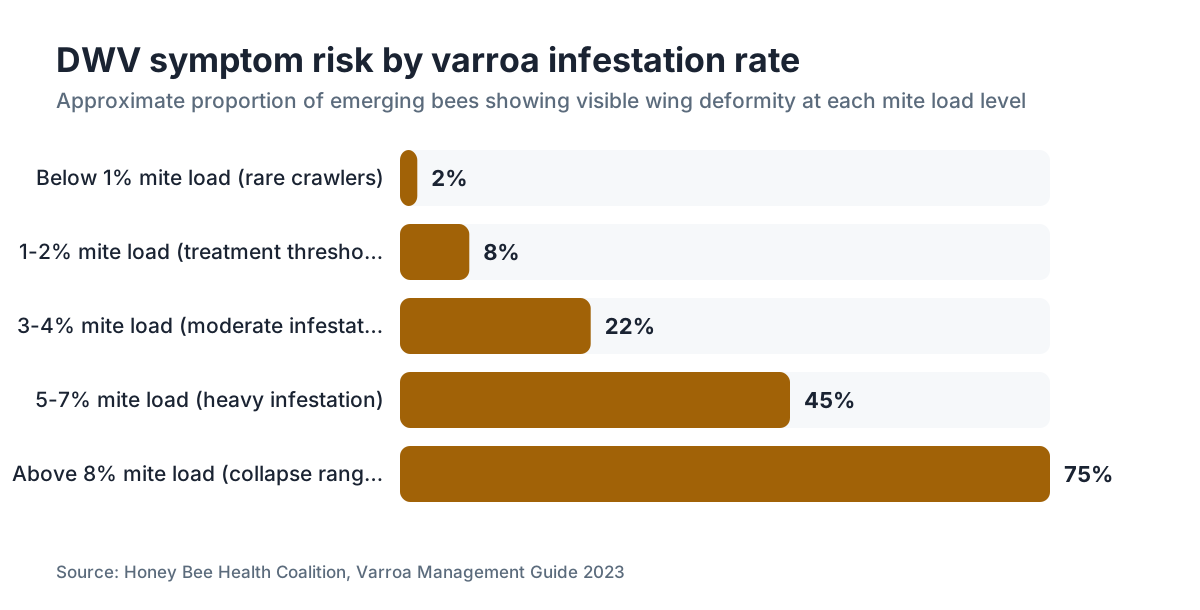
Visible wing deformity tends to get obvious when alcohol wash or sugar roll counts pass roughly 2 to 3 mites per 100 bees (a 2 to 3% rate), though you can spot the odd crawler below that if a few unlucky brood cells took heavy parasitism [2]. The Honey Bee Health Coalition's guide sets an action threshold of 2 mites per 100 bees during brood rearing, exactly because DWV expression climbs sharply above that line.
By the time infestation hits 5% or higher, a big share of emerging bees can show deformity. Populations crash fast, because deformed bees do no foraging and no brood care, and they die within days [2].
One caveat. Crawlers at the entrance during a heavy flow can sometimes point elsewhere: pesticide exposure, chalkbrood, or sacbrood virus. DWV is tied specifically to the crumpled-wing look. Sacbrood, by contrast, deforms pupae inside the cell rather than producing deformed adults at the door.
How is DWV different from other bee diseases that cause crawling or deformity?
Getting this right matters, because the response differs.
| Sign | DWV | Sacbrood | Pesticide poisoning | Varroa mite only (no virus) |
|---|---|---|---|---|
| Wing deformity | Yes, crumpled/stubby | No | No | Rare without virus |
| Crawling at entrance | Yes | No (dead in cell) | Yes, in larger numbers | Sometimes |
| Deformed pupae in cells | No | Yes (sac-shaped, yellow-brown) | No | No |
| Onset | Gradual over weeks | Patchy, scattered cells | Sudden, after spray event | Gradual |
| Mite count elevated? | Almost always | Not directly | No | Yes |
| Season | Late summer peak | Spring often | Anytime | Late summer peak |
Pesticide poisoning drops a sudden pile of dead bees, usually with normal wings, within 24 to 48 hours of an exposure event. DWV crawlers build up over days and weeks. Sacbrood kills bees before they emerge, so you find it by uncapping suspect cells, not by watching the entrance.
Acute bee paralysis virus and chronic bee paralysis virus can also throw crawling bees with trembling or greasy-looking coats, but the wing deformity is the DWV tell. Crumpled wings point to DWV first [2].
How do you inspect a hive specifically to look for DWV signs?
Start outside, before you crack the lid. Give the entrance two or three minutes of your attention. Watch for bees that emerge and drop straight to the landing board or the grass. Crawlers with crumpled wings are your cleanest signal. Watch too for workers hauling small, still-living bees away from the entrance and dumping them in the grass. That's hygienic behavior aimed at DWV-affected bees.
Open the hive and go to capped brood, especially older capped brood about to emerge. Look at bees chewing through their cappings. A DWV-affected bee often struggles to exit, and you may catch one halfway out of a cell with wings already crumpled.
Check the uncapped cells nearby too. DWV bees sometimes die before emergence, leaving a brown, shrunken bee inside rather than the yellow-white prepupa of sacbrood. Less common than the crawling adult, but worth a look.
Run a mite wash during the same visit. Pull a frame of capped brood with nurse bees, scoop about 300 bees (roughly half a cup) into your wash cup, and do an alcohol or oxalic acid wash [10]. Count the mites. If you're seeing DWV crawlers, the count almost always comes back over threshold. The visual symptom is the alarm. The mite count tells you how bad the fire is.
Logging counts over time is far easier with a set routine. VarroaVault's free mite management tools let you record washes and flag when treatment is due.
What does a DWV-affected bee look like at different life stages?
DWV expression is almost entirely a pupal-stage event. A larva infected by a feeding mite develops normally through the larval stage. Then, as it pupates and wing tissue forms, the virus wrecks wing disc development. The adult emerges crumpled.
Crack a capped cell and look at a late pupa (pink or purple-eyed, wing buds showing) and you generally won't see deformity yet. The wings sit as flat, translucent pads at that point. The damage only appears when the adult forms and the wings try to expand. So you can't catch DWV by inspecting pupae mid-development the way you check for American foulbrood or sacbrood.
Bees infected as pupae but carrying only a mild load may look normal and still have shorter lifespans, poorer learning, and weaker foraging [5]. A 2007 study in PLOS ONE found DWV-infected bees started foraging several days early and showed reduced memory, both of which cut their lifetime value to the colony [5]. This subclinical drag means your effective workforce is smaller than the bee count suggests.
Here's the takeaway. Visibly deformed bees are the tip of the iceberg. For every crawler you see, there are likely many more that look fine but aren't pulling their weight.
Can a colony survive DWV on its own?
Sometimes, yes, and this is where Varroa-sensitive hygiene (VSH) and hygienic genetics earn their keep. Some stocks detect and pull mite-infested pupae before the mites finish reproducing, which also removes the highest-DWV-load developing bees. Colonies with strong VSH traits can hold mite populations down without the beekeeper lifting a finger, and they carry lower DWV as a result.
Don't bank on it with typical stock. The Honey Bee Health Coalition is blunt that unchecked varroa, and by extension unchecked DWV, kills the average managed colony within one to three years [2]. Feral colonies that hang on long-term in mite-heavy country tend to combine reduced mite reproduction with elevated hygienic behavior, but those traits aren't reliable in most managed hives.
If you're seeing crawlers in your first or second year with a colony from a standard package or split, it will not fix itself. Treat.
What should you do once you've confirmed DWV in your hive?
First move: quantify the mite load with a real mite wash. Two crawlers at the entrance tell you DWV is expressing. They don't tell you how far gone your mite population is. You need a number.
If the wash comes back at or above 2% (2 mites per 100 bees), treat now with an EPA-registered miticide matched to your season and conditions [6]. Options registered in the United States include oxalic acid (dribble, vaporization, or extended-release glycerin strips), amitraz (Apivar), and hop beta acids (Hopguard 3), among others. Your pick depends on whether the colony has capped brood, the ambient temperature, and how you feel about residue in wax.
Symptoms won't vanish overnight. Bees that are already infected stay infected. Treatment stops new bees from getting hit by knocking down the mite population. Over three to six weeks, as the infected cohort dies off and mite-free bees emerge, the share of crawlers should drop hard.
If your wash reads below 2% despite visible crawlers, recheck your sample size and technique. A 300-bee sample is the floor for reliability [10]. If the count really is low, you're either seeing the tail of a mite population that just peaked, or a handful of heavily parasitized cells threw a few deformed bees. Watch closely and recheck in two weeks.
Write it all down. Date, bee count, mite count, treatment chosen, crawlers seen. Patterns across seasons show you whether your management is actually working.
Does treating varroa actually reduce DWV levels in the colony?
Yes, and the data is fairly clear. A 2009 study by Highfield and colleagues in PLOS ONE found that effective varroa treatment sharply cut DWV titers in treated colonies compared to untreated controls, and the drop in viral load tracked with less visible wing deformity [7]. The mechanism is plain: fewer mites means fewer DWV injections during pupal development, so fewer bees emerge loaded.
Timing carries a nuance. Treat in late summer with a big brood nest present and the mite population falls, but bees already capped at treatment still emerge infected. Expect a two to three week lag before the visible symptom rate drops. A few crawlers three weeks out doesn't automatically mean the treatment failed. Rewash at the three-week mark.
Oxalic acid applied when the colony is broodless (winter, or a short broodless window) gets the steepest mite drop, because every mite is riding a bee with no capped cells to hide in [6]. That's why plenty of beekeepers time an oxalic treatment to a broodless window specifically to knock DWV-driving mites near zero heading into winter.
For label requirements and registered products, the EPA's pesticide pages cover oxalic acid and amitraz [6].
How does season affect when you're most likely to see DWV symptoms?
Late summer and early fall is when most temperate-climate beekeepers see DWV symptoms peak, and the math behind it is straightforward.
Mite populations grow through the brood-rearing season. The mite-to-bee ratio stays manageable in spring, when bees and mites both rise together. But mites keep reproducing on every capped cycle through summer while bee numbers start to shrink in late summer as the queen slows down. The mite load per bee spikes in August and September across most of the Northern Hemisphere.
Meanwhile, the bees raised in late summer are the winter bees. They need to live five to seven months and raise the first spring brood. Raise them under heavy varroa pressure and they emerge with high DWV loads, short lifespans, and weak hypopharyngeal glands that can't produce enough royal jelly for spring brood [5]. That's the winter bee quality problem. A colony can look fine in September with a decent cluster, then crash in January or February because the bees were never healthy enough to overwinter.
This pattern is exactly why the August mite count is the single most predictive number for winter survival in most extension guidance. Penn State Extension recommends treating by mid-August in most Northern Hemisphere climates to protect winter bee development [8].
Are there any good resources or tools for tracking DWV and mite levels over time?
The Honey Bee Health Coalition publishes a free Varroa Management Guide covering monitoring, treatment thresholds, and product efficacy in plain language. It gets updated periodically and is the most cited single resource in North American beekeeping [2].
University of Minnesota Extension's Bee Lab publishes monitoring and treatment guides that are free to read, and USDA maintains honey bee health resources with links to state apiarists [10].
If you want a structured way to log mite counts, flag treatment windows, and compare results across seasons, VarroaVault's free tools are built for that workflow. The point is to decide treat-or-wait on real numbers instead of gut feel.
For miticides and monitoring gear, beekeeping supply companies carry most registered products. See the beekeeping supply companies that stock miticides in the resources section of this site.
Can DWV spread between colonies, and does robbing matter?
Yes, and robbing is a real transmission route. When a weak DWV-affected colony gets robbed out by neighbors, the robbers pick up virus-laden material and carry it home. They also pick up varroa mites straight off the robbed colony, which is arguably the bigger problem, because the mites bring the virus with them.
Drifting and swarming shuffle mites and virus between colonies too. That has real consequences for anyone running multiple hives or sitting near other beekeepers. A colony at 6% infestation in the yard next door is a reservoir of mites and DWV that keeps reinfesting your treated hives.
The Honey Bee Health Coalition recommends treating all colonies in an apiary at once for exactly this reason, and it walks through the reinfestation problem in detail [2]. Treat one of three hives and leave two untreated, and you hand the mites a refuge that undercuts the hive you did treat.
Spring packages, nucs, and queens can carry DWV as background infection too, though usually low enough that a healthy package shows no visible symptoms. It turns into a visible problem once the colony's mite population runs unchecked.
Frequently asked questions
Can deformed wing virus kill a colony?
Yes. DWV doesn't kill colonies directly, but the varroa-driven viral load degrades the bee population fast enough to cause collapse, usually within one to three years without treatment. Late-summer DWV peaks hit the winter bee cohort hardest. Bees raised under high mite pressure live shorter and have weaker glands, and a colony that can't rear healthy winter bees rarely sees spring.
How many crawlers at the entrance is too many?
There's no hard per-day number in published guidance, but seeing even a handful of bees with visibly crumpled wings on a regular basis means your mite load is high enough to cause harm. One or two now and then might be low-level background parasitism. Several a day is a clear warning. Any crumpled-wing crawlers should trigger a mite wash before you decide whether to treat.
Can I tell DWV apart from sacbrood just by looking at the hive entrance?
Usually yes. DWV produces adult bees that emerge alive but can't fly, so you see crawlers with crumpled wings at the entrance. Sacbrood kills bees inside the cell before they fully emerge, so the evidence is inside the hive when you uncap cells, not at the door. Sacbrood larvae turn yellow-brown and the skin toughens into a sac. Crawlers with wing deformity point to DWV.
Is deformed wing virus contagious to humans or other animals?
No. DWV is a honey bee-specific RNA virus. It does not infect mammals, birds, or other animals. There's no health risk to you, your pets, or livestock from handling DWV-affected bees. Still wear gloves and a veil when working a stressed or sick colony, because the bees run more defensive, but the virus itself poses no threat outside the hive.
Do all bee species get deformed wing virus?
DWV turns up in bumble bees and some other wild bees, likely through flower-based transmission or shared foraging. But the severe disease driven by varroa is specific to Apis mellifera and Apis cerana. Without the injection route that varroa provides, DWV in wild bees tends to stay low-level and subclinical rather than causing mass deformity.
What mite count triggers visible DWV symptoms?
Visible wing deformity usually appears when alcohol wash counts reach around 2 to 3 mites per 100 bees, though this shifts with colony size, brood cycle timing, and bee stock. The Honey Bee Health Coalition sets the treatment action threshold at 2% (2 mites per 100 bees) during brood rearing, partly because DWV symptoms escalate fast above that level.
Can you treat deformed wing virus directly?
No antiviral for DWV exists or is registered for use in honey bee colonies. The only effective move is cutting varroa populations, which removes the main transmission vector. After effective mite treatment, DWV titers drop over several weeks as infected bees die off and new bees emerge without high loads. Treating the mite is treating the virus.
What does a healthy emerging bee look like compared to a DWV bee?
A healthy emerging bee chews through its capping and crawls out with wings folded flat but intact, full adult body size, and a normal abdomen. It joins the cluster within minutes. A DWV-affected bee emerges with wings that are shortened, twisted, or crumpled, a smaller body, and a somewhat bloated or darkened abdomen. It can't fold its wings normally and can't fly.
Does DWV get worse in summer or winter?
Symptoms peak in late summer and early fall in temperate climates, when the mite-to-bee ratio runs highest after a full season of mite reproduction and shrinking bee numbers. Winter itself is usually quieter for visible symptoms, since there's little brood for mites to breed in, but colonies that entered winter with high viral loads from a summer surge often die between January and March.
If I see one deformed bee, should I immediately treat?
Run a mite wash first. One deformed bee isn't an emergency by itself, but it's a clear signal to check your count. If the wash comes back at or above 2 mites per 100 bees, treat. If you're below threshold but seeing occasional crawlers, recheck in two weeks. The visual sign is the alarm. The mite count is the decision tool.
Can hygienic bees or VSH bees prevent DWV?
Bees with strong hygienic or VSH (Varroa-sensitive hygiene) traits pull mite-infested pupae from cells before mite reproduction finishes, which suppresses varroa and cuts DWV transmission. Studies show VSH colonies can hold lower mite levels without chemical treatment. But VSH is a population-level trait that needs ongoing selection and isn't a guarantee. Most beekeepers with VSH stock still monitor and occasionally treat.
Do deformed bees pass DWV to their nestmates?
Deformed adult bees aren't the main vector. They carry high viral loads, but the primary routes are varroa mites moving between bees and cells, and to a lesser extent oral transmission through shared food. Healthy bees can pick up low-level DWV from infected food or fecal material, but the disease driven by oral routes stays far milder than the mite-injection route.
How long after treating for varroa will deformed bees stop appearing?
Expect a two to four week lag after effective treatment before the crawler rate drops much. Bees already in capped cells at treatment time still emerge with whatever load they got. As those bees cycle out and new bees emerge from a lower-mite environment, the share of deformed adults falls. A mite wash at three weeks post-treatment confirms whether it actually worked.
Sources
- Honey Bee Health Coalition, Varroa Management Guide (2023 edition): Action threshold of 2 mites per 100 bees; DWV is the most prevalent honey bee virus; unchecked varroa kills colonies within 1-3 years; simultaneous treatment of all colonies recommended
- Wilfert L et al., Science 2016: Deformed wing virus is a recent global epidemic in honeybees driven by Varroa mites: Varroa transmits DWV producing titers millions of times higher than oral infection; DWV detected on every continent where bees are kept
- Ryabov EV et al., PLOS Pathogens 2017: A new strain of deformed wing virus (DWV-B) displaces the predominant strain DWV-A: DWV-B displacing DWV-A across Europe and parts of North America with higher replication titers
- Iqbal J and Mueller U, PLOS ONE 2007: Virus infection causes specific learning deficits in honeybee foragers: DWV-infected bees began foraging earlier and showed reduced memory performance, reducing lifetime colony contribution
- US EPA, Pesticides program (oxalic acid and amitraz bee treatments): Oxalic acid is EPA-registered for varroa control; broodless application achieves steepest mite drop; label requirements for registered miticides
- Highfield AC et al., PLOS ONE 2009: Deformed wing virus implicated in overwintering honeybee colony losses: Effective varroa treatment dramatically reduced DWV titers in treated colonies compared to untreated controls
- Penn State Extension, Varroa Mite Management guidance: Mid-August treatment recommendation in Northern Hemisphere climates to protect winter bee development
- University of Minnesota Extension, Bee Lab: Varroa Mite Monitoring and Treatment: Alcohol wash using 300-bee sample as minimum for statistical reliability in mite monitoring
- Ramsey SD et al., PNAS 2019: Varroa destructor feeds primarily on honey bee fat body tissue: Varroa feeds on fat body of developing bees during pupal stage, the site of DWV injection
Last updated 2026-07-09