Easy check mite counter: how to use it and what the numbers mean

TL;DR
- The Easy Check is a plastic device built for varroa alcohol washes on a measured 300-bee sample.
- Fill it, shake it, invert it, and read the mite count through a clear graduated base.
- A result above 2 mites per 100 bees during the brood season is the standard treatment threshold, per the Honey Bee Health Coalition.
- With 300 bees, that is 6 mites.
What is the Easy Check mite counter and how does it work?
The Easy Check is a two-part plastic tool made for one job: varroa alcohol washes. The top chamber holds about 300 bees. The bottom is clear, graduated, and catches the wash liquid after you shake. Mites drop through a mesh screen into that lower chamber, where you count them against a white grid without pouring anything out.
Vetoquinol developed it, and beekeeping suppliers carry it now across the US. The design skips the fuss. No syringes, no second jar, no improvised strainer. You fill the top with bees and alcohol, cap it, shake for 60 seconds, invert it, and read the bottom.
The principle is the same as any alcohol wash. Varroa mites riding adult bees are phoretic. They grip the bee between body segments. Alcohol breaks that grip instantly and kills the mite, so it falls free. A mesh screen (around 1.5 mm) passes mites but holds bees back. That separation is the whole trick. It lets you count without picking through dead bees by hand.
Understand one limit up front. The Easy Check counts phoretic mites only. Mites breeding inside capped brood cells never show up. That is true of every adult-bee method ever devised. A colony packed with capped brood always looks cleaner than it really is, which is why you sample on a schedule and watch the trend instead of treating one number as the final word.
How do you fill the Easy Check correctly to get an accurate count?
Accuracy lives almost entirely in the sample size. The Easy Check is calibrated for roughly 300 bees, the volume that fills the top chamber to the etched fill line. That line matters. Under-fill it and your percentage breaks, because the denominator you divide by is no longer 300.
Here is the method that gives reliable results:
- Open the hive and find a frame heavy with nurse bees. Frames next to open brood work well, since nurse bees cluster there. Skip the queen's frame if you can spot her.
- Shake or brush bees straight into the top chamber until they reach the fill line.
- Add enough isopropyl alcohol to cover the bees (70% works, 91% works and kills faster). About 30 to 40 ml usually submerges the sample.
- Snap the lid closed.
- Shake hard for 60 seconds. Some folks shake 30, pause, shake 30 more. Full coverage is the point.
- Invert the device. Liquid and mites drain through the mesh into the clear lower chamber. Give it 30 to 60 seconds to finish draining.
- Set it flat and count the mites on the grid.
A few practical notes. Alcohol kills the bees, so each sample costs you about 300 of them. That is the price of an accurate count. It sounds harsh, but 300 bees is under 0.5% of a typical summer colony, and the read you get back is worth far more than those bees [1]. Soapy water works in a pinch, and the steps are basically the same, but alcohol releases more mites in head-to-head tests. Oregon State University Extension rates alcohol wash the most reliable of the adult-bee sampling methods [2].
What mite count from an Easy Check means you need to treat?
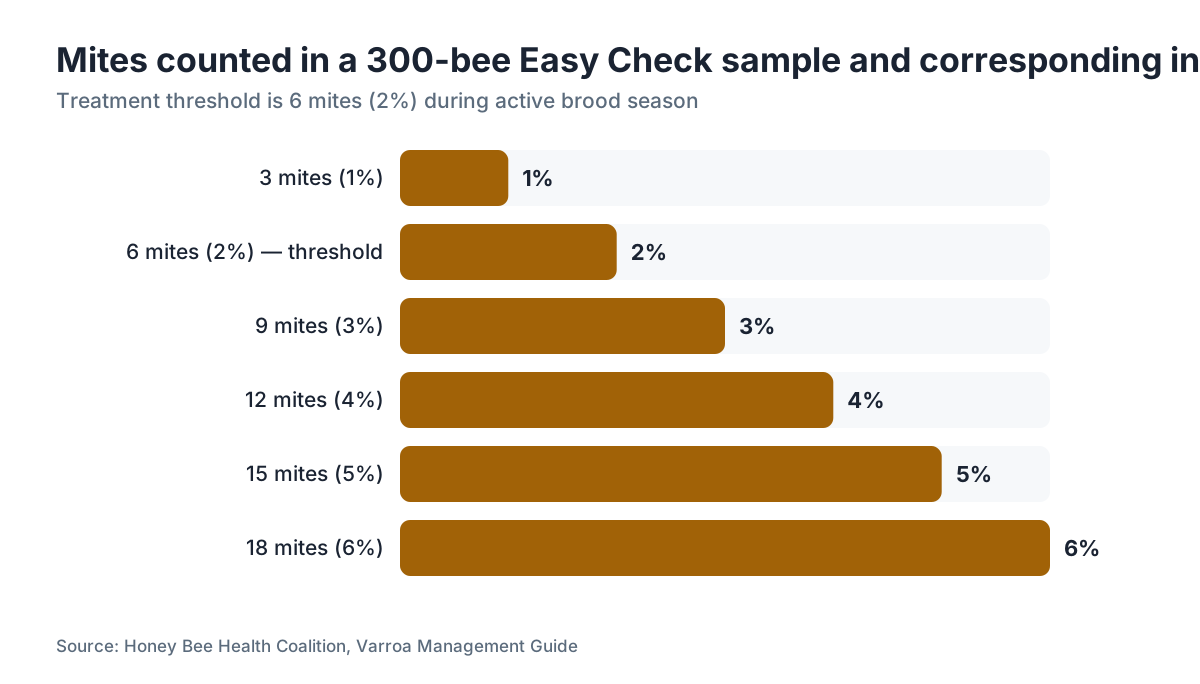
Six mites. That is the number to burn into memory for a 300-bee sample. The Honey Bee Health Coalition's Varroa Management Guide sets treatment at 2 mites per 100 bees (2%) during the active brood season [1], and 2% of 300 is 6. Some extension services put the trigger at 3%, mostly in spring when mite populations are still climbing. The 2% number is more conservative and more widely cited. It is the one I use.
With a 300-bee Easy Check sample, the math stays simple:
| Mites counted | Infestation rate | Action |
|---|---|---|
| 0-3 | 0-1% | Monitor monthly |
| 4-5 | 1.3-1.7% | Monitor every 2-3 weeks |
| 6 | 2% | Treatment threshold reached [1] |
| 7-9 | 2.3-3% | Treat promptly |
| 10-15 | 3.3-5% | Treat urgently |
| 16+ | 5%+ | Colony at serious risk; treat immediately |
Thresholds shift with the season. In late summer and fall, when a colony raises its winter bees (the long-lived bees that carry it through the cold), the Honey Bee Health Coalition recommends treating at 2% or even lower, because mites wreck hive health faster once brood rearing slows [1]. A 3% count in August is more dangerous than a 3% count in May. Same number, different stakes.
A zero is not a clean bill of health. A true zero from 300 bees happens, but it is uncommon, and it does not mean the colony is mite-free. Recheck in three to four weeks. One clean read is good news, not a reason to stop monitoring for the year.
How does alcohol wash compare to sugar roll and sticky board monitoring?
Three main monitoring methods exist, and they are not equally accurate. Knowing the trade-offs tells you when the Easy Check is the right tool and when something else should back it up.
Alcohol wash (Easy Check or jar) is the standard for adult-bee sampling. Studies keep showing it detects mites at higher rates than sugar roll, because alcohol destroys the mite's grip completely while powdered sugar does not always shake every mite loose. The Honey Bee Health Coalition recommends alcohol wash as the most accurate option [1].
Sugar roll uses the same 300-bee sample but coats the bees in powdered sugar instead of alcohol. You shake, pour bees and sugar over a mesh screen, and count mites in the residue. The upside is that the bees live, so you can return them. The downside is release rates that run lower and less consistent, so you might read 1.5% on a colony sitting at 2.5%. For hobbyists who want to spare the bees, I get the appeal. For treatment decisions, that uncertainty makes me nervous.
Sticky board monitoring (24-hour or 48-hour natural mite drop) gives you a different angle: how many mites fall off the bees on their own. It is completely non-invasive and hints at the size of the mite population, but it does not map onto the alcohol wash percentage thresholds. It reads trends over time better than it reads a single treatment decision. The University of California ANR notes that mite drop counts swing with hive size and season, which makes them hard to use as standalone treatment triggers [10].
So: run the Easy Check alcohol wash for the counts that drive treatment. Drop a sticky board in between checks if you want an early warning that something is moving fast.
How often should you sample with the Easy Check?
Sample at least monthly through the active season, which runs roughly April through October across most of the US. That is the recommendation from both the Honey Bee Health Coalition and most extension programs [1][6]. Monthly is the floor. If you have ever lost a colony to varroa and spent the winter wondering how, monthly is not enough. Every two to three weeks shows you how fast the mite population is climbing.
Mite populations can roughly double every month at peak brood season, according to University of Minnesota Extension [7]. A colony at 1% in early June can hit 3 to 4% by early July with nothing changing but the calendar. Monthly sampling catches that curve, but barely. Bi-weekly sampling catches the acceleration before it turns into a crisis.
Two windows deserve extra attention. One is late summer (late July through August in most of the northern US). The other is any time the colony acts strange: spotty brood, bees with deformed wings, a sudden population drop. Deformed wing virus, the most damaging pathogen varroa carries, shows up as crumpled or shortened wings. USDA ARS research treats visible wing deformity as a late sign; by the time you see it, the mite load is usually already high [3].
After any treatment, recheck with the Easy Check at the end of the treatment window, usually three to four weeks out depending on the product. That post-treatment count tells you whether the treatment actually worked. Still above 2% after a full oxalic acid or Apivar cycle? Something went wrong. Bad application, heavy capped brood shielding mites during treatment, or an expired product are the usual suspects.
Which frame should you sample from, and does it matter?
It matters more than most hobbyists think. Frame choice decides which bees you sample, and mite loads are not even across the hive.
Sample from a frame with open brood in the active brood nest. Nurse bees (3 to 10 days old) crowd open brood frames, and they carry the heaviest phoretic mite loads because mites gravitate toward cells about to be capped. Foragers on the outer cluster or the honey frames carry fewer phoretic mites, so they hand you an artificially low reading. North Carolina State Apiculture confirms nurse bees on open brood carry the highest phoretic loads [8].
The Honey Bee Health Coalition guide says to sample the brood nest, not a random frame [1]. This is not a technicality. Hobbyists who sample an outside honey frame have pulled 0.3% readings off colonies that turned out above 4% when sampled right. That is the kind of miss that kills a colony over winter.
On very large colonies, some beekeepers take two samples from different parts of the brood nest and average them. Probably unnecessary if you sample the same area each time, but not a bad move for a first check or when you suspect a number is off.
One more thing. Do not sample the day after a treatment or any big manipulation. Give the bees a few days to settle and spread back across the frames before you pull a monitoring sample.
What do you do with the mites and bees after the wash?
The bees are dead. Bag them for the trash or bury them away from the hive. Do not dump dead bees in front of the entrance. There is a small but real chance of spreading disease through washings if you dump the liquid near other hives.
The alcohol solution can go down a drain. It is a tiny volume (30 to 40 ml of isopropyl thinned with bee-body fluid). At hobby scale this is not a hazardous waste situation. Just do not pour it over and over near garden plants, since repeated high concentrations of isopropyl can hurt soil biology.
Cleaning takes a minute. Rinse both chambers with fresh isopropyl alcohol, shake it out, and let it air dry. The mesh screen is the part most likely to clog with bee debris, so hold it up to the light after rinsing and check that the openings are clear. A soft toothbrush handles stubborn bits. Skip boiling water, because the plastic can warp.
Store it dry between uses. If you ran soapy water instead of alcohol, rinse it hard, because soap residue on the mesh changes how it drains and can trap mites above the screen on your next test.
What treatments work after a high mite count, and how do you choose?
A high Easy Check reading is not a disaster. It is information. What comes next depends on your timing, whether the colony has capped brood, your local temperatures, and how you like to manage.
The major registered options in the US, with their basic parameters [4][5]:
| Treatment | Active ingredient | Brood penetration | Temp range | Treatment period |
|---|---|---|---|---|
| Apivar strips | Amitraz | Partial (long contact) | 50-105°F | 6-8 weeks |
| Mite Away Quick Strips | Formic acid | Yes (kills mites in cells) | 50-79°F | 7 days |
| ApiLife VAR | Thymol blend | Partial | 59-69°F | 3x 6-8 day cycles |
| Oxalic acid dribble | Oxalic acid | No | Above 50°F | Single treatment |
| Oxalic acid vaporization | Oxalic acid | No (broodless) / Partial (extended) | Above 50°F | Extended protocol varies |
A few practical notes. Oxalic acid (dribble or vaporizer) works best in broodless colonies, since it only reaches phoretic mites. Use it over heavy capped brood and the mites in the cells sit safe. Some beekeepers run an extended vaporization protocol (every 5 days for 15 to 20 days) during the active season to catch mites as they emerge from cells. The EPA registration for oxalic acid products like Api-Bioxal governs legal use, and the label "governs legal application methods including dribble and vaporization" [5].
Formic acid (MAQS or Formic Pro) does reach capped brood cells and kills mites there, which makes it useful when you have a lot of brood and need fast action. It is temperature-sensitive. Above 85 to 86°F it can damage brood or kill queens. Read the label before you apply in midsummer.
Apivar is the easiest for most hobbyists to run correctly. Long exposure, wide temperature range, proven efficacy. The catch is amitraz resistance in some varroa populations. If you use Apivar every year and it quits working, suspect resistance first.
To find supplies and stay current on treatment options, a good beekeeping supply companies resource helps you compare availability and pricing before you lock in a plan.
For the mite biology under all of this, the varroa mite guide covers the lifecycle and why brood presence changes how every treatment performs.
Can you use the Easy Check for powdered sugar roll instead of alcohol wash?
Yes, technically. The Easy Check mesh passes powdered sugar and dislodged mites into the lower chamber the same way it passes alcohol. Fill the top with 300 bees and about two tablespoons of powdered sugar, close it, roll it gently for a minute, then shake it over the clear base.
The practical problem is that sugar roll counts run consistently below alcohol wash on the same population. Studies comparing the two show sugar roll finding roughly 60 to 75% of the mites alcohol catches on the same bees. Nobody has a clean published figure for this. The range across several extension studies is that sugar roll underestimates by 25 to 40% [2][8]. So an Easy Check sugar roll reading of 1.5% could be a real 2 to 2.5%, which puts you at or over the threshold.
If you run sugar roll in the Easy Check, be conservative. Treat at a lower trigger (say 1.5% instead of 2%) to cover the underestimate. Or just use alcohol and accept the bee cost. The quality gap is real, and treatment calls made on undercounts lose colonies.
One more issue specific to sugar roll in the Easy Check. Powdered sugar clumps on the mesh in humid weather and blocks mite passage. Shake firmly, and add a little water afterward to check whether mites are stuck on the screen.
How much does an Easy Check cost, and is it worth buying?
The Easy Check usually runs between $18 and $28 from US beekeeping suppliers (as of mid-2025). Pricing moves around. You can find it at most major beekeeping supply companies, and sometimes at local beekeeping association events or county extension sales.
Worth it? For most hobbyists, yes. The main alternative is the DIY jar method: a mason jar with a 1/8-inch hardware cloth lid, maybe $3 in materials. The jar works fine. But you pour the wash into a separate white pan to count, which means more handling, more ways to lose count, and more mess. The Easy Check keeps it all in one sealed unit. The clear graduated base speeds up counting, and the risk of losing mites in a transfer drops to zero.
Run the numbers for two to six hives. One Easy Check, used right, is almost certainly cheaper than losing a colony to undetected varroa. A replacement package of bees costs $150 to $200 or more in most regions, depending on local supply. A $22 counting tool pays for itself the first time it saves a colony.
If you are watching the budget and shopping around, checking free shipping honey bee supply companies can shave a few dollars off the order.
VarroaVault's free protocol tools include threshold calculators and monitoring log templates that pair with Easy Check counts, so you can track trends across the season without building your own spreadsheet.
What are the most common mistakes people make when using the Easy Check?
Read enough extension guidance and beekeeper forums and the same errors surface over and over.
Wrong frame. Sampling honey frames or comb with no open brood gives artificially low readings, because foragers and older bees carry fewer phoretic mites than nurse bees. Sample the brood nest, every time.
Underfilling. Put 150 bees in, count 3 mites, and you might calculate 2%. But 150 is not a standard sample and the confidence interval is terrible. Use the fill line.
Shaking too little. Thirty seconds of halfhearted rolling does not free every mite. Sixty seconds of hard shaking is what the test needs. Some mites hang on tight and need the mechanical hit.
Sampling right before or right after treatment. Wait until the colony is stable. A sample 24 hours after applying a product tells you nothing useful about the load and cannot yet tell you whether the treatment is working.
Ignoring the season. A 2% count in March, with almost no brood and a naturally low mite population, is a different animal from a 2% count in September as a heavy brood cycle ends. Both cross the line. The September read is far more urgent.
Treating on one surprising count without rechecking. Get a shock 4% reading and it is worth pulling a second sample from a different brood frame before you commit. Not to stall on a real problem, but because sampling error happens and a recheck takes ten minutes.
VarroaVault's monitoring log templates are built to catch these, flagging odd readings and prompting a recheck when numbers jump unexpectedly between sessions.
Does the Easy Check work for monitoring splits, nucs, and small colonies?
Small colonies need care. A nuc or fresh split might hold 1,000 to 3,000 bees total. A 300-bee sample stays statistically sound, but pulling 10 to 30% of the adult population out of a small colony is a real hit.
For very small nucs (under 2,000 bees), some beekeepers cut the sample to 150 bees and adjust the threshold. With 150 bees, 3 mites equals 2%. Workable, but your statistical confidence drops. The smaller the sample, the more a single miscount swings the percentage.
Wait until a nuc or split builds to at least three or four frames of bees before you take a full 300-bee alcohol wash, if you can. In the meantime, a sticky board gives you a rough trend without costing bees the colony cannot spare.
For established hives heading into winter, the same 300-bee protocol holds. Sample in early September (earlier in colder climates) to catch any colony that crossed the threshold before brood rearing stops or slows. Treatment options narrow fast once temperatures drop below 50°F, so timing that fall check right keeps your options open [1][4].
Frequently asked questions
How many bees do you put in the Easy Check?
Fill the top chamber to the etched fill line, which holds about 300 bees. That sample size is what the percentage thresholds are calibrated to. Under-filling reduces accuracy. You do not count individual bees; you shake them in until they reach the line.
Can I use the Easy Check without killing the bees?
Not with alcohol. An alcohol wash kills every bee in the sample. You can use powdered sugar instead and return the bees to the hive, but sugar roll underestimates mite counts by roughly 25 to 40% versus alcohol. If you use sugar roll, treat at a lower trigger like 1.5% to cover the gap.
What percentage of mites means my colony needs treatment?
The Honey Bee Health Coalition's Varroa Management Guide sets the treatment threshold at 2 mites per 100 bees (2%) during the active brood season. With a 300-bee Easy Check sample, that is 6 mites. In late summer and fall, some experts treat at lower counts because mite damage to winter bees is especially harmful.
How do I calculate the mite percentage from an Easy Check count?
Divide the mites you count by 300 (your sample size) and multiply by 100. Example: 9 mites divided by 300 equals 0.03, times 100 equals 3%. If you use a non-standard sample size, substitute your actual bee count for 300.
Is the Easy Check better than a homemade jar method?
Both methods give equivalent accuracy when used correctly. The Easy Check costs $18 to $28 but keeps everything in one sealed unit, so you never pour liquid into a separate pan to count, which cuts handling error and mess. The jar method costs a few dollars but adds steps. For frequent monitoring, the Easy Check's convenience is real.
How often should I use the Easy Check to monitor my hives?
At minimum once a month during the active season (roughly April through October in most of the US). Every two to three weeks shows how fast mite populations are climbing. After any treatment, recheck at the end of the treatment window to confirm it worked.
What kind of alcohol do I use in the Easy Check?
Both 70% and 91% isopropyl alcohol work. Either concentration destroys the mites' grip and dislodges them into the wash liquid. You need about 30 to 40 ml per wash, enough to fully submerge the 300-bee sample. Drugstore rubbing alcohol is fine.
Can high varroa counts from the Easy Check be a false alarm?
Occasionally. Wrong frame selection can nudge readings, and under-shaking can deflate them. If a number surprises you, recheck from a proper open-brood frame before deciding to treat. Two checks that agree are far more reliable than one outlier, and a recheck takes about ten minutes.
Does the Easy Check work in winter when there is no brood?
Yes. A broodless winter cluster is actually ideal, because every mite is phoretic with none hiding in capped cells. Take a sample from the cluster and the count reflects the total mite load accurately. If the colony is too small or too cold to disturb safely, wait for a warm day above 50°F when the bees are moving.
Where do I buy the Easy Check mite counter?
Most major beekeeping suppliers in the US stock it, usually for $18 to $28. It also turns up at local beekeeping association events and county extension sales. Checking current beekeeping supply companies for pricing and shipping is the fastest way to compare.
What does the Easy Check mesh size let through?
The mesh openings pass varroa mites (roughly 1.1 mm wide) while holding adult bees back. Dead bees stay in the top chamber and mites fall into the clear counting base. Bee debris smaller than the mesh can pass too, but varroa mites read as reddish-brown oval dots against the white grid.
How do I clean the Easy Check between uses?
Rinse both chambers with fresh isopropyl alcohol, shake out the liquid, and let it air dry. Check the mesh by holding it to the light, since clogged openings affect drainage and mite passage next time. A soft toothbrush clears stubborn debris. Avoid boiling water, which can warp the plastic.
Does the Easy Check count mites in capped brood?
No. Like all adult-bee methods, the Easy Check counts only phoretic mites riding adult bees at the moment you sample. Mites inside capped brood cells are not captured. Your true infestation is always somewhat higher than the wash count, especially in colonies with heavy capped brood.
What should I do if my Easy Check count is zero?
A genuine zero from a properly collected 300-bee brood-frame sample is uncommon but possible in early spring or after a successful treatment. Do not stop monitoring. Recheck in three to four weeks. Two or three consecutive zeros from correct samples mean the colony is clean for now, but varroa can rebuild quickly.
Sources
- Honey Bee Health Coalition, Varroa Management Guide: 2% (2 mites per 100 bees) alcohol wash threshold for treatment during active brood season; recommendation to sample from brood nest; alcohol wash as most accurate adult-bee sampling method
- Oregon State University Extension, Bee Health: Alcohol wash produces higher and more consistent mite detection rates than sugar roll in comparative adult-bee sampling studies
- USDA Agricultural Research Service, Bee Research Laboratory: Deformed wing virus vectored by varroa; visible wing deformity is a late indicator of high mite infestation levels
- Michigan State University Extension, Varroa Mite Control: Temperature requirements and brood penetration characteristics for major registered varroa treatments including Apivar, MAQS, and oxalic acid
- U.S. EPA, Api-Bioxal (Oxalic Acid) Registration: Api-Bioxal oxalic acid is EPA-registered for varroa control; label governs legal application methods including dribble and vaporization
- Penn State Extension, Varroa Mite Monitoring and Control: 300-bee sample size is standard for alcohol wash and sugar roll; monthly monitoring recommended during active season
- University of Minnesota Extension, Honey Bee Diseases and Pests: Varroa populations can roughly double monthly during peak brood season; late summer mite loads especially damaging to winter bees
- North Carolina State University Apiculture, Varroa Sampling Methods: Sugar roll underestimates mite counts relative to alcohol wash; nurse bees on open brood frames carry highest phoretic mite loads
- University of California Agriculture and Natural Resources, Bee Health: Sticky board mite drop counts vary with hive size and season, making them harder to use as standalone treatment triggers compared to adult-bee wash counts
Last updated 2026-07-09